The annotations in this volume, originally published in 1996, intend to assist the reader of Faulkner's The Hamlet to understand obscure or difficult words and passages, including literary allusions, dialect, and historical events that Faulkner uses or alludes to. This title will be of great interest to students of literature.
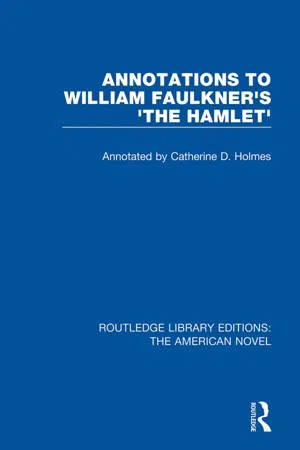
- 234 pages
- English
- ePUB (mobile friendly)
- Available on iOS & Android
eBook - ePub
Annotations to William Faulkner's 'The Hamlet'
About this book
Information
Annotations
The Hamlet [title]: In his preface to Mans, the final volume of the Snopes trilogy, Faulkner calls that work the “final chapter of, and the summation of, a work conceived and begun in 1925” (Mans xi). During the long gestation of Ham, Faulkner experimented with several titles. The title of his original attempt to tell the Snopes story, FA, alludes to the Biblical patriarch’s leading his people out of bondage and sets the pattern of progress that carries Flem, and his clan along with him, from tenant farming to bank presidency. This interpretation is reinforced in Flags: “With this foothold and like Abraham of old, he led his family piece by piece into town” (154). Kibler suggests that Faulkner may have been thinking not of the Biblical model but of the American Abraham (Kibler 5–6). If his memory is accurate and the Snopes work was incepted in 1925, Faulkner may have been living in New Orleans when he conceived the trilogy. While there, he saw Sherwood Anderson, who was working on a biography of Abraham Lincoln, regularly. Anderson, in the surviving fragment of the biography, refers to Lincoln as “Father Abraham” and stresses his impoverished background as the son of a “no-account” and a “shiftless” father. Dimino mentions Benjamin Franklin’s Father Abraham, who, in the preface to Poor Richard Improved, tutors the American colonists in strategies for success, in spite of the British tariffs that deplete their profits (noted 164). Dimino sees the allusion as one of a number of references to colonial economies that run through the novel.
The working title of The Hamlet during the final composition process was The Peasants. In a letter to Robert Haas received 15 December 1938, Faulkner outlined his plans for each volume of the Snopes trilogy and announced his intention to title Book One The Peasants (SL 107). The title derives from Balzac’s Les Paysans. During his class sessions at the University of Virginia, Faulkner praised Balzac, along with Dickens, for his “concept of the cosmos in miniature” (FU 231–32). Faulkner’s own ambitions toward breadth and inclusivity clearly paralleled Balzac’s, and the title of this first volume of the Snopes trilogy acknowledges the debt. Stone, in his introduction to The Marble Faun, Faulkner’s first book, quotes the author as saying, in response to Stone’s comment that the trouble with Amy Lowell “and her gang of drum-beaters” was that they had one eye on the ball and the other eye on the grandstand, that he “had one eye on the ball and the other eye on Babe Ruth” (8). As in the case of The Marble Faun, Faulkner eyed the masters in the composition of Ham. Cohen notes many thematic, structural, and plot analogies between Balzac’s study of “rural class warfare” and Faulkner’s own treatment of the same (“French Peasants”). Indeed, Balzac’s portrayal of the peasants of the title as rapacious, wily hedonists who undermine the aristocratic order and civility of the community is echoed in Faulkner, particularly in his earliest efforts at the Snopes material. Balzac’s Fourchon, a peasant who combines “sloth and cunning,” is referred to as “Father Fourchon” (Les Paysans 28). Although Faulkner’s first two Yoknapatawpha novels, Flags and S&F, both products, like FA, of the late twenties, are intimately concerned with the decline of the aristocratic tradition and the displacement of the old families by a new, crasser class of people, he had, by the late thirties, softened his previous harsh attitudes toward the rural poor (Meriwether, “Introduction”).
It is not known specifically why Faulkner chose to re-title his novel The Hamlet, but the choice, as in all his novel titles, was a superb one. The published title of the novel may owe something to Balzac in its geographical emphasis. Balzac’s groupings of the novels in his panoramic Comédie humaine center on the physical locus of the action: Scenes of Private Life, Scenes of Provincial Life, and Scenes of Paris Life.
In the early short prose piece, “The Hill,” the protagonist ascends a hill and looks down into the valley and the town below: “The hamlet slept, wrapped in peace and quiet beneath the evening sun, as it had slept for a century; waiting, invisibly honey-combed with joys and sorrows, hopes and despairs, for the end of time” (EPP 91). The hamlet of that short piece is, like Ham, associated with the world of classical mythology; it is a place where “in the dusk, nymphs and fauns might riot to a shrilling of thin pipes” (EPP 92).
Dedication: To Phil Stone: Stone, a fellow resident of Oxford, was Faulkner’s closest friend and mentor at an important stage early in his career. Professionally a lawyer, Stone was interested in literature, and he introduced Faulkner to many of the modern poets. Stone claimed later, in a 1957 letter to James B. Meriwether, that he had given Faulkner the idea for the Snopes story: “…the real revolution in the south was not the race situation but the rise of the redneck, who did not have any of the scruples of the old aristocracy, to places of power and wealth” (Brodsky 207). Although Faulkner dedicated each of the three Snopes volumes to Stone, they had drifted apart by this time. Stone would claim credit in a letter for “giv[ing] him a sense of humor” (Brodsky 207) and for inventing “almost all the characters Bill has used” (Brodsky 208), but he consistently underrated Faulkner’s achievements, as, for example, when, in response to a letter from Meriwether, he predicted that Faulkner’s place in history would be that of a “splendid second-rate writer” (Brodsky 216).
Meriwether suggests that Faulkner was unable to complete the Snopes work until he had put some distance between himself and Stone’s condescending attitudes toward poor white trash (FA, “Introduction”).
Emily Whitehurst Stone admits to asking Faulkner to honor her husband Phil with a dedication. Snell records the incident in her biography of Stone:
…at a cocktail party in 1939 or 1940 she [Mrs. Stone] assayed that reserve, in full knowledge of the risk she ran, because she suspected that her husband’s old friend might indeed redeem the self Stone had sacrificed to family honor. She asked Faulkner whether he had decided to whom he would dedicate the first Snopes book. The author “looked away above that lifted neck of his as though to get me out of his world and said in that high-pitched, tentative voice of his, ‘No.’” But she had gone too far to retreat. “I wish…you’d think about dedicating it to Phil,” she continued, to which Faulkner “did not answer at all” (Phil Stone of Oxford: A Vicarious Life 244).
[Manuscript Opening]: Faulkner wrote “Bam,” he said in a letter to Malcolm Cowley, as an “induction toward the spotted horse story” (SL 197). The first seventeen pages of the manuscript at the Alderman Library of the University of Virginia are headed Book One/Chapter I, as well as indicating the deleted short-story title “Barn Burning.” A thirty-two- page typescript version of the story, also housed at the Alderman Library, is headed simply “Chapter One,” with no supplementary title. Because thirty-two pages were removed from the typescript setting copy of The Hamlet, it is fair to assume that, until a relatively late stage in the revision process, Faulkner intended to open the novel with the story of Sarty Snopes (Millgate 185).
Scholars have questioned Faulkner’s decision to eliminate this important material from the published novel. Millgate speculates that Faulkner may have felt that Sarty’s poignant story would predispose the reader too favorably toward the Snopes clan and so would not effectively introduce a novel detailing Flem’s rise to power (185). Beck suggests that Sarty’s rapid emancipation from his Snopes blood would undermine one of the main tenets of the trilogy: the gradual but implacable rise of Snopesism (Faulkner 279). The story nonetheless would have set up several of the themes that run throughout the book and the trilogy. The stress on the kinship bond in the story carries over in Flem’s betrayal of Mink, his kinsman, and allows for the revenger’s tragedy that dominates Mans. “Barn” also establishes the interplay of love and law that is an important factor in the Snopes trilogy. The DeSpain mansion, “big as a courthouse,” is a component of an orderly universe and represents the old agrarian ideal of man living in close harmony with nature. The advantage of presenting Sarty’s dreaming a dream enforced by the sight of such a mansion and following it with Will Varner’s sitting in a chair on the lawn of the Old Frenchman’s Place wondering what it would feel like to “need all this” (6) is obvious. Had Faulkner conformed to his original plan, Sarty would have been the first of a parade of dreamers who contrast with Flem, who has no dreams of his own. but capitalizes on the dreams of others. Sarty’s response to the DeSpain mansion, as the embodiment of a dream in “Barn Burning,” would point up the dream’s corruption when Flem occupies the same mansion in the third Snopes volume.
Finally, the third-person narration of “Barn” establishes a base from which the reader can appreciate the shaping, creative power of Ratliff’s retelling of the same story, which followed in Chapter Two of Book One in the original typescript.
The plot synopsis that Faulkner sent to Robert Haas on 15 December 1938 outlines the expansive role that Faulkner originally envisioned for Sarty:
This is the plot, if any. Flem gets his wife because she is got with child by a sweetheart who clears out for Texas; for a price he protects her good name. No, before this, his youngest brother tries to keep his father from setting fire to his landlord’s barn, believes he has caused the father to be shot, and runs away from home, goes west, has a son which the other Snopes know nothing about.
Flem moves to town with his wife whose child pretty soon sees what a sorry lot Snopes are. She goes to New York (has money from her actual father) and is overseas in the War with the ambulance corps, where she meets the son of the boy who ran away from home, finds him a kinsman, finds how his father has tried to eradicate the Snopes from him. After the war she brings together this Snopes and the daughter of a collateral Snopes who also looks with horror on Snopes. She and her remote cousin marry, have a son who is the scion of the family.
What this will tell is, that this flower and cream, this youth, whom his mother and father fondly believed would raise the family out of the muck, turns out to have all the vices of all Snopes and none of the virtues—the ruthlessness and firmness—of his banker uncle, the chief of the family. He has not enough courage and honesty to be a successful bootlegger nor enough industry to be the barber for which he is finally trained after Flem has robbed her mother of what money her father and husband left her. He is in bad shape with syphilis and all the little switch-tailed nigger whores call him by his first name in private and he likes it.
By this time Flem has eaten up Jefferson too. There is nothing else he can gain, and worse than this, nothing else he wants. He even has no respect for the people, the town, he has victimised, let alone the parasite kin who batten on him. He reaches the stage where there is just one more joke he can play on his environment, his parasite kin and all. So he leaves all his property to the worthless boy, knowing that no other Snopes has sense enough to hold onto it, and that at least this boy will get rid of it in the way that will make his kinfolk the maddest (SL 107–08).
Book One/Flem: Faulkner begins and ends the Snopes trilogy with books entitled “Flem.” The final section of Mans, consisting of seven chapters, bears the same title as this opening book of the trilogy.
John Cullen remembers a Flem McCain who lived in Dutch Bend. Although he did not resemble Flem Snopes in most aspects, Flem McCain did go to Texas and bring back a string of spotted ponies for auction. Cullen suggests that the model for Flem may have been Lem Prince, whose family were Union supporters during the Civil War. Because the Union army burned their cotton, they were reimbursed handsomely, and Lem became the richest man in the county. His rise out of Dutch Bend to found a bank in Oxford parallels Flem Snopes’s similar progress (100). Finally, McHaney advances a model for Flem in Joe Parks, who ousted Faulkner’s grandfather from the bank presidency. Parks came from the hamlet of Etta, northeast of Oxford (“Falkners” 257, also noted Cullen 104, but Cullen refers to Parks as Jim Packs).
Kreiswirth proposes another source for the name Flem: the phlegmatic temperament as Faulkner found it defined in a book in his library, D. Starke’s Character and How to Strengthen It:
Phlegm is a defense against visible emotion. It is not hypocrisy or falsehood, for the phlegmatic utter no sentiment contrary to that which they fill. They are content not to let anything transpire of the cause of their agitation. One may compare a phlegmatic man to a thick veil under which the play of the features, and under this the acts of the mind, are dissembled. Hypocrisy resembles a dead wall covered with lying advertisements.
Phlegm is this dead wal...
Table of contents
- Cover
- Half Title
- Title Page
- Copyright Page
- Table of Contents
- Acknowledgments
- Abbreviations
- Preface by Series Editor
- Introduction
- Annotations
- Works Cited
Trusted by 375,005 students
Access to over 1.5 million titles for a fair monthly price.
Study more efficiently using our study tools.
Frequently asked questions
Yes, you can cancel anytime from the Subscription tab in your account settings on the Perlego website. Your subscription will stay active until the end of your current billing period. Learn how to cancel your subscription
No, books cannot be downloaded as external files, such as PDFs, for use outside of Perlego. However, you can download books within the Perlego app for offline reading on mobile or tablet. Learn how to download books offline
Perlego offers two plans: Essential and Complete
- Essential is ideal for learners and professionals who enjoy exploring a wide range of subjects. Access the Essential Library with 800,000+ trusted titles and best-sellers across business, personal growth, and the humanities. Includes unlimited reading time and Standard Read Aloud voice.
- Complete: Perfect for advanced learners and researchers needing full, unrestricted access. Unlock 1.5M+ books across hundreds of subjects, including academic and specialized titles. The Complete Plan also includes advanced features like Premium Read Aloud and Research Assistant.
We are an online textbook subscription service, where you can get access to an entire online library for less than the price of a single book per month. With over 1.5 million books across 990+ topics, we’ve got you covered! Learn about our mission
Look out for the read-aloud symbol on your next book to see if you can listen to it. The read-aloud tool reads text aloud for you, highlighting the text as it is being read. You can pause it, speed it up and slow it down. Learn more about Read Aloud
Yes! You can use the Perlego app on both iOS and Android devices to read anytime, anywhere — even offline. Perfect for commutes or when you’re on the go.
Please note we cannot support devices running on iOS 13 and Android 7 or earlier. Learn more about using the app
Please note we cannot support devices running on iOS 13 and Android 7 or earlier. Learn more about using the app
Yes, you can access Annotations to William Faulkner's 'The Hamlet' by Catherine D. Holmes in PDF and/or ePUB format, as well as other popular books in Literature & Literary Criticism. We have over 1.5 million books available in our catalogue for you to explore.