- 278 pages
- English
- ePUB (mobile friendly)
- Available on iOS & Android
eBook - ePub
About this book
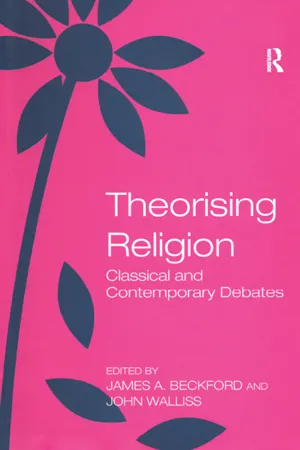
Religion is controversial and challenging. Whilst religious forces are powerful in numerous societies, they have little or no significance for wide swaths of public or private life in other places. The task of theoretical work in the sociology of religion is, therefore, to make sense of this apparently paradoxical situation in which religion is simultaneously significant and insignificant. The chapters of Part One consider the classical roots of ideas about religion that dominated sociological ways of thinking about it for most of the twentieth century. Each chapter offers sound reasons for continuing to find theoretical inspiration and challenge in the sociological classics whilst also seeking ways of enhancing and extending their relevance to religion today. Part Two contains chapters that open up fresh perspectives on aspects of modern, post-modern and ultra-modern religion without necessarily ignoring the classical legacy. The chapters of Part Three chart new directions for the sociological analysis of religion by fundamentally re-thinking its theoretical basis, by extending its disciplinary boundaries and by examining previously overlooked topics.
Information
PART I
CLASSICAL ROOTS
Chapter1
Religion as an Elementary Aspect of Society: Durkheim’s Legacy for Social Theory
Introduction
The nature and value of Durkheim’s intellectual legacy has been much disputed over the century or so that has passed since he published his major works, though more recently, with the decline of Marxist-inspired forms of sociology and the rise of a new social theoretical interest in the symbolic and ritual dimensions of social life, Durkheim’s influence has again started to grow (Poggi, 2000, pp. 11–12). Nonetheless, Durkheim’s legacy remains contentious for two reasons: first, despite the increasing appreciation of the ‘cultural’ aspects of Durkheim’s arguments, including his sociology of religion, the value of his social realist view of society is also frequently called into question; second, what is notable about both the renewal of interest in Durkheim’s work and the contemporary critiques of it is the diversity of the interpretations of the Durkheimian project on offer. In short, while there is still much debate about the value of Durkheim’s legacy, there is also a set of widely differing views as to its nature.
The aim of this paper is to help illuminate the particular character of this legacy as well as arguing for its contemporary significance, focusing especially upon the religious dimensions of Durkheim’s sociological thought (see Mellor, 2004). In particular, I shall suggest that there are two key features of Durkheim’s legacy that remain of vital importance for contemporary scholars. The first of these features is his focus on society as a sui generis reality, transcendent of the individuals who constitute it. Indeed, the conventional view of sociology as the study of society reflects a great debt to Durkheim: he, more than any of the ‘founding figures’ was concerned with the establishment of sociology as a discipline centred on the study of society as a distinct reality. The second key feature of Durkheim’s legacy concerns the fundamental importance he attributes to the religious dimensions of society. His analysis of religions as collective representations of the emotional and moral dynamics of group life has not only had a significant impact on sociology and anthropology but also remains a key influence upon some of the more creative and interesting areas of contemporary social and cultural theory. Nonetheless, the full implications of his view that societies are inherently religious phenomena, that ‘the religious life of a people is a manifestation of its profoundest being’ (Hertz, 1983, p. 87), have rarely been grasped fully. In the course of this paper, I hope to show how Durkheim came to this conclusion, and to help illuminate why it remains of contemporary significance.
A point I shall emphasise is that the true value of Durkheim’s legacy can only be appreciated fully if it is recognised that its two key features are inseparably linked. Indeed, I shall argue that many of the divergent responses to Durkheim’s legacy reflect faulty understandings of the sociological project he sought to develop. In particular, I shall note that, contrary to the views of some contemporary critics, Durkheim’s vision of society is not tied to outmoded forms of the modern nation-state, but offers a dynamic and still relevant account of the way in which human embodiment allows for the emergence of collective ways of being that act back upon individuals in powerful ways. Contrary to some of the contemporary uses of Durkheim’s sociology of religion, however, I shall also suggest that a proper engagement with Durkheim’s social realism demonstrates the need for a more subtle, yet more radical, account of just how significant the religious dimensions of contemporary life remain.
Sociology as the Study of Society
In an influential article in 1989, Touraine asked the question ‘Is sociology still the study of society?’ Touraine’s own answer, in the negative, and repeated in a number of publications since then (e.g. Touraine, 1995, 2003), has also been echoed by sociologists such as Urry (2000). Focusing on the need for a sociology of change, Touraine (1989, p. 11) had argued that ‘the very idea of society should be eliminated’, and that ‘individuals are increasingly determined by their movements rather than by their belonging’ (Touraine, 1989, p. 15). More recently, Touraine (2003) has attempted to redefine sociology as the study of the absence of society, the disappearance of social actors, and the destruction of social bonds. Urry’s (2000) ‘manifesto for sociology’ also makes the claim that sociologists should abandon the concept of ‘society’, and, instead, become focused on the analysis of ‘global networks and flows’ since societies, at least as sociologists have conceived them, no longer exist. One of the notable features of such studies is that it is Durkheim’s view of society that is singled out as being the most influential source of sociology’s ‘anachronistic’ concern with society.
For Touraine (1989, p. 7), Durkheim’s understanding of society crystallises the classical sociological concern with integration and order that he believes is now outmoded. Urry argues that the central organising principle of sociology has been Durkheim’s identification of an autonomous realm of the ‘social’, distinguished from the ‘natural’, as the core object of sociological analysis (Urry, 2000, p. 10). For Urry (2000, p. 26), the fluidity, sensuousness and positive embrace of différance characteristic of contemporary social life render this ‘static’ Durkheimian concept of society redundant. Here, the influence of postmodern social and cultural theory upon these writers is particularly evident: theorists of postmodernity such as Baudrillard (1983, 1990a, 1990b), Deleuze (1979), Lyotard (1984) and Derrida (1991) have all, either directly or indirectly, challenged the notion of society, basically seeing it as culturally relative construction masking the endemic plurality and indeterminacy of the world. For Urry (2000, p. 26), Durkheim’s legacy rests on an erroneous attempt to impose cognitive order on the ‘fluidities of sensuousness’ that blur the boundaries of ‘society’ and ‘nature’. The globalised ‘mobilities’ affecting bodies, ideas, images and institutions in the contemporary world make his error explicit, and demand ‘new rules of sociological method’ (Urry, 2000, p. 210; Game, 1995).
It is possible to criticise such writings for a number of reasons. First of all, as Archer (2000, p. 2) has commented, the influence on social theory of post-structuralist and postmodernist writings has contributed to a neglect of important questions about the actions, cares and concerns of embodied human beings who live in real communities. The simplistic idea that globalisation obliterates the human need for belonging is surely an example of this. Second, the notion of society such writings reject is often tied to the modern form of the nation-state. Norbert Elias (1978, p. 241) may have been correct in noting that ‘Many twentieth century sociologists, when speaking of “society”, no longer have in mind … a “bourgeois society” or a “human society” beyond the state, but increasingly the somewhat diluted ideal image of a nation-state’ (see Billig, 1995, pp. 52–4). Nonetheless, although Urry (2000, pp. 8–9) builds on Elias’s insight by drawing attention to the historical and cultural specificity of this particular association, he then compounds the problem identified by Elias in linking their mutual decline. Durkheim, in contrast, did not associate society exclusively, or even primarily, with the nation-state.
Indeed, the Durkheim such writings reject is often something of a sociological parody, wherein his arguments are characteristically reduced to a neo-Parsonian concern with the Hobbesian ‘problem of order’ (see Mellor, 1998, 2004; Morrison, 2000). This understanding of Durkheim appears to be an established part of sociology’s collective memory, but is unsustainable on the basis of a direct and detailed reading of his work. Contrary to the view that Durkheim identifies society as a realm entirely autonomous from nature (Urry, 2000, p. 10), for example, he actually argues for sociology being focused on society as ‘a specific reality’, but also notes that this has to be contextualised within a recognition that ‘man and society are linked to the universe and can be abstracted from it only artificially’ (Durkheim, 1995, p. 432; see Jones, 1997, p. 154). Furthermore, it can be noted that he emphasised that an abstract, reified conception of ‘Society’ (such as he associated with Comte) should not be the focus for sociological analysis (Durkheim, 1974b, p. 197; Strenski, 1997, pp. 158–9). Instead, sociology should concern itself with the constitution and development of societies through the dynamic interrelationships of people in their everyday lives and across time (see also Mauss, 1969; Hertz, 1960; Bataille, 1991, 1992; Caillois, 1960; Turner, 1969; Maffesoli, 1996).
In fact, although Durkheim is often accused of promoting an abstract conception of society, it is the post-societal view, with its dissipation of questions about embodied being into cultural processes and flows, that tends towards an abstractionism Durkheim can help prevent. In particular, it is the Durkheimian tradition that expresses most forcefully the idea that being part of society is inextricably tied to our humanity, offering a vision of the irrepressibly vital social energies that characterise human encounters and relationships, nurturing and sustaining solidarities, bonds, moral obligations and collective symbols. In this regard, and in contrast to the ‘static’ image of society often associated with him, it is important to stress Durkheim’s interest in society as an ‘emergent’ reality.
Society as an Emergent Reality
The concept of ‘emergence’ is becoming central to a number of forms of contemporary sociology, as social scientists seek new ways of making sense of complex social realities. It is generally associated with realist forms of philosophy and sociology, where its usefulness is held to rest on its capacity to explain how certain phenomena can be contingent upon other forces or factors, and yet come to have an irreducibly real existence and to exercise causal power over other phenomena, including those upon which they are themselves contingent. In other words, the concept of emergence is not only used as a way of explaining how certain phenomena come to exist, but also as a way of signalling the kind of existence they have.
For example, in contemporary sociological uses of complexity theories, the notion of emergence is part of a broad vision of the web of interrelationships, levels of reality and forms of being that constitute the world. Reed and Harvey (1992, p. 359) and Byrne (1998, p. 39), for example, draw upon chaos and complexity theories developed in the natural sciences to argue that nature and society should be understood as ontologically open and historically constituted, comprising various emergent realities in a contingent relationship to each other. Although complexity theory certainly encourages sociologists to recognise the contingency of all emergent phenomena, and, therefore, to explore the ambiguity of social phenomena with regard to problems of order and disorder (Harvey and Reed, 1994, p. 390; see also Durkheim, 1995, pp. 412–13), this has little in common with the constructionism, relativism and linguistic imperialism of certain areas of social theory, particularly in its postmodern forms. Rather, contingency has to be studied in relation to patterns of emergence that have, themselves, to be seen in a holistic context (Hayles, 1991, pp. 16–17).
These sociological uses of complexity theory have a great deal in common with the emphasis on emergence characteristic of critical realism. Here, Bhaskar (1989) and Archer (1995) are key representatives of the sociological attempt to interpret social realities as emergent, ontologically stratified wholes that are irreducible to their constituent parts. Archer, for example, argues that ‘human interaction constitutes the transcendental conditions of human development’, meaning that all humans share a common, practical orientation to the world through which distinctively human properties and powers are reflexively constituted (Archer, 2000, p. 17). The development of society is made possible by these ‘transcendental conditions’ but, once in existence it has, like humanity, sui generis properties and powers since it entails emergent structural and cultural characteristics. Thus, society cannot construct, through normative labelling, the emotional energies and capacities associated with phenomena such as shame, remorse, pride or envy, but these become ‘socially constituted properties which are emergent from the interrelationship between a subject’s concerns and a society’s normativity’ (Archer, 2000, p. 215). It is through such interrelationships that humans become ‘social beings’.
Alongside her vision of society as an emergent phenomenon, however, Archer is also interested in the fact that people are not simply the embodied ground out of which society emerges, but are also creatures who continue to develop contingent, emergent powers and properties of their own, such as self-consciousness and the development of an evaluative orientation in terms of our interactions with natural and natural realities (Archer, 2000, p. 316). It is this attentiveness to the ‘internal conversation’ inherent to individual human beings that causes her to reject Durkheim’s vision of society as one which attributes it with too many powers and properties, even though she is fully attentive to the fact that social reality has sui generis characteristics (Archer, 2000, p. 19). Nonetheless, contrary to Archer’s doubts, key thinkers in the Durkheimian tradition have seen these sui generis characteristics as phenomena that nurture and expand embodied human potentialities rather than deplete or curtail them.
Durkheim (1995, p. 213), talks of the ‘stimulating action of society’ as an embodied experience affecting nearly every instant of our lives. He emphasises that collective representations, ‘which form the network of social life’, arise from the interactions between individuals but that they are not simply products, or aggregate outcomes, of ‘the psychic life of individuals’ (Durkheim, 1974b, pp. 24–5). On the contrary, he argues that ‘private sentiments do not become social except by combination under the action of the sui generis forces developed in association’ (Durkheim, 1974b, p. 26). Thus, ‘individual representations’, the mental forms particular to individuals, are surpassed by the collective, which add to, and transform, personal experiences in the light of knowledge, sentiments and symbols developed over large tracts of time (Durkheim, 1995, p. 437). Furthermore, he suggests that this relationship between the individual and the collective is analogous to the relationship between the biological mental processes within individual minds (nervous energy, neural pathways, brain functions) and those representations that constitute the ‘psychic life’, or ‘spirituality’, of the individual (Durkheim, 1974b, pp. 27–8). Individual representations are the result of sui generis forces arising from the association of diverse elements within the mind, while collective representations are the dynamic outcomes of social interactions characterised by a ‘hyper-spirituality’ (Durkheim, 1974b, p. 34). In short, the emergent, sui generis phenomenon that is society, though constituted by individuals, has a reality transcendent of them (see Sawyer, 2002). This takes us right to the heart of what Durkheim understands society to be.
Although Durkheim explores a number of different aspects of society and, consequently, uses the term in a number of different ways, his primary interest is in what can be called the ‘supra-individual’ elements in social life relating to social actions, feelings, beliefs, values and ideals (Lukes, 1973, p. 115). As Bellah (1973, p. ix) suggests, for Durkheim, ‘Not only is a society not identical with an external “material entity”, it is something deeply inner’. His critique of empiricism is significant in this regard, since he argues that reducing reality to experience inevitably results in a denial of the truth, meaning or value of anything outside the specific individual or social constructions placed upon phenomena: in other words, the deepest strata of human, social and natural forms of life are simply argued away (Durkheim, 1995, pp. 12–18). Contrary to such reductions, he identifies society with ‘an immense cooperation that extends not only through space but also through time’, combining ideas and feelings in a rich and complex set of processes through which we become ‘truly human’ (Du...
Table of contents
- Cover
- Half Title
- Title Page
- Copyright Page
- Table of Contents
- Notes on Contributors
- Introduction
- PART I: CLASSICAL ROOTS
- PART II: NEW GROWTH
- PART III: FRESH BLOOMS
- Index
Trusted by 375,005 students
Access to over 1.5 million titles for a fair monthly price.
Study more efficiently using our study tools.
Frequently asked questions
Yes, you can cancel anytime from the Subscription tab in your account settings on the Perlego website. Your subscription will stay active until the end of your current billing period. Learn how to cancel your subscription
No, books cannot be downloaded as external files, such as PDFs, for use outside of Perlego. However, you can download books within the Perlego app for offline reading on mobile or tablet. Learn how to download books offline
Perlego offers two plans: Essential and Complete
- Essential is ideal for learners and professionals who enjoy exploring a wide range of subjects. Access the Essential Library with 800,000+ trusted titles and best-sellers across business, personal growth, and the humanities. Includes unlimited reading time and Standard Read Aloud voice.
- Complete: Perfect for advanced learners and researchers needing full, unrestricted access. Unlock 1.5M+ books across hundreds of subjects, including academic and specialized titles. The Complete Plan also includes advanced features like Premium Read Aloud and Research Assistant.
We are an online textbook subscription service, where you can get access to an entire online library for less than the price of a single book per month. With over 1.5 million books across 990+ topics, we’ve got you covered! Learn about our mission
Look out for the read-aloud symbol on your next book to see if you can listen to it. The read-aloud tool reads text aloud for you, highlighting the text as it is being read. You can pause it, speed it up and slow it down. Learn more about Read Aloud
Yes! You can use the Perlego app on both iOS and Android devices to read anytime, anywhere — even offline. Perfect for commutes or when you’re on the go.
Please note we cannot support devices running on iOS 13 and Android 7 or earlier. Learn more about using the app
Please note we cannot support devices running on iOS 13 and Android 7 or earlier. Learn more about using the app
Yes, you can access Theorising Religion by John Walliss, James A. Beckford in PDF and/or ePUB format, as well as other popular books in Theology & Religion & Religion. We have over 1.5 million books available in our catalogue for you to explore.