eBook - ePub
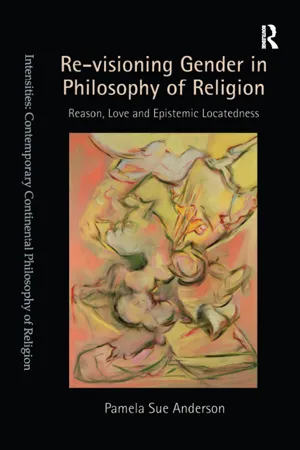
Re-visioning Gender in Philosophy of Religion
Reason, Love and Epistemic Locatedness
- 264 pages
- English
- ePUB (mobile friendly)
- Available on iOS & Android
eBook - ePub
Re-visioning Gender in Philosophy of Religion
Reason, Love and Epistemic Locatedness
About this book
A passion for justice and truth motivates the bold challenge of Revisioning Gender in Philosophy of Religion. Unearthing the ways in which the myths of Christian patriarchy have historically inhibited and prohibited women from thinking and writing their own ideas, this book lays fresh ground for re-visioning the epistemic practices of philosophers. Pamela Sue Anderson seeks both to draw out the salient threads in the gendering of philosophy of religion as it has been practiced and to re-vision gender for philosophy today. The arguments put forth by contemporary philosophers of religion concerning human and divine attributes are epistemically located; yet the motivation to recognize this locatedness has to come from a concern for justice. This book presents invaluable new perspectives on the philosopher's ever-increasing awareness of his or her own locatedness, on the gender (often unwittingly) given to God, the ineffability in both analytic and Continental philosophy, the still critical role of reason in the field, the aims of a feminist philosophy of religion, the roles of beauty and justice, the vision of love and reason, and a gendering which opens philosophy of religion up to diversity.
Information
Chapter 1
Re-visioning Gender and the Myths of Patriarchy1
Introduction: gendering and re-visioning gender
Gendering is to some degree a hidden process of determining the identities of women and men. Re-visioning gender in this book, as already set out in the Preface, aims to be an act of looking back with open eyes at the gendering process from a new critical direction;2 that is, looking back with a ‘reflective critical openness’3 to the epistemic locatedness of men and women in philosophy of religion. A central contention of Re-visioning Gender in Philosophy of Religion: Reason, Love and Epistemic Locatedness is that the field of philosophy of religion continues to be implicitly and explicitly gendering the moral and religious dimensions of human identities; this includes shaping human emotion, reason and cognition. In this domain of philosophy, the arguments of philosophers of religion concerning human and divine relations are either shaping or accepting (given) exclusive norms of heterosexuality, of femininity and masculinity.
Traditionally Anglo-American philosophers of religion have assumed uncritically that gender has to do with sociology, politics or, possibly, developmental psychology but not with philosophy. Admittedly, discussions of the sexually specific knowledge concerning transgender, bi-sexual, gay and lesbian identities has been increasingly emerging in moral psychology and branches of theology, including moral and pastoral theology, historical and systematic theology. Yet more explicit, philosophical debate about the deep and often ethically damaging gender norms in philosophy of religion is long overdue. With this in mind, the chapters to follow will seek (i) to recognize the process of gendering in western philosophy, even if it is only possible to draw out salient threads of this process; and (ii) to propose the ‘re-visioning’4 of gender as it has been functioning in fairly central ways in philosophy of religion.
As introduced already in the Preface, Re-visioning Gender in Philosophy of Religion maintains that gender needs to be understood in terms of intersectionality; an adequate understanding of human identity requires a careful interpretation of the intersection of gender with a range of other material and social variables, including age, class, ethnicity, race, religion and sexual orientation. Gender theorists in the past twenty or more years have persuasively demonstrated that ‘gender’ is not a mere cultural construction as distinct from a biological or natural given of ‘sex’, or of sexual orientation. Of course, this does not make gender a simple or discrete matter. Instead it is necessary to support ongoing discussions of gender’s necessary and multi-faceted intersection with other social and material categories such as religion and race. The intersection of these categories continues to be crucial for understanding ethical, legal, political and religious issues in our global world. This is evident, for example, in the writings of Naomi Zack, as well as Crenshaw’s 2012 collection of essays.5
Contemporary philosophers of religion tend to hold gender assumptions which have been determined by the social constructions of western patriarchy. Roughly speaking, patriarchal beliefs and norms have constituted gender roles which privilege men over women, father over son, materially or socially privileged fathers over less privileged men, and so on. These roles, in turn, have determined the dominant, heterosexual relations of men and women in the western world. In philosophy of religion, gendering re-enforces both the un-ramified beliefs and those ramified religious beliefs which are most problematic for sex/gender relations;6 this includes beliefs which have been determined by traditional Christian myths7 concerning the human and the divine (attributes). The use of ‘myth’, in this context as also mentioned in the Preface, does not mean a mere falsehood as assumed in more everyday conversation. Instead myth is characterized by its plot; its narrative which is often about perennial questions concerning the beginning and end of life (birth and death); its human and divine characters and their most fundamental relationships. Myth has emerged in the histories of humankind to tell stories about the origins of human goodness and evil, human culture and social contracts. Myths are often about human and divine relations concerning procreation and sex; concrete sexual relations are portrayed by variations on a narrative core, accompanied by varying arrangements of often perennial imagery. All of these features come together in myth to help shape the identities of individuals and collectives. For this reason, tradition holds on to its cultural and religious myths, while innovation plays with creating variations on older mythical themes. Some philosophers might imagine that myth and myth-making were left behind with the emergence of ancient Greek philosophy and its rational discourse; but arguably, myth has always accompanied philosophy in constituting the identities of men, women and the divine. In this way, myth has a fundamental role to play in the (implicit) gendering of philosophy of religion, especially since religion relies on myth for sustaining its ritual practices and norms of behaviour, but also, for conceptions of the divine.
If left as it is, without any further qualifications, this and the previous paragraphs could be accused of sweeping and unfair generalizations about gender and patriarchy. However, in order to be clear, the challenge needed to be set out starkly; yet these introductory paragraphs are not meant to be against any particular philosopher. In this book, I would like to appeal to a collective consciousness in carrying out my proposals for re-visioning.
Instead of leaving things as they are, Re-visioning Gender in Philosophy of Religion begins with an extended exploration of how we might unearth the obstacle which does not have a precise name in the literature of Europe and in the Anglo-phone world of philosophy. This obstacle is, bluntly stated, ‘patriarchy’. The problem is that the patriarchal structures of gender oppression in western philosophy and, more particularly, in theism are not readily visible. Yet once gender oppression is glimpsed, even if the structures of patriarchy are not completely visible, then the reader can begin to understand what is meant here by ‘gender’ in philosophy of religion, but also by the re-visioning of gender norms.
One critical dimension of the obstacle which needs to be addressed is the normative function of patriarchy in Anglo-American philosophy of religion. This barely perceptible dimension of gender oppression remains deeply embedded in the lives of those women who have been decisively constrained by the rule of the father. Another part of the obstacle is that patriarchy itself as an object of contemporary feminist critiques is not straightforwardly one thing. For this reason, feminist critiques vary according to the different, social and material locations of women and men. Nevertheless, whenever oppressive structures determine philosophical norms and religious beliefs, both the reader and the woman writer can attempt to work out the myths of patriarchy which render women and non-dominant men vulnerable to sexually specific suffering. Indications of these myths can be recognized in the imagery and stories which represent the lives of women and men.
The Nobel prize-winner Toni Morrison captures the imperceptible reality of racial domination with imagery of a fishbowl. Her readers are compelled to imagine the bowl as a transparent structure permitting the ordered life which it contains to exist in a larger world.8 Her imagery reveals the ways in which apparently invisible structures of domination can suddenly become visible. With Morrison’s cogent use of imagery in mind this chapter aims to recognize patriarchy by revealing both the transparent structure of male domination which has contained women’s lives and the ways in which feminism has emerged with this revelation. The bare outlines of patriarchy will be made evident in a quick look at a sample of women writers in the history of western ‘philosophical theology’ (which is another name of what is currently treated as a pre-Enlightenment form of ‘philosophy of religion’). These women in philosophical theology remain in some sense at least shaped by Christian patriarchy. The emergence of feminism can be seen when the writer and reader are as if outside that ordered life which privileges father-son relations. This attempt to move outside fixed norms aims to tackle for the non-privileged ‘the obstacle which does not speak its name’.9
The reality of patriarchy and the emergence of feminism
Feminism and patriarchy form a conceptual pair. Together these two concepts can help men and women come to see what has been the significant reality of a woman’s material and social relations to men, to other women and to the impersonal agents of traditional institutions. As long as patriarchy in the most basic sense of father rule justifying the domination of women by men makes up the fundamental structure of societies in various explicit and implicit ways, feminism will have its raison d’etre: to enable each woman to become aware of her own capacity to think for herself and to live in a situation of equality with men, other women and institutional agents.
Yet patriarchy exists in different cultural forms, including its different religious forms.10 Feminism in philosophy of religion also has its various forms, figures and differences; but feminist philosophers are readily aware that contemporary feminists continue to disagree about their own self-definition.11 Nevertheless, a common feature of every form of feminism is ultimately to remove the patriarchal structures which oppress women’s lives; eradicate the structures which devalue women’s acting, thinking, feeling and, as will be found in this chapter, writing their own ideas. At the very least, feminist authors in this context would agree that a woman deserves to have her reason, experience, authority, identity and truth-claims given equal consideration to those of every man and every other woman.
In the historical writings of philosophical theology, feminism and patriarchy are found to enable or to inhibit women’s own reading and writing. In the useful terms of socialist feminism,12 women’s role, or their lack of a socially significant role, in the production of philosophical and theological works is dialectically related to the material conditions of their lives.13
From the seventeenth century at least, women in the English-speaking world are known to have struggled against adverse material conditions in order to write poetry, plays, philosophical essays and correspondences of a significant intellectual nature. As will be discussed here, Virginia Woolf (1882–1941) offers us a classic description of the conditions necessary for a woman to write a literary piece of her own in A Room of One’s Own (1929). Woolf claims that Aphra Behn (1640–89) is possibly the earliest English woman to prove ‘that women could make money by writing’.14 Behn’s contribution to the recognition of patriarchal oppression rests both in her personal struggle to be paid for written work and in her sexually explicit writings of poetry, drama, and especially of the fiction which possibly invented the novel: Oroonoko, or the Royal Slave.15
Already in her own century Behn’s writing is taken up by other women writers. For a notable example, Catharine Cockbum (née Trotter, 1679–1749) writes a verse dramatization of Behn’s ‘Agnes de Castro’ which is performed in 1695 at the theatre in Drury Lane. Highly significant in the present context is that Cockbum and her seventeenth-century predecessor Viscountess Anne Conway (née Finch, 1631–79) both also write philosophical essays on theological topics. Along with her conversation and correspondence with the Cambridge Platonist Henry More (1614–87),16 Conway develops her own distinctive non-trinitarian and cogent philosophical arguments concerning God, Christ and creation. More himself is the university tutor of Conway’s brother and friend of her husband, so someone through whom Anne Conway has indirect access to debates in philosophical theology. As a seventeenth-century woman Conway is certainly not allowed a university education. For a woman of her time to develop her own ideas discursively is doubly difficult, since socially her role as daughter, sister, lover or wife would prevent her direct access to learning, let alone the equality to think and write for herself.17 It is, then, highly significant that Conway has correspondence with and intellectual respect from More.
Conway’s original account of metaphysical change and process, and in particular her argument that ‘substance’ incorporates body-mind-spirit, can still challenge Christian orthodoxy today and engage modem physicists in timely debates. Conway left a volume of her philosophical writings which More published for her posthumously in Holland; and it has been suggested that this work influenced the metaphysical ideas of the great German eighteenth-century philosopher Gottfried Leibniz (1646–1716).18 Equally, after her marriage to Reverend Patrick Cockbum, Catharine Cockbum writes well-argued theological essays on such matters as the resurrection (admittedly, defending the view of John Locke, 1632–1704) and on whether God ordains what is good and evil at will or according to the fitness to creation – about which she writes for and is read by certain clergymen of her day.19
In addition, Mary Astell (1666–1731) should be recognized as another seventeenth-century woman writer who gains access to, and authority for, writing seriously on theological ideas, in large part, due to her dialogue with a Cambridge Platonist, John Norris (1657–1711). Her letters on both personal and philosophical matters reflect Astell’s intellect as a woman, revealing both her self-education and the significant material conditions necessary for her writing. Not unlike Conway, Astell writes on theological matters; and like Behn, she also creates poetry and drama.
The published essays by Conway, Cockbum and Astell provide significant evidence of the feminism emerging as women and men begin to recognize the oppressiv...
Table of contents
- Cover
- Half Title
- Title Page
- Copyright Page
- Dedication
- Table of Contents
- Preface
- 1 Re-visioning Gender and the Myths of Patriarchy
- 2 Gender in Philosophy of Religion
- 3 Gendering Theism and Feminism
- 4 Philosophy on and off ‘the Continent’
- 5 Gendering Love in Philosophy of Religion
- 6 Restoring Faith in Reason
- 7 Feminist Philosophy of Religion
- 8 Gender Justice and Unselfish Attention
- 9 Re-visioning Love and Reason
- 10 Epistemic Locatedness: Diversity and Gender
- Bibliography
- Index
Trusted by 375,005 students
Access to over 1.5 million titles for a fair monthly price.
Study more efficiently using our study tools.
Frequently asked questions
Yes, you can cancel anytime from the Subscription tab in your account settings on the Perlego website. Your subscription will stay active until the end of your current billing period. Learn how to cancel your subscription
No, books cannot be downloaded as external files, such as PDFs, for use outside of Perlego. However, you can download books within the Perlego app for offline reading on mobile or tablet. Learn how to download books offline
Perlego offers two plans: Essential and Complete
- Essential is ideal for learners and professionals who enjoy exploring a wide range of subjects. Access the Essential Library with 800,000+ trusted titles and best-sellers across business, personal growth, and the humanities. Includes unlimited reading time and Standard Read Aloud voice.
- Complete: Perfect for advanced learners and researchers needing full, unrestricted access. Unlock 1.5M+ books across hundreds of subjects, including academic and specialized titles. The Complete Plan also includes advanced features like Premium Read Aloud and Research Assistant.
We are an online textbook subscription service, where you can get access to an entire online library for less than the price of a single book per month. With over 1.5 million books across 990+ topics, we’ve got you covered! Learn about our mission
Look out for the read-aloud symbol on your next book to see if you can listen to it. The read-aloud tool reads text aloud for you, highlighting the text as it is being read. You can pause it, speed it up and slow it down. Learn more about Read Aloud
Yes! You can use the Perlego app on both iOS and Android devices to read anytime, anywhere — even offline. Perfect for commutes or when you’re on the go.
Please note we cannot support devices running on iOS 13 and Android 7 or earlier. Learn more about using the app
Please note we cannot support devices running on iOS 13 and Android 7 or earlier. Learn more about using the app
Yes, you can access Re-visioning Gender in Philosophy of Religion by Pamela Sue Anderson in PDF and/or ePUB format, as well as other popular books in Philosophy & Religion. We have over 1.5 million books available in our catalogue for you to explore.