- 168 pages
- English
- ePUB (mobile friendly)
- Available on iOS & Android
eBook - ePub
About this book
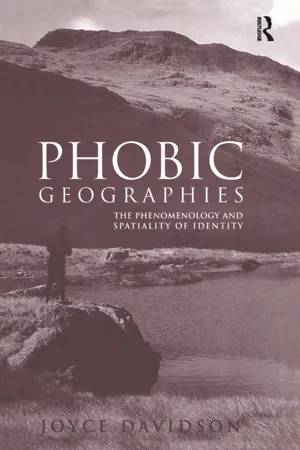
Despite recent estimates that there are currently 10 million people in the UK suffering from phobias, there is a substantial and conspicuous gap in existing academic literature and research on this topic. This book addresses this gap in relation to geography literature, but also extending beyond this field to connect with a wide range of academics, health professionals and phobic 'others' whose ideas are (re)formed by fear. In doing so, it provides non-clinical, specifically geographical insights into phobia, of relevance for its sufferers and expands human geographical understandings of the relations between gender, embodiment, space and mental health, via a study of agoraphobia. This book argues that a critical geographic perspective is better placed to take account of the importance of wider social contexts and relations, and can give a fully spatialised account of the disorder more faithful to the way sufferers actually describe their experiences. By drawing attention to some of the more unusual ways that people relate to each other, and to their environments, we can illuminate some ordinarily taken for granted aspects of personal geographies.
Information
Table of contents
- Cover
- Half Title
- Dedication
- Title Page
- Copyright Page
- Table of Contents
- Acknowledgements
- Introduction: Notes on Stories, Selves and Spaces
- 1 What in the World is Agoraphobia?
- 2 ‘Joking Apart…’: The Negotiation of Group Boundaries Through Humour
- 3 Fear and Trembling in the Mall: Kierkegaard and Consumer/Consuming Spaces
- 4 ‘Putting on a Face’: Sartre, Goffman and Agoraphobic Anxiety in Social Space
- 5 A Phenomenology of Fear: Merleau-Ponty and Agoraphobic Life-Worlds
- 6 Pregnant Pauses: Agoraphobic Embodiment and the Limits of (Im)pregnability
- 7 ‘All in the Mind&?’: Analysing the Subject of ‘Self-Help’
- Conclusion: Re/solution of Spatial Identities
- Bibliography
- Index
Trusted by 375,005 students
Access to over 1.5 million titles for a fair monthly price.
Study more efficiently using our study tools.
Frequently asked questions
Yes, you can cancel anytime from the Subscription tab in your account settings on the Perlego website. Your subscription will stay active until the end of your current billing period. Learn how to cancel your subscription
No, books cannot be downloaded as external files, such as PDFs, for use outside of Perlego. However, you can download books within the Perlego app for offline reading on mobile or tablet. Learn how to download books offline
Perlego offers two plans: Essential and Complete
- Essential is ideal for learners and professionals who enjoy exploring a wide range of subjects. Access the Essential Library with 800,000+ trusted titles and best-sellers across business, personal growth, and the humanities. Includes unlimited reading time and Standard Read Aloud voice.
- Complete: Perfect for advanced learners and researchers needing full, unrestricted access. Unlock 1.5M+ books across hundreds of subjects, including academic and specialized titles. The Complete Plan also includes advanced features like Premium Read Aloud and Research Assistant.
We are an online textbook subscription service, where you can get access to an entire online library for less than the price of a single book per month. With over 1.5 million books across 990+ topics, we’ve got you covered! Learn about our mission
Look out for the read-aloud symbol on your next book to see if you can listen to it. The read-aloud tool reads text aloud for you, highlighting the text as it is being read. You can pause it, speed it up and slow it down. Learn more about Read Aloud
Yes! You can use the Perlego app on both iOS and Android devices to read anytime, anywhere — even offline. Perfect for commutes or when you’re on the go.
Please note we cannot support devices running on iOS 13 and Android 7 or earlier. Learn more about using the app
Please note we cannot support devices running on iOS 13 and Android 7 or earlier. Learn more about using the app
Yes, you can access Phobic Geographies by Joyce Davidson in PDF and/or ePUB format, as well as other popular books in Naturwissenschaften & Geographie. We have over 1.5 million books available in our catalogue for you to explore.