- 604 pages
- English
- ePUB (mobile friendly)
- Available on iOS & Android
eBook - ePub
About this book
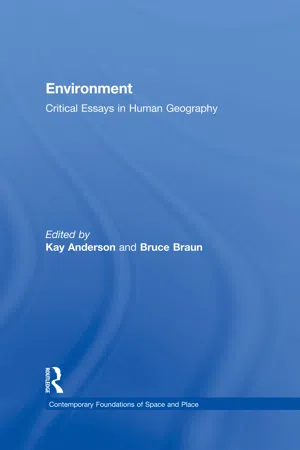
Spanning cultural and political ecology, the political economy of the environment, humanistic landscape interpretation, cultural studies of nature, and science and technology studies, this volume is the definitive guide to environmental studies in Human Geography over the past 30 years. The articles collected capture conceptual developments in the field for audiences within and beyond Geography, and illustrate the diversity and remarkable vitality of geographical research on society-environment relations.
Information
Part I
Nature and Society: New Directions for Environmental Geography
[1]
Environmental Appreciation: Localities as a Humane Art
by D. W. MEINIG
I
AMERICA’S “DISCOVERY” OF THE ENVIRONMENT in 1970 was so sudden and so sensational that we are as yet very far from realizing just what it all means. It was inevitable and appropriate, given the relative lack of attention over so many years, that this first spasm of concern should focus upon the problems associated with the environment; so much so that people now link the very word most immediately with smog and garbage, filthy streams, oil slicks, and used-car dumps. Now it is surely proper that we give first attention to life-endangering aspects of the environment, for our neglect has been so gross as to face us with genuine crises. I wish, however, to emphasize some life-enriching aspects, although I will go on to argue that the two are necessarily interrelated.
“Environment” refers to that with environs, that which surrounds, that which we live amidst. Thus it clearly includes man as well as nature. It is “place” or “locality,” which may be taken to refer to areas and their contents defined at a human scale, areas we can directly experience. Logically, the locality most of us know best is that of our home area, yet inevitably that which is so familiar, so routinely part of our lives, tends to be taken for granted until something unusual happens to jar us into seeing more clearly through the daily blur. Travel and migration are probably the most common sorts of events which through freshness and comparison help us to experience our environments more fully. However if we seek to foster some widespread improvement in environmental appreciation we can hardly rely upon such erratic events. We need some sort of formal program.
I employ the word “appreciation” not in the sense, necessarily, of approval, but as the dictionary more carefully puts it: “to perceive distinctly”; “to be keenly sensible of or sensitive to.” Environmental appreciation therefore is akin to music and art appreciation in the fullest sense of a long-term training of the mind and attunement of the senses to grasp, to penetate, to experience to a more than ordinary degree. Such a study may seem on first hearing a very mundane and prosaic one compared with those well-established humanities, but it is hardly more modest in aspiration. Like art and music, while it can be enjoyed at a wide range of levels, it is infinitely complex. If environment is inclusive of man and nature at the scale of localities, it is obviously too complex to be grasped in all of its major aspects at any great depth of understanding by any one person. But it is not because of this inherent complexity that we have no body of experts, no adequate literature, and no course of training to serve the purpose I am advocating. It is because we have never really made a serious attempt to approach the environment in ways appropriate to the need.
II
Characteristically, we have looked at “environment” very largely through the eyes of science rather than of the humanities. Science proceeds first of all by analysis, by dis-integrating, and thus we do have large numbers of highly trained specialists on various parts of the environment: geologists, hydrologists, zoologists, botanists, soil scientists, and meteorologists, to name only the most familiar. We also have various kinds of ecologists who study the interrelations between living things and their environment and thus have inherently a more integrative approach. But not only is this last an alarmingly small group (as we have suddenly realized), it tends as well to be far too narrow to serve the purpose. For most “ecologists” are “natural scientists,” meaning that they have consciously specialized in “nature” and not in “human culture,” and there has been a very strong tendency (entirely desirable for certain purposes) to try to separate the two, to regard man and his works as “unnatural” intruders. Thus, for example, the meteorologists move the weather station out of the city not only because the Weather Bureau has historically been regarded as primarily a rural service, but because that urban conglomeration of asphalt and steel, smoke and exhausts distorts what the weather is “really” like. It is only very recently that much attention has been paid to the need for an “urban micro-climatology” which deals with the weather in the actual environments most of us live in. Only very recently have works in “ecogeology” and urban hydrology which deal with man’s modifications of nature’s surfaces and subsurfaces become prominent. We are really only beginning to realize the extent and the consequences of (to use the title of a great landmark symposium of fifteen years ago) “man’s role in changing the face of the earth.”1 While specialists know much about such things within narrow fields, we have a long way to go to connect these studies and to make such understandings more readily accessible to a much wider public.
If we turn to those fields which have focused more directly upon man and his works we will find more that is immediately applicable, but still a very uneven and incomplete coverage. There is a large literature usually classified under “Conservation” that contains much that is of interest, but it tends to have a strong rural bias and to deal with types of problems rather than complexities of specific areas. Architecture offers a fine and rapidly expanding body of work on man’s most notable kind of imprint upon the earth. Yet any perusal will show a much greater emphasis upon individual buildings than upon whole streets and neighborhoods, more upon the historical, the monumental, and the unusual, than upon the common and ordinary; more on the leading cities than upon smaller towns and rural areas. There is a small, little-known, literature on other aspects of the landscape such as cemeteries, fences, roads, field patterns. And there is even a remarkably interesting journal called Landscape2 which has been one of the more effective agents in trying to give some coherence to such topics but it alone can hardly do the job. That journal originally carried “human geography” in its subtitle, and there has been a handful of American geographers who have been working on more comprehensive and interpretive approaches to landscape study. Even so, a review of the broader literature in geography suggests only that it is a field of great potential but as yet of relatively little accomplishment in “environmental appreciation.” Despite the fact that “landscape” and “man and environment” are old themes in geography, the older work tended toward rather wooden stereotyped descriptions of landscape elements with rather simplistic interpretations, while the newer work, enamored of quantification and systems analysis, becomes increasingly theoretical and antithetical to any kind of local application.
Ours is a technological society, our landscape is strewn with machinery and each of us knows, directly or vicariously, a good deal about a remarkable array of equipment. I am quite sure that we are much less aware of just how deeply and extensively that equipment shapes our lives and environment. There is certainly a varied literature on Western man and his technology, but that which deals with cultural behavior tends to be philosophical or polemical and is rarely applied to the scale of the locality. That is a proper subject for ethnologists and if we were other than part of the mainstream of Western Civilization we would probably have had such matters considered in great detail at the community scale by visiting anthropologists.
The local community as a social entity has been rather extensively studied by American sociologists and some of their literature is nearer to what I am suggesting that is any other. Those of us interested in the American West immediately think of Lowry Nelson’s The Mormon Village wherein the communities of Escalante, Ephraim, and American Fork are quite vividly portrayed in reasonably full environmental settings.3 Unfortunately not since the vigorous movements in rural and regional sociology of the 1920’s and 1930’s (of which Nelson’s work is an example) has there been any concerted effort to build a body of such studies to illustrate the rich variety of community types in America. It would appear that since that time sociology has been much more interested in building a “science of society” and in focusing intently upon the study of social problems. Neither of these is irrelevant, but certainly neither is very central to the descriptive and interpretive literature on localities.
Every community has a history and many a town library has a set of books on the local area. But in most cases, a sampling is enough to demonstrate why “local history” tends to be a rather odious term among professional historians, despite a few stout defenders and a few unusual works. The most common sort of work is the ponderous stereotyped county and city histories of the late 19th and early 20th centuries: with Volume I full of a vast miscellany of facts about pioneers, early industries, churches, lodges, and lists of officials; followed by one or two volumes of photographs with accompanying biographical sketches of every local citizen who had enough money and ego to subscribe for the production of such works. Derided as “mug books,” they are mines of information but hardly the kind of penetrating interpretive history one needs to help understand the social character of a locality. Such a history should attempt to describe the community in terms of changing and competitive aggregations of persons, and to identify such things as which groups had prestige, who really governed, and what social tensions existed at various times. But that is asking for something very difficult to achieve. For the data are rarely complete and explanations rarely simple, and the historian will almost certainly be forced into a whole set of assumptions and interpolations, or to put it another way, be forced to rely upon controlled imagination.
Now “imagination” is an uncomfortable term for the social scientist and the historian, but it is the very basis of the novelist’s existence. And a fair sampling of the creative literature on communities and localities would certainly suggest that the skillful novelist often seems to come closest of all in capturing the full flavor of the environment. His sensitivity to a scene, to the seasons, to the special qualities of life in a particular locality are often vividly evocative. And yet his main emphasis will almost certainly be upon the interactions of personalities, and it is likely that his real purpose is to transcend the local to display something of the universal in human life. We can be grateful for the good work that has thus been done, for the examples of techniques in relating an environment, but we can hardly rely upon the novelist alone to serve our purpose.
This hasty review cannot be offered as an adequate assessment, nor is it in any way meant to be a disparagement of the literature in any field. My only intent is to argue that despite the size and diversity of the volume of works which in some way deal with the environment, we cannot simply piece together an adequate underpinning for the kind of “environmental appreciation” I am advocating. Any such attempt will quickly reveal not only very great unevennesses in topics and areas but serious deficiencies in demonstrated ways of relating one topic to another.
III
Thus we must create a special education to serve the purpose. I say “education” rather than just “literature” because the latter is not enough. For surely a greater training in how to look at an area, how to open the eyes and become keenly sensible of one’s environment is a prime requirement. And the status and styles of “field study” in our educational system are a good expression of how little serious attention we have paid to the environment. Most school “field trips” are visits to museums, factories, or farms. The more “general field trip” — the going out simply to take a careful look at our surroundings, to see what we can see, what sense we can make of it, what questions it seems to pose — is, except for a few anomalous geography departments, almost certainly to be found only in the elementary school, and perhaps at no more than the kindergarten “walk-around-the-block” level. That is certainly a good place to start, but hardly the place to quit. Implicit in this state of affairs is the idea that the local area is basically simple, easily understood, well-suited for juvenile study but insufficient for even modestly advanced students. To call that a silly and disastrous notion is not to overstate the case: as if the anatomy of any landscape, the ecology of any area, the life of any community, the forces that have created any environment were really simple! Indeed, anyone who has taken a hard look at any of these is likely to feel that those who study the nation, the society at large, the surface of the earth, or the state of the world have an easier time of it: for it seems easier to apply a set of general concepts to the forest than to know intimately any single tree.
Environmental appreciation is not something inherendy simple or superficial. It can absorb a lifetime of study from any number of approaches. But, like music or art, it can be made available to a broad range of persons once it begins to take shape as a coherent field of study. As noted, some useful materials are already available, but there has not as yet been much shaping. One of the critical needs is for works in “environmental perception,” studies of how people now experience environments and how they can be helped to experience them more deeply. Studies such as Kevin Lynch’s The Image of the City4, Ian Nairn’s The American Landscape, A Critical View5, David Lowenthal’s “The American Scene,”6 are indicative.
There is actually a great miscellany of encouraging signs: photographic histories of cities, photographic studies of regions, architectural surveys, all presented not as albums of pretty pictures but as coherent displays of the development and particular environmental qualities of a locality, of the landscape as shaped by historical forces and cultural values. But we have hardly begun to realize the rich possibilities for books which combine word, map, photograph, sketch, and diagram for the depiction and penetrating interpretation of local areas. We have never had a literature on “topography,” or “scenery,” or even a good “guidebook” series at all comparable to those of Western Europe. The famous series of guidebooks which covers each state, many cities, and a number of special areas, produced by the Federal Writer’s Project during the New Deal is much the best sort of thing ever done in this country, but it far from fulfills our needs. More automobile tour guides are appearing each year but only a few offer anything beyond the most banal coverage. How many American cities have even as much as a Chamber of Commerce brochure to serve as a walking guide to the townscape?
But how could we expect anything else? As a people we do not walk for leisure and pleasure. And as for looking, for really seeing anything beyond our most practical needs, we have been attuned to admire only that which is big, new, or historically famous. The idea of regarding our urban landscapes as intricate continuous surfaces which display changing styles and tastes, technologies and functions, which are in turn expressions of our cultural values, our really basic ideologies; of consciously open...
Table of contents
- Cover Page
- Title Page
- Copyright Page
- Contents
- Acknowledgements
- Series Preface
- Introduction
- Part I Nature and Society: New Directions for Environmental Geography
- Part II Culture/Economy/Power: Thickening the Critical Turn in Environmental Geography
- Part III Beyond Dualism: Relational Histories and Ontologies
- Name Index
Trusted by 375,005 students
Access to over 1.5 million titles for a fair monthly price.
Study more efficiently using our study tools.
Frequently asked questions
Yes, you can cancel anytime from the Subscription tab in your account settings on the Perlego website. Your subscription will stay active until the end of your current billing period. Learn how to cancel your subscription
No, books cannot be downloaded as external files, such as PDFs, for use outside of Perlego. However, you can download books within the Perlego app for offline reading on mobile or tablet. Learn how to download books offline
Perlego offers two plans: Essential and Complete
- Essential is ideal for learners and professionals who enjoy exploring a wide range of subjects. Access the Essential Library with 800,000+ trusted titles and best-sellers across business, personal growth, and the humanities. Includes unlimited reading time and Standard Read Aloud voice.
- Complete: Perfect for advanced learners and researchers needing full, unrestricted access. Unlock 1.5M+ books across hundreds of subjects, including academic and specialized titles. The Complete Plan also includes advanced features like Premium Read Aloud and Research Assistant.
We are an online textbook subscription service, where you can get access to an entire online library for less than the price of a single book per month. With over 1.5 million books across 990+ topics, we’ve got you covered! Learn about our mission
Look out for the read-aloud symbol on your next book to see if you can listen to it. The read-aloud tool reads text aloud for you, highlighting the text as it is being read. You can pause it, speed it up and slow it down. Learn more about Read Aloud
Yes! You can use the Perlego app on both iOS and Android devices to read anytime, anywhere — even offline. Perfect for commutes or when you’re on the go.
Please note we cannot support devices running on iOS 13 and Android 7 or earlier. Learn more about using the app
Please note we cannot support devices running on iOS 13 and Android 7 or earlier. Learn more about using the app
Yes, you can access Environment by Bruce Braun, Kay Anderson in PDF and/or ePUB format, as well as other popular books in Physical Sciences & Politics. We have over 1.5 million books available in our catalogue for you to explore.