Soy in South America constitutes one of the most spectacular booms of agro-industrial commodity production in the world. It is the pinnacle of modernist agro-industrial practices, serving as a key nexus in food–feed–fuel production that underpins the agribusiness–conservationist discourse of "land sparing" through intensification. Yet soy production is implicated in multiple problems beyond deforestation, ranging from pesticide drift and contamination to social exclusion and conflicts in frontier zones, to concentration of wealth and income among the largest landowners and corporations. This book explores in depth the complex dynamics of soy production from its diverse social settings to its transnational connections, examining the politics of commodity and knowledge production, the role of the state, and the reach of corporate power in everyday life across soy landscapes in South America. Ultimately, the collection encourages us to search and struggle for agroecological alternatives through which we may overcome the pitfalls of this massive transnational capitalist agro-industry.
This book was originally published as a special issue of The Journal of Peasant Studies.
Strategies and hybrid dynamics of soy transnational companies in the Southern Cone
Valdemar João Wesz Jr
Economical liberalization, market globalization and soy expansion stimulated the advance of big transnational companies in the Southern Cone countries (Brazil, Argentina, Paraguay and Uruguay). Currently, the main corporations acting on the last links of the productive chain are ADM (Archer Daniels Midland), Bunge, Cargill and Dreyfus (the ABCD firms), global leaders in the soy trade. The objective of this contribution is to analyze the different strategies these companies articulate in the Southern Cone, and their dynamics in local space through market relations with local producers. The results show the rapid and intense process of denationalization of the firms in the soy productive chain as well as the high level of market internationalization and company concentration. In spite of this, this study shows that all transnational power of ABCD firms, which seems so abstract and intimidating when seen in the global scale, depends on its basis of the formation, maintenance and exploration of relations of proximity, trust and reciprocity with local actors (especially rural producers), including family friendship linkages.
Introduction1
From 1970 onward a new international order started in the political and institutional sphere, characterized by the emergence of a complex reconfiguration of the world’s economy and the alteration of the nature and dynamics of production, consumption and markets (Friedmann and McMichael 1989; Santos 2002). In the agricultural and food-production sector, this process is expressed in the liberalization of international commerce and the performance of transnational companies looking to exploit the comparative advantages of this new order (Wilkinson 2009). In this context, heterogeneous and geographically dispersed actors and spaces are connected, and the dynamics of the relations between firms and ways of governance are modified (Gereffi, Humphrey, and Sturgeon 2005; Bonanno and Constance 2008; Clapp and Cohen 2009; Clapp and Fuchs 2009).
In Latin America’s Southern Cone2, the globalization process was intensified from the 1990s, during which a strong commercial and financial opening occurred, the results of which were the mutation of the companies’ patrimonial structure, exemplified by the expansion of foreign direct investment (FDI) and the increase in the number of mergers and acquisitions (M&A). Also, intensification of the firms’ denationalization process, growth of markets’ internationalization, business concentration and capital centralization occurred (Benetti 2004; Cohen 2007; De La Torre and Schmukler 2007).
In the soy market, the economic liberalization and market globalization process, and the legume production increase, stimulated the advance of the big transnational companies in the Southern Cone. This way, ADM (Archer Daniels Midland), Bunge, Cargill and Dreyfus, world leaders in agricultural trade, started to play an important role in the region’s soy market, from the 1990s onward. It is important to notice that soy is today the main farming activity in economic (export value) and territorial (planted surface) terms in Brazil, Argentina, Paraguay and Uruguay.
The objective of this paper is to analyze the strategies and dynamics of the transnational companies ADM, Bunge, Cargill and Dreyfus (known as the ABCD firms) on the Southern Cone soy productive chain. In this way, it seeks to understand, through the different national and international transformations, the current configuration of the companies related to the region’s soy market, which have led the world production of this bean. At the same time, it discusses the dynamics of these firms in the local space related to their commercial relations with rural producers. With this debate it aims at understanding how transnational companies’ global practices are shifted, shuffled and adapted, and regain meaning through interactions with actors and the contexts that exist in the different scales (processes that produce hybrid organizations).
Besides using specialized academic literature on the subjects discussed, secondary data research was conducted for the different countries, mainly consulting the Brazilian Association of Vegetable Oils Industries (ABIOVE; Brazil), the Brazilian Institute of Geography and Statistics (IBGE; Brazil), the National Company of Supply (CONAB; Brazil), the Foreign Trade Secretariat (SECEX; Brazil), the Ministry of Agriculture, Livestock and Fishing (MAGyP; Argentina), the National Institute of Statistics and Census (INIDEC; Argentina), the Ministry of Economies and Public Finances (MECON; Argentina), the Ministry of Agriculture and Livestock (MAG; Paraguay), the Paraguayan Assembly of Cereals and Oilseeds Exporters and Traders (CAPECO; Paraguay) and the Ministry of Livestock, Agriculture and Fishing (MGAP; Uruguay). Also, information was collected from the media, especially newspapers and magazines, as well as reports, institutional bulletins and balance sheets of ADM, Bunge, Cargill and Dreyfus. Thirty-six qualitative interviews were held in 2012 and 2013 in Mato Grosso (the main Brazilian state for soy production) with representatives of ABCD companies and with rural producers (with regard to the latter, producers that plant more than 200,000 hectares of soy and farmers in rural settlements that produce the grain on 10 hectares were interviewed).
After this introduction, the soy expansion in the Southern Cone is presented, highlighting this market’s features in the four countries. In the following, the presence of ABCD in the region is discussed with special attention in terms of the installed crush capacity and export volume. The main strategies of the ABCD firms are also analyzed. And, before the concluding section, the performance of these companies in the local space related to their commercial relations with rural producers is discussed.
The soy expansion in the Southern Cone
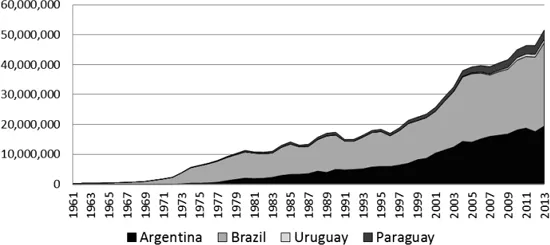
Until the mid part of the twentieth century, soy was an experimental crop in the Southern Cone countries, without economic and territorial importance. Between the 1950s and 1960s there was a first movement to stimulate production, mainly in Brazil, where soy started to be planted in rotation with wheat (Embrapa 2004). As shown in Figure 1, from 1970 onwards, there is a significant increase in the planted area, led by Brazil and, to a lesser extent, by Argentina. The decades of 1980 and 1990 were characterized by an increase in the planted surface, although there were significant recession periods, especially in Brazil, which entered an economic crisis (Delgado 2005). By the mid 1990s, what has been called the soy boom took place (in Uruguay this process came later, starting by the 2000s), the main characteristic of which was the high rate of planted area growth, which doubled in less than 10 years. In a general way, this expansion has continued until today, mainly in the Paraguayan and Argentinean cases, where the planted surface has had practically uninterrupted growth during the last 20 years (Figure 1). Today, the soy-planted area in the Southern Cone equals the sum of the territories of Germany, Portugal and Belgium.
The dynamics of soy in the Southern Cone is linked to the incorporation, on a global scale, of this legume in the production of vegetal oil and proteins for animal feed (swine, birds and cattle) that was boosted mainly by the USA after World War II (Du Bois, Tan, and Mintz 2008). The growth of the international demand for and the price of the grain, especially from 1973 onwards, stimulated countries in the Southern Cone to invest in the legume for export. It is important to highlight that the national states played a fundamental role in disseminating this harvest when they created several measures to encourage its production. In this sense, policies for the modernization of agriculture were decisive, for they relied on subsidized credit, technological innovation, minimal prices, modernization of the input and processing industry, the creation of new channels for distribution, etc. (Piñeiro and Moraes 2008; Heredia, Palmeira, and Leite 2010; Gras and Hernández 2013).
In parallel, the soy expansion received strong benefits from migration policies, especially in Brazil and Paraguay. In the former, the military government promoted the ‘occupation of Cerrado’ and the expansion of the agriculture frontier through several public policies (directed at land concession, infrastructure construction, agriculture modernization, territory occupation, fiscal incentives, etc.). One of its main goals was to extend farm production in the region to generate earnings and equalize the commercial balance via the increase of exports (Fernández 2007; Moreno 2007). In the Paraguayan case, the Stroessner government (1954–1989) tried to consolidate the agroexporting model through the incorporation of Brazilian people in its territory, so that they could extend areas of plantation destined for export (especially soy and wheat). For such, the law forbidding the acquisition of land by foreigners in the range of 150 kilometres from their borders was abolished, and it facilitated the land concession and financing of agricultural activities (Pappalardo 1995; Albuquerque 2005; Blanc, 2015). Today, it is estimated that 90 percent of Paraguayan soy is produced by Brazilians or their descendants (Revista Exame 2011).
Figure 1. Soy-planted area in the Southern Cone (1961 to 2013). Source: Faostat (2014).
In addition to sectorial actions of the different countries (such as rural credit, price, land and territorial order, agronomic research, technical assistance policies, etc.), a series of instruments were decisive for the construction of an environment favourable to soy expansion (such as labour, environmental, industrial, commercial, fiscal, tributary, energy, infrastructure and services policies, etc.). Still, domestic impulses cannot be analyzed as disconnected actions, but as a set of instruments mobilized to sustain an agroexport model of development that, during the years, has shifted and restructured when faced with the national and international political-economic context (Pires and Santos 2013).
It is necessary to recognize that public policies constructed by the different countries to maintain the agroexport model are linked to the context of economic, commercial and financial globalization, defended and stimulated by international organizations (especially the International Monetary Fund, the World Bank and the World Trade Organization) (Gilpin 2011). In parallel, the transnational companies deepen and intensify the process of market integration, since they are the main locus of accumulation and economic power controlling specific assets (capital, technology and management, organizational and market capacity) and defining private norms for market regulation (Clapp and Fuchs 2009). In brief, it can be said that the expansion of the soy frontier in the Southern Cone has been stimulated by the relations among national governments, transnational companies and institutions of global governance.
Gudynas (2008), Guibert et al. (2011) and Gras and Hernández (2013) also note how technological and socio-organizational transformations were also fundamental for the soy boom. Amongst the technical changes, the authors highlight the importance of direct seeding and transgenic variety introduction, which simplified the planting and management process, reducing implementation costs (despite the payment of royalties and the growing use of agrotoxics). On the socio-organizational front, there were information and communication structures, business management, new financial tools and the organization of the companies on business networks, that allowed the introduction of financial sources coming from other sectors, the expansion of actors’ mobility, and the possibility of controlling bigger areas in different regions.
In the last few decades, the Southern Cone has become the main area of expansion of soy plantations (mainly Brazil and Argentina, which dominate more than 90 percent of the regional planted surface of the grain, but with a growing advance over the Paraguayan and the Uruguayan territories3). In 2013 these four countries accounted for more than half of the world’s production (52 percent), while in 1970 they represented only 4 percent. From 1970 to 2013, the soy-planted area grew more than 34 times, while in the other producer countries, this growth was only two times (Faostat 2014). The data show the region’s importance and leading role in soy cultivation.
Genok (2012) argues that, associated with this productivity growth through the years, since the 1990s there has been an expansion over native vegetation areas, and over other activities (such as summer cultivation and livestock). The strong hegemony soy has assumed on Southern Cone agriculture can be observed in the control that it exerts on the total arable lands, which has been greater than 40 percent since 2005. Two of every five arable hectares in the region are used for soy (Genok 2012).
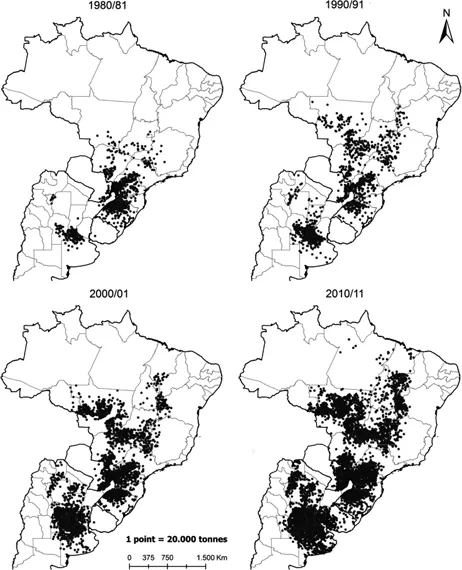
Figure 2. Soy production in the Southern Cone (Brazil, Argentina, Paraguay and Uruguay). Source: IBGE (2013); MAGyP (2013); MAG (2013); Capeco (2013); MGAP (2013), compiled by the author.
The territorial expansion of soy can be observed in Figure 2, which presents the grain production in Brazil, Argentina and Paraguay. This instrument allows us to comprehend, historically and spatially, the expansion of the legume in the different regions of the countries analyzed. While at the beginning of the 1980s, soy was present in a more significant way in the Brazilian South and the humid pampas of Argentina, through the years it is possible to observe the proliferation of new spots, such as the center-north of Brazil and Argentina, the Uruguayan west and the Paraguayan east (Figure 24).
When analyzing the soy data in each country, the importance it has assumed over the last decade becomes unquestionable. In Brazil’s case, the legume occupies a surface that is greater than 50 percent of temporary cultures and accounts for 9.4 percent of total exports. It is also the largest country exporting soy, in grain (CONAB 2013; SECEX 2013). In Argentina, soy has become the main farm activity, surpassing traditional cultures such as wheat, corn and sunflower. Over the last few years the grain has reached 60 percent of farming planted areas and is responsible for 25 percent of the total value of sales to foreign countries, and the country is the world leader in soybean meal and oil exports (INDEC 2013; Faostat 2014). In Paraguay, soy has been identified as ‘the backbone of agribusiness’, occupying 72 percent of arable lands in the country and accounting for 9.7 percent of national gross domestic product (GDP), and 42 percent of total exports (C...
Table of contents
Cover
Half Title
Series Page
Title Page
Copyright Page
Contents
Citation Information
Notes on Contributors
Introduction: Sacred groves, sacrifice zones and soy production: globalization, intensification and neo-nature in South America
1 Strategies and hybrid dynamics of soy transnational companies in the Southern Cone
2 Disappearing nature? Agribusiness, biotechnology and distance in Argentine soybean production
3 Which territorial embeddedness? Territorial relationships of recently internationalized firms of the soybean chain
4 The geopolitics of Brazilian soybeans
5 China’s soybean crisis: the logic of modernization and its discontents
6 Different farming styles behind the homogenous soy production in southern Brazil
7 Soybean agri-food systems dynamics and the diversity of farming styles on the agricultural frontier in Mato Grosso, Brazil
8 Farming is easy, becoming Brazilian is hard: North American soy farmers’ social values of production, work and land in Soylandia
9 Green for gold: social and ecological tradeoffs influencing the sustainability of the Brazilian soy industry
10 On the margins of soy farms: traditional populations and selective environmental policies in the Brazilian Cerrado
11 Genetically modified soybeans, agrochemical exposure, and everyday forms of peasant collaboration in Argentina
12 ‘More soy on fewer farms’ in Paraguay: challenging neoliberal agriculture’s claims to sustainability
13 The moving frontiers of genetically modified soy production: shifts in land control in the Argentinian Chaco
14 Bolivia’s soy complex: the development of ‘productive exclusion’
Index
Trusted by 375,005 students
Access to over 1.5 million titles for a fair monthly price.
Study more efficiently using our study tools.
Frequently asked questions
Yes, you can cancel anytime from the Subscription tab in your account settings on the Perlego website. Your subscription will stay active until the end of your current billing period. Learn how to cancel your subscription
No, books cannot be downloaded as external files, such as PDFs, for use outside of Perlego. However, you can download books within the Perlego app for offline reading on mobile or tablet. Learn how to download books offline
Perlego offers two plans: Essential and Complete
Essential is ideal for learners and professionals who enjoy exploring a wide range of subjects. Access the Essential Library with 800,000+ trusted titles and best-sellers across business, personal growth, and the humanities. Includes unlimited reading time and Standard Read Aloud voice.
Complete: Perfect for advanced learners and researchers needing full, unrestricted access. Unlock 1.5M+ books across hundreds of subjects, including academic and specialized titles. The Complete Plan also includes advanced features like Premium Read Aloud and Research Assistant.
Both plans are available with monthly, semester, or annual billing cycles.
We are an online textbook subscription service, where you can get access to an entire online library for less than the price of a single book per month. With over 1.5 million books across 990+ topics, we’ve got you covered! Learn about our mission
Look out for the read-aloud symbol on your next book to see if you can listen to it. The read-aloud tool reads text aloud for you, highlighting the text as it is being read. You can pause it, speed it up and slow it down. Learn more about Read Aloud
Yes! You can use the Perlego app on both iOS and Android devices to read anytime, anywhere — even offline. Perfect for commutes or when you’re on the go. Please note we cannot support devices running on iOS 13 and Android 7 or earlier. Learn more about using the app
Yes, you can access Soy, Globalization, and Environmental Politics in South America by Gustavo de L. T. Oliveira,Susanna B. Hecht in PDF and/or ePUB format, as well as other popular books in Economics & Development Economics. We have over 1.5 million books available in our catalogue for you to explore.