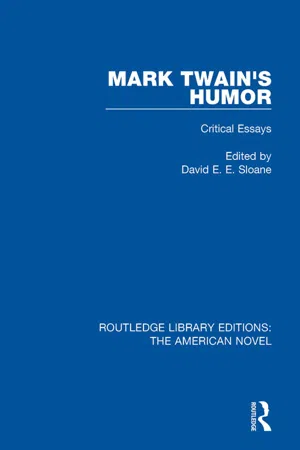
Originally published in 1993. The purpose of this volume is to lay out documents which give an estimate of Mark Twain as a humourist in both historical scope and in the analysis of modern scholars. The emphasis in this collection is on how Twain developed from a contemporary humourist among many others of his generation into a major comic writer and American spokesman and, in several more recent essays by younger Twain scholars, the outcomes of that development late in his career. The essays determine how the humor takes on meaning and importance and how the humor works in a number of ways in the literary canon and even in the persona of Mark Twain.
- 658 pages
- English
- ePUB (mobile friendly)
- Available on iOS & Android
eBook - ePub
About this book
Information
The Middle Career of Mark Twain from Tom Sawyer to Pudd’nhead Wilson: The Comedian as Major Author
Novels of the Week: The Adventures of Tom Sawyer
The name of Mark Twain is known throughout the length and breadth of England. Wherever there is a railway-station with a bookstall his jokes are household words. Those whose usual range in literature does not extend beyond the sporting newspapers, the Racing Calendar, and the ‘Diseases of Dogs,’ have allowed him a place with Artemus Ward alongside of the handful of books which forms their library. For ourselves, we cannot dissociate him from the railway-station, and his jokes always rise in our mind with a background of Brown & Polson’s Corn Flour and Taylor’s system of removing furniture. We have read ‘The Adventures of Tom Sawyer’ with different surroundings, and still have been made to laugh; and that ought to be taken as high praise. Indeed, the earlier part of the book is, to our thinking, the most amusing thing Mark Twain has written. The humour is not always uproarious, but it is always genuine and sometimes almost pathetic, and it is only now and then that the heartiness of a laugh is spoilt by one of those pieces of self-consciousness which are such common blots on Mark Twain’s other books. ‘The Adventures of Tom Sawyer’ is an attempt in a new direction. It is consecutive, and much longer than the former books, and as it is not put forward as a mere collection of “Screamers,” we laugh more easily, and find some relief in being able to relax the conventional grin expected from the reader of the little volumes of railway humour. The present book is not, and does not pretend to be a novel, in the ordinary sense of the word; it is not even a story, for that presupposes a climax and a finish; nor is it a mere boys’ book of adventures. In the Preface the author says, “Although my book is intended mainly for the entertainment of boys and girls, I hope it will not be shunned by men and women on that account, for part of my plan has been to try pleasantly to remind adults of what they once were themselves, and of how they felt and thought and talked, and what queer enterprises they sometimes engaged in.” Questions of intention are always difficult to decide. The book will amuse grown-up people in the way that humorous books written for children have amused before, but (perhaps fortunately) it does not seem to us calculated to carry out the intention here expressed. With regard to the style, of course there are plenty of slang words and racy expressions, which are quite in place in the conversations, but it is just a question of whether it would not have been as well if the remainder of the book had not been written more uniformly in English.
On the Structure of Tom Sawyer
Walter Blair
I
Since, as several critics have suggested, The Adventures of Tom Sawyer (1876) attacked earlier juvenile literature in something roughly like the way Joseph Andrews attacked Pamela,1 a note on the structure of the novel may well start (though it should not, I think, terminate) with a consideration of Clemens’ book in its literary contexts. Such a consideration, by indicating the nature of the writings attacked and the way Mark Twain and other American humorists assaulted them, may emphasize certain architectural peculiarities in the volume and suggest more clearly than critics have done,2 a unifying narrative thread.
Notable in earlier juvenile fictional works had been their characters, their preachments, and their plots. The children portrayed had been, for the most part, characterized with extraordinary simplicity: they had been good or bad, and that had been an end of it.3 Horatio Alger’s street boy heroes in the sixties, to be sure, had been more inclined towards naughtiness than flawless Little Eva or even beautifully trained Little Rollo had been.4 But Alger’s Ragged Dick, though he used profanity, patronized the Old Bowery Theatre, smoked, and played jokes on country folk, was “above doing anything mean or dishonorable…. or imposing upon younger boys…. His nature was noble and had saved him from all mean faults.”5 And as a rule, as a critic of the Alger books has recently remarked:
Our hero was…. a good boy, honest, abstemious (in fact sometimes unduly disposed to preach to drinkers and smokers), prudent, well-mannered (except perhaps for preaching), and frugal…. Nor did any subtleties of character-drawing prevent one from determining who were the good characters and who were the bad ones. They were labeled plainly.6
The bad children—as lacking in complexity as the good—had been distinguished, perhaps, more by their proclivities toward sin than by their accomplishments. Their crimes had ranged all the way from simply being lazy or playing truant to the most horrible outrages within their infantile powers—lying, stealing, battering the helpless and the weak, swearing, smoking, and even drinking. In short, with few exceptions, a bad child had been as totally depraved (in intention) as the non-elect of Calvinistic theology.7
The authors of juvenile tales, employing these angelic or villainous children, had provided sermon-like commentaries and had fashioned lesson-teaching plots. Constantly these writers had “extolled the precocious child, deprecated wholesome pleasure, and delighted in didactic sentimentality,”8 patting good children on the back, and scolding bad children sternly. Even when he had skipped the sermons, the reader of a typical story had been able to get its point by noticing that the author’s dénouement observed the strictest poetic justice. In stories following what seemingly was the earliest pattern—the best known instance of which is the tale of Little Eva—the pallid virtuous child had died at the age proverbially prescribed for the Good, but had promptly gone to Heaven. The Alger boys, somewhat better adapted to the Gilded Age, had survived childhood to become successful business men. But the bad boy who had played truant “and was not really sorry for what he had done … went from one bad thing to another, and grew up to be a very wicked man, and at last committed a murder”; while naughty Thomas, who loafed all day or played with his kite, had a depressing adulthood:
Without a shilling in his purse,
Or cot to call his own,
Poor Thomas went from bad to worse,
And hardened as a stone.9
During the years before Tom Sawyer appeared, such good-bad-child tales, with their preachments and predetermined conclusions, had suggested incongruities between fiction and life useful to many American humorists. Beginning in the forties comic writers had sporadically beguiled readers with amoral portraits of unregenerate boys. Johnson J. Hooper’s Simon Suggs had cheated his father at cards in 1845,10 and in the fifties adolescent Sut Lovengood and young Ike Partington had perpetrated sundry deviltries. Ike, perhaps the most notorious of these juvenile delinquents, in the first volume in which he had appeared, had told lies, scratched letters on a newly japanned tray, broken countless windows, stolen oranges and cakes and doughnuts, hanged a cat, and imitated the hero of The black avenger, or the pirates of the Spanish Main.11 In the seventies Max Adeler’s Cooley boy was creating commotions in church, and kindred spirits in the writings of other humorists were behaving, in sketches, as Tom was to behave in a book. Doubtless the incongruity between these youths and those in contemporary books not only augmented their comic appeal but also molded the form of stories about them.
At least as early as the sixties, various authors had begun an even more direct onslaught upon juvenile fictional characters. Henry Ward Beecher, for example, had said in an essay written for a New York paper:
The real lives of boys are yet to be written. The lives of pious and good boys, which enrich the catalogues of great publishing societies, resemble a real boy’s life about as much as a chicken picked and larded, upon a spit, and ready for delicious eating, resembles a free fowl in the fields. With some honorable exceptions, they are impossible boys, with incredible goodness. Their piety is monstrous. A man’s experience stuffed into a little boy is simply monstrous…. Boys have a period of mischief as much as they have measles or chicken-pox.12
In 1869, Thomas Bailey Aldrich had launched his somewhat mild full-length portrait of Tom Bailey with a defiant passage calling attention to the difference between the Model Boy and the human youngster:
I call my story the story of a bad boy, partly to distinguish myself from those faultless young gentlemen who generally figure in narratives of this kind, and partly because I really was not a cherub. I may truthfully say I was an amiable, impulsive lad, blessed with fine digestive powers, and no hypocrite. I didn’t want to be an angel…. and I didn’t send my little pocketmoney to the natives of the Feejee Islands, but spent it royally on peppermint drops and tiffy candy. In short, I was a real human boy, such as you may meet anywhere in New England, and no more like an impossible boy in a story-book than a sound orange is like one that has been sucked dry.13
The story carrying this foreword could swell the circulation of Our young folks in 1869, and, in book form, could quickly run through eleven editions.14
By the middle of the seventies, the Moral Boy had become a dependable butt for humorists. During the year 1873, when Tom Sawyer was incubating, James M. Bailey was surmising that the nine-year-old Concord boy whose ability to repeat the multiplication table backwards had been recorded in a news item was the same hateful paragon who had lived next door to Bailey in his childhood—a youth who “always went to bed at eight o’clock…. brushed his hair back of his ears, and carried a store handkerchief…. He was the model boy, the boy our parents used to point to, and speak of…. while unfitting us for sitting on anything harder than a poultice.”15 The year before Tom Sawyer was issued, a Detroit humorist published sketches, “The good boy” and “The bad boy,” satirizing some of the excesses of Sunday school fiction.16 In the year Clemens’ novel appeared, Robert Burdette humorously referred to “well-known ‘good boys’ who wash their faces every morning, keep their clothes clean, wear white collars, and don’t say bad words.”17
None of these attacks, it is probable, can be thought of as a direct inspiration of Mark Twain’s book about boys. They are useful only to show a common conception of the humor of childhood and the nature of children of which he could take advantage. As a matter of fact, Twain himself had been rather early in the field with “The story of the good little boy who did not prosper” (1867) and “The story of the bad little boy who didn’t come to grief” (1870)—both burlesques.18 Jim, the hero of the former sketch, stole jam without the usual consequences: “all at once a terrible feeling didn’t come over him…. He ate that jam and said it was bully.” He stole apples and survived, purloined the teacher’s penknife and shifted the blame to “the moral boy, the good little boy of the village, who always obeyed his mother, and never told an untruth, and was fond of his lessons, and infatuated with Sunday-school.” Jim was delighted when the paragon was whipped, because he “hated moral boys. Jim said he was ‘down on them milksops.’” Thus “everything turned out differently with him from the way it does to the bad Jameses in the books.” In manhood, Jim “got wealthy by all manner of cheating and rascality; and now he is the infernalest wickedest scoundrel in his native village, and is universally respected, and belongs to the legislature.”
Jacob Blivens in the 1870 sketch behaved so abnormally—refusing to play hookey, to lie, and to play on Sunday—that other children decided he was “afflicted,” though the real trouble was simply that he “read all the Sunday-school books…. This was the secret of it.” Again there was an attack upon the endings of stories about children. In them, the models “always had a good time, and the bad boys had the broken legs; in his case there was a screw loose somewhere, and it all happened the other way.”
II
One who turns to Tom Sawyer with the conventional literature and the humorous attacks on that literature by various writers including Twain in mind may see some important achievements of Clemens’ novel. These were suggested by a contemporary critic who said:
This literary wag has performed some services which entitle him to the gratitude of his generation. He has run the traditional Sunday-school boy through his literary mangle and turned him out washed and ironed into a proper state of collapse. That whining, canting, early-dying, anaemic creature was held up to mischievous lads as worthy of imitation. He poured his religious hypocrisy over every honest pleasure a boy had. He whined his lachrymous warnings on every playground. He vexed their lives. So when Mark grew old enough, he went gunning for him, and lo, wherever his soul may be, the skin of the strumous young pietist is now neatly tacked up to view on the Sunday-school door of to-day as a warning.19
That the attack thus suggested may have been responsible in part for the organization of the narrative becomes clear if the story is restated in the way it would have been handled in the literature attacked. The opening chapter of Clemens’ novel reveals a character who, in terms of moralizing juvenile literature, has the indubitable earmarks of a Bad Boy. As the story opens, Tom is stealing. Caught in the act, he avoids punishment by deceiving his aunt. He departs to play hookey, returns to stand slothfully by while a slave boy does his chores for him, then enters the house to deceive his aunt again. His trickery exposed by his half-brother Sid, he dashes out of the door shouting threats of revenge. A few minutes later, he is exchanging vainglorious boasts with a stranger whom he hates simply because the stranger is cleanly and neatly dressed. The action of the chapter concludes with Tom pounding the strange boy into submission (for no righteous reason), then chasing him home. “At last,” says the autho...
Table of contents
- Cover
- Half Title
- Title Page
- Copyright Page
- Table of Contents
- General Editor’s Note
- Acknowledgments
- Chronology
- Introduction: David E. E. Sloane
- The Early Writings of Mark Twain: The Growth of the Comedian
- The Middle Career of Mark Twain from Tom Sawyer to Pudd’nhead Wilson: The Comedian as Major Author
- The Later Career of Mark Twain: The Comedian as a Cultural Representative
- Selected Bibliography
- Index
Trusted by 375,005 students
Access to over 1.5 million titles for a fair monthly price.
Study more efficiently using our study tools.
Frequently asked questions
Yes, you can cancel anytime from the Subscription tab in your account settings on the Perlego website. Your subscription will stay active until the end of your current billing period. Learn how to cancel your subscription
No, books cannot be downloaded as external files, such as PDFs, for use outside of Perlego. However, you can download books within the Perlego app for offline reading on mobile or tablet. Learn how to download books offline
Perlego offers two plans: Essential and Complete
- Essential is ideal for learners and professionals who enjoy exploring a wide range of subjects. Access the Essential Library with 800,000+ trusted titles and best-sellers across business, personal growth, and the humanities. Includes unlimited reading time and Standard Read Aloud voice.
- Complete: Perfect for advanced learners and researchers needing full, unrestricted access. Unlock 1.5M+ books across hundreds of subjects, including academic and specialized titles. The Complete Plan also includes advanced features like Premium Read Aloud and Research Assistant.
We are an online textbook subscription service, where you can get access to an entire online library for less than the price of a single book per month. With over 1.5 million books across 990+ topics, we’ve got you covered! Learn about our mission
Look out for the read-aloud symbol on your next book to see if you can listen to it. The read-aloud tool reads text aloud for you, highlighting the text as it is being read. You can pause it, speed it up and slow it down. Learn more about Read Aloud
Yes! You can use the Perlego app on both iOS and Android devices to read anytime, anywhere — even offline. Perfect for commutes or when you’re on the go.
Please note we cannot support devices running on iOS 13 and Android 7 or earlier. Learn more about using the app
Please note we cannot support devices running on iOS 13 and Android 7 or earlier. Learn more about using the app
Yes, you can access Mark Twain's Humor by David E. E. Sloane in PDF and/or ePUB format, as well as other popular books in Literature & Literary Criticism. We have over 1.5 million books available in our catalogue for you to explore.