Violence and Power in Ancient Egypt examines the use of Egyptian pictures of violence prior to the New Kingdom. Starting with the assertion that making and displaying such images served as a tactic of power, related to but separate from the actual practice of violence, the book explores the development and deployment of this imagery across different contexts. By comparatively utilizing violent images from a variety of other times and cultures, the book asks that we consider not only how Egyptian imagery was related to Egyptian violence, but also why people create pictures of violence and place them where they do, and how such images communicate what to whom. By cataloging and querying Egyptian imagery of violence from different periods and different contexts—royal tombs, divine temples, the landscape, portable objects, and private tombs—Violence and Power highlights the nuances of the relationship between aspects of royal ideology, art, and its audiences in the first half of pharaonic Egyptian history.
eBook - ePub
Violence and Power in Ancient Egypt
Image and Ideology before the New Kingdom
- 314 pages
- English
- ePUB (mobile friendly)
- Available on iOS & Android
eBook - ePub
About this book
Information
p.1
1 Picturing violence
This is not a book about violence. A reader could be forgiven for thinking it so; a flip through its pages will give numerous images of soldiers firing arrows, of kings preparing to bash in the heads of opponents, of fortress walls being stormed. But this is a book about pictures of violence, and where and why Egyptians made them for the first half of pharaonic history. Many societies made or make images of or related to violence, and their use is often complex. An example from our own time, and another not much older, serve to demonstrate some of the ways in which such images can function, some of the reasons why it is important to distinguish pictures of violence from the practice of it, and thus some of the questions that will structure the examination of Egyptian pictures of violence that follows.
2015 was the 200th anniversary of the Battle of Waterloo. To commemorate the battle, Belgium, where Waterloo lies, decided to issue a coin with a schematic image of the battlefield on its reverse (Figure 1.1). The most prominent visual component of the scene is the lion-topped commemorative mound erected on the site; the dirt for the mound was excavated from what had been a key position during the battle. Represented schematically against this on the coin are the roads and troop positions of the battlefield from a contest in which a coalition composed primarily of British and Prussian troops decisively defeated Napoleon Bonaparte and put an end to French ambitions for European hegemony.
Belgium is part of the eurozone. Countries in the eurozone issue their own coins, which may be decorated with images of national significance, but the coins are legal tender throughout the zone and so become dispersed. While the importance of Waterloo for shaping European history is universally acknowledged, the emotional relationship to that battle is different in different places, and has itself changed over time. No better understanding of the changes in emotional impact of the battle can be achieved than by recalling the celebration of its 100th anniversary. There was no celebration. 1915 was not a good time for any of the parties involved to recall a battle in which combined English and German troops kept Europe from being overrun by a violently expansionist France. In 2015, conversely, the shaping of modern Europe could be celebrated, if not without some ambivalence.
The coin itself proved to be a point of more than ambivalence—it became a point of active anger. The first issue struck was a €2 coin. France, which is a member of the eurozone and so a place where the coin would be legal tender, was insulted and required the withdrawal of the issue as a matter of national pride.1 In the end, a commemorative €2.5 coin was issued. This, as an irregular denomination, is legal tender only within Belgium (which did not exist in 1815). Rather than a European piece of money that commemorated an event of international significance, the coin became national and almost entirely symbolic, as well as much more limited in distribution. It was packaged in a cardboard sleeve decorated with a reproduction of a painting of the battle and sold for more than its face value.
p.2
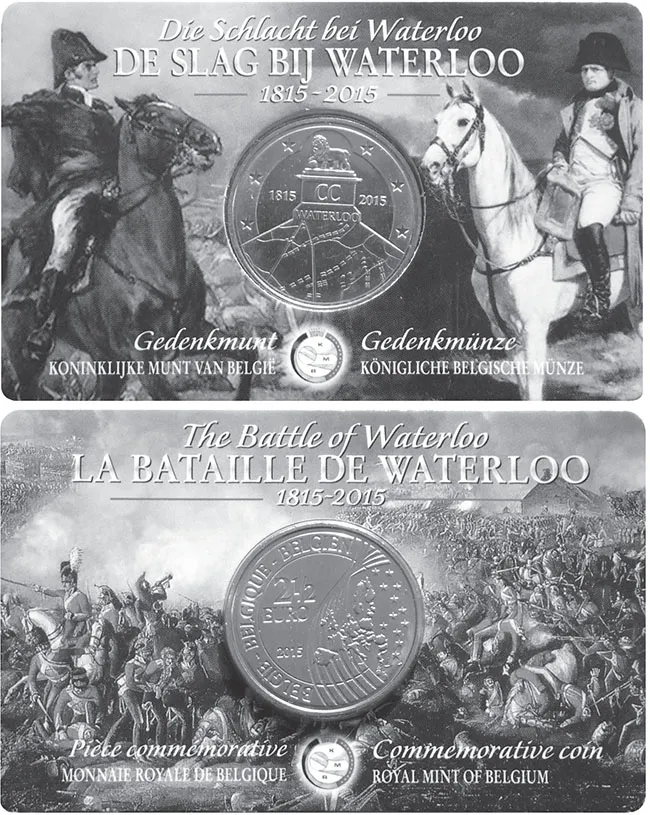
Figure 1.1 Belgian €2.5 coin issued to commemorate the 200th anniversary of the battle of Waterloo, in which a British and German coalition defeated the armies of Napoleon. The reverse of the coin shows the monument erected at the battlefield and the field itself, with dotted lines indicating the position of troops.
p.3
Several points raised by the Belgian coin picturing the Waterloo battlefield help us question the relationship between images and violence more generally. At its most basic, what constitutes an image of violence? No overt violence is shown on the coin itself, though the sleeve in which it was sold was more direct, but even the reference of the schematic image is to an extremely violent event. Without the historical knowledge of what Waterloo was, would we interpret this as an image of violence at all? When are we looking at pictures of violence, or pictures about violence, and how can we tell where the boundaries are when we lack specific knowledge?
Another issue raised by the coin is that of authors and audience. One point of concern in revoking the first issue was that viewing the coin would not be voluntary, but would rather be forced on the audience by its circulation. France itself has issued commemorative images of the 200th anniversary of Waterloo, so in this case it was a combination of the author and audience that was toxic: for Belgium to force the French to be confronted with an image that elicited memories of French defeat was more of a problem than the French-controlled commemoration of that defeat. This not only suggests that we need to pay attention to who makes and who sees images referring to violence, but also that we should be alert to restrictions placed on viewership. That states are directly concerned with the ideological import of circulating such images is also clear in this case.
In the case of the coin, it is not the image itself but rather, as already suggested, the relation of that image to a real and historically well-attested event that is effective. The image tells us nothing of the event. If it were not labeled, it is unlikely that any but a select audience of military history enthusiasts would recognize it. The image does not say anything about who won, or even who fought. It works only in a context where its audience has other means of understanding what happened at Waterloo and what that meant. As such, while the image relies on a relationship to an actual event, it does not show a picture of that event or directly communicate through visual means any information about it. How can this help us approach Egypt?
In part because we lack the same kinds of detailed historical records for Egypt that we have for Europe, we generally cannot know if we have an image that refers to violence unless it directly shows it. Nonetheless, many of the questions raised above are relevant to a study of the fairly large number of remaining pictures from Egypt that do directly show violence. The first question raised by the coin, that of “what is an image of violence?” is a good starting point. From Egypt, I have identified two basic types of images that I am confident speak about violence: triumph scenes that either show the king smiting an enemy with a weapon or, in the form of a fantastical beast, trampling him; and battle images, which show troops in combat. These categories are not necessarily intrinsic to the material, and we must recognize that there may have been additional visual references to violence that we now cannot see as such. Furthermore, even though the pictures that we can study as images of violence are overt in their imagery, can we really use them as the basis of an understanding of royal actions, weapons and battlefield organization, friends and foes, specific campaigns, and booty? Or are their references as oblique as the battlefield image on the €2.5 coin? The temptation to read Egyptian imagery of violence as a direct report on the practice of violence has been strong in scholarship, for the understandable reason that if these pictures do not answer questions about historical violence, we have very little evidence to answer them at all.2
p.4
An argument against giving in to this temptation of expecting violent imagery to communicate clearly and directly about war and the practice of violence can be advanced on two fronts. This whole book will offer a sustained discussion of specificity and what we might call reliability, and will show time and again that there are internal details of the images, either present or deliberately left out, that make reading them as 1:1 reports on actual events impossible. This does not make them entirely divorced from history, as we will repeatedly see, only unreliable guides. But beyond this, even if real events were pictured, though perhaps not with total accuracy, an attempt to understand them primarily as historical documents misses an essential point. The act of picturing violence is necessarily an act of recasting that violence, of making it tell a story that fits a bigger narrative, one that is ideologically driven rather than true to history—even if we were to assume something so simplistic as the existence of a history. The €2.5 coin—with its de-peopled imagery and surrounding political kerfuffle—demonstrates one way in which an image could be caught up in conflicting ways to remember and interpret a war, but a further example serves to demonstrate that issues of reinterpretation, context, audience, and reference to reality are present even with pictures that more realistically and directly present acts of violence.
In the 1880s, there was a craze in America (and elsewhere) for cycloramas showing various battles of the American Civil War. These enormous panoramic canvases were painted on the basis of photographs, displayed in cylindrical halls built for the purpose of making an audience feel immersed in the experience of the battlefield, and augmented by the presence of artifacts—even dummies of dead soldiers—carefully arranged before the canvas. They were the nineteenth-century precursor to IMAX. No “realer” art of war has ever existed. Yet, as Yoni Appelbaum has written,
[Their] stunning rendition of a battle utterly divorced from context appealed to a nation as eager to remember the valor of those who fought as it was to forget the purpose of their fight. [Their] version of the conflict proved so alluring, in fact, that it changed the way America remembered the Civil War.3
Only 20 years after it had been fought, with Reconstruction a demonstrable disaster, many Americans wanted to remember a different war than had happened. They wanted it to have been a shared national traumatic birth in which the valor and bravery of both sides shone—not the moral opposition it was largely understood to be at the time. With an exodus of black Americans leaving the still-repressive south, the role of slavery in the war was actively erased. The memory of the war was simplified and cleansed and images of Pickett’s Charge at Gettysburg could be refashioned into a moment—a single moment to represent a bloody four years!—of valor and courage that failed, but in failing birthed a new era for the prosperous emergence of America on the world stage. The most visually realistic imagery could be employed to tell a story different from the one understood by the protagonists at the time. Pickett hated that his name was attached to the charge, about which there had been serious disagreement among the Confederate generals.4 Meade and Lee did not do battle to give rise to rampant industrialized capitalism. But the context and audience for the display of this image, much more even than what it particularly depicted, drove home the new message.
p.5
The coin and the cyclorama together illustrate the starting point behind this study: committing violence and making pictures of it are fundamentally different tactics of power, regardless of the “realism” of the image. Both can be used as means of control. They can be exercised at vastly different times, and by very different people, to widely different ends. Even when exercised by the same people at the same time, they function differently and produce different outcomes. Pictures, even realistic ones, are so prone to manipulation and are so context-dependent in their meaning that they must be approached in their own light rather than as direct evidence of the practice of violence. Pictures can show violence differently than it happened. Pictures can show violence that never happened. Violence that did happen is also certainly not always turned into a picture. As such, studying the images left to us from Egypt allows us to better understand one tactic of pharaonic power: that of imaging it. These images do not give us reliable insight into the practice of violence itself any more than the coin tells us about Waterloo or the cyclorama lets us understand Gettysburg. This is first surprising, then disappointing. But, once accepted, it frees us to consider the images and their power on their own.
The structure of this book
I have gathered and present here all extant images of violence from Egypt that I know of dating prior to the New Kingdom. One goal of this book is that it be a sourcebook for anyone else who wishes to address how and why Egyptians visualized violence, and this is the reason I have striven both to include as much evidence as I know to exist and to illustrate as much of it as I could. The inclusion of images themselves is critical to allowing the reader to accept or challenge my own observations of each piece and the interpretations I suggest. Dimensions given are those published. Every piece for which I could obtain permission to publish is illustrated, and all, including the few I was not able to illustrate, are described.
Because my goal is not to illuminate historical events but rather to examine how pictures of violence in Egypt communicated what to whom, I have chosen to organize this material primarily by context. It has become clear to me that the same image could work differently in different places—that the king smiting an Asiatic on the walls of his tomb does something else than the same picture on a rock face in the Sinai. Context and audience were deeply entwined and often heavily regulated in ancient Egypt. “Where,” or perhaps more precisely “on what,” was thus the guiding principle followed in organizing this book.
p.6
The material of pharaonic date is divided into contextual chapters, addressing the royal tomb; divine temples; the landscape; portable objects; and private tombs. The chapters are of wildly uneven length because these contexts are represented by vastly different amounts of material. The kings of the first half of Egyptian history spent much more time and effort on decorating their tombs with violence than anywhere else. The variety as well as the number of violent pictures from royal tombs is overwhelming even in its very fragmentary current state.
That a contextual organization makes sense can be seen from a simple chart, such as the chronological table in the front matter. Trends of scene type by context are very consistent and support the argument that the relationship between image and context was meaningful and controlled. For instance, battle scenes are known only from tombs, both royal and private. Smiting scenes are found in all contexts except private tombs. Smiting is the only scene type found in the landscape., etc.
While I thus thought the Dynastic material would be best organized contextually, the issue of the origin of violent imagery is not easy to treat in the same way. This is in part because the types of contexts on which we have violent imagery—the contexts arguably more than the images themselves—changed fundamentally both during the period of state formation in the late fourth millennium and between that period and the Old Kingdom. Consequently, the first two chapters of the book are organized chronologically and present the early occu...
Table of contents
- Cover Page
- Violence and Power in Ancient Egypt
- Routledge Studies in Egyptology
- Title
- Copyright
- Dedication
- Contents
- List of Figures
- Acknowledgments
- The Chronology and Contexts of Scenes of Violence from Egypt through the Middle Kingdom
- 1 Picturing Violence
- 2 The Origins of Violent Imagery
- 3 The Violence Inherent in the System: Imagery and Royal Ideology in the Period of State Formation
- 4 To Live Forever: The Decoration of Royal Mortuary Complexes
- 5 Uniter of the Two Lands: Images of Violence in Divine Temples
- 6 The Preservation of Order: Images in the Landscape
- 7 Out and About: Images of Violence on Portable Objects
- 8 Who is Who? Private Monumental Images of War
- 9 Violence, Power, Ideology
- Bibliography
- Index
Trusted by 375,005 students
Access to over 1.5 million titles for a fair monthly price.
Study more efficiently using our study tools.
Frequently asked questions
Yes, you can cancel anytime from the Subscription tab in your account settings on the Perlego website. Your subscription will stay active until the end of your current billing period. Learn how to cancel your subscription
No, books cannot be downloaded as external files, such as PDFs, for use outside of Perlego. However, you can download books within the Perlego app for offline reading on mobile or tablet. Learn how to download books offline
Perlego offers two plans: Essential and Complete
- Essential is ideal for learners and professionals who enjoy exploring a wide range of subjects. Access the Essential Library with 800,000+ trusted titles and best-sellers across business, personal growth, and the humanities. Includes unlimited reading time and Standard Read Aloud voice.
- Complete: Perfect for advanced learners and researchers needing full, unrestricted access. Unlock 1.5M+ books across hundreds of subjects, including academic and specialized titles. The Complete Plan also includes advanced features like Premium Read Aloud and Research Assistant.
We are an online textbook subscription service, where you can get access to an entire online library for less than the price of a single book per month. With over 1.5 million books across 990+ topics, we’ve got you covered! Learn about our mission
Look out for the read-aloud symbol on your next book to see if you can listen to it. The read-aloud tool reads text aloud for you, highlighting the text as it is being read. You can pause it, speed it up and slow it down. Learn more about Read Aloud
Yes! You can use the Perlego app on both iOS and Android devices to read anytime, anywhere — even offline. Perfect for commutes or when you’re on the go.
Please note we cannot support devices running on iOS 13 and Android 7 or earlier. Learn more about using the app
Please note we cannot support devices running on iOS 13 and Android 7 or earlier. Learn more about using the app
Yes, you can access Violence and Power in Ancient Egypt by Laurel Bestock in PDF and/or ePUB format, as well as other popular books in Social Sciences & Archaeology. We have over 1.5 million books available in our catalogue for you to explore.