Originally published in 1984, Urbanization in Israel describes the urban geography of Israel, and analyses the development of urban settlements from the beginning of the 21st century. The book places special emphasis on the period since Israeli statehood and describes urbanization from a geographic, historic and planning point of view. Using a series of examples to demonstrate the process, the book looks at Jerusalem, Tel Aviv and Haifa, the old historic towns, the agricultural settlements which became towns, and the new development towns which have been established after 1948. This book will appeal to academics of geography with a focus on the development of the Middle East.
- 236 pages
- English
- ePUB (mobile friendly)
- Available on iOS & Android
eBook - ePub
Urbanization in Israel
Chapter One
THE DEVELOPMENT AND DISTRIBUTION OF TOWNS IN THE LAND OF ISRAEL
The existence of towns in the Middle East long precedes their establishment in Europe. The world’s most ancient town is assumed to be Jericho, founded 6000 years before Christ.
During the following Millenia towns appeared throughout the region, particularly along the Fertile Crescent - the fertile and temperate zone that stretched from Mesopotamia to Egypt. By the Greek and Roman periods, the development of towns extended to Europe as well. Such towns were usually garrison towns, offering protection behind their walls, particularly during time of war, to the resident and local surrounding population and functioning as hubs for marketing and trade. Royalty and those that directly served it, generally resided in the towns. Economically their populations were engaged primarily in subsistence agriculture; they lacked the high degree of occupational specialization and economic interdependence so characteristic of modern urbanization. These attributes began to appear in the Middle East, with the Moslem era in the 7th century, with the establishment of the renown cities of Baghdad, Cairo, Damascus and Constantinople - all of which are to this day - and, in Europe, during the Crusador period beginning in the 12th century. With the exception of those cities just mentioned above, other Middle Eastern towns, despite their early origins, did not achieve the size or diversity of many eventually later established in Europe. Still they were of particular importance in the region, owing to their status as centers of administrative, economic and social activity.
THE HISTORY OF TOWN DEVELOPMENT AND DISTRIBUTION IN THE LAND OF ISRAEL
Israel is unique in that it contains both very ancient and new towns. Some, such as Jerusalem and Nazareth, have existed since before the common era; others were founded as little as twenty years ago. The establishment and existence of urban settlements throughout various locations and historic periods have been strongly interrelated with the natural, political and economic events of the country. Through the centuries, towns experienced alternating periods of prosperity and depression. They flourished when conditions in the country were peaceful and settled, and declined during periods of war, invasion and incursions of nomadic desert tribes.
Until the 20th century, in general, the towns of Israel remained small. They did not have sufficient economic base or agricultural hinterland for intensive growth and development. Their economies relied mainly on trade and commerce, serving as market towns for nearby farming villages and as trading points along caravan and shipping routes. Due to Israel’s position within the center of the Fertile Crescent, already in ancient times, the country served as a passageway for various nomadic peoples wandering from region to region through the land. Major travel routes developed including the Via Maris (1) and the Mountainous Route (2), along which travellers and goods-laden caravans crossed the country, enroute to Europe, Africa and elsewhere. Most towns existed along such routes, where they could profit from trade with travelling merchants and peddlers and through the provision of hostelries and supplies.
Over the centuries, whenever the country’s population felt threatened, they tended to concentrate in the towns, which offered greater security. The depredation of desert nomads and sea robbers induced many people to move to towns or large villages. Populations in the areas of towns such as Hebron, Beer Sheva and Gaza, were particularly vulnerable to nomadic attack, due to their location within the zone separating the cultivatable areas of the country from the barren arid and semi-arid regions of the south and east. With the encroachment of the desert varying according to the yearly rainfall - further north during years of low rainfall, receding southward in seasons of greater precipitation - the border zone was an area of frequent tension between the local agricultural settlements and the desert nomads, who drove their flocks into the zone during times of low rainfall and did not hesitate to take from the crops and property of the villagers.
Due to the constant struggle for power among nations of the Middle East, war was a common phenomenon. On numerous occasions, Israel became a battleground, as a result of internal conflict, enemy attack, or the meeting of foreign armies within its borders. Even the largest towns were not immune to the plunderings of powerful armies, marching along the major roads. Towns on the flat coastal plain were more easily destroyed as they were prone to attack from both land and sea, and lacked material barriors of protection. Hill towns had greater defensibility as the material surroundings could be used to advantage; building towns on hilltops assured enemies of an ascenting attack, and there was always a plentiful supply of stone building materials. For these reasons, in periods of danger and insecurity, hill towns were favored while coastal towns declined.
To maintain control of the land, once gained, ruling governments generally erected fortresses and fortified cities along important routes. Ramparts and center walls reflected the protective, primary function of the early towns. By Roman times, the country abounded in such urban settlements, but most subsequently suffered destruction. Roman rule was followed by that of the Byzantines, whose civilization during the 5th and 6th centuries CE was also of a predominantly urban character; many churches and other buildings date to this period. By the decline of the Islamic Empire beginning in the 8th century, however, the Arabs were still in the process of transition from a nomadic to a settled way of life: they were not attracted to an urban environment and founded mainly villages. The Crusaders enlarged and fortified a number of towns during the time of their conquests in the 12th century, and left behind many fortresses and churches, the ruins of which scatter the country to this day. They were followed by Mamelukes and Turks, who showed little interest either in the towns or the development of the country’s economy.
The distribution of urban settlement in the Land of Israel, through the time of Turkish rule, was generally characterized by three longitudinal axes, with a chain of towns in the coastal plain, another along the mountain watershed and in the Jordan Valley, and one chain in the northern part of the Negev. A number of distinguishable geographical phenomena of town distribution in Israel during this time are discussed as follows: (Figure 1.1)
1.Most of the ancient towns whether located on the coast, mountains, or in the valleys remained situated on their historical sites and through to the 19th century, did not expand beyond their original boundaries; thus urban sprawl, near or on their peripheral areas, did not occur. For example, Gaza, Jaffa and Acre on the coastal plain and Hebron, Jerusalem and Nazareth in the mountains, remained within their original boundaries throughout their history, during periods of growth and prosperity as well as in times of adversity and depression.
2.Almost all of the towns were located on primary travel routes. The mountain towns were established on both sides of the Mountainous Route. Most coastal towns developed where geographical conditions fostered the building of small harbours; these towns served as ports for maritime transportation and nodes for the distribution of, to and from the interior of the country. Other coastal towns were located along the historical Via Maris. The distance between one town and the next along either the coast or mountains demonstrates the towns strong relationship to their travel routes. It is apparent that the distance between coastal harbour towns resulted from the possibility of being able to travel from one town to the next within a single day. This relationship applies to the primary harbours of Gaza, Jaffa, and Acre, and others to the north and south beyond the borders of Israel, and also to the secondary, smaller harbours of Ashqelon Ashdod-Yam, Rishpon, Caesarea, Dor, Atlit and Shiqmona, the intervals reflect distances negotiable within a day by various types of sailing vessels. Even the distance between the towns of Beer Sheva, Hebron, Jerusalem, Ramallah, Nablus and Jenin are surprisingly more or less equidistant, spaced at 20–25 miles (32–40 km.) intervals readily traversed by caravans or pedestrians in one day.
3.Towns have also been established on sites which have some historic or religious importance. The location of Nazareth, for example, is connected with the life of Jesus, and Safed, because of its association with the Kabbalists (3), because a holy city to the Jews, and Bethlehem, where Jesus was born, became a holy city for Christianity.
Figure 1.1:Towns in the Land of Israel (1947)
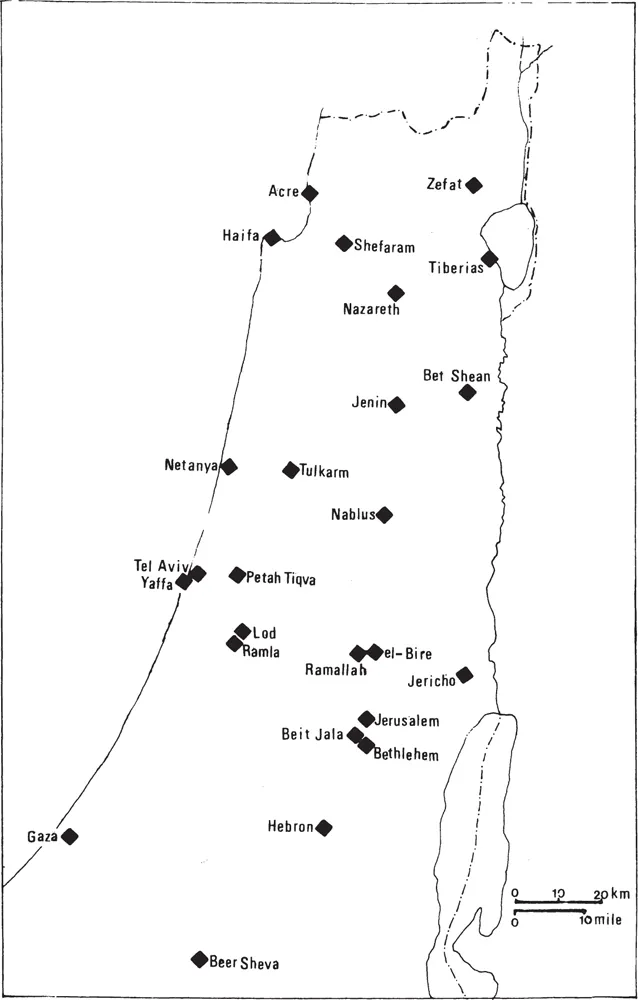
Various special factors have led to other towns’ locations: Jericho was developed on an oasis; Bet Shean and Tiberias were established as transition points between the Jordan Valley and the Jezreel Valley. Not all of the ancient towns of Israel retained their original functions. Most became smaller and many just disappeared, including Yavne-Yam, Caesarea, Dor and Shiqmona of which only archeological remnants remain.
During Turkish rule of the Land of Israel, the economic neglect and insecurity in the country maintained support for towns in the hill regions while the coastal towns declined. Along the coast, Gaza, Jaffa and Acre functioned primarily as small port towns and gateways to the inland settlements including the towns of Jerusalem, Hebron, Nablus and Safed all found on the country’s central mountain axis. By the late 19th century, the weakness of the Ottoman Empire, meaning the end of its 400 year reign, was reflected by political, economic and military instability. At the same time, however, the first Zionist pioneers were enterin the country. Settlement activities were beginning, among all sectors of the country’s population, that produced significant changes in the distribution and pattern of urban settlement in Israel. The extent of this growth is indicated in Table 1.1.
Table 1.1: Urban Development 1875–1982

PRE-STATE URBAN DEVELOPMENT
In the years prior to World War I many of the Jewish immigrants settled in existing towns, particularly Jaffa. Others founded rural settlements - including the first Moshavot (Jewish agricultural villages), many of which urbanized in later years. In 1909, Tel Aviv was founded as a suburb of Jaffa (it was granted local authority in 1921). In Judea and Samaria, Tulkam, El-Bire and Beit Jala received town status from the Turkish authorities as did Bet Shean in the Jordan Valley.
World War I brought an end to the Ottoman Empire, and British Mandate period began. Significant British development activity occurred including the establishment of Haifa as a major port and industrial site. With the improved security of British rule the years 1923 and 1931 saw a substantial growth in coastal urbanization. New urban centers were added, especially in the vicinity of Tel Aviv, including Ramat Gan, Bene Berag, Bat Yam, Givatayim, Herzliyya and slightly to the north, Netanya.
Between 1931 and 1947, which marked the end of the British Mandate, the coastal plain became quite developed. Urbanization of Moshavot began. Tel Aviv became a flourishing town, no longer dependent of Jaffa, and received municipal status in 1934. Nahariyya and Holon were added to the list of new urban communities. By the end of the Mandate period, the number of towns in the coastal plain was 22, in contrast to 12 in the mountainous regions, with the coast continuing to hold the greater potential for further urban growth. (Table 1.1)
BRITISH URBAN DEVELOPMENT ACTIVITY
During the Mandate period, the British objectives were not to improve the spatial distribution of towns in the country; what was done was no more than the selective development of existing urban infrastructures and the advancement of particular settlements according to the security, strategic and economic interests of the Mandate authorities. In their limited activities, however, they brought a European standard of planning skills and an awareness of urban issues.
Among their activities, the British were interested in developing Haifa as a large harbour in the eastern part of the Mediterranean and therefore encouraged investments in the building of a harbour, in its installations, and in reclaiming land for an industrial zone near the harbour. They were also interested in developing administration and services in Jerusalem and expressed this objective by building public institutions and residential neighbourhoods for British personnel. Other towns of interest to them were: Beer Sheva as the capital of the Negev, Jaffa as the second harbour in the country, and Gaza as the southern-most harbour along the coastal plain. Administrative and security objectives also gave impetus to settlements such as Ramla and Lod as transportation nodes, Lod for its airport and railway operation center, Ramla as the hub of interurban bus service, and Nahariyya and Netanya as recreational centers.
URBAN DEVELOPMENT DURING STATEHOOD
Since the establishment of the State of Israel in 1948, there has been a distinct change in the pace of urbanization in the country. The early decades of the State have seen the rapid development of new towns in every region. This has occurred despite that, at the inception of the State there was no policy within the new government as to an approach for urban development. During the pre-State era, the emphasis of the Zionist settlement organizations had been directed almost entirely toward agricultural rural settlements. The needs of the State, however, posed the necessity for a comprehensive approach to settlement in Israel, with particular focus on urbanization. The primary factors that forced this re-evaluation and change of policy were:
1.The mass immigration that occurred in the years immediately following statehood, resulting in a pressing housing shortage which only urban settlement could solve;
2.the desire to create a series of medium-sized towns, dispersed throughout the country to function in an intermediary capacity between the large cities and small agricultural villages; and
3.the need to populate underpopulated areas, particularly along the border, as a means of securing the State’s territory.
The recognition of urban settlement as a solution for Israel’s rapidly populating regions did not immediately lead to the establishment of new towns; instead, population was added first to those already in existence, including Lod, Ramla, Bet Shean and Beer Sheva. As they reached the point of saturation, immigrants were directed to Maabarot (4) erected alongside veteran Moshavot. Some of the Maabarot were later dismantled as immigrants were transferred to...
Table of contents
- Cover
- Half Title
- Title Page
- Copyright Page
- Table of Contents
- List of Figures
- List of Tables
- Introduction
- 1. The Development and Distribution of Towns in the Land of Israel
- 2. Urbanization in the Land of Israel During the Pre-State Period of Zionist Settlement
- 3. Social and Demographic Factors of the Immigrant Role in Israel’s Urbanization
- 4. Jerusalem - The Capital of Israel
- 5. Tel Aviv and the Conurbation
- 6. Haifa - The Harbour, Town and Suburbs
- 7. Old Towns
- 8. Moshavah - Towns
- 9. Beer Sheva: A Town on the Fringe of the Desert
- 10. The New Towns
- 11. Ashdod
- 12. Elat - A Gate to the South
- 13. Arad - A New Town in the Desert
- 14. Towns in Judea and Samaria
- 15. Changes in the Urban Settlement Pattern of the Gaza Strip
- 16. Town Planning in the Land of Israel
- Selected Bibliography
- Index
Trusted by 375,005 students
Access to over 1.5 million titles for a fair monthly price.
Study more efficiently using our study tools.
Frequently asked questions
Yes, you can cancel anytime from the Subscription tab in your account settings on the Perlego website. Your subscription will stay active until the end of your current billing period. Learn how to cancel your subscription
No, books cannot be downloaded as external files, such as PDFs, for use outside of Perlego. However, you can download books within the Perlego app for offline reading on mobile or tablet. Learn how to download books offline
Perlego offers two plans: Essential and Complete
- Essential is ideal for learners and professionals who enjoy exploring a wide range of subjects. Access the Essential Library with 800,000+ trusted titles and best-sellers across business, personal growth, and the humanities. Includes unlimited reading time and Standard Read Aloud voice.
- Complete: Perfect for advanced learners and researchers needing full, unrestricted access. Unlock 1.5M+ books across hundreds of subjects, including academic and specialized titles. The Complete Plan also includes advanced features like Premium Read Aloud and Research Assistant.
We are an online textbook subscription service, where you can get access to an entire online library for less than the price of a single book per month. With over 1.5 million books across 990+ topics, we’ve got you covered! Learn about our mission
Look out for the read-aloud symbol on your next book to see if you can listen to it. The read-aloud tool reads text aloud for you, highlighting the text as it is being read. You can pause it, speed it up and slow it down. Learn more about Read Aloud
Yes! You can use the Perlego app on both iOS and Android devices to read anytime, anywhere — even offline. Perfect for commutes or when you’re on the go.
Please note we cannot support devices running on iOS 13 and Android 7 or earlier. Learn more about using the app
Please note we cannot support devices running on iOS 13 and Android 7 or earlier. Learn more about using the app
Yes, you can access Urbanization in Israel by Elisha Efrat in PDF and/or ePUB format, as well as other popular books in Physical Sciences & Geography. We have over 1.5 million books available in our catalogue for you to explore.