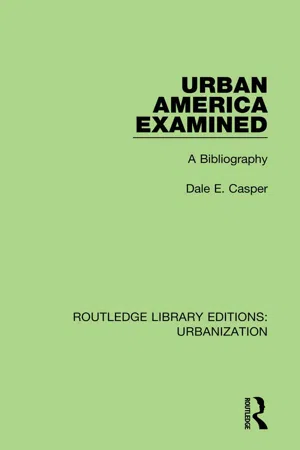
Originally published in 1985 Urban America Examined, is a comprehensive bibliography examining the urban environment of the United States. The book is split into sections corresponding to the four main geographic regions of the country, looking respectively at research conducted in the East, South, Midwest and West. The book provides a broad cross section of sources, from books to periodicals and covers a range of interdisciplinary issues such as social theory, urbanization, the growth of the city, ethnicity, socialism and US politics.
- 220 pages
- English
- ePUB (mobile friendly)
- Available on iOS & Android
eBook - ePub
GEOGRAPHIC QUINTET
Urbanization in the United States has been a twentieth-century phenomenon. Since 1940, however, the central feature of American urban growth has been visible in a migration of population away from the northern industrial centers of the nation toward the so-called sunbelt cities. This population shift has been detailed in The New Urban America: Growth and Politics in Sunbelt Cities (1981) by Carl Abbott. Abbott examined sunbelt area population growth, metropolitan expansion, rise in per capita income, and employment statistics. From this examination, Abbott concluded that there were two distinct sunbelt growth regions: one comprised of seven states located in the southeast, including Delaware, Maryland, and Virginia, the other made up of ten states and containing Washington, Oregon, Utah, and Colorado which are not always listed as sunbelt members.
Abbott’s primary focus, however, was on the patterns of urban-suburban growth in the sunbelt as they affected urban and suburban politics. He stressed that the mobilization of United States resources to fight World War II was a critical factor in promoting the original growth patterns in the sunbelt cities. Population migration from the north to the sunbelt followed the awarding of federal government defense contracts to southern and southwestern locations. According to Abbott, this population shift toward the sunbelt was accelerated after 1945 because of the region’s steady economic growth due to the location of defense and high technology industries in the sunbelt as well as the creation of activities associated with tourism, recreation, and retirement living which attracted northern population groups southward. The work is an important attempt to define and clarify recent conclusions reached from census data that the American urban populace is located increasingly in the south and southwest regions of the nation.An earlier but less influential work,The Rise of the Sunbelt Cities (1974) by David C. Perry and Alfred J. Watkins, attempted to outline the same phenomenon. Abbott’s work has been followed by Raymond A. Mohl’s Sunbelt Cities: Politics and Growth Since World War II (1982). These three works form the significant research efforts conducted to date into the urban environment of the southern and southwestern regions of the United States.
In the East, the work of Theodore Hershberg,Philadelphia: Work, Space, Family and Group Experience in the Nineteenth Century (1981) is the major study so far of the urbanization process. Hershberg’s study of Philadelphia is based on census data and concentrates on the years 1850 to 1880. Three important elements are emphasized in this study: environment, behavior, and group experience. The interrelationship between these elements explains, according to Hershberg, the uniqueness of American urban life. The Divided Metropolis: Social and Spatial Dimensions of Philadelphia, 1800–1975 (1980) by William Cutler II and Howard Gillette, Jr., addresses key questions of urban policy in Philadelphia. Regional consideration of urban growth in the East is examined in The Boston Region, 1810–1850: A Study in Urbanization (1980) by Francis Blouin. Though less academic than the previous studies, several brief research booklets have been published by the Brooklyn Educational and Cultural Alliance: The Shaping of a City: A Brief History of Brooklyn (1979) by David Ment and Building Blocks of Brooklyn:A Study of Urban Growth by David Ment and David Framberger. These publications provide starting points for further research into the various boroughs of New York City.
Midwest cities have received considerable attention from urban researchers. Milwaukee, St. Louis, and Chicago are all frequent subjects of general and specific research on urban concerns. Recently urban researchers have also examined less important urban areas of the Midwest. Robert G. Barrows provided an excellent mobility study of Indianapolis, “Hurryin’ Hoosiers and the American Pattern: Geographic Mobility in Indianapolis and Urban North America” (Social Science History 5, 2 (1981): 197–222). Zane Miller’s Suburb: Neighborhood and Community in Forest Park, Ohio 1935–1976 (1981) details the growth of a middle-class suburb and concludes with the viewpoint that Forest Park’s development was similar to countless other cities which sprang up in the Midwest after the Second World War. Miller’s opinions are confirmed in Frederick Steiner’s The Politics of New Town Planning: The Newfields,Ohio Story (1981).
The five following chapters list books and journal articles which have been published during the last ten years and represent research conducted into the urban environment of the United States in general and specifically of the geographic divisions of the nation: East, South, Midwest, and West.
UNITED STATES (GENERAL)
1. Abrahamson, M., and M. DuBick. “National Dominance and Urban Exploitation.” Urban Affairs Quarterly 15, 2 (1979): 146–163.
2. “Accommodating Diversity: Civic Leadership in Transition.” National Civic Review 68, 11 (1979): 583–599.
3. Ahlgren, D. “Architectural Drawings: Sources for Urban History.” Urban History Review 11, 3 (1983): 67–72.
4. Allen, W.R. “Class, Culture, and Family Organization: The Effects of Class and Race on Family Structure in Urban America.” Journal of Comparative Family Studies 10, 3 (1979): 301–314.
5. Anderson, J., et al.Redundant Spaces in Cities and Regions? Studies in Industrial Decline and Social Change. New York: Academic Press, 1983.
6. Angle, J. “The Ecology of Language Maintenance: Data from Nine U.S. Metropolitan Areas.” Urban Affairs Quarterly 17, 2 (1981): 219–232.
7. Angotti, T. “The Planning of the Open Air Museum and Teaching Urban History.” Museum 34, 3 (1982): 179–188.
8. Appelbaum, R.P. Size, Growth, and U.S. Cities. New York: Praeger, 1978.
9. Arnold, J.L. “Suburban Growth and Municipal Annexation,1745–1918.” Maryland Historical Magazine 73, 2 (1978): 109–128.
10. Ashford, D.E. National Resources and Urban Policy. New York: Methuen, 1980.
11. Atlas, J., and P. Dreier. “The Housing Crisis and the Tenants Revolt.” Social Policy 10, 4 (1980):...
Table of contents
- Cover
- Half Title
- Title Page
- Copyright Page
- Table of Contents
- Preface
- Introduction to the Literature of Urban Studies: Highlights, Trends, and Directions
- Guide to Use of This Book
- Abstracts and Indexes
- Periodicals
- Geographic Quintet
- An Ambience of Ethnicity
- “Sewer” Socialism
- All God’s People in the City
- Politics as Usual
- Schooling the City
- Moving Goods and People
- Geographic Index
- Topical Index
Trusted by 375,005 students
Access to over 1.5 million titles for a fair monthly price.
Study more efficiently using our study tools.
Frequently asked questions
Yes, you can cancel anytime from the Subscription tab in your account settings on the Perlego website. Your subscription will stay active until the end of your current billing period. Learn how to cancel your subscription
No, books cannot be downloaded as external files, such as PDFs, for use outside of Perlego. However, you can download books within the Perlego app for offline reading on mobile or tablet. Learn how to download books offline
Perlego offers two plans: Essential and Complete
- Essential is ideal for learners and professionals who enjoy exploring a wide range of subjects. Access the Essential Library with 800,000+ trusted titles and best-sellers across business, personal growth, and the humanities. Includes unlimited reading time and Standard Read Aloud voice.
- Complete: Perfect for advanced learners and researchers needing full, unrestricted access. Unlock 1.5M+ books across hundreds of subjects, including academic and specialized titles. The Complete Plan also includes advanced features like Premium Read Aloud and Research Assistant.
We are an online textbook subscription service, where you can get access to an entire online library for less than the price of a single book per month. With over 1.5 million books across 990+ topics, we’ve got you covered! Learn about our mission
Look out for the read-aloud symbol on your next book to see if you can listen to it. The read-aloud tool reads text aloud for you, highlighting the text as it is being read. You can pause it, speed it up and slow it down. Learn more about Read Aloud
Yes! You can use the Perlego app on both iOS and Android devices to read anytime, anywhere — even offline. Perfect for commutes or when you’re on the go.
Please note we cannot support devices running on iOS 13 and Android 7 or earlier. Learn more about using the app
Please note we cannot support devices running on iOS 13 and Android 7 or earlier. Learn more about using the app
Yes, you can access Urban America Examined by Dale Casper in PDF and/or ePUB format, as well as other popular books in Physical Sciences & Geography. We have over 1.5 million books available in our catalogue for you to explore.