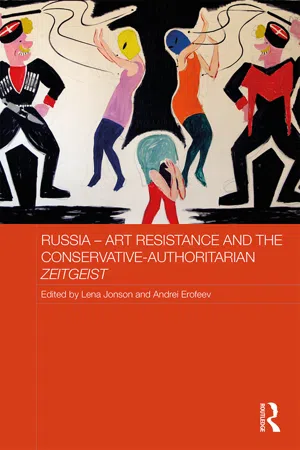
This book explores how artistic strategies of resistance have survived under the conservative-authoritarian regime which has been in place in Russia since 2012. It discusses the conditions under which artists work as the state spells out a new state cultural policy, aesthetics change and the state attempts to define what constitutes good taste. It examines the approaches artists are adopting to resist state oppression and to question the present system and attitudes to art. The book addresses a wide range of issues related to these themes, considers the work of individual artists and includes besides its focus on the visual arts also some discussion of contemporary theatre. The book is interdisciplinary: its authors include artists, art historians, theatre critics, historians, linguists, sociologists and political scientists from Russia, Europe and the United States.
eBook - ePub
Russia - Art Resistance and the Conservative-Authoritarian Zeitgeist
- 328 pages
- English
- ePUB (mobile friendly)
- Available on iOS & Android
eBook - ePub
Russia - Art Resistance and the Conservative-Authoritarian Zeitgeist
About this book
Information
1Introduction
Lena Jonson
What happens to culture and the arts when domestic policy makes a drastic turn and the social atmosphere becomes highly ideologized? How do artists react when the margins for the freedom of political debate and cultural expression become narrower and the pressure increases on culture and the arts to conform? What strategies of resistance might be adopted in art? These questions are discussed below using the case of Russia’s development since May 2012, when Vladimir Putin returned as president bringing with him a political and ideological agenda of conservatism from an authoritarian tradition – an agenda that became even more pronounced in 2014 after the Russian annexation of Crimea.
Concerns about what will happen to culture and the arts in this new situation are reflected on in the interviews with Russian contemporary artists in the present book. The artists differ with each other in their reflections and views but share concerns about what happens when new collective myths get a grip and throw society back into the past. What happens to the critical eye of art when censorship and repression return? What happens when people are divided into ‘friends’ and ‘enemies’ in society? How can art tackle a situation in which public life feels like a façade, fake and inauthentic? And how should radical artists react when the authorities copy their methods – playing with shock, provocation, scandal and aggression staged in theatrically performed actions – as they did in the annexation of Crimea and the war in Ukraine? The artists reflect on how to devise survival strategies and develop artistic strategies under the new political conditions, where an ideological hegemony covers society like a wet blanket.
The purpose of this book is to discuss some of the artistic strategies of resistance that have been adopted under the conditions of the new official paradigm of neo-conservative authoritarian thought in Russia since 2012. Counterstrategies of the most diverse kind are discussed – from subtle criticism to direct and open dispute. Jacques Rancière’s concept of dissensus, in the sense of a questioning of the hegemonic consensus, will be a helpful guide.
In order to discuss artistic strategies of resistance, we need first to present the political context in which they appear and exist. Russia is rapidly changing as the new official ideology penetrates society. In the interviews for this book, the artists call this an imitation of ideology rather than a genuine one. Whichever is the case, policy is now dressed in the clothes of new political-ideological terms and concepts that were not prevalent in the official Russian vocabulary in the first ten years of Putin’s rule. Developments in Russia have been so rapid that most people today find it difficult to recognize and understand what is going on and even harder to understand where it will all end.
The new official Russian conservative-authoritarian paradigm and its penetration of society have parallels in several European countries, although the specific context and underlying factors may vary between countries. These developments are the result of both policy from above and processes from below. In Russia it has taken the form of a general backlash and a reactionary response to the break-up of the Soviet Union, the failed reforms of the 1990s and the cynicism that penetrated social life.
It might be assumed that the new conservative policy and the new zeitgeist that followed on from the backlash would affect the conditions under which artists work. One important development to be expected would be efforts by the state to twist the perspectives and perceptions of people – to ‘capture the interpretation’ – in order to make it correspond with the new, conservative official world view.
This volume therefore starts with the question of how the state tried to take control of the ‘sensory landscape’ – that is, the way in which people perceive and interpret the current order of things – in order to make culture and the arts into instruments for securing, spreading and consolidating the conservative world view.
The major issue discussed in this volume, however, is the artistic strategies adopted in response to the current policy and the dominant loyal zeitgeist. What counterstrategies or strategies of resistance exist in the arts to the official paradigm and its perceptions and conceptions? This volume has no ambition to cover all possible artistic counterstrategies. The purpose instead is to stimulate – through a selection of strategies of resistance – a discussion about the relationship between art and politics, and about art resistance under conditions of a strongly ideological regime, in this case a conservative-authoritarian one. The focus is on contemporary visual art, but chapters on theatre are included to illustrate that parallel processes are also taking place in other fields. In the midst of the second decade of the twenty-first century, it even seemed as if theatre had once again become the forerunner with regard to providing intellectual resistance and that theatre therefore became a major target of political criticism by the regime and its conservative supporters. A chapter on events in Hungary is included to show that the political winds blowing in Russia have their equivalents in other countries. There are also similar trends in Europe as nationalist and conservative-authoritarian parties strengthen their influence. Wherever these parties have come to power, it has had consequences for the cultural scene. Nationalist-conservative parties and regimes usually consider a Kulturkampf to be at the core of their conflict with liberal-oriented opponents; and culture becomes a key arena for a political battle of values.
The conservative-authoritarian policy turn and the dominant zeitgeist
How to characterize the new political conditions in which art has operated since 2012? The term ‘conservative-authoritarian’ is used here to characterize the new paradigm that dominates Russian policy. What does it mean in the Russian context? How did this conservative turn come about? What have been the consequences for cultural life?
Conflicts over art exhibitions and theatre productions in Russia in the 2000s reflected the fact that a conservative and Orthodox religious paradigm was gradually penetrating the authorities’ view of what art is and what art should be permitted to be exhibited in the public sphere. Only in May 2012, however, was this paradigm made the foundation of official policy. The Russian response to the Maidan revolution in Kiev, its annexation of the Crimean Peninsula in the spring of 2014, was to a large extent the consequence of Putin’s new political agenda. The annexation of Crimea and the Russian military involvement in the war in eastern Ukraine contributed in turn to a drastic change in the whole atmosphere of Russian society into a patriotic euphoria and to what Russian sociologists call ‘a conservative reconsolidation around power’ in public opinion (Gudkov 2014). Although this support for the regime can be described as a kind of compensatory pride against a background of the general disillusion felt by ordinary people, it was first and foremost the result of a policy choice at the top and deliberate propaganda to manipulate public opinion.
This brings us to the question of the general atmosphere in the society in which this policy was formulated and implemented. We call this atmosphere the zeitgeist and define it as the ‘spirit of the time’ (die Geistige Situation der Zeit), following Karl Jaspers’ term from his 1931 study, which was translated into English in 1933 as Man in the Modern Age (Jaspers 2010). Speaking in terms of the ‘mental situation of the epoch’, Jaspers understands the zeitgeist as tendencies with regard to ideas about the nature of man and what future mankind is moving towards that influence the way in which the present, past and future are regarded.
On the one hand, the zeitgeist can be regarded as the product of ideas and values that come from below, and this support from below is a necessary precondition for any state policy to be successfully implemented. On the other hand, the zeitgeist may be the product of a state that is trying to build up and consolidate a new hegemonic consensus. To create loyalty to the regime, the regime needs the active assistance of key institutions such as the media, schools and universities, the church, sport and leisure organizations and, of course, cultural institutions.
The conservative turn in Russia found fertile soil in the gap that had emerged between the democratic rhetoric maintained in official discourse in the 1990s and early 2000s and a reality in which reform – twisted and distorted and then interrupted at an early stage – did not bring the expected results. After the Soviet system broke down, the democratic and liberal vision of government at first created euphoria and expectations of a better future. When the government could not deliver, disillusion and despair spread among the population. Ralf Dahrendorf had warned in the early 1990s that the transition from communist societies in Eastern Europe would be a long and thorny path (Dahrendorf 1990). In Russia, brutal reality struck citizens with a feeling that ‘nothing is solid anymore’, and they soon became aware of the gap between official declarations and real life. Cynicism rapidly spread.
It is interesting to compare the situation in Russia with the analysis of German society by the philosopher Peter Sloterdijk. His book Critique of Cynical Reason is based on a study of the Weimar Republic but with reference also to West German society in the 1970s and early 1980s (Sloterdijk 1987). Without in any sense comparing Russian society to German society in a completely different historical epoch, his conclusions are still valuable for gaining a general understanding of what can cause a radical-conservative turn. He argues that a mixture of disillusionment and despair that stemmed from a feeling of emptiness and arbitrary fear gave rise to various reactions in Germany in the late 1910s and 1920s. One result of the awareness of the gap between the official liberal rhetoric at the top and the actual state of things was widespread cynicism. He describes cynicism as ‘one of the categories in which modern unhappy consciousness looks itself in the eye’ (Sloterdijk 1987: 140). Nonetheless, he makes a distinction between a reflective cynicism, which he also calls ‘enlightened false cynicism’, in the sense of being conscious of the real situation but siding with power, the master, the stronger; and kynicism, which instead follows the tradition of an ironic and disrespectful gaze on those in power, from the perspective of the grassroots. We return to this latter perspective below.
In a society where ‘rage at having been deceived’1 spread as it did in the Weimar Republic, anti-democratic thinking became ‘only the tip of the iceberg of social scepticism and private reservations about politics’, and the cynical disposition of society soon developed into manifest aggression (Sloterdijk 1987: 500). In the fluid and insecure state of society, the door was opened to the simplifications offered by political forces of the extreme – in this case the extreme right – to exploit popular frustration. Describing the Weimar Republic, Sloterdijk writes that fraud and expectations of being defrauded became endemic. It was felt as if the untenable and chaotic could emerge from behind any solid illusion. In this state of mind, he writes,
A revolution took place in those deep regions of collective feelings toward life in which the ontology of everyday life was laid out: a dull feeling of the instability of things penetrated into souls, a feeling of lack of substance, of relativity, of accelerated change, and of involuntary floating from transition to transition.
(Sloterdijk 1987: 483)
This feeling of having been deceived resulted in a readiness to turn away from this state of the world, and, he writes, hate was remoulded into acceptance of those politicians who promised the ‘greatest simplifications and the most energetic return to a “substantial” and reliable state of affairs’ (Sloterdijk 1987). Zygmunt Bauman produces a similar analysis of contemporary modern European societies. The feeling of Unsicherheit created from the fluid features of society, according to Bauman, puts people in a state of mind where they are more ready to listen to the alluring tones of authoritarian voices that offer remoulded, partly illusory stability and security (Bauman 1999: 5). To the state of Unsicherheit and cynicism in Russia is added the neo-liberal conditions of a ruthless state capitalism about which many in the Russian intellectual debate now talk.
The cynical state of society paved the way for politicians and a politics that propagate a return to ‘absolute’ values of the nation, state, church and family. However, the understanding of these values is captured by a conservative-authoritarian interpretation. In Russia, Putin received public support in 2012 for such an interpretation of the values of patriotism, religious belief and tradition.
However, this policy response turned out to be as cynical as the cynicism dominating society. ‘My Moscow peers’, writes Peter Pomerantsev of his experiences of Moscow at the end of the first decade of the 2000s, ‘are filled with a sense that they are both cynical and enlightened’ (2015: 86). It is characteristic of the zeitgeist in a cynical society that cynical egos most often adopt the perspective of the strong, of the person in power, and obey the rules of the game without resistance. Support for the Putin regime seems to a large extent to depend on this kind of cynical consideration. Consequently, people became easy victims of the grand visionary illusions of the regime. Opinion research highlighted a widespread lack of trust in society. Young people were fully aware of the corruption, scandals and theft within the state bureaucracy but believed that the only way to secure their own personal wealth was to become part of the power system. A position in the state system was easily the most coveted. According to Lev Gudkov, the head of the Moscow Levada Centre for opinion research,
Therefore success or an orientation towards well-being, to a high standard of living is followed by cynicism: to achieve well-being at any cost, regardless of the means, and this leads of course not only to moralism but also to a decomposition of society.
(Tsvetkova 2016)
The policy response at the top to the cynicism in society is cynical in itself. To those at the top, the Great Inquisitor in Dostoevskii’s The Brothers Karamazov is a role model, according to Sloterdijk. The Great Inquisitor links: ‘a rigorous cynicism of means with an equally rigid moralism of ends’ (Sloterdijk 1987: 192). You use whatever means necessary to achieve the ‘good’ ends. ‘Good and moral ends’ are defined by the master, and, as he pursues his interests, what is good and what is evil may even change place. For the sake of good, any means can be used. Pomerantsev’s book Nothing Is True and Everything Is Possible presents the Western audience with the quintessence of a policy that is covered with moralist arguments but unethical in its results. For many years Vladislav Surkov, first deputy head of the presidential administration and close to Putin, stood out as the major representative of the cynicism of the Putin regime. Thus, authoritarian-conservatism is to a large extent a Janus face of cynicism dressed in moralism and ‘absolute’ values. This cre...
Table of contents
- Cover
- Half Title
- Series Information
- Title Page
- Copyright Page
- Contents
- List of Illustrations
- Notes on Contributors
- Preface
- 1 Introduction
- Part I The conservative zeitgeist and Russian cultural policy
- Part II The state of affairs: Voices from the Russian art scene
- Part III Artistic counterstrategies
- Part IV Theatre: A parallel development
- Index
Trusted by 375,005 students
Access to over 1.5 million titles for a fair monthly price.
Study more efficiently using our study tools.
Frequently asked questions
Yes, you can cancel anytime from the Subscription tab in your account settings on the Perlego website. Your subscription will stay active until the end of your current billing period. Learn how to cancel your subscription
No, books cannot be downloaded as external files, such as PDFs, for use outside of Perlego. However, you can download books within the Perlego app for offline reading on mobile or tablet. Learn how to download books offline
Perlego offers two plans: Essential and Complete
- Essential is ideal for learners and professionals who enjoy exploring a wide range of subjects. Access the Essential Library with 800,000+ trusted titles and best-sellers across business, personal growth, and the humanities. Includes unlimited reading time and Standard Read Aloud voice.
- Complete: Perfect for advanced learners and researchers needing full, unrestricted access. Unlock 1.5M+ books across hundreds of subjects, including academic and specialized titles. The Complete Plan also includes advanced features like Premium Read Aloud and Research Assistant.
We are an online textbook subscription service, where you can get access to an entire online library for less than the price of a single book per month. With over 1.5 million books across 990+ topics, we’ve got you covered! Learn about our mission
Look out for the read-aloud symbol on your next book to see if you can listen to it. The read-aloud tool reads text aloud for you, highlighting the text as it is being read. You can pause it, speed it up and slow it down. Learn more about Read Aloud
Yes! You can use the Perlego app on both iOS and Android devices to read anytime, anywhere — even offline. Perfect for commutes or when you’re on the go.
Please note we cannot support devices running on iOS 13 and Android 7 or earlier. Learn more about using the app
Please note we cannot support devices running on iOS 13 and Android 7 or earlier. Learn more about using the app
Yes, you can access Russia - Art Resistance and the Conservative-Authoritarian Zeitgeist by Lena Jonson, Andrei Erofeev, Lena Jonson,Andrei Erofeev in PDF and/or ePUB format, as well as other popular books in Social Sciences & Ethnic Studies. We have over 1.5 million books available in our catalogue for you to explore.