eBook - ePub
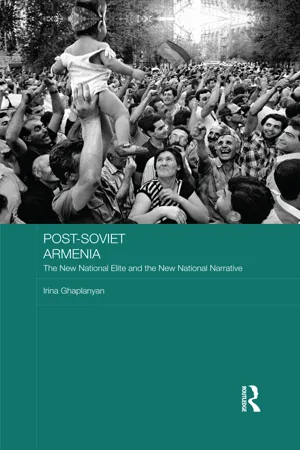
Post-Soviet Armenia
The New National Elite and the New National Narrative
- 268 pages
- English
- ePUB (mobile friendly)
- Available on iOS & Android
eBook - ePub
About this book
Following the collapse of the Soviet Union, Armenia has struggled to establish itself, with a faltering economy, emigration of the intelligentsia and the weakening of civil society. This book explores how a new national elite has emerged and how it has constructed a new national narrative to suit Armenia's new circumstances. The book examines the importance of the Nagorno-Karabakh conflict with Azerbaijan, considers the impact of fraught relations with Turkey and the impact of relations with other neighbouring states including Russia, and discusses the poorly-developed role of the very large Armenian diaspora. Overall, the book provides a key overview to understanding the forces shaping all aspects of present-day Armenia.
Information
1
Introduction
Setting the stage
Tucked away into the volatile depths of peripheral Eurasia, Armenia is often known not because of its small territory or its volatile geopolitics, but because of the Armenian Genocide, the Armenian Diaspora (largely comprised of genocide survivor bloodlines) and the Nagorno-Karabakh (NK) conflict. Genocide was the single most traumatic event of Armenian history, which not only annihilated half of this nation’s population, but also stripped it of its land, cultural heritage and perhaps, more importantly, of its intellectual and cultural leaders – its elite.1 Yet almost a century later the NK conflict became the driving force behind Armenia’s independence, mobilizing nationalists, non-nationalists and local communist elites in defending another historically Armenian piece of land and its inhabitants. Did this nationally mobilizing conflict, combined with the historical periphery of the collapse of the Soviet Union, shape the emergent political leadership in now independent Armenia?
This research is an empirical study of the post-Soviet Armenian emergent political class, their constructed and articulated national narrative and subsequent policies.2 In examining this political class the research focused on who the key political leaders were, how they acquired and sustained power and how they articulated the new national project. In examining the national narrative the study focused on the politically most relevant issues in the articulation and construction of the new nation state: the NK conflict, Armenia’s relations with Turkey, Armenia’s relations with its Diaspora and the geopolitical orientation of the country with its near and far neighbours, referred to as ‘Zero Axes’ in this research.3 This list of issues was generated both as a result of the analysis of interviews and data, as well as drawn and selected from the original research project. In analysing the respective political discourse, the work outlines four inter-connected narrative categories: the narrative of survival or victimhood, security, exceptionalism and nation versus state.
On one hand, the emergent political class and the new national narrative were shaped by exogenous factors – the collapse of the Soviet Union, Armenia’s peripheral geopolitics and the NK war.4 On the other hand, they were shaped by more idiosyncratic endogenous factors such as lack of state and institutional memory, the disconnect between national narrative and policies and the peripheral nature of the Armenian nation. In this study the concept of peripheral nature, often intertwined with the concept of liminality (elaborated further), implies geopolitical periphery, cultural periphery and physical periphery, the latter meaning that the Armenians in the Diaspora numerically far outweigh those living in the state. Externally, Armenia was shaped and reshaped by the transformative events of the end of the Cold War, which were largely unpredictable. This historical period fell into what can be defined as liminal condition, the understanding of which required a reassessment of not only how the global processes were to operate without the counterbalance, but also how power relations were to be defined and constructed anew.
The dissolution of the Soviet Union was arguably the most significant of these transformative events on both global and local scales. The external ‘disorder’ dramatically shaped what was happening in post-Soviet Armenia internally. It was an end to an established order and a beginning of a period of uncertainty, which was marked by elements of both continuity and change. This new period called for the reinterpretation of people’s understanding of social relations and power. It called for a new stage of creating meanings and building institutions. In this liminal reality of sociopolitical transformation, of the dissolution of the old and creation of new meanings and order, the role of the agent became overwhelming. The agent, in this research referred to as Armenia’s emergent political class, had two particularly challenging tasks on the domestic front – to create new institutions and ‘articulate a nation’.5 As this study further discusses, the institutions were mostly given a ‘face-lift’ or remodelled, rather than scrapped and rebuilt anew, whereas the articulation of a new national narrative was overtaken by war and independence-driven nationalism. The creation of ‘new meanings’ pertaining to the construction of the new democratic order, which the Armenian emergent political class espoused to bring about, was conveniently reduced to populism. Arguably, the outbreak of the war hindered a more intellectual and ideological articulation of the new national narrative.
A quarter of a century later, not only Armenia but almost the entire post-Soviet space finds itself stranded in this protracted transformation. The study argues that the primary reasons behind this protractedness were the failure to meet these two tasks: the institutions were largely employed to reproduce the political class, rather than institute democracy, whereas the new discursive content was in disconnect with both the essence as well as the institutional substance of the new political order.
This study outlines, at length, the significance of Armenian geopolitics in shaping the country’s domestic and external narrative and policies. However, the primary argument is that in the post-Soviet reality of collapsed institutional infrastructure the agent, or the emergent Armenian political class played an over-whelming role in not only shaping these policies, but also in articulating a new national and political reality. To support this argument, this book examines 1) who constituted the new political class, 2) how or through which mechanisms they appropriated power and 3) how this political class shaped and constructed a political narrative around politically and nationally significant issues.
Armenia’s peripheral geopolitical positioning at the East–West and North–South intersection has been both a gift and a curse of fate. This in-between situation or, in anthropological terms, a liminal condition, was further underlined at the dawn of this past century – in other words, the geopolitical periphery, the historical periphery pertaining to the collapse of the Soviet Union, the immediacy of constructing an independent statehood without relevant state memory, the outbreak of the war over the ethno-territorial NK conflict, the exodus of Soviet Armenians, the opening of the Iron Curtain and increased interest of the Armenian Diaspora communities in now independent Armenia, the influx of Armenian refugees from Nagorno-Karabakh Republic (NKR) and Azerbaijan, and many other factors contributed to the shaping of post-Soviet Armenian national self-perception. More importantly, Armenia found itself pulled in different political and sociocultural directions and by conflicting allegiances. Even defining what constituted an Armenian nation posed a challenge to Armenia’s new political leaders: as the Armenians scattered around the world outnumber those living in Armenia proper, the political leaders of new sovereign Hayastan often conflict with each other in defining the boundaries of who and what constitutes the Armenian nation.
The emergent political class of this nascent sovereign republic has defined Armenia as European and Middle Eastern, as strictly Caucasian and post-colonial Russian, as both cosmopolitan and exclusively Armenian. And as the geopolitical and historical periphery shapes the perceptions and narratives of the Armenian people about who they are and where they are on the global map, this work argues that the new political class discursively built upon and exploited the flexibility of this peripheral identity.
Through the examination of how the new political class emerged and who constituted it, as well as how the discursive substance of Armenia’s nationally and politically significant issues was shaped, the study argues that the main protagonist or agent responsible for the articulation of this nationally significant narrative and implementation of subsequent policies was the emergent political class.
What, why and how?
The chronological focus of this research is the period after Armenia gained its independence from 1991 to the present. Each chapter provides a brief historical account of relevant issues, and the conceptual analysis is done taking into account the visual, textual and oral significance of history. As Armenia engaged in a full-scale war, as it tried to part with its ‘colonial’ history, and as it was trying to build a new nation state, the political class – comprised of former Soviet apparatchiks, former dissidents, military leaders and Diaspora – extensively employed ethno-symbolism in its political narrative.6 For this very reason, narrating relevant fragments from Armenian history becomes crucial, inclusive of legendary historical narratives, which were so aptly used in the national narrative of the emergent political class aimed at furthering a certain agenda or justifying a certain policy. The narration of relevant historical accounts in each respective chapter provides a contextual background to each of the relevant issues and illustrates how the political class employs historical narratives.
This study is set against a background of a peripheral time in history or the ‘new world disorder’, when an independent Armenia appeared laden by three inimitable factors. First, the new and sovereign Hayastan (the Armenian name for the country, translated as ‘The Land of Hays’) was born out of a collapsed empire into a new reshifted and realigned world where those who were to lead had to make sense of what was now going on in the region and the world at large.7 Second, Armenia was experiencing sovereignty for the first time in the past nine centuries. The Armenian kingdom lost its sovereignty in the eleventh century, its European Crusader supported off-shoot principality of Cilicia survived until the late fourteenth century and it saw a two-year-long independence between 1918 and 1920 burdened by genocide-surviving refugees, post First World War economic hardships, starvation, and Ottoman and Red Army invasions.8 So when new sovereign Armenia’s leaders raised the tricolour flag over Yerevan in 1991 proclaiming its independence, neither them nor the people at large had the institutional memory of how to run an independent state or what it was like to be a sovereign nation.
All these factors – the collapse of the Soviet Union, the ‘new world disorder’, the lack of national, political and institutional memory and the war – in addition to the liminal geopolitical positioning of the country, significantly shaped who came to power in post-Soviet Armenia and how they articulated the new national project. By examining all of these defining factors and setting the analysis against the stated background, the research focuses on identifying who constituted the emergent political class, how it came to power and how it constructed a new national narrative.
Research question
This study raises two empirical and one theoretical question. Conceptually, utilizing existing elite theories, this study raises the question of how a new political class emerges. It utilizes both existing classical theorists as well as resorts to empiricists in the search of more substantial normative definitions of what constitutes a political elite and what are the processes of its emergence in non-Western countries.
Empirically, this study first examines how in post-Soviet Armenia a new political class formed and how it was constituted. In this study political class refers to the ruling political elite, as well as to the oppositional and diapsoric political parties and organizations. As much as the ruling political forces had and continue to have agency in shaping ‘national narratives’, and despite the weakness of the oppositional forces and peripheral nature of the diasporic organizations, the latter two played an important role in these processes as well. Moreover, as the study shows, many political leaders remained on Armenia’s political arena, often simply switching ‘camps’ from being the ruling power to ending up in the opposition.
The study then focuses on how the liminal or, in other words, transitory historical, geopolitical or sociocultural conditions of the collapse of the Soviet Union shaped the composition of this emergent political class in Armenia. As this examination shows, these members of the emergent political class, which included many former-Soviet apparatchiks, former dissidents, military leaders, and members of the Diaspora, were themselves ‘liminal’ entities as they came to power as a result of transition itself.9 This ‘liminality’ or rather ‘in-betweenness’, also defined what qualities of personal capacity granted the individuals the seat at the top. Here the study explores whether it was intellect and morality (Pareto, Mosca), or rather wit, quick response, actual proximity to former-Soviet state wealth and administrative resources and continuity of preceding rules and practices that formed the emergent political class.
The second empirical question examines the role of this new emergent political class in constructing and articulating a new national narrative. It explores this nationally and politically relevant discourse and questions whether it was employed to articulate a new and viable national project or rather to ensure reproduction of the political forces in power.
Why Armenia?
Empirical significance
In the examination of the post-Soviet political elites and the construction of their national-political narrative, the Armenian case is significant for a number of reasons. First, in presenting Armenia’s extremely volatile geopolitics of bordering sanctioned Iran, withstanding the blockades unilaterally imposed by Turkey and Azerbaijan, Georgia’s often unfriendly politics, and Russia’s political and economic ‘bullying’, the study underlines the country’s lack of choice in constructing its security and political reality. However, it argues that in order to assess comprehensively the lack of this choice, it is essential to examine domestic politics in general, and in particular the political leadership that emerged following the disintegration of the Soviet Union. Moreover, as most of the existing literature on post-Soviet Armenia assesses the security and political reality of the region by focusing on geopolitics or the exogenous factors at large, this study focuses on the endogenous factors – the emergent political class and their construction of the national narrative.
Second, this study examines the political leadership and the mechanisms through which it came to power in post-Soviet Armenia. By providing a detailed map of this political leadership, the research also offers insight into the decision- and policy-making processes in Armenia and a discourse analysis of politically and nationally relevant issues.10 Third, through this...
Table of contents
- Cover
- Title
- Copyright
- Dedication
- Contents
- Acknowledgements
- List of abbreviations
- 1 Introduction
- 2 Armenia’s political elites?
- 3 Constructing and deconstructing the national narrative
- 4 The nerve of Armenian politics: Nagorno-Karabakh
- 5 Turkey: confronting the past, surviving the present
- 6 Diaspora: Armenia’s failed marriage
- 7 Zero axes
- 8 Conclusion
- Appendix I: Contacted and interviewed politicians
- Appendix II: Interview questions
- Appendix III: Post-independence Armenia timeline
- Index
Trusted by 375,005 students
Access to over 1.5 million titles for a fair monthly price.
Study more efficiently using our study tools.
Frequently asked questions
Yes, you can cancel anytime from the Subscription tab in your account settings on the Perlego website. Your subscription will stay active until the end of your current billing period. Learn how to cancel your subscription
No, books cannot be downloaded as external files, such as PDFs, for use outside of Perlego. However, you can download books within the Perlego app for offline reading on mobile or tablet. Learn how to download books offline
Perlego offers two plans: Essential and Complete
- Essential is ideal for learners and professionals who enjoy exploring a wide range of subjects. Access the Essential Library with 800,000+ trusted titles and best-sellers across business, personal growth, and the humanities. Includes unlimited reading time and Standard Read Aloud voice.
- Complete: Perfect for advanced learners and researchers needing full, unrestricted access. Unlock 1.5M+ books across hundreds of subjects, including academic and specialized titles. The Complete Plan also includes advanced features like Premium Read Aloud and Research Assistant.
We are an online textbook subscription service, where you can get access to an entire online library for less than the price of a single book per month. With over 1.5 million books across 990+ topics, we’ve got you covered! Learn about our mission
Look out for the read-aloud symbol on your next book to see if you can listen to it. The read-aloud tool reads text aloud for you, highlighting the text as it is being read. You can pause it, speed it up and slow it down. Learn more about Read Aloud
Yes! You can use the Perlego app on both iOS and Android devices to read anytime, anywhere — even offline. Perfect for commutes or when you’re on the go.
Please note we cannot support devices running on iOS 13 and Android 7 or earlier. Learn more about using the app
Please note we cannot support devices running on iOS 13 and Android 7 or earlier. Learn more about using the app
Yes, you can access Post-Soviet Armenia by Irina Ghaplanyan in PDF and/or ePUB format, as well as other popular books in Social Sciences & Ethnic Studies. We have over 1.5 million books available in our catalogue for you to explore.