This book is available to read until 8th December, 2025
- 206 pages
- English
- ePUB (mobile friendly)
- Available on iOS & Android
eBook - ePub
Available until 8 Dec |Learn more
Ethics for Managers
About this book
This title was first published in 2000: This text examines the relationship between ethics and business, looking in detail at key areas like personal standards, leadership, marketing, empowerment and the implications of "going green". Practical guidance is offered based largely on what successful organizations are already doing. Drawing on sources ranging from classic philosophy to modern managment expertise, Philip Holden shows how meeting the needs of employees, customers and the community, together with respect for the environment, can lead to improved business performance.
Frequently asked questions
Yes, you can cancel anytime from the Subscription tab in your account settings on the Perlego website. Your subscription will stay active until the end of your current billing period. Learn how to cancel your subscription.
No, books cannot be downloaded as external files, such as PDFs, for use outside of Perlego. However, you can download books within the Perlego app for offline reading on mobile or tablet. Learn more here.
Perlego offers two plans: Essential and Complete
- Essential is ideal for learners and professionals who enjoy exploring a wide range of subjects. Access the Essential Library with 800,000+ trusted titles and best-sellers across business, personal growth, and the humanities. Includes unlimited reading time and Standard Read Aloud voice.
- Complete: Perfect for advanced learners and researchers needing full, unrestricted access. Unlock 1.4M+ books across hundreds of subjects, including academic and specialized titles. The Complete Plan also includes advanced features like Premium Read Aloud and Research Assistant.
We are an online textbook subscription service, where you can get access to an entire online library for less than the price of a single book per month. With over 1 million books across 1000+ topics, we’ve got you covered! Learn more here.
Look out for the read-aloud symbol on your next book to see if you can listen to it. The read-aloud tool reads text aloud for you, highlighting the text as it is being read. You can pause it, speed it up and slow it down. Learn more here.
Yes! You can use the Perlego app on both iOS or Android devices to read anytime, anywhere — even offline. Perfect for commutes or when you’re on the go.
Please note we cannot support devices running on iOS 13 and Android 7 or earlier. Learn more about using the app.
Please note we cannot support devices running on iOS 13 and Android 7 or earlier. Learn more about using the app.
Yes, you can access Ethics for Managers by Philip Holden in PDF and/or ePUB format, as well as other popular books in Business & Business General. We have over one million books available in our catalogue for you to explore.
Information
1
Being a good person
Find a quiet room somewhere and think about what you would like to be remembered for. Then write your thoughts down on one side of a piece of paper. What does this statement say about the real you? Whether you like it or not, it will reflect your morals or ethics, the rules you choose to play life's game. They embrace the pursuit of right, truth, values and principles, but they are difficult to put into action. The Golden Rule of 'love your neighbour as yourself is widely considered to be a maxim which should be applied in all situations. However, its application is riddled with problems. For example, who is your neighbour – your boss wanting you to work late, or your partner seething over an empty dinner table? If you help someone, will it hurt you or your ability to help?
Giving may well increase your self-esteem but it could just as easily destroy someone else's independence and fulfilment. It is quite easy to become a human doormat whose individuality is submerged by the demands of others. Parents with young children know the dangers! You might have to help someone by sacrificing another principle. In Pasternak's novel, for instance, Doctor Zhivago steals some wood to keep his family warm. Theft is wrong, but his action is hard to condemn. You must do three things to negotiate this moral maze and find a path to goodness and right.
1 Understand your needs
Abraham Maslow (1954) defines needs as:
- Physiological – hunger, thirst, sex and shelter
- Safety – security and protection from both physical and psychological loss
- Love and belongingness – acceptance, friendship, affection, sense of being part of a group, to love and be loved, to like and be liked
- Esteem – self-esteem, power, prestige, esteem from others, achievement, self-confidence, independence and freedom
- Self-actualization – personal fulfilment, realizing your full potential, the need for purpose and meaning in life, and the desire to know and understand, including aesthetic needs (a need for the beautiful).
Erich Fromm (1991) provides another interesting view of people's needs. He asserts that there are five human needs which free you from alienation: relatedness (to yourself, others and nature); transcendence (creativity which transcends passivity); rootedness (embedded in either the past or some desirable future state that leaves the past behind); experience of identity (with yourself and the world); and a frame of orientation and an object of devotion (orienting your life to achieve a given purpose). Fromm believes that such purpose is necessary, but it can be productive (e.g. loving) or destructive (e.g. wealth and power).
2 Identify your values
Laura Nash (1990), suggests that all managers share certain values: honesty, integrity, trustworthiness, respect for others, self-respect, family, achievement, reliability, fairness and loyalty. You might also consider compassion, self-sacrifice (putting others first), humility, faith (belief in something which is good and worth striving for), hope (keeping alive a desire for good and expectation of things to come), prudence (taking the time to think about what you are doing and the likely result), temperance (moderation in all things and self-discipline), courage (or valour, to do what you think is right), courtesy, patience, promise keeping, respect for the rights of others and obedience to the law. Many of these values are summarized in the Hippocratic Oath, when every new doctor swears 'Above all, not knowingly to do harm'.
3 Put your values into action
Your values relate to looking after yourself and helping others. The good life finds the right balance between the two. Be clear about your desires, motives and intentions in every decision, but remember that 'the road to Hell is paved with good intentions'. St Augustine reminds us that desire should always be backed up by devotion and duty. It is this sense of duty (what you ought to do) that lies at the heart of all ethical behaviour. There are three facets to your character: who you are, who you can be and who you ought to be. Be careful, though; one of the main causes of mental problems, neurosis, occurs when people blame themselves for something they ought to have done. A psychological hairshirt can scar you for life.
Desire is an important part of the soul, Plato believes, but it must be controlled by reason. The soul's final component, spirit (ambition, indignation and resolution), completes Plato's simile of reason, the charioteer, controlling two horses, spirit and desire. In other words virtue is dependent on reason and self-control being in the driving seat. St Thomas Aquinas's concept of 'natural theology' also puts reason and logic centre stage by stating that they can be reconciled with belief and religion: 'To reach God men need not... turn away from human life'. You must also decide if a value is universally applicable (absolute) or if it depends upon the situation, and your role, social group or culture (relative). Aristotle believed that the virtuous person pursues 'the mean', doing the right thing in the right way at the right time (see also p. 17).
The history of philosophy is littered with sages offering their own brand of absolute truth and values.
Moses (thirteenth century BC)
The Ten Commandments, given to Moses by God in the Bible, created a covenant of mutual responsibility and commitment between God and each individual.
Lao Tse (sixth century BC)
The founder of Taoism believed that following the way (the road to fulfilment) is of absolute value, not achieving a final goal. The journey is more important than the destination, and it is a journey that requires self-knowledge, continual learning, simple living and self-discipline. 'He who conquers others is strong; he who conquers himself is mighty.'
Buddha (563–483BC)
In the Four Noble Truths the Buddha taught that suffering arises from desire and ignorance. To end suffering you must stop desiring, and to stop desiring (and hence suffering) you must follow the Eightfold Path. This path comprises right knowledge, right attitude (through intensity and constancy of will and purpose), right speech (speak nothing but the truth and avoid deceit), right action, right livelihood (consistent with spiritual progress), right effort, right awareness (through careful and self-disciplined consideration) and right concentration (involving Yoga techniques of mental discipline).
Confucius (551–479BC)
There are six recurring themes in Confucius' teaching: rite (holy ritual), reciprocity (not to do to others what you do not want done to yourself, i.e. the Golden Rule in negative), learning, loyalty, music and humaneness. Your main duty is to take humanity as your burden with self-discipline, persistent effort and constant improvement.
Mencius (c 371–289BC)
The chief exponent of Confucianism expands upon this need for self-improvement:
He who commands our liking is called good
He who is sincere with himself is called true
He who is sufficient and real is called beautiful
He whose sufficiency and reality shine forth is called great
He whose greatness transforms itself is called sagely
He whose sageliness is beyond our comprehension is called spiritual.
Plato (429–347BC)
Absolute good is knowledge through the use of the mind to obtain understanding and perception of fundamental truths like humanity and beauty. Virtue is both knowledge and perception. This is mirrored in René Descartes' belief that we only meaningfully experience what we think we experience, resulting in his famous dictum, 'I think, therefore I am.'
Aristotle (384–322BC)
Man's purpose should be knowledge, truth and the 'activity of soul in accordance with goodness'. Happiness requires the voluntary performance of virtuous actions. Therefore, Aristotle concludes, self-discipline and moral responsibility are particularly important.
Jesus (c4BC–c29)
Jesus's philosophy was based upon faith, hope (of heaven) and charity, reflected in his two main commandments to love God and love your neighbour as yourself through understanding the word of God (the Bible) and spiritual purity. 'Blessed are the pure in heart', Jesus said in the Sermon on the Mount, 'for they shall see God.'
Mohammed (c370–632)
Truth is contained in the book of Mohammed's sayings, the Koran (or Qu'ran), which is the Muslims' holy book. Emphasis is given to charity (the well-off should help the less fortunate), fasting (Ramadan), obedience to God and religious toleration: 'Unto you your religion and unto me my religion', says the Koran.
John Locke (1632–1704)
Locke's Two Treatises of Government emphasized the sacredness of people's inalienable rights, embodied in the American Constitution as life, liberty and the pursuit of happiness. People will lose these rights only if exercising them causes harm to others.
Immanuel Kant (1724–1804)
Kant's 'categorial imperative' is a moral duty (like humanity or respect for people) which is applied to every situation. This is reflected in his rewriting of the Golden Rule: 'do unto others as you would have everyone do unto everybody'. A breach of moral duty or principle (e.g. lying) is wrong, even if it does good.
Jeremy Bentham (1748–1832) and John Stuart Mill (1806–1873)
The key proponents of utilitarianism who believed that anything is good or right, if it maximizes happiness and minimizes pain.
David Hume (1711–1776)
Similarly argued that good is what you feel is pleasurable and useful, either to yourself or others.
What can we make of this whistle-stop philosophical tour? The most important conclusion is that if it is to be ethical, any decision must consider the assumptions and intentions of the parties involved, the circumstances, the action itself and the foreseeable consequences. Chaos theory reminds us that a minor event (for example, an individual's act) may have major consequences. The father of chaos theory, MIT metereologist Edward Lorenz, asked the question: 'Does the flap of a butterfly's wing in Brazil set off a tornado in Texas?'.
Such considerations will make it easier to find principles which govern your actions such as happiness, the impact on others and gaining a purpose and perspective. In one survey of managers by Professor Archie Carroll (1990) the most used principles in order of importance were: (1) The Golden Rule, (2) Disclosure Rule (if you can tell it to family and friends, do it), (3) Intuition Ethic (follow your 'gut feeling'), (4) Categorial Imperative (do something if the principle can be adopted successfully by everyone else), (5) Professional Ethic (follow the rules of your profession), (6) Utilitarian Principle (pursue the greatest good for the greatest number). However, when you are formulating your principles don't assume more than you have to. Bear in mind 'Ockham's razor', propounded by William of Ockham in the fourteenth century: 'What can be explained by the assumption of fewer things is vainly explained by the assumption of more things'.
Another central issue is: are you better off acting selfishly or in co-operation and sympathy with other people? The considerations are best summarized by a matrix (see Figure 1.1).
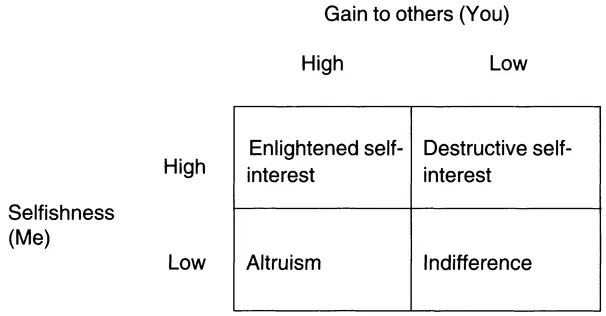
Figure 1.1 Me/You matrix
Enlightened self-interest is illustrated by the fufilment that emanates from giving and by an organization's decision to be ethical, to increase profits through greater employee commitment, thus appealing to socially conscious customers and attracting the best people (see Chapter 6). Adam Smith's 'invisible hand' of competition in The Wealth of Nations also guarantees that individual economic self-interest will be in everyone's interests. In The Theory of Moral Sentiments (1976) he extends this individualism into personal morality which emphasizes 'humanity, justice, generosity and public spirit'. However, self-interest can also be destructive, as portrayed in Thomas Hobbes's Leviathan (1996) where people are egotistical and devoid of feelings for others.
Altruism reflects the self-sacrificial 'ethics must hurt' philosophy, whilst indifference is personified by the ethical couch potato who does little for him (or her) self or others.
Game theory, as illustrated by the classic game Prisoner's Dilemma, provides another angle on the selfishness versus cooperation debate. The best option, according to this Dilemma, is for everyone to co-operate and help each other (as in the Golden Rule) until someone hurts you and loses your trust, when you retaliate. The threat of retaliation then becomes a deterrent for the other side. Successful co-operation depends on trust, as shown by attempts to achieve international agreements on environmental protection and disarmament. An arms race is a good example where mistrust means that no one is better off. Another example where selfishness harms everyone is the so-called 'problem of the commons', where farmers may increasingly exploit their right to graze on common land which legitimately destroys the land for everyone. This can also be a problem in an organization, when people perceive its common resources as a battle chest for their own selfish purposes and political in-fighting.
In I and Thou, first published in 1923, Martin Buber (1984) concludes that a real life consists of reciprocal relationships (encounters) with others that are firmly rooted in the here and now without any need for hopes and promises. Therefore, 'I require a You to become' and 'love is a responsibility of an I for a You'. Your soul (the 'innate You') is realized through such relationships and the world in which you live (the It-world which is necessary to life and experience but lacks humanity without relationships). However, your effectiveness as a human being depends just as much on the strength of the I because you must have the inner capacity to help others. Like Erich Fromm (see pp. 35-36) Buber believes that such love can be destroyed by the desire to possess things. Real fulfilment, on the other hand, comes from God, oneness between the body and soul (the 'unified I') and empathetic relationships (the 'boundless You'). Wisdom is understanding yourself without being preoccupied with yourself to the exclusion of others.
Paul Leinberger and Bruce Tucker (1991) describe how American baby boomers, born between 1946 and 1964, are turning away from self-centredness towards improving their relationships with others and achieving a sense of community. The search for self-fulfilment (the 'self ethic') is becoming much more important in American life, as people experience greater anxiety and isolation. This is being replaced by an 'enterprise ethic' based upon personal freedom, creativity and changes in career, job and organization. The baby boomers' affluent upbringing has given them the confidence to be bold and attribute less importance to job security and organizational loyalty.
Whatever values you choose, remember the maxim 'It's not what you do but the way that you do it'. Implementation has an important effect on the perception and effectiveness of a decision. Principle and process go hand-in-hand. This relates to the verification principle of the Austrian philosopher, Moritz Schlick, which states that 'the meaning of a proposition is the method of its verification'.
A final consideration is the potential conflict between per...
Table of contents
- Cover
- Half Title
- Dedication
- Title
- Copyright
- Contents
- List of figures
- Preface
- Acknowledgements
- 1 Being a good person
- 2 Tales of truth
- 3 Soul surgery: paths to peace
- 4 Happiness from the heart
- 5 Influence through integrity
- 6 Profit through principle?
- 7 Moral leadership
- 8 Caring for people
- 9 Moral marketing
- 10 Going green
- 11 The moral society
- Bibliography
- Name index
- Subject index