- 368 pages
- English
- ePUB (mobile friendly)
- Available on iOS & Android
eBook - ePub
About this book
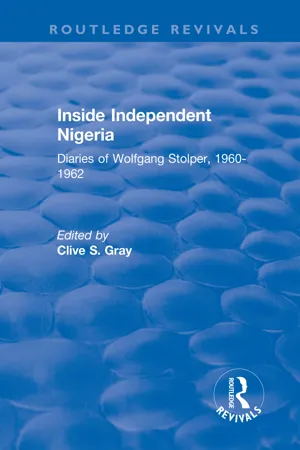
This title was first published in 2003.Wolfgang Stolper was one of the first Western economists to serve as an adviser in the government of an independent African country. In 1960 he was brought in by the Nigerian government to help shape Nigeria's first post-independence development plan. His remarkably candid diaries chronicle his struggles and frustrations with officials, interference, waste and corruption at the heart of a government and unfolds the extraordinary story of his warmth and friendship with a country and its people. Brutally frank, compelling and disarmingly thoughtful, Inside Independent Nigeria brings to light one of the most exceptional documents on post-independence Nigeria, and delivers a fascinating picture of a pivotal era in the development of Western economic planning in Africa. No student or researcher of African political history, economics or development studies will want to be without this utterly riveting book.
Information
Chapter 1
July 17-30, 1960 Arrival in Nigeria: First Impressions, First Tour in the Countryside
July 15, 1960 (London)
...I telephoned Galsworthy...and took off to the Colonial Office. He is 44, very nice, knowledgeable. He gave me a number of names: Fenton, the Governor of the new Central Bank of Nigeria (CBN), a young (40) Englishman who resigned from the Bank of England to accept the job. The resignation came at the request of the BoE, fearing an eventual conflict of interest. Galsworthy said the Minister of Finance, Chief Festus O...something or other - I have to look it up1, was a personal friend of his - they were on a first name basis - was very good, and easy to get along with, which is important since I will work with him.
I raised the question of communist trade missions and was told not to worry. The Nigerians are quite up to the communists. In fact Chief Festus was in Prague and handled the situation marvelously. The Nigerians do not want bilateral deals or anything that would cost them freedom of action. They did not object to trade but would not tolerate trade missions in their country. They have seen what happens elsewhere and don't like it.
Galsworthy was enthusiastic about the Nigerians. He repeated again and again that he loved them, and so would I. It was a great country with a great future. They were intelligent and hard working, and had a sufficient resource base. We talked about Fenton's effort to establish a capital market by developing Treasury bills of different maturities. And there are attempts to establish a stock market. A tremendous amount of African private capital formation is going on in construction. The road from the airport, formerly through the bush, now has African housing along it. They build, buy and sell and know its value.
Galsworthy like everyone else disagrees with Bauer on marketing boards, thinks they did a good job. He took me for lunch at the Oxford and Cambridge Club...
July 18, 1960 (Ikoyi-Lagos, Nigeria)
So this is Nigeria. I am somewhat tired despite sleeping most of the day after arriving...
July 16 (London). In the morning I talked to E.F. Jackson. So far no particular help in finding a replacement or anything else. But at least I know who worked with Jackson on the national accounts, a man by the name of Okigbo.
...Took off finally at about 7:00 PM...I sat beside a retired Lt. Col. Bull, British Army, who had built bridges all over the world and was doing it now in Nigeria. After a few cracks about Americans coming in when money was to be made, after the British had opened up the country by giving their lives - cracks which were not malicious - we got on fine. He talked interestingly and enthusiastically about Nigeria's future, offered to introduce me in the Club.
The Britishers here have no racial prejudices whatsoever. Clubs, residential areas, everything is desegregated. I noticed again and again that every one who has been here fell in love with the place and the people...It was light when we landed at Kano, and the airport [see Photo No. 1] looked like any other - except for the vultures sitting on the roofs, waiting for God knows what. There were also quite a few American Army transport planes, probably bringing troops in into the Congo, but I don't know. I am quite sure that we don't have bases in Nigeria and that the transports were not permanently stationed here.
July 17. Kano is high, and it was quite cool. I was and am still wearing the suit with which I left America...Then we were off to Lagos, but we had another hour's delay while we were circling over Lagos to wait for the fog to dispel - this being the rainy season. You could see the coast line and the heavy surf.
Lagos airport is smaller than Kano's. Much to my surprise it not only didn't rain, but it was really very pleasant - cooler than in New York. I was told that it was both cooler and dryer than usual, that they had had very little rain this year and hoped it would stay that cool. I was met by Oduba, a Ministry of Information official who took charge of my immigration and luggage - though I noticed everyone was treated equally courteously and quickly. The officers were all Nigerian. I am told that few British officers are left, even in the army. Oduba also gave me a welcoming letter from Thompson, inviting me for a drink this evening (July 18). But I was too tired after the trip and went to bed. There are now a few minutes time to continue before I get fetched for the office.
The airport-Lagos drive is about 11-12 miles, paved highway, lots of cars, trucks, bicycles and people. Every car seems to be of a different make or year. The road is lined with new African housing, some shanty towns, but as there is no overcrowding it isn't depressing. There are palms and a few other trees and a lot of bush or brush, rather undistinguished. The soil is red, probably low iron content. You see no naked grown-ups but lots of naked children. Women carry heavy loads on their heads and as a result walk beautifully erect.
The parts of Lagos I have seen - which do not include the slums - are not unattractive. You enter Lagos over a long bridge. There are lots of shanty buildings but the new Government buildings are attractive. Almost all new building is cement bloc, painted with a kind of cement plaster, mostly colored.
We then entered Ikoyi, a residential suburb that is apparently the best part of town and contains mostly villas or large apartment blocs. It is not European, but mixed. I am put up in a Government house, and have a most attractive apartment, consisting of a living-dining room, study, dressing room, bedroom, bath and kitchen. The bedroom and study are air-conditioned. I have two servants, a cook and washerman...
As I said, it is reasonably cool. The windows in the non-air-conditioned rooms are open day and night and there are no screens, but there seem to be few flies or mosquitoes. Lots of big lizards outside, some in color which behave pretty much as our squirrels do...I slept until 6:00 PM. At 7:00 PM Thompson drove me around Ikoyi, to the lagoon - too dirty to swim in - but very attractive. Little mangrove swamp left on the island. All being rapidly developed for housing, all concrete.
Then to his house. He is a Permanent Secretary (PS), top of the top civil servants. It was not unpleasant, though warm. All his windows and doors were open, and there were lizards running up and down his wall which turned out to be geckos and which are supposed to eat bugs. Otherwise, nothing tropical about it.
Thompson has been in Nigeria for 27 years, first in the bush, now at headquarters. We talked a little of my job. He felt, as I hoped he would, that I should spend the first month talking with as many people in the Federal and Regional Governments and in private industry about their development plans and ideas. After a week or ten days in Lagos I should go to the Regions. After a month he hoped I could meet with the Joint Economic Committee and give them a proposal as to what I felt should be done and how I wanted to proceed. On the whole this is precisely how I wanted to proceed, except that I hoped to have all summer.
July 18. At 9:00 AM the car came and brought me to Thompson, who called in some assistants...I'll get a car of my own in a few days and also a Nigerian driver's license on the basis of my American license and an assurance that we have driver's exams. Actually I am not too eager to drive myself, the traffic is quite heavy and the driving rather bad...From the Ministry I went to the US Consulate, a modern building quite close to the center of town. Emmerson, the Consul General and a friend of Ed Mason's and Dave Bell's,2 was in the Southern Cameroons, but the Consul, Dorros, a youngish man from North Western University, was in and we had a pleasant chat. From there I went to Weast, the Economic Officer, from California, who has been here over a year and knows his way around. Then I finally met [Don] Kingsley at the Ford Foundation, about 50-55, pleasant, and now I am home...
July 19, 1960
It continues to be cool, but everyone tells me (a) that this is the cool season anyway, and (b) that it is unusually cool and dry. It hasn't rained since I have arrived, and I am told that we have the usual dry spell of August a month early. After September it begins to build up and in February it is really unbearable. It will be impossible to write without having a blotting paper underneath the arm, and clothes get moldy in non-air-conditioned rooms.
July 18. Coming out of Thompson's office I had a nice encounter. As I was looking for my car, I noticed two Nigerians eyeing me. After a short while they came up to me and wanted to know where I got my suit - the blue dacron-cotton one - and how much it cost and where they could get it. I told them, giving the Harvard Coop address. The one introduced himself as a crown counsel which corresponds roughly to an assistant solicitor general, and he invited me to his wedding next Saturday. I may go if I can.
At 5:00 PM, Thompson in shorts and sneakers fetched me for a drive and a walk. I got into my shorts too, and off we went. The beach is protected by huge granite boulders to keep it from eroding. The breakers are about as on Fire Island on a mildly stormy day, real breakers not simply waves. The danger is a very strong undertow and tricky currents which frequently make diving through breakers dangerous. Thompson said that he himself took the danger seriously only after two narrow calls. There were people on the beach, but no one swam. Also there is of course no rescuing facility.
About 100 yds out was a stick, or so it looked, which is where the beach used to be 5 years ago. It was all that could be seen of a Belgian freighter that ran ashore in a fog. The beach is in part being built up by sand being pumped in. People go swimming in a bay protected by moles on both sides. On the beach the usual urchins offered to watch your car "good," but they have not yet taken to damage it when you tell them firmly "no thanks."
From the beach, and after a brief walk, I was taken through Lagos to the harbor, all of it artificially built up. Everything is completely flat and is reclaimed land from the swamps. There is very little mangrove swamp left anywhere in Lagos and so far I have noticed remarkably few mosquitoes - but I am told this is Lagos and not Nigeria, and it is the cool season. The reclaiming is done by pumping sand from the bay or the ocean into the swamp. There is a remarkable amount of building going on. Houses, apartment houses, offices everywhere, with gardens which gradually are being built up on the sand. The foundations of all these houses require special treatment: they are either piles or rafts. The power station with at present 25 MV (and 60 MV being installed now) is a huge building whose foundation is a raft in the sand used to fill in the swamp. Thompson said he shuddered to think what would happen if there were a tidal wave here as violent as the Chilean one.
I saw something of the slums, part of which are being cleared. But here as elsewhere slum clearance runs against sharply rising real estate prices and the long run prospects are not good. There are tin huts, and run down cement buildings, open air shops, and crowds of people on foot, on bicycles and in cars. But it seems an orderly and quiet crowd, and there is remarkably little noise I am told that in Lagos there is the usual urban unemployment as people stream in from the country but thus far I have seen no evidence of it.
Thompson and I talked about the Congo and American politics...On the Congo he thought the Belgians were beneath contempt in the way in which they had panicked. They should have hung on instead of giving the Congo its independence, arrest trouble makers and set about systematically preparing the country for independence by training people and giving them administrative independence gradually as fast as possible to make them learn their job. I couldn't agree more. About my question how all this affected Nigeria he thought that was extremely difficult to say. The Nigerians were a little smug about it because it couldn't happen here, on the other hand, being a Federation they could not move as fast as Ghana to send troops, and they were probably too much intrigued by their own national politics to be much interested in what happened outside their borders. (This could mean that after independence Nigeria may be less of a stabilizing factor in African affairs than we hoped.)
I am getting along fine with Thompson who is probably also relieved at what he got in me. Unfortunately, he is retiring in December of this year and I will have to get used to a new PS in the Ministry of Economic Development (MED) and quite a few other ministries. To anticipate a brief discussion we had this morning, he mentioned to me that the Prime Minister would get an economic advisor from the [World] Bank - which I knew - and he wanted to make quite clear to the Prime Minister that the MED did not wish to build up a rival economic advisor; that I was part of the executive, actually working rather than advising, and not only working out a new development program but also building up a planning staff.
I assured him that I understood I was a Nigerian civil servant who with a specified job to do in a specified time, taking general directions from my superiors, rather than an academic who would do a research job as he pleased in his own good time. He said - I believe with more relief in his voice than he meant to show - that he was not worried about me but about the Prime Minister. I come back to this conversation later.
About 7:30 PM Whalley (pronounced Wally), the Senior Assistant Secretary (Economics) fetched me to his home...There I met his charming young wife, active in the choir - you have to be active here because you depend on the entertainment you provide yourself - daughter of a musician. Both are around thirty, he perhaps over, she below. After dinner with wine served by Africans whom she had trained this is again a major activity of wives here, to teach the Nigerians how to do things in the European manner, from hygiene to sewing - I was taken to the Ikoyi Club where an evening of Scots dancing was on the program. The house in which the Whalleys live seemed spacious; all windows and doors were open to the breeze and there were the geckos on the wall...
The Ikoyi Club reminded me a little of a small edition of the hotel in Yellowstone Park, but there are nicer wings, a bar, and I am told, very pleasant air-conditioned rooms with private bath. I met a few people, with one of whom, a Scott named Simpson, I will have professional contact. He is a statistician in the Ministry of Health. He told me that Lagos was growing at the rate of 4% per year - which means a lot - that the country was growing as a whole at 2% as far as anyone knew.
It seems that the dearth of statistics is a handicap and a barrier into which all planning and everything else runs quickly, and one of my tasks will be to set up some improved organization together with the Department of Statistics. Simpson also said death rates in age groups below five years were appallingly high - 20%-50% - the chief causes being pneumonia, diarrhea and a third disease I can't remember. He also wanted to know whether I had had polio shots and was relieved that I said yes. He believes that out here they are more important than yellow fever, but added he couldn't convince many people of it. After a few jabs at me as an American, without real spite and which I parried with sufficient humor, I think, we parted amiably...
July 19. This morning my first stop was the CMS Bookshop, CMS standing for Church Missionary Society, to buy Sir Alan Burns, Histoiy of Nigeria. Then off to the Ministry where I got some more documents. I worked in the Minister's office (he was absent) and at 11:00 AM Thompson took me to see Fenton, the CBN Governor. Like all central banks the Bank was plush, trying by the very stone in which they are built to give the feeling of Sound Money. The offices are air-conditioned, and the Governor's office was also sound-proofed. The visit was short since I had little to ask at this stage. Thompson led off by explaining that I was going to see people in Lagos and then in the regional capitals; he expected me to report and to come up with a first plan of procedure by the end of August at the meetings of the National Economic Council, which Fenton suggested should meet in Kaduna, the Northern capital, where it had not yet met.
Then Fenton gave me a real shock by suggesting that I might have a rough plan worked out by March 1961! I pointed out that this was physically not possible, that I just had got here; that I had to be back by September to teach, that I wouldn't be back in Lagos until February, and that March 1961 was simply out of the question; moreover Thompson's letter had specified March 1962. Thompson fortunately came to my aid and told me later that Fenton had given him a jolt also. Apparently Fenton had in mind that the first budget of an independent Nigeria should already reflect the new program, but this simply will have to await the second budget. Fenton stressed that while things like monetary policy could be done, they had to be done simply since the country was primitive - Lagos was not Nigeria - the statistics were poor, as I would find in my work. He warned me, as if I needed the warning, not to do too sophisticated a plan.
We talked briefly about the capital market which he had started to create, by selling short-term Treasury bills. A real stock market was still a long way off, but he hoped to have a dozen or so good stocks on the market which people could buy with reasonable security, and thus gradually get into the habit of investing. Most purchasers would, of course, be institutions rather than individuals, but they would include not only expatriate firms or banks with some loose cash, but also financial intermediaries in which the small man (whose annual cash income might be £25 a year and who could therefore hardly be counted upon to invest in stock) actually saved...
Thompson is writing letters to all the other PSs, and on Monday I will start calling for appointments. He then spoke of his recruitment woes, which fall into two classes. First, expatriates or technical assistance costs a lot more. Even if the money is found outside the budget, as in my case, it raises problems except with the top echelon, because the locals don't like the idea that someone doing the same work they do gets paid twice to three times as much.
If you raise their salaries this then gets reflated down the line to the lowest point, because the salary scheme of the British civil service is a lot more rigid than ours. The UN is trying to build up an international civil service, but this does not avoid the problem altogether....
Table of contents
- Cover
- Half Title
- Title
- Copyright
- Contents
- List of Photographs
- Editor's Introduction
- Cast of Characters
- 1 July 17-30, 1960 Arrival in Nigeria: First Impressions, First Tour in the Countryside
- 2 August 2-17, 1960 First Tour of the Three Regions
- 3 August 18-September 11, 1960 Visit to Benin, Completion of First Tour in Nigeria
- 4 February 1-March 8, 1961 Second Tour Begins: Consultations in London and Rome, First Meeting of Joint Planning Committee (JPC) Under Chairman [Prime Minister's Economic Adviser] Prasad, Grubbing for Planning Data, Gov. "Soapy" Williams' Visit
- 5 March 9-April 16, 1961 Preparing First Paper for the JPC, First Clashes with Prasad, Initial Estimates of Five-Year Plan Magnitudes, Analysis of Selected Public Investments, Ford Foundation Team Attacked in Parliament
- 6 April 17-June 6, 1961 Rivkin Mission on US Aid for Nigeria's Plan, JPC, Trips to Eastern and Western Regions
- 7 June 12-July 24, 1961 Federal Investment Program, World Bank Mission, Managing the Ford Team, Malaria, Preparing Introductory Plan Paper for JPC and National Economic Council (NEC)
- 8 July 24-August 28, 1961 New Minister (Waziri Ibrahim), Macroeconomic Policy, Consultations with World Bank and IMF Missions, JPC Discusses Stolper's Paper, German White Elephant Factories in Eastern Nigeria
- 9 August 30-September 22, 1961 Visit to Kano, Maiduguri, Lake Chad: Plan Drafting Begins, Regions Pressed to Submit Their Investment Proposals
- 10 September 24-November 6, 1961 Rivkin Mission Returns, Negotiations with Regions, "Irresponsible" Eastern Region Plan, New Permanent Secretary Godfrey Lardner, JPC Discusses Plan Memo
- 11 November 7-December 13, 1961 Efforts to Trim Investment Programs, Possible Stretch to Six Years, JPC Discusses Plan Outline
- 12 January 21-March 3, 1962 Cabinet Debates Program Cuts, Tensions in Ford Team, Corruption, Integrated Plan versus Four Separate Plans, Stolper Attends NEC Meeting in Ibadan
- 13 March 5—April 26, 1962 Visit to Eastern Region, Trip to Cameroon, Ford Team's Future, AID Queries about Plan Assumptions, Parliamentary Debate and Vote on the Plan
- 14 April 27-June 3, 1962 Nigerian Economic Society Meeting, Israelis Promote Farm Settlements, Visit to Jos Tin Mines and Other Eastern Region Sites, Stolper Offered a Job in Malta, Visit to Ghana, Clash with Prasad Peaks, Stolper Insists on Coherent Macroeconomic Framework, Disputes about Projected Underspending, Plan Completed
- Postscript (1999)
- Addendum (June 2001)
- Index of Names
- Index of Subjects
Trusted by 375,005 students
Access to over 1.5 million titles for a fair monthly price.
Study more efficiently using our study tools.
Frequently asked questions
Yes, you can cancel anytime from the Subscription tab in your account settings on the Perlego website. Your subscription will stay active until the end of your current billing period. Learn how to cancel your subscription
No, books cannot be downloaded as external files, such as PDFs, for use outside of Perlego. However, you can download books within the Perlego app for offline reading on mobile or tablet. Learn how to download books offline
Perlego offers two plans: Essential and Complete
- Essential is ideal for learners and professionals who enjoy exploring a wide range of subjects. Access the Essential Library with 800,000+ trusted titles and best-sellers across business, personal growth, and the humanities. Includes unlimited reading time and Standard Read Aloud voice.
- Complete: Perfect for advanced learners and researchers needing full, unrestricted access. Unlock 1.5M+ books across hundreds of subjects, including academic and specialized titles. The Complete Plan also includes advanced features like Premium Read Aloud and Research Assistant.
We are an online textbook subscription service, where you can get access to an entire online library for less than the price of a single book per month. With over 1.5 million books across 990+ topics, we’ve got you covered! Learn about our mission
Look out for the read-aloud symbol on your next book to see if you can listen to it. The read-aloud tool reads text aloud for you, highlighting the text as it is being read. You can pause it, speed it up and slow it down. Learn more about Read Aloud
Yes! You can use the Perlego app on both iOS and Android devices to read anytime, anywhere — even offline. Perfect for commutes or when you’re on the go.
Please note we cannot support devices running on iOS 13 and Android 7 or earlier. Learn more about using the app
Please note we cannot support devices running on iOS 13 and Android 7 or earlier. Learn more about using the app
Yes, you can access Inside Independent Nigeria by Clive S. Gray in PDF and/or ePUB format, as well as other popular books in Politics & International Relations & Politics. We have over 1.5 million books available in our catalogue for you to explore.