- 254 pages
- English
- ePUB (mobile friendly)
- Available on iOS & Android
eBook - ePub
About this book
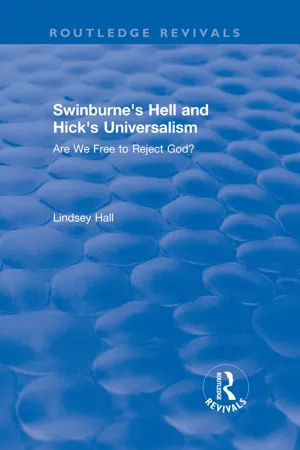
This title was first published in 2003. This book seeks to establish whether a Christian position must entail a belief in hell or whether Christians can hold a coherent theory of universal salvation. Richard Swinburne's defence of hell depends on the argument that hell is necessary if humans are to be genuinely free. It becomes clear that the contemporary discussion of hell and universalism cannot be separated from the issues of human freedom and God's knowledge, and so Hall centres the discussion round the question 'Are we Free to Reject God?' John Hick argues that although we are free to reject God there will eventually be an universalist outcome. Having examined the contrasting arguments of Hick and Swinburne, Hall builds on Hick's position to develop an argument for Christian universal salvation which holds in balance our freedom in relation to God and the assurance that all will finally be saved.
Information
Chapter 1
The Debate About Hell
Introduction
The debate about hell has occupied Christian thought throughout the centuries. The doctrine of hell has never been unequivocally defined and thus there have been many suggestions of what constitutes hell and who will be sent there. These suggestions have ranged from discussing the temperature and offensive smell of hell to the ideas of suffering the pain of separation from God or passing out of existence, which are popular today. The idea of some sort of eternal torment for the wicked after death has been prevalent since the beginning of Christianity, but it has always been controversial. Arguments have ensued not only over the nature of hell, but also many have challenged the existence of hell in favour of belief in the salvation of all people. Thus the debate about hell has always been a heated one. However during the twentieth century, the debate cooled and hell seemed to be largely removed from the theological agenda. Although many churches and indeed many theologians have been silent on the subject of hell there is one growing group amongst whom discussion of hell has been prominent. The Evangelical Churches in Britain and America have been more concerned to preach about hell than many of the mainstream churches, but although it still featured heavily in evangelical belief systems, published articles on hell had significantly decreased. The recognition of this situation may well account for the large proportion of evangelical literature concerning the doctrine of hell to have been produced in the last twenty or so years.1 Many of the books and articles that have been published during this time bemoan the fact that this topic has been sorely neglected both by academics and in the preaching of the Christian Church.
This influx of material was no doubt also prompted by the fear that universalism was becoming generally accepted in the mainstream churches. A further reason for this renewed interest in the question of hell may be the massive current interest in the relationship between Christianity and other Religions. Although this issue has existed in Christianity from the beginning it has never been so prevalent as in today's world. Despite Christianity's conflict from the earliest days with those adhering to other belief systems many Christian doctrines have been established and grown in something of a vacuum. John Hick writes:
Christian theology ... was developed, not indeed in ignorance, but nevertheless in essential unawareness, of the other religions of the world. I do not think it is an exaggeration to say that traditional Christian theology simply ignored the greater part of the human race!2
Thus today's world with its enhanced awareness of other faiths challenges the Christian position that all outside of Christianity are sentenced to an eternity in hell.
In this book I will look at detences and denials of the doctrine of hell in order to establish whether there is an overwhelming defence of hell which will cause us to think that it was necessary for God to have created it. The most prominent and forceful modern defence of hell is the Free Will Defence. This states that in order to honour our human freedom, it was necessary for God to create hell so that we could, if we so desired, ultimately choose to reject God. Many who support this defence of hell reject other defences. For example, Jerry L. Wails defends the existence of hell in Hell: The Logic of Damnation but writes that his argument: 'involves a strong commitment to the value of libertarian freedom. This value judgement is surely one of the main pillars of the orthodox Christian doctrine of hell and indeed, I think the doctrine would topple without it'.3 Thus the necessity of hell will be established by asking the question: 'Are we free to reject God?'. Whilst this will be the main focus of the book, it will in places be appropriate to look at other defences of hell and discuss the way in which they respond to the problem of hell.
My aim in this book is to establish whether one can hold a theologically and philosophically defensible position which rejects the existence of hell. There could of course be the option that there is no afterlife at all. However the concept of afterlife has been an integral part of Christian thought since its beginnings and for the purposes of this book I will assume that it is coherent to talk of an afterlife. Gerald Bray writes; 'Any consideration of the subject of hell ought naturally to begin with the Biblical evidence'.4 Although the evidence and testimony of scripture is, of course, essential in establishing a Christian position, the aim of this book is primarily to explore the topic of hell in relation to concepts of philosophy of religion. There will be some discussion of the Biblical material throughout this work, but it will not make up the main focus of this book. I will look at both Swinburne and Hick's use of Biblical material and finally in chapter 6 I will examine universalist approaches to Scripture in order to establish whether the Bible can support a universalist position.
In this book I aim to examine not only whether the existence of an eternal hell is compatible with a loving God but further whether there is any good reason for God to have created hell at all. Hans Urs Von Balthasar maintains that hell is not created by God. Sachs summarizes his argument: 'One should not say that God has created hell. If anything, hell is the creation, or better, the 'anticreation' of the sinner, who obstinately refuses God's divine will and eternal purpose in creating'.5 However, even if a person creates his/her own hell by rejecting God, all states if not directly created by God are allowed and kept in existence by God. Thus God must allow a person to retreat into and stay in the hell which he/she has created for him/herself. This is not to assert that if God sees fit to create a place of everlasting torment, God should also provide a justification of it in order to satisfy philosophers of religion. However if the doctrine of hell is to be defended on the grounds of its philosophical and theological coherence it must also be open to challenge on these grounds. The writers of the ACUTE report assert: 'The Christian doctrine of hell is ultimately a construct of systematic theology'.6 As noted above, examination of the Biblical material pertaining to the problem of hell will not constitute the core of this book. Rather I will seek to demonstrate that philosophically the creation of an eternal hell by a loving God is unnecessary. The relationship between theology and matters of faith and belief is a difficult one and thus it might be possible that an individual could accept the conclusions of this book as an academic investigation, and yet reject them on the grounds of Biblical revelation. Although my approach to this subject will primarily be to consider it as a question of philosophy of religion, I do not intend for it to be removed from issues of faith. However, I recognise that those who believe in the absolute authority of the Bible as the only source of revelation are likely to find this approach unacceptable and consequently reject the conclusions reached. For those who believe that religious faith is more about seeking truth through a combination of Biblical revelation, reason and experience this book may be of greater relevance. I hope to show not only that rejecting the doctrine of hell is philosophically defensible, but also a position which can be maintained within a broadly Christian framework.
In order to do this I will look at two particular responses to the problem of hell. A topic as wide as this one invariably requires that some parameters be placed around the study. Thus I will focus on the question through the work of Richard Swinburne and John Hick. My aim in concentrating in turn on Swinburne and Hick is to look at their very different understandings of the problem of hell in order to consider the question: 'Are we free to reject God?'. Both Hick and Swinburne claim that we are free to do so, and for Swinburne that is the key to his argument. Hick also claims that we are free to reject God; however he believes that ultimately no one will. Whether Hick can actually respond affirmatively to this question is a matter of some debate. There is no debate over whether Swinburne endorses our freedom to reject God, however there is much to be debated over the price he pays to ensure this freedom. Although very different in their beliefs, Hick and Swinburne have similarities in the aspects of philosophy of religion which have interested them and their initial approach to philosophy. They are both rationalists, and at one time were both theists. Thus their contrasting theories provide an interesting and useful framework in which to ask the question: 'Are we free to reject God?'.
In this chapter I will introduce the issues which will be of the greatest importance to this work. I will establish the 'problem of hell' and discuss the 'moment of decision', that is the point when one decides for or against hell. I will then define the different understandings of hell and universalism before looking at the different types of human freedom and God's knowledge. This will then allow us to proceed with examining the work of Hick and Swinburne on this subject in subsequent chapters.
The Problem of Hell
In order to define the problem of hell, it will be helpful to look first, at the more familiar problem of evil. The problem of evil has occupied philosophers and theologians for centuries. Kenneth Surin in Theology and the Problem of Evil explains:
The so-called 'problem of evil' is deemed by its proponents to have a venerable ancestry, and was apparently first formulated by Epicurus (341 - 270 BC) in the form of a dilemma which perhaps receives its most succinct formulation in the words of David Hume (1711 - 76): 'Is he willing to prevent evil, but not able? then he is impotent. Is he able, but not willing? then he is malevolent. Is he b...
Table of contents
- Cover
- Title
- Copyright
- Dedication
- Contents
- Preface
- 1 The Debate About Hell
- 2 Richard Swinburne's Hell
- 3 Evaluation of Swinburne's Hell
- 4 John Hick's Universalism
- 5 Evaluation of Hick's Universalism
- 6 Firm Universalism
- Bibliography
- Index
Trusted by 375,005 students
Access to over 1.5 million titles for a fair monthly price.
Study more efficiently using our study tools.
Frequently asked questions
Yes, you can cancel anytime from the Subscription tab in your account settings on the Perlego website. Your subscription will stay active until the end of your current billing period. Learn how to cancel your subscription
No, books cannot be downloaded as external files, such as PDFs, for use outside of Perlego. However, you can download books within the Perlego app for offline reading on mobile or tablet. Learn how to download books offline
Perlego offers two plans: Essential and Complete
- Essential is ideal for learners and professionals who enjoy exploring a wide range of subjects. Access the Essential Library with 800,000+ trusted titles and best-sellers across business, personal growth, and the humanities. Includes unlimited reading time and Standard Read Aloud voice.
- Complete: Perfect for advanced learners and researchers needing full, unrestricted access. Unlock 1.5M+ books across hundreds of subjects, including academic and specialized titles. The Complete Plan also includes advanced features like Premium Read Aloud and Research Assistant.
We are an online textbook subscription service, where you can get access to an entire online library for less than the price of a single book per month. With over 1.5 million books across 990+ topics, we’ve got you covered! Learn about our mission
Look out for the read-aloud symbol on your next book to see if you can listen to it. The read-aloud tool reads text aloud for you, highlighting the text as it is being read. You can pause it, speed it up and slow it down. Learn more about Read Aloud
Yes! You can use the Perlego app on both iOS and Android devices to read anytime, anywhere — even offline. Perfect for commutes or when you’re on the go.
Please note we cannot support devices running on iOS 13 and Android 7 or earlier. Learn more about using the app
Please note we cannot support devices running on iOS 13 and Android 7 or earlier. Learn more about using the app
Yes, you can access Swinburne's Hell and Hick's Universalism by Lindsey Hall in PDF and/or ePUB format, as well as other popular books in Theology & Religion & Religion. We have over 1.5 million books available in our catalogue for you to explore.