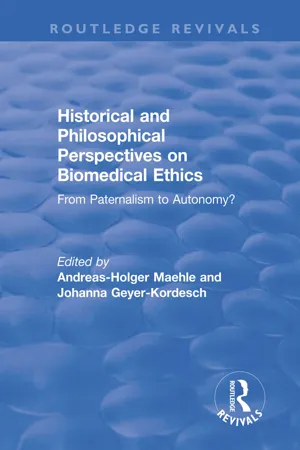
This title was first published in 2002: This volume discusses the subject of biomedical ethics. Various views, historical and contemporary, are discussed, with the editors using the contrasting concepts in the shift from paternalism to autonomy in 20th-century medicine as a heuristic tool for the critical study of ethics in medicine.As far as the evidence in this volume goes, paternalistic medical practices and patient autonomy had an uneasy relationship by the beginning of the 20th century. A hundred years later, full autonomy in decisions on medical treatment is still subject to numerous caveats. The text pays close attention to the interplay between various players, noting how factors such as social contexts, governmental organizations and the biotechnological industry influence and shape responses to the principle of bioethics.
eBook - ePub
Historical and Philosophical Perspectives on Biomedical Ethics: From Paternalism to Autonomy?
From Paternalism to Autonomy?
- 172 pages
- English
- ePUB (mobile friendly)
- Available on iOS & Android
eBook - ePub
Historical and Philosophical Perspectives on Biomedical Ethics: From Paternalism to Autonomy?
From Paternalism to Autonomy?
Chapter 1
‘Honour and Interests’: Medical Ethics and the British Medical Association
Andrew A.G. Morrice
In this chapter, which is based on a much larger body of research (Morrice, 1999), I shall examine the nature and content of medical ethics in Britain during the late nineteenth and early twentieth centuries. The focus will be primarily on the British Medical Association (BMA), and the work of its Central Ethical Committee (CEC) particularly between 1902 and 1948. I shall also discuss the basic historiographical problems raised in writing a history of medical ethics, as well as making more general comments on the light this study may shed on the social function of medical ethics.
Introduction
For many readers the first question will be, 'why the BMA?'. The BMA's ethical work drew on written and unwritten rules dating back over the previous hundred years, and related closely to general notions of inclusion and exclusion embodied by the ancient medical corporations. The work of the ethical committees was seen as integral to the Association's aim to 'maintain the honour and interests of the medical profession', itself integral to the professionalisation of medicine in Britain. The Association attempted to influence and work with the statutory body overseeing medical practitioners, the General Medical Council (GMC), and with professional defence bodies, particularly the Medical Defence Union (MDU). By the early twentieth century the BMA represented the majority of doctors practising within the British Isles, and many of those practising in the rest of the British Empire, and had amongst its membership practitioners of every kind and status. In contrast to the other organisations dealing with doctors' conduct, it had to debate and decide its policies with reference to its members. Both the 'codes' of 'medical ethics' published by British authors between the BMA's founding in 1832 (as the Provincial Medical and Surgical Association) and the Second World War were produced by men with active and important links with the BMA, indeed the second was written by a chairman of the CEC (de Styrap, 1878, 1886, 1890, 1895; Saundby, 1902, 1907). The Association was described in 1933 as having 'gone from strength to strength' and as perhaps the most successful professional body of its times, 'credited with powers it d[id] not in fact possess'.1 These factors, and the survival of extensive archive materials in accessible form, make the BMA's ethical work perhaps the single most informative window onto the relationship between early twentieth century medical ethics and the wider context in which the profession was working.
After the Second World War the CEC finally produced a code of medical ethics (BMA, 1949), a task that had been first proposed 116 years previously. It can be read as a summary of their work in the previous 45 years, which was itself based on ideas dating back a further century. Yet it was at this historical moment that two documents – the Nuremberg Code (1947)2 and the Declaration of Geneva (1948)3 – both arising from the aftermath of the Second World War, prefigured a quite different kind of medical ethics. This newer, and to modern eyes more recognisable medical ethics had, by the 1970s and 1980s, almost entirely eclipsed the kind of issues on which the BMA had laboured so long.
An initial survey of 'medical ethics' between the turn of the nineteenth century – when Thomas Percival chose the phrase to title his codification of professional behaviour (Percival, 1803) – and the mid-twentieth century would show that it was concerned largely with doctors' behaviour towards other practitioners. Thus the arrangements for conferring over cases without threatening the original doctor (consultation ethics) featured strongly, along with matters of propriety, mutual respect for medical brethren and the avoidance of disputes. Later in the nineteenth century, relationships with unorthodox healers and the strict avoidance of anything that might be construed as advertising had become prominent issues (de Styrap, 1878). By the turn of the century the relationship of doctors to lay organised medical services, whether mutual self-help organisations or commercial enterprises, joined the list of major concerns. The most familiar looking issue in this canon of medical ethical writings is the topic of confidentiality, or secrecy, as it was sometimes known. Writers on medical ethics were doctors, and the disciplinary and ethical organisations of the profession involved no lay people.4 Moreover, the application of moral principles was limited to general appeals to notions such as the 'Golden Rule' ('do as you would be done by') which was generally invoked in relation to other orthodox practitioners alone.5
Critics of the medical profession have long found much to deplore in the ethics produced 'by and for' the profession which characterise the period up to the Second World War (Leake, 1927; Roberts, 1937; Waddington, 1975; Freidson, 1975; Berlant, 1975). Such critics, along with leaders of medical opinion in the post-war years, have tended to re-categorise the earlier professional ethics as 'mere etiquette' and have made much of the way that professional ethics underpinned the power and prosperity of the medical profession.6
Modern medical ethics involves many experts in moral philosophy, and therefore the detailed deliberation of a large number of philosophical ideas, and addresses issues primarily of concern to patients. Its rise has been part of the social trend to limit and modulate the power of the medical profession.7 The behaviour of doctors toward each other now receives little attention aside from injunctions to report wrong-doing or poor performance promptly (Doyal and Gillon, 1998). The issues discussed are usually matters involving the extremes of medical intervention and the fundamental events of life: reproduction and terminal illness, and a set of ethical principles, most prominently the right of autonomy. Perhaps most significantly, medical ethics has become an academic subject in its own right, with a rapidly burgeoning literature, 'so copious that any physician wanting to keep abreast of [it] would have to abandon the practice of medicine',8 and it is now possible to pursue a career in medical ethics (Jonsen, 1990 and 1998).
Thus the content and form of the writings, ideas and adjudicatory structures denoted by 'medical ethics' have shifted radically during the 200 years in which the phrase has been used in the English speaking world. Had Percival listened to some of his correspondents, who urged him to call the book 'medical jurisprudence',9 or had he the clairvoyant capacity to respond to his critics in the twentieth century, and had published Medical Etiquette, the historian's task would be subtly but significantly different. Since the medical professions of both the United Kingdom and the United States of America looked to Percival as the originator of their medical ethics up to the middle years of the twentieth century, this is no minor consideration.10 As it is, Percival was swayed by the notion that his work was based on moral ideas rather than legalistic ones, and recognised the distinction between the etiquette he proposed, and the ethics underlying it. He felt, like his friend and correspondent, Thomas Gisboume, who had published his Enquiry into the Duties of Men in the Higher and Middle Classes of Society in 1794, that there was a profound moral dimension to the advice they offered. They were also drawing on ideas of gentility and gentlemanly conduct, which became a core aspirational, self-defining ideal in British medicine, particularly during the late nineteenth and early twentieth centuries (Peterson, 1984; Lawrence, 1985).
Thus at the heart of any endeavour to write the history of medical ethics lies an intellectual and historiographical problem. This dilemma can be viewed as a semantic problem generated by the apparently changing content of 'medical ethics'. It could be viewed as a conflict of methodology between social historians, who have recently dominated the history of medicine, and those primarily concerned with the current discipline and philosophical basis of medical ethics. It may be unrealistic to expect moral philosophers engaged in establishing their role as adjudicators of medical rights and wrongs to look for moral content in a professional ethic that can so easily be dismissed as self-serving. For social historians the problem can be viewed as a choice between the argument that the content of medical ethics has simply changed as the social context and day to day work of doctors has changed, or that beneath this apparent shift lies a more profound continuity of social function. Those interested in the subject should, perhaps, take their lead from Mary Warnock, who writing an account of moral philosophy in the twentieth century stated she 'ha[d] not, I hope had any preconceived idea of what ethics is' (Warnock, 1960). For this particular social historian, the most useful guidance as to what, in social historical terms, medical ethics might be, has been articulated by Roger French. He says:
The current interest in medical ethics is an interest in ethical problems. It might seem unproblematic that medical ethics have a history, and that these problems can be studied in the past. We might for example take the problem of abortion and look at it historically. But... such a history would be the history of a practice, not of an ethical problem. ... modern medical ethics derives from the particular nature of modern medicine and the society in which it exists. So a history of medical ethics is a history of medicine and of society and of the problems that looked ethical to them, but not necessarily to us. Looked at in this way it soon becomes clear that ethics have a function, for the group that practices them, other than the internal, explicit injunctions that are normally seen as 'ethical' in some abstract way. ... Ethics comprise a system of rules that not only characterises the group but which in directing the behaviour of the group contributes to its success. (French, 1993:72)
Doctors operate within a set of forces that shape their behaviour. Some of these are very fundamentally cultural, some legal, some arising from the statutory functions of medical organisations, some contractual, some frankly economic, whilst some derive from ideals of what a doctor should be, generated not only by society but by the profession itself. My research has been based not on tracing back current ethical concerns in history, but on looking at the organisational structures and procedures described by contemporaries using the terms 'medical ethics' and 'professional conduct', and literature related to them. However, since this overlaps with legal questions relating to medical practice and with statutory professional discipline, I have simultaneously used a second definition or frame. This defines medical ethics as setting standards for, and adjudicating between right and wrong medical behaviour, where this is not defined by law. I shall describe the forms of this advice and adjudication, and the assumptions and ideals underpinning it. Taking my cue from French I have attempted to describe the way these ideas and procedures structured and characterised the medical profession, and how, and to what extent they 'contributed to its success'. It seems to this author naive to suppose that in an era characterised by the sometimes belligerent defence of group interests in society (Harris, 1993), and structured around notions of class and respectability (Thompson, 1988), that doctors would not organise and promote norms of behaviour that secured and promoted their place in society. In the light of Perkin's work, it would be strange to assume that medical ethics would function to undermine a profession's socially sanctioned role (Perkin, 1989). In fact those involved in the BMA's ethical work frequently and explicitly – if in modern eyes rather simplistically – linked the profession's own interests with 'the public interest', and recognised that the ideal was a situation in which the needs of doctors and patients could be harmonised.11
Medical Ethics, Professionalisation and the BMA in the Nineteenth Century
Prior to the Medical Act of 1858 the existence of a medical profession in Britain was a medico-political ambition rather than a statutory reality. Up until this point the behaviour of medical men might be influenced by writers such as Percival, John Gregory, or Gisbourne, and they might be...
Table of contents
- Cover
- Title
- Copyright
- Contents
- List of Figures and Tables
- Notes on Contributors and Editors
- Acknowledgements
- Introduction
- 1 'Honour and Interests': Medical Ethics and the British Medical Association
- 2 The Emergence of Medical Professional Ethics in Germany
- 3 Health Costs and the Ethics of the German Sickness Insurance System
- 4 Problems of Consent to Surgical Procedures and Autopsies in Twentieth Century Germany
- 5 Human Research: From Ethos to Law, from National to International Regulations
- 6 Ethical Aspects of Life-Saving and Life-Sustaining Technologies
- 7 Autonomous Agency and Consent in the Treatment of the Terminally Ill
- 8 The 'Frankensteinian' Nature of Biotechnology
- Index
Trusted by 375,005 students
Access to over 1.5 million titles for a fair monthly price.
Study more efficiently using our study tools.
Frequently asked questions
Yes, you can cancel anytime from the Subscription tab in your account settings on the Perlego website. Your subscription will stay active until the end of your current billing period. Learn how to cancel your subscription
No, books cannot be downloaded as external files, such as PDFs, for use outside of Perlego. However, you can download books within the Perlego app for offline reading on mobile or tablet. Learn how to download books offline
Perlego offers two plans: Essential and Complete
- Essential is ideal for learners and professionals who enjoy exploring a wide range of subjects. Access the Essential Library with 800,000+ trusted titles and best-sellers across business, personal growth, and the humanities. Includes unlimited reading time and Standard Read Aloud voice.
- Complete: Perfect for advanced learners and researchers needing full, unrestricted access. Unlock 1.5M+ books across hundreds of subjects, including academic and specialized titles. The Complete Plan also includes advanced features like Premium Read Aloud and Research Assistant.
We are an online textbook subscription service, where you can get access to an entire online library for less than the price of a single book per month. With over 1.5 million books across 990+ topics, we’ve got you covered! Learn about our mission
Look out for the read-aloud symbol on your next book to see if you can listen to it. The read-aloud tool reads text aloud for you, highlighting the text as it is being read. You can pause it, speed it up and slow it down. Learn more about Read Aloud
Yes! You can use the Perlego app on both iOS and Android devices to read anytime, anywhere — even offline. Perfect for commutes or when you’re on the go.
Please note we cannot support devices running on iOS 13 and Android 7 or earlier. Learn more about using the app
Please note we cannot support devices running on iOS 13 and Android 7 or earlier. Learn more about using the app
Yes, you can access Historical and Philosophical Perspectives on Biomedical Ethics: From Paternalism to Autonomy? by Andreas-Holger Maehle,Johanna Geyer-Kordesch in PDF and/or ePUB format, as well as other popular books in Law & Science & Technology Law. We have over 1.5 million books available in our catalogue for you to explore.