With a balance of theory, research, and applications, Motivation for Sustaining Health Behavior Change: The Self-as-Doer Identity introduces the self-as-doer identity as an accessible motivational identity and discusses how it can be incorporated into health behavior change efforts. The book introduces the self-as-doer theory and presents research and recommendations for how the self-as-doer can be used in both clinical and non-clinical populations to promote health behavior change and maintenance. The book will be of interest to researchers, students, and professionals interested in health promotion.
eBook - ePub
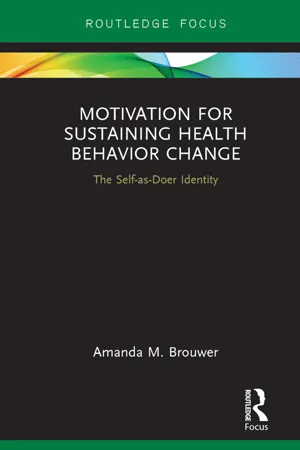
Motivation for Sustaining Health Behavior Change
The Self-as-Doer Identity
- 90 pages
- English
- ePUB (mobile friendly)
- Available on iOS & Android
eBook - ePub
About this book
Information
1
A Primer on Health, Health Behavior Change, and Identity
The World Health Organization defines health as “a complete state of physical, mental and social well-being and not merely the absence of disease or infirmity” (World Health Organization, 1948). Health is a culturally-defined, multidimensional construct. It can be measured as a state of optimal physiological functioning of various body systems (e.g., good blood pressure, strong resting heart rate, absence of pain) as well as in terms of psychological wellness (e.g., mood, depression, stress levels) and engaging in healthy psychological practices (e.g., use good coping skills). One’s state of health (e.g., “She is healthy because she engages in physical activity quite regularly”) can also be explained as the degree to which individuals engage in health promoting (e.g., eating healthy, being physically active) or health diminishing (e.g., smoking, excessive alcohol consumption) behaviors. From this perspective, health is conceptualized as more than just a biological state; one’s well-being is also a result of his or her social and psychological experiences which are then considered important facets of health.
Unfortunately, many people fall short of achieving good health. For instance, only one in five American adults are meeting physical activity recommendations (Center for Disease Control [CDC], 2014) and less than one in ten Americans consume the recommended daily servings of fruit and vegetables (Kimmons, Gillespie, Seymour, Serdula, & Blanck, 2009; Moore & Thompson, 2015). Approximately 3% of the United States population reports experiencing serious psychological distress and are twice as likely to have heart disease or diabetes compared to those who do not experience psychological disease (Weissman, Pratt, Miller, & Parker, 2015). Results from the National Health and Nutrition Examination Survey demonstrate that more than 78% of American adults are overweight or obese (Fryar, Carroll, & Ogden, 2016). Diseases owing to lifestyle factors are becoming more pervasive. The rates of chronic illnesses such as diabetes and cardiovascular disease are growing with approximately 28% of adults having a diagnosis cardiovascular disease and over 1.5 million individuals having diagnosis of diabetes, a number that has tripled since 1980 (CDC, 2015a). Chronic diseases such as heart disease, cancer, and diabetes, which are primarily the result of unhealthy lifestyle behaviors, account for more than 50% of all deaths each year (CDC, 2015b). Others indicate that 40% of premature deaths can be specifically attributed to suboptimal health behaviors (Spruijt-Metz, et al., 2015). That unhealthy lifestyle behaviors are often indicators of the cause of disease diagnosis and progression suggests that health promotion efforts focus on modifying health diminishing behaviors and enhancing health promoting behaviors.
The recommendations for reducing risk of disease and achieving optimal health are to engage in health behaviors such as getting regular physical activity, eating a healthy diet, limiting alcohol consumption, and not using tobacco (CDC, 2015b; Ford, Zhao, Tsai, & Li, 2011; Riekert, Ockene, & Pbert, 2014). Researchers have found that engaging in a combination of these behaviors has potential to decrease mortality risks by 66% (Loef & Walach, 2012). Additionally, Hastert, Ruterbusch, Beresford, Sheppard, and White (2016) found that modifying risk factors (e.g., smoking, diet, physical activity, disease screening rates, etc.) can explain health disparities in cancer mortality rates. The researchers determined that among those with low socioeconomic status, where cancer mortality rates are the highest, the modifiable risk factors could explain as much as 45% of the relationship between socioeconomic status and cancer mortality. Given that the leading causes of death are primarily the result of poor lifestyle behavior choices and that healthy lifestyle choices require self-regulatory behaviors (e.g., choosing to exercise, abstain from tobacco, eat a healthy diet, etc.), optimal health and disease management strategies should then focus on improving lifestyle and health decision-making behaviors.
Healthy lifestyle change is difficult, however. Attrition rates for health behavior change programs are often high and maintenance for successful behavior change is low (Crutzen, Viechtbauer, Spigt, & Kotz, 2015; de Bruin, McCambridge, & Prins, 2015; Dumville, Torgerson, & Hewitt, 2006). Researchers demonstrate that for various forms of health behaviors, individuals are often successful at first, but then struggle to maintain the behavior change. For example, people who enrolled in a healthy eating intervention focused on increasing fruit and vegetable consumption did increase their fruit and vegetable consumption after the intervention, but less than half still maintain those behaviors 6 months after the intervention (Hamel & Robbins, 2013; Lee Olstad et al., 2016). Similar results can be found for weight loss programs. Many successfully lose weight, but then gain the weight back within 3–5 years (Avenell et al., 2004; Dombrowski et al., 2014; Foster et al., 2010). Smoking cessation programs also have poor maintenance outcomes with various interventions (e.g., text messaging, exercise programing, etc.) causing participants to show initial promise for smoking abstinence, but then having high relapse rates at 6- and 12-month follow-ups (Agboola, Mcneill, Coleman, & Leonardi Bee, 2010; Prapavessis et al., 2016; Spohr et al., 2015). Health behavior change is challenging and sustaining changes proves to be even more difficult.
In exploring how to promote health amid the difficulty of making and sustaining changes, it is of value to consider the context in which individuals make health decisions. Again, health is a multifaceted construct influenced by social, psychological, and environmental contexts. Each day, people make choices that can move them more toward poor health (e.g., poor diet, lack of exercise, smoking) or toward more optimal health (e.g., eating well, getting regular physical activity, sleeping well). The factors that influence these decisions are widespread and can vary from day to day, thereby affecting one’s ability to make sustaining health behavior change. Individual (idiosyncratic) and contextual barriers to health behavior change exist and reduce the success of making and sustaining needed health behavior change.
Researchers have identified several barriers to engaging in health behaviors including lack of time because of family or occupational responsibilities, difficulty accessing facilities or resources needed to enact the behavior, financial costs, having negative outcome expectancies of engaging in a behavior (e.g., “my back hurts because I worked out”), lack of knowledge to make measurable changes (e.g., “what constitutes a serving of vegetables?”), and the development of certain beliefs and attitudes about health behaviors that then prevent the engagement of that behavior (e.g., “whole grain foods are tasteless and dry,” “walking more will only damage my knee further”; Bouma, van Wilgen, & Dijkstra, 2015; Kelly et al., 2016). In proposing ways to overcome barriers to health behavior enactment and given the multidimensional nature of health, it is of value to consider psychological and social factors that can motivate individuals to persist in health behaviors despite the barriers they face. Programs grounded in comprehensive health behavioral models have been more successful in creating and sustaining behavior change than programs not grounded in health behavior change models (Fishbein, 2002; Near & Zimmerman, 2005). Two specific health behavior models merit mention here due to their inclusion of social and psychological variables and how useful they have been in predicting a diverse set health behaviors. They include the Health Belief Model and the Theory of Planned Behavior.
Health Belief Model
The Health Belief Model (HBM) was developed out of a need to better understand and explain why individuals routinely fail to accept and engage in preventative care behaviors like that of early disease screenings (Rosenstock, 1974). It has since then been extended to describe preventative action, illness behaviors, and sick-role behaviors (Rosenstock, 1990). The model was built to focus on personalized beliefs about disease and disease risk. According to this model, an individual’s primary objectives when choosing to engage in health behaviors are to avoid illness and reduce risk of disease (Riekert et al., 2014). More specifically, a health-related behavior will be based on the degree to which one perceives a certain degree of susceptibility for contracting a disease or illness and the perceived severity of the disease. Before enacting a health behavior, individuals will also consider the benefits of engaging in behavior and whether those benefits will outweigh the barriers (or costs of) that might prevent the success of reducing susceptibility to or severity of the disease. Cues to action, environmental and sociodemographic factors that stimulate the decision-making process (e.g., advice from friends, age, gender, etc.), are also considered important to the process of taking health-related action (Rosenstock, 1990). As Rosen-stock (1990) stated,
it is now believed that individuals will take action to ward off, to screen for, or to control ill-health conditions if they regard themselves as susceptible to the condition, if they believe it to have potentially serious consequences, if they believe that a course of action available to them would be beneficial in reducing either their susceptibility to or severity of the condition, and if they believe that the anticipated barriers to (or costs of) taking the action are outweighed by its benefits.
(pp. 42–43)
The HBM has been used to better understand healthy eating behaviors (Deshpande, Basil, & Basil, 2009; Martinez et al., 2016; Sapp & Weng, 2007), safe sex practices (Asare, Sharma, Bernard, Rojas-Guyler, & Wang, 2013; Wright, Randall, & Hayes, 2012), dental hygiene (Anagnostopoulos, Buchanan, Frousiounioti, Niakas, & Potamianos, 2011; Buglar, White, & Robinson, 2010) and health screening behaviors (Brenner, Ko, Janz, Gupta, & Inadomi, 2015; Lee, Stange, & Ahluwalia, 2015; Sohler, Jerant, & Franks, 2015). In a systematic review of the effectiveness of the HBM in health-related interventions, Jones, Smith, and Llewellyn (2014) determined that barriers and benefits tend to be the strongest predictor of health behaviors whereas there is less support for susceptibility and severity. They also found that the model seemed to best suited to predict primary prevention behaviors (rather than secondary preventative behaviors) and worked most efficiently to predict adherence. Although researchers have found evidence to support the use of the HBM in health behavior interventions, many have argued that the model is limited in that fails to focus on motivational and self-regulatory processes. Nonetheless the HBM has been an integral model in understanding health behavior change and ways to promote health behaviors.
Theory of Reasoned Action and the Theory of Planned Behavior
The Theory of Planned Behavior (TPB) was developed from an earlier theory proposed by Ajzen and Fishbein (1980), the Theory of Reasoned Action (TRA). The TRA was developed with the idea that humans are rational beings who weigh the outcomes of their actions before they engage in them (i.e., “reasoned action”; Ajzen & Fishbein, 1980). As a result, an underlying concept of the TRA is that behavior is determined by one’s intentions to perform behavior. That is, the degree to which one is ready to behave or has determined a particular plan of action, predicts whether one will actually enact a behavior. The TRA has been used to identify factors which predict intentions (Ajzen & Fishbein, 1980). These factors are determined by beliefs about the consequences of behavior and beliefs concerning the opinions of others about the behavior. Beliefs about the consequences of behavior determine attitudes (i.e., favorable or unfavorable feelings) toward certain behaviors and normative beliefs determine subjective norms (i.e., beliefs about what others in an individual’s social environment think about the behavior; Ajzen, 1985). Together, attitudes and subjective norms predict intention, which consequently predict behavior.
Although research using the framework of the TRA demonstrates some success in predicting behavioral intentions (Boyd & Wanderseman, 1991; McEachan, Taylor, Harrison, Lawton, Gardner, & Conner, 2016; Poss, 2001), the predictive ability of the TRA is limited in that it does not consider the degree of control individuals have over their ability to perform behaviors (Ajzen & Madden, 1986; Astrom & Rise, 2001; Ragin, 2011). That is to say, behavioral intentions are only relevant when a person has both external (i.e., time, opportunity, etc.) and internal (i.e., knowledge, skills, abilities, etc.) control. To address this limitation, Ajzen and colleagues (Ajzen, 1991; Ajzen & Madden, 1986) proposed adding a measure of perceived behavioral control to the model. Perceived behavioral control is defined as the degree to which individuals perceive internal and external mastery over behaviors, or more simply, whether a behavior is perceived as easy or difficult to p...
Table of contents
- Cover
- Title
- Copyright
- Contents
- Preface
- Acknowledgments
- Contributors
- 1 A Primer on Health, Health Behavior Change, and Identity
- 2 The Self-as-Doer: An Introduction
- 3 Creating Self-as-Doer Identities
- 4 Self-as-Doer Identity and Health Behavior Change Within Non-Clinical Populations
- 5 Self-as-Doer Identity and Health Behavior Change Within Clinical Populations
- 6 Recommendations for Using the Self-as-Doer Identity
- Index
Trusted by 375,005 students
Access to over 1.5 million titles for a fair monthly price.
Study more efficiently using our study tools.
Frequently asked questions
Yes, you can cancel anytime from the Subscription tab in your account settings on the Perlego website. Your subscription will stay active until the end of your current billing period. Learn how to cancel your subscription
No, books cannot be downloaded as external files, such as PDFs, for use outside of Perlego. However, you can download books within the Perlego app for offline reading on mobile or tablet. Learn how to download books offline
Perlego offers two plans: Essential and Complete
- Essential is ideal for learners and professionals who enjoy exploring a wide range of subjects. Access the Essential Library with 800,000+ trusted titles and best-sellers across business, personal growth, and the humanities. Includes unlimited reading time and Standard Read Aloud voice.
- Complete: Perfect for advanced learners and researchers needing full, unrestricted access. Unlock 1.5M+ books across hundreds of subjects, including academic and specialized titles. The Complete Plan also includes advanced features like Premium Read Aloud and Research Assistant.
We are an online textbook subscription service, where you can get access to an entire online library for less than the price of a single book per month. With over 1.5 million books across 990+ topics, we’ve got you covered! Learn about our mission
Look out for the read-aloud symbol on your next book to see if you can listen to it. The read-aloud tool reads text aloud for you, highlighting the text as it is being read. You can pause it, speed it up and slow it down. Learn more about Read Aloud
Yes! You can use the Perlego app on both iOS and Android devices to read anytime, anywhere — even offline. Perfect for commutes or when you’re on the go.
Please note we cannot support devices running on iOS 13 and Android 7 or earlier. Learn more about using the app
Please note we cannot support devices running on iOS 13 and Android 7 or earlier. Learn more about using the app
Yes, you can access Motivation for Sustaining Health Behavior Change by Amanda M. Brouwer in PDF and/or ePUB format, as well as other popular books in Psychology & Public Health, Administration & Care. We have over 1.5 million books available in our catalogue for you to explore.