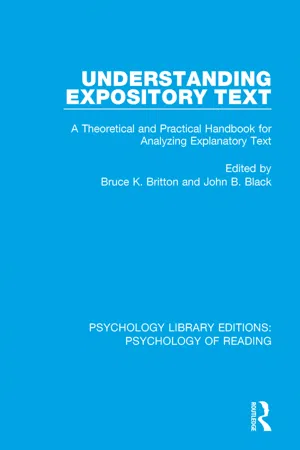
Originally published in 1985, the various chapters in this volume give examples of research on all three aspects of text understanding – namely, structure, world knowledge and process. More than this, however, the research described represents a shift in emphasis from studying stories, which dominated the field in the late 1970s, to studying expository text. This focus on stories was probably due to the essential first step in any science of examining the simplest materials possible. However, the editors thought that it was time to shift the research focus from stories to expository text and this volume is their attempt to provide this transition.
eBook - ePub
Understanding Expository Text
A Theoretical and Practical Handbook for Analyzing Explanatory Text
- 422 pages
- English
- ePUB (mobile friendly)
- Available on iOS & Android
eBook - ePub
Understanding Expository Text
A Theoretical and Practical Handbook for Analyzing Explanatory Text
About this book
Information
1 Understanding Expository Text: From Structure to Process and World Knowledge
Bruce K. Britton
University of Georgia
John B. Black
Yale University
Text is an ancient technology of information transfer. It must be almost as old as recorded history, for the record of history is preserved for the most part in the medium of text. The earliest texts whose meaning we understand describe what were apparently some objects of business and sacred transactions in Mycenaean Greece (circa 1400 B.C.; Chadwick, 1967; Ventris & Chadwick. 1956). Most of these texts (Chadwick, 1967) are of the expository form considered as “lists” by Meyer (in her chapter later in this volume), e.g.:
One footstool inlaid with a man and a horse and an octopus and a griffin in ivory.
One footstool inlaid with ivory lions’ heads and grooves.
One footstool inlaid with ivory nuts.
or
Kobalos repaid the following quantity of olive oil to Eumedes: 648 liters of oil. From Ipsewas, thirty-eight stirrup jars.
Some of them are quite evocative:
To all the gods, one amphora of honey.
To the Mistress of the Labyrinth, one amphora of honey. (p. 160)
The study of discourse structure seems to have begun in the Western world before 600 B.C. The systematic investigation of discourse structure was the major topic of the Greek teachers of rhetoric, and it was they who prepared the ground for the philosophers who laid the foundation for Western civilization. In contrast, the study of discourse structure in the Eastern world seems to be less ancient in origin. The focus of ancient language studies in the South Asian tradition was instead on the phonetic aspects of speech. The accurate transmission across the centuries of the spoken forms of the sacred documents—the most ancient is the Rigveda—seems to have been the objective of the early Indian linguists, who believed that the sounds of the sacred texts had significance in and of themselves. It is interesting to note that the discourse structure of the Rigveda itself is extremely complex (Klein, 1978, 1980) showing that the development of a technology of text does not depend on an explicit formal understanding of discourse structure. But such an understanding may nevertheless be very helpful in improving the technology. Many technologies that were originally developed without formal understanding have been greatly improved by it.
The importance of written text in the psychosocial evolution of the human race is difficult to exaggerate. As an extension of spoken language across historical time, it has permitted the binding together of mental events taking place at widely separated places and times, allowing ideas to be transmitted across generations, across cultures, and from beyond the grave, allowing each generation to stand on the shoulders of its predecessors.
The rate of information growth has increased exponentially throughout human history, and the rate of increase is now so rapid that no one can make good on Francis Bacon’s boast, “I have taken all knowledge to be my province.” Perhaps this information overload, and the stress on persons and society that it produces, is one reason why the study of text has expanded so rapidly over the past score of years. Most human knowledge is embodied in text, and most information transfer is through the medium of text. The information overload is primarily an overload of text. It is perhaps natural that the medium in which the overload is embodied should be due for some study on its own.
During most of the history of psychology, text was a background phenomenon: It was taken for granted in the sense that all scholarly discourse was expressed in the medium of text, but psychologists did not consider text a psychological phenomenon worthy of study in itself. Ebbinghaus (1885) used text in some of his experiments, but he was entirely concerned with developing a theory of memory, not with exploring the complexities of text itself, for which he had a healthy respect, noting that in
poetry or prose, the content is now narrative in style, now descriptive, or now reflective; it contains now a phrase that is pathetic, now one that is humorous; its metaphors are sometimes beautiful, sometimes harsh; its rhythm is sometimes smooth and sometimes rough. There is thus brought into play a multiplicity of influences which change without regularity and are therefore disturbing. Such are associations which dart here and there, different degrees of interest, lines of verse recalled because of their striking quality or their beauty, and the like. (23)
Bartlett (1932) also used text, but, like Ebbinghaus, he was not concerned with the text but with a theory of memory. Their successors in the verbal learning tradition wisely chose, in laying the foundation for the psychology of memory and thought, to simplify their materials as much as they could. They followed Ebbinghaus in his preference for meaningless materials like nonsense syllables, as a way of avoiding the complexities of text, which are
avoided with our syllables. Among many thousand combinations there occur scarcely a few dozen that have a meaning and among these there are again only a few whose meaning was realized while they were being memorized … More indubitable are the advantages of our material in two other respects. In the first place it permits an inexhaustible amount of new combinations of quite homogeneous character, while different poems, different prose pieces always have something incomparable. It also makes possible quantitative variation which is adequate and certain; whereas to break off before the end or to begin in the middle of the verse or the sentence leads to new complications because of various and unavoidable disturbances of the meaning. (pp. 23–24)
There followed three quarters of a century of working upward from nonsense syllables, digits and letters to lists of unrelated words as materials, arriving at isolated sentences only during the psycholinguistic revolution begun by Chomsky (1957). The results of those decades of careful work in the verbal learning tradition underly current developments in the understanding of text.
Meanwhile the linguists were proceeding with their analyses of text structure, although largely in isolation from the psychologists. The original impetus for modern linguistic studies of text structure had a religious basis. Translations of the Christian Bible into all the languages of the world was regarded by some denominations as a fundamental precondition for the eventual establishment of the kingdom of God on Earth. This was a formidable task from the beginning of the Christian era, and became even more formidable as more languages were discovered. Each language had to be learned by a translator, and this usually involved the preparation of a comprehensive dictionary and grammar; these are still the major source of our knowledge of many languages. But these early linguistic workers soon realized that a language was more than just words and sentences, for the structures of stories in different languages differ in striking ways. The Bible, which is mostly made up of a series of narratives, stories and parables, cannot be meaningfully translated just word for word and sentence for sentence, for the nature of a story itself differs in different languages (Fuller, 1959; Grimes, 1975; Longacre, 1968, 1972; Pike, 1954; Taber, 1966). It was the linguists’ analyses of narrative structures that provided the input for some of the early psychological investigations of text structure. Another linguistic current of fundamental importance has been the study of the linguistic relations between sentences (e.g., Halliday & Hasan, 1976).
In the decade of the 1970s the stage was set for the emergence of text as a major theme of psychological research. The verbal learning tradition had thoroughly worked out the major variables influencing verbal units in isolation and in unrelated groups, the psycholinguistic tradition was well advanced with the psychological analysis of the isolated sentence, and the linguists had developed text structure analyses. Also in the 1970s another major force emerged that emphasized the importance of research on text. This force is the new field of artificial intelligence (AI).
AI is the study of how to program computers so that they will exhibit intelligence. Athough AI had started in the 1950s (Feigenbaum & Feldman, 1963), it was not until the 1970s that language understanding became a major topic in the field (Schank, 1975; Schank & Colby, 1973; Winograd, 1983). Although language study in AI originally focused on words and sentences, the focus soon changed to full-fledged texts and discourses (Joshi, Webber, & Sag, 1981; Schank & Abelson, 1977). However, AI not only provided more impetus for the study of text understanding, but also indicated that the study of text structure alone was not sufficient for a complete explanation of text understanding.
In particular, merely knowing about text structure is not sufficient for the design of a computer program that will understand text; two other aspects are necessary. These aspects are (a) the processes used in understanding the text and retrieving the text information from memory later, and (b) the knowledge necessary to make the inferences that are needed to link the information in the text into a coherent mental representation of the text. Further, many of the inferences required not only knowledge about texts, but also general knowledge about the world and specialized knowledge about the domain being discussed. This knowledge is of several different kinds varying from lower-level word meanings to higher-level thematic patterns (Reiser, Black, & Lehnert, in press). The need for these different levels was highlighted by early attempts to generate inferences using only word meanings. These attempts found that inferences generated and constrained only by lower-level knowledge quickly get out of hand, so higher-level knowledge structures are necessary to channel the inferencing in appropriate directions.
For example, Rieger (1975) estimated that a single simple utterance would, if all the possible inferences were considered, generate an average of 750 inferences. This seems like a rather large number. It is instructive to consider first a much smaller set of inferences, say of size 20, not, it would seem, a very large number. But in a story of 100 utterances, with 20 possible inferences per utterance, there are 20100 (= 10130) possible paths. Do readers consider all of these? To see how large this number really is, we can consider some other numbers. The number of elementary particles in the universe is 1079; the number of seconds since the big bang is 1019; the shortest known time for a physical event is 10–24 second, which is the time it takes for light to cross an atomic nucleus. Together these numbers give us a not implausible estimate of the total number of events in the universe until now of about 10122. 10122 is less than 10130. So the universe has not had enough actual states to even represent all these possible story paths. That is, understanding this simple story could not have been finished by today if the universe were a dedicated computer devoted to this story since the beginning of time (example adapted and paraphrased from Wimsatt, 1980). This illustrates the magintude of savings due to using higher-level knowledge structures and text structures to constrain the inferences made during text understanding.
Higher-level structures constrain the possible inferences because they represent information about what can follow what in texts (higher-level text structures) and the world in general (world knowledge structures). For example, one well-studied world knowledge structure is the script (Abbott, Black, & Smith, in press; Bower, Black, & Turner, 1979; Graesser, 1981; Schank & Abelson, 1977). Scripts represent people’s knowledge about what happens in conventional, stereotyped situations like eating in a restaurant or visiting a doctor’s office. Such a knowledge structure constrains inferences because it provides the actions conventionally connecting other actions in the situation. For instance, if a description of a restaurant visit stated “John sat down at the table and gave his order,” then the restaurant script provides the inferences that he also probably read a menu and selected his order from the dishes listed there. The reader does not have to consider all the inferences possible when sitting at a table or giving orders, but merely the possibilities typical for that situation. Thus the world knowledge embodied in scripts provides constraints on the inferences that readers make when reading texts that evoke scripts.
A complete account of text understanding also requires specifying the processes that utilize these text and world knowledge structures to comprehend texts and build memories that represent the information in the texts in a form that facilitates later retrieval. For example, the various processes that need to be specified include those that connect meaning units in working memory (Kintsch & van Dijk, 1978), those that determine how mental resources will be allocated during reading (Britton, Glynn, Meyer, & Penland, 1982; Britton & Tesser, 1982; Graesser, Hoffman & Clark, 1980), those that evoke knowledge structures and use the structures to filter and sort the information in the text (Black, Galambos, & Read, in press), and those that organize the information for efficient retrieval (Reiser & Black, 1982). The processing aspect of text understanding has received less attention at this point than the structural and world knowledge aspects, so it is a particularly important topic for research in the near future.
Thus AI has added the study of processes and world knowledge to the traditional study of text structure. The various papers in Part 1 of this book represent these different aspects of studying expository text. In particular, Meyer (1975) was one of the first psychological studies of text structure and Meyer’s chapter in this volume gives the current state of that long-standing line of research. Mayer’s chapter...
Table of contents
- Cover
- Half Title
- Title Page
- Copyright Page
- Dedication
- Table of Contents
- I. THEORIES OF TEXT ANALYSIS
- 1. Understanding Expository Text: From Structure to Process and World Knowledge
- 2. Prose Analysis: Purposes, Procedures, and Problems
- 3. Structural Analysis of Science Prose: Can We Increase Problem-Solving Performance?
- 4. Thematic Processes in the Comprehension of Technical Prose
- 5. Implicit Knowledge, Question Answering, and the Representation of Expository Text
- 6. Knowledge and the Processing of Narrative and Expository Texts
- 7. A Knowledge-Based Model of Prose Comprehension: Applications to Expository Texts
- 8. Cognitive Demands of Processing Expository Text: A Cognitive Workbench Model
- 9. An Exposition on Understanding Expository Text
- II. A RESEARCH HANDBOOK FOR TEXT AND WORLD KNOWLEDGE ANALYSIS
- 10. Prose Analysis: Purposes, Procedures, and Problems (Part II)
- 11. How to Analyze Science Prose
- 12. A Guide to Propositional Analysis for Research on Technical Prose
- 13. How to Construct Conceptual Graph Structures
- 14. Knowledge and the Processing of Narrative and Expository Text: Some Methodological Issues
- 15. A Knowledge-Based Model of Prose Comprehension: An Annotated Trace
- Author Index
- Subject Index
Trusted by 375,005 students
Access to over 1.5 million titles for a fair monthly price.
Study more efficiently using our study tools.
Frequently asked questions
Yes, you can cancel anytime from the Subscription tab in your account settings on the Perlego website. Your subscription will stay active until the end of your current billing period. Learn how to cancel your subscription
No, books cannot be downloaded as external files, such as PDFs, for use outside of Perlego. However, you can download books within the Perlego app for offline reading on mobile or tablet. Learn how to download books offline
Perlego offers two plans: Essential and Complete
- Essential is ideal for learners and professionals who enjoy exploring a wide range of subjects. Access the Essential Library with 800,000+ trusted titles and best-sellers across business, personal growth, and the humanities. Includes unlimited reading time and Standard Read Aloud voice.
- Complete: Perfect for advanced learners and researchers needing full, unrestricted access. Unlock 1.5M+ books across hundreds of subjects, including academic and specialized titles. The Complete Plan also includes advanced features like Premium Read Aloud and Research Assistant.
We are an online textbook subscription service, where you can get access to an entire online library for less than the price of a single book per month. With over 1.5 million books across 990+ topics, we’ve got you covered! Learn about our mission
Look out for the read-aloud symbol on your next book to see if you can listen to it. The read-aloud tool reads text aloud for you, highlighting the text as it is being read. You can pause it, speed it up and slow it down. Learn more about Read Aloud
Yes! You can use the Perlego app on both iOS and Android devices to read anytime, anywhere — even offline. Perfect for commutes or when you’re on the go.
Please note we cannot support devices running on iOS 13 and Android 7 or earlier. Learn more about using the app
Please note we cannot support devices running on iOS 13 and Android 7 or earlier. Learn more about using the app
Yes, you can access Understanding Expository Text by Bruce K. Britton,John B. Black in PDF and/or ePUB format, as well as other popular books in Psychology & Cognitive Psychology & Cognition. We have over 1.5 million books available in our catalogue for you to explore.