Using case studies from the full range of educational institutions, this book, originally published in 1994, provides an analytical overview of the quality debate in British education, illuminating the evolution of one of the most prevalent and forceful cultural phenomena in contemporary education at the time. Lessons are learned from quality improvement in industry and public service, and the case studies show how procedural approaches like TQM, IIP and BS 5750 are being adapted to the educational context. Directed towards all involved in educational management, the book is of particular value to those responsible for initiating and monitoring quality improvement in their institutions.
eBook - ePub
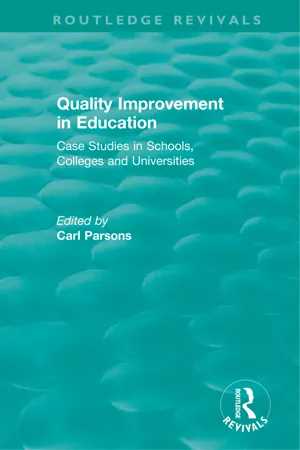
Quality Improvement in Education
Case Studies in Schools, Colleges and Universities
- 208 pages
- English
- ePUB (mobile friendly)
- Available on iOS & Android
eBook - ePub
About this book
Information
Chapter 1
The Politics and Practice of Quality
Carl Parsons
Introduction
Quality assurance management systems have been in existence for decades. The military set up procedures early in the century to try to ensure that suppliers delivered ammunition and weapons that were up to standard. Currently organizations that buy in components, materials or services from other producers or suppliers employ systems to ensure that those businesses are run in such a way as to minimize the possibility of faulty goods or deficient services being delivered. It is at the very least interesting to note the role of the military until very recently in the quality business: the Institute of Quality Assurance and the British Quality Association had retired brigadiers and rear admirals on their boards or councils. As the biggest procurer over the years of quality assured goods and services the domination of the forces should be no surprise. The NHS may, in more recent times, have become the biggest buyer. It seems better somehow to have quality assurance associated with improving and saving lives rather than with efficient killing! The British Quality Association, now the Federation, has a responsibility for running the National Quality Awards and the whole quality push has definitely moved from the military to the industrial and commercial. The inroads it has made into the education sector come largely from this quarter with TECs instituting procedures to audit and inspect colleges and training centres to which contracts are awarded. FE colleges are going for BS 5750 certification as a requirement for getting business from firms who are themselves required to have quality assurance registration.
As from 1 August 1994, BS 5750 becomes BS EN ISO 9000 (British Standards, 1994), with some changes in the clauses and standards statements. All this brings it more explicitly in line with the international standard, but the essentials remain the same and discussions in this and later chapters about BS 5750 remain stubbornly relevant.
Expensively produced, yet free, booklets have been available from DTI on such topics as The Quality Gurus (DTI, 1992a) and Total Quality Management and Effective Leadership (DTI, 1992a) along with a series of videos, also free. These are not directed at education but the advice must be to draw on quality wisdom wherever you can find it.
Against such a background this chapter has four purposes:
- to define quality assurance and associated terms;
- to review existing quality assurance management systems and frameworks;
- to examine the recent origins of, and the responses to, quality assurance demands;
- to develop a constructively critical view of quality management, whether partial quality management or total quality management.
Defining Quality
Quality is 'the totality of features and characteristics of a product or service that bear on its ability to satisfy stated or implied needs' (British Standards, 1987a). This covers fitness for purpose and satisfying customer needs.
Quality control is the 'operational techniques and activities that are used to fulfil requirements for quality' (British Standards, 1987a).
Quality assurance is all the planned and systematic actions necessary to provide adequate confidence that a product or service will satisfy given requirements for quality.
Quality audit is a check to see if the quality system exists and operates as claimed.
Quality assessment is making a judgement about the standards reached by an organization.
A quality assurance management system (QAMS) directs attention to the appropriate quality assurance controls that can be applied in all key areas and to all stages of supply of the product or service. This is to ensure that the processes involved in providing the product or service have been quality assured. The aims of a QAMS are to prevent non-conformity or customer problems and to achieve customer satisfaction; the objectives are to minimize risk and cost and maximize benefits that can be obtained from achieving the required quality standards (Vorley, 1991, p. 10)
A Standard Quality Assurance Management System: British Standards 5750
The best-known QAMS is the BS 5750 certification scheme which directly parallels the Geneva-based International Standards Organization's ISO 9000. The scheme has 18 or 20 sections, depending on whether the enterprise invents or designs its own product or service. British Standards have brought out advisory documents showing how the scheme, originally designed for manufacturing, could apply to services and, indeed, there is a specific advisory document for education. BSI certification is not an indicator that an institution is a quality institution but that it has procedures in place to check, control and assure quality. Table 1.1 sets out the sections that have to be satisfied and many of these can be readily interpreted into a form applicable to an educational setting. Freeman (1993) offers very helpful guidance for educational institutions applying for BS 5750.
Table 1.1 ISO 9000/ BS 5750 quality standard categories
| 4.1 | Management responsibility |
| 4.2 | Quality system |
| 4.3 | Contract review |
| 4.4 | Design control |
| (Part 1 only unless the product or service is unique, i.e. invented by the institution) | |
| 4.5 | Document control |
| 4.6 | Purchasing |
| 4.7 | Purchaser supplied product |
| 4.8 | Product identification and traceability |
| 4.9 | Process control |
| 4.10 | Inspection and testing |
| 4.11 | Inspection, measuring and test equipment (sometimes called 'calibration') |
| 4.12 | Inspection and test status |
| 4.13 | Control of non-conforming product |
| 4.14 | Corrective action |
| 4.15 | Handling, storage, packaging and delivery |
| 4.16 | Quality records |
| 4.17 | Internal quality audits |
| 4.18 | Training |
| 4.19 | Servicing (Part 1 only unless contract agreement requires follow-up) |
| 4.20 | Statistical techniques |
Source: (BSI,1987b)
Some authors (e.g., Vorley, 1991) actually suggest that other focuses should be part of a quality system also. These include after-sales servicing, as in 4.19 above, market reporting, product safety and reliability, motivation (of the work force) and economics (the cost of achieving quality or the cost of poor quality).
The benefits of certification are said to be various, and include:
- a fully documented system which informs insiders about the organization and systems for documentation, quality checks and support;
- documentation that is very useful for the induction of newcomers;
- it points out the gaps in procedures, areas of uncertainty, areas where data should be available and where checks should be made regularly;
- it gives a sense of control, i.e. it sets out important aspects of how the work of the organization should be run and what records there are that it is being run according to the plan (being out of control simply means not being quite sure what is going on);
- a documented system to assure (impress?) outsiders; it is powerful in presenting to outside bodies which have a stake in the organization (DfE, FEFCE, HEFCE, HEQC) that it is run well and that, consequently, there is little need to check the organization thoroughly themselves — the Let's Do It To Ourselves Before They Do It To Us syndrome! (Parsons, 1992);
- it can provide the basis for a total quality management approach.
The drawbacks are less about the expense of setting up and maintaining the system — though certification is expensive — than with the language and structure of the system and the fact that it does not apply naturally to education.
Lesser and Partial Quality Assurance Man...
Table of contents
- Cover
- Title
- Copyright
- Original Title
- Original Copyright
- Contents
- Preface
- Contributors
- Chapter 1: The Politics and Practice of Quality
- Chapter 2: Quality Improvement in Action
- Chapter 3: TQM Goes to School
- Chapter 4: A Quest for Quality in Key Stage 1 Assessment
- Chapter 5: Parents in Partnership
- Chapter 6: Communication and Quality in the Primary School
- Chapter 7: BS 5750 and Beyond in a Secondary School
- Chapter 8: Getting a Secondary School's Ready for OFSTED Inspection
- Chapter 9: Acting up: Quality Assurance in A Level Theatre Studies and GCSE Drama
- Chapter 10: The Listening School: Sixth Formers and Staff as Customers of Each Other
- Chapter 11: Investors in People in a College of Further Education
- Chapter 12: BS 5750 and on to TQM in a College of Further Education
- Chapter 13: Operating beyond BS 5750 in a Training Centre
- Chapter 14: Right Second Time: TQM in the In-service Training of Professionals
- Chapter 15: Number-crunching Quality Control in Teacher Education
- Chapter 16: Training for Quality Management in Healthcare
- Chapter 17: Strategic Quality Improvement at De Montfort University
- Chapter 18: Southampton's Departmental Self-assessment Programme
- Bibliography
- Index
Trusted by 375,005 students
Access to over 1.5 million titles for a fair monthly price.
Study more efficiently using our study tools.
Frequently asked questions
Yes, you can cancel anytime from the Subscription tab in your account settings on the Perlego website. Your subscription will stay active until the end of your current billing period. Learn how to cancel your subscription
No, books cannot be downloaded as external files, such as PDFs, for use outside of Perlego. However, you can download books within the Perlego app for offline reading on mobile or tablet. Learn how to download books offline
Perlego offers two plans: Essential and Complete
- Essential is ideal for learners and professionals who enjoy exploring a wide range of subjects. Access the Essential Library with 800,000+ trusted titles and best-sellers across business, personal growth, and the humanities. Includes unlimited reading time and Standard Read Aloud voice.
- Complete: Perfect for advanced learners and researchers needing full, unrestricted access. Unlock 1.5M+ books across hundreds of subjects, including academic and specialized titles. The Complete Plan also includes advanced features like Premium Read Aloud and Research Assistant.
We are an online textbook subscription service, where you can get access to an entire online library for less than the price of a single book per month. With over 1.5 million books across 990+ topics, we’ve got you covered! Learn about our mission
Look out for the read-aloud symbol on your next book to see if you can listen to it. The read-aloud tool reads text aloud for you, highlighting the text as it is being read. You can pause it, speed it up and slow it down. Learn more about Read Aloud
Yes! You can use the Perlego app on both iOS and Android devices to read anytime, anywhere — even offline. Perfect for commutes or when you’re on the go.
Please note we cannot support devices running on iOS 13 and Android 7 or earlier. Learn more about using the app
Please note we cannot support devices running on iOS 13 and Android 7 or earlier. Learn more about using the app
Yes, you can access Quality Improvement in Education by Carl Parsons in PDF and/or ePUB format, as well as other popular books in Education & Education General. We have over 1.5 million books available in our catalogue for you to explore.