- 360 pages
- English
- ePUB (mobile friendly)
- Available on iOS & Android
eBook - ePub
Septic Tank System Effects on Ground Water Quality
About this book
This valuable reference delineates the ground water quality concerns associated with the planning and usage of septic tank systems. Septic tank systems represent a significant source of ground water pollution in the United States. Since many existing systems are exceeding their design life by several-fold, the usage of synthetic organic chemicals in the household and for system cleaning is increasing, and larger-scale systems are being designed and used.
Information
CHAPTER 1
INTRODUCTION
The first reported use of a septic tank for serving the wastewater disposal needs of a household was in France about 1870. Septic tanks were introduced in the United States in 1884 through the use of a two-chamber tank utilizing an automatic siphon for intermittent effluent disposal (Cotteral and Norris, 1969). Since their introduction in the United States, septic tanks systems have become the most widely used method of on-site sewage disposal, with over 70 million people depending on them (Hershaft, 1976). Approximately 17 million housing units, or 1/3 of all housing units, dispose of domestic wastewater through the use of septic tank systems. About 25 percent of all new homes being constructed in the United States use septic tank systems for treatment prior to disposal of the home-generated wastewater (U.S. Environmental Protection Agency, October 1980). Figure 1 is a summary of the approximate populations in the United States utilizing septic tank systems. As can be seen, the greatest densities of usage occur in the east and southeast as well as the northern tier and northwest portions of the country.
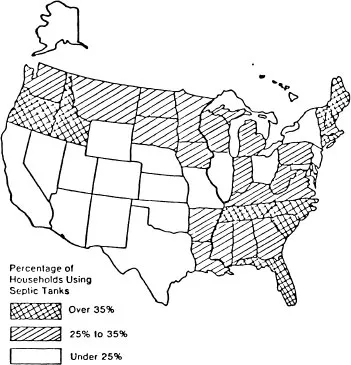
Figure 1: Approximate Populations Using Septic Tanks
A septic tank system includes both the septic tank and the subsurface soil absorption system. Approximately 800 billion gallons of wastewater is discharged annually to the soil via tile fields following the 17 million septic tanks (Scalf, Dunlap and Kreissl, 1977). Of all ground water pollution sources, septic tank systems and cesspools rank highest in total volume of wastewater discharged directly to soils overlying ground water, and they are the most frequently reported sources of contamination (U.S. Environmental Protection Agency, 1977). Figure 2 displays the components of the septic tank system and indicates the general relationship between the soil absorption system and underlying ground water (Bouma, 1979). In sparsely populated urban and rural areas, septic tank systems that have been properly designed, constructed, and maintained are efficient and economical alternatives to public sewage disposal systems. However, due to poor locations for many septic tank systems, as well as poor designs and construction and maintenance practices, septic tank systems have polluted, or have the potential to pollute, underlying ground waters. It is estimated that only 40 percent of existing septic tanks function in a proper manner. A major concern in many locations is that the density of the septic tanks is greater than the natural ability of the subsurface environment to receive and purify system effluents prior to their movement into ground water. A related issue is that the design life of many septic tank systems is in the order of 10-15 years. Due to the rapid rate of placement of septic tank systems in the 1960’s, the usable life of many of the systems is being exceeded, and ground water contamination is beginning to occur.
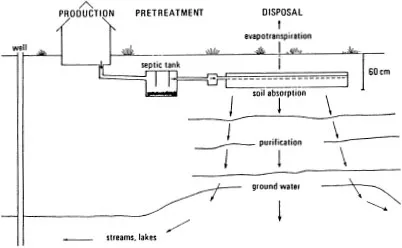
Figure 2: Schematic Cross-Section Through a Conventional Septic Tank Soil Disposal System for On-Site Disposal and Treatment of Domestic Liquid Waste (Bouma, 1979)
A type of ground water pollution of historical as well as current concern is associated with bacterial contamination. Contamination of drinking supplies by malfunctioning septic tank systems has caused outbreaks of waterborne communicable diseases. Documented cases of infectious hepatitis (Hepatitis a) have been traced to contaminated water. In central Appalachia, where few people are served by sewers and septic tank systems often malfunction, the occurrence of infectious hepatitis is high. Many other pathogens, such as typhoid, cholera, streptococci, salmonella, poliomyelitis, and protozoans are also transmitted by septic tank system overflows. Many of these pathogenic organisms have a slow die-off rate in the subsurface environment.
While localized incidents of ground water pollution from septic tank systems are of concern, regional problems have also been recognized in areas of high septic tank system density. Within the United States there are four counties (Nassau and Suffolk, New York; Dade, Florida; and Los Angeles, California) with more than 100,000 housing units served by septic tank systems and cesspools. In addition, there are 23 counties with more than 50,000 housing units served by septic tank systems and cesspools (U.S. Environmental Protection Agency, 1977). Table 1 summarizes relevant county statistics and the density (number per square mile) of septic tank systems and cesspools (U.S. Department of Commerce, 1980; and Newspaper Enterprise Association, Inc., 1982). Densities range from as low as 2 to greater than 346 per square mile. It should be noted that the densities were calculated based on assuming an even distribution of the septic tank systems and cesspools throughout the county. If they are localized in segments of the county the actual densities could be several times greater than those shown in Table 1. Density ranges can be considered as low (less than 10 per square mile or 3.8 per square kilometer), intermediate (between 10 and 40 per square mile, or 3.8 and 15 per square kilometer), and high (greater than 40 per square mile or 15 per square kilometer). Areas with more than 40 per square mile can be considered to have potential contamination problems. Actual densities in areas with documented problems have considerably exceeded the arbitrary 40 per square mile indicator (U.S. Environmental Protection Agency, 1977). Another means of expressing density is by the number per acre, with 40 per square mile equalling 0.062 per acre. The maximum density shown in Table 1 is 346 per square mile, or 0.54 per acre. Considering septic tank system localization within a county, or nonuniform distribution, it would be possible for several counties listed in Table 1 to have densities of greater than 1 septic tank system per acre.
Table 1: Densities of Septic Tank Systems and Cesspools for Counties with More than 50,000 Housing Units Served by These Systems
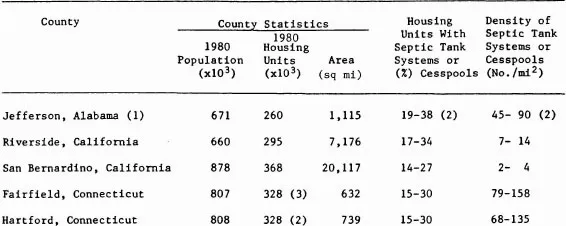
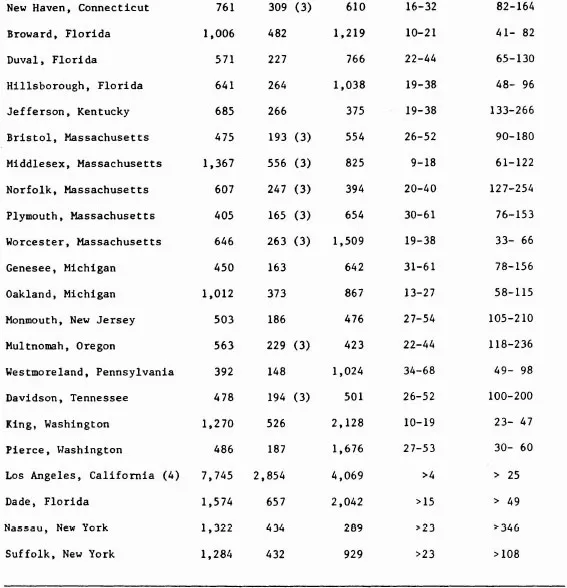
(1) Counties from Jefferson, Alabama through Pierce, Washington have more than 50,000 housing units, but less than 100,000 housing units, served by septic tank systems.
(2) First number is based on 50,000 housing units served by septic tank systems, and second number by 100,000 housing units served by septic tank systems.
(3) Calculated based on 2.46 persons per housing unit; this value based on reported data for counties of Jefferson, Alabama; Riverside and San Bernardino, California; Broward, Duval, and Hillsborough, Florida; Jefferson, Kentucky; Genesee and Oakland, Michigan; Monmouth, New Jersey; Westmoreland, Pennsylvania; and King and Pierce, Washington.
(4) Counties from Los Angeles, California through Suffolk, New York have more than 100,000 housing units served by septic tank systems.
SEPTIC TANK SYSTEM REGULATION
Several types of institutional arrangements have been developed for regulating septic tank system design and installation, operation and maintenance, and failure detection and correction. Most of the regulatory activities are conducted by state and local governments. Design and siting regulations exist in most states for both individual housing unit systems as well as systems serving clusters of up to several hundred housing units (U.S. Environmental Protection Agency, 1977). Site inspection and installation permit issuance is handled either by the state, regional authority, county, or town, or by a joint effort by two or more of these entities. A state or local governmental entity may regulate all domestic and industrial septic tank system installations; or it may regulate only systems serving multiple housing units and/or industries; or it may regulate only installations in certain critical areas. Where regulations exist, the associated inspections may range from minimal checking to comprehensive evaluations. State regulation and inspection of septic tank installation is generally considered to be more effective than local regulation (U.S. Environmental Protection Agency, 1977).
Operation and maintenance of single housing unit septic tank systems is largely not regulated and is left to the judgment of the system owner. Systems serving multiple housing units or industries may be subject to routine inspections and reporting requirements. Failure detection and correction is difficult to regulate and is typically handled on an individual complaint basis or when a health hazard arises (U.S. Environmental Protection Agency, 1977).
In terms of protection of ground water quality...
Table of contents
- Cover
- Title Page
- Copyright Page
- Dedication
- Table of Contents
- 1 INTRODUCTION
- 2 DESIGN OF SEPTIC TANK SYSTEMS
- 3 GROUND WATER POLLUTION FROM SEPTIC TANK SYSTEMS
- 4 SEPTIC TANK SYSTEM MODELING
- 5 SUMMARY
- APPENDIX A: ANNOTATED BIBLIOGRAPHY
- APPENDIX B: CHARACTERISTICS OF SEPTIC TANK AREAS IN CENTRAL OKLAHOMA
- APPENDIX C: PHILLIPS, NATHWANI AND MOOIJ ASSESSMENT MATRICES
- APPENDIX D: ERROR FUNCTION IN HANTUSH ANALYTICAL MODEL
- APPENDIX E: KONIKOW-BREDEHOEFT SOLUTE TRANSPORT MODEL
- INDEX
Trusted by 375,005 students
Access to over 1.5 million titles for a fair monthly price.
Study more efficiently using our study tools.
Frequently asked questions
Yes, you can cancel anytime from the Subscription tab in your account settings on the Perlego website. Your subscription will stay active until the end of your current billing period. Learn how to cancel your subscription
No, books cannot be downloaded as external files, such as PDFs, for use outside of Perlego. However, you can download books within the Perlego app for offline reading on mobile or tablet. Learn how to download books offline
Perlego offers two plans: Essential and Complete
- Essential is ideal for learners and professionals who enjoy exploring a wide range of subjects. Access the Essential Library with 800,000+ trusted titles and best-sellers across business, personal growth, and the humanities. Includes unlimited reading time and Standard Read Aloud voice.
- Complete: Perfect for advanced learners and researchers needing full, unrestricted access. Unlock 1.5M+ books across hundreds of subjects, including academic and specialized titles. The Complete Plan also includes advanced features like Premium Read Aloud and Research Assistant.
We are an online textbook subscription service, where you can get access to an entire online library for less than the price of a single book per month. With over 1.5 million books across 990+ topics, we’ve got you covered! Learn about our mission
Look out for the read-aloud symbol on your next book to see if you can listen to it. The read-aloud tool reads text aloud for you, highlighting the text as it is being read. You can pause it, speed it up and slow it down. Learn more about Read Aloud
Yes! You can use the Perlego app on both iOS and Android devices to read anytime, anywhere — even offline. Perfect for commutes or when you’re on the go.
Please note we cannot support devices running on iOS 13 and Android 7 or earlier. Learn more about using the app
Please note we cannot support devices running on iOS 13 and Android 7 or earlier. Learn more about using the app
Yes, you can access Septic Tank System Effects on Ground Water Quality by Larry W. Canter,Robert C. Knox in PDF and/or ePUB format, as well as other popular books in Technology & Engineering & Hydrology. We have over 1.5 million books available in our catalogue for you to explore.