eBook - ePub
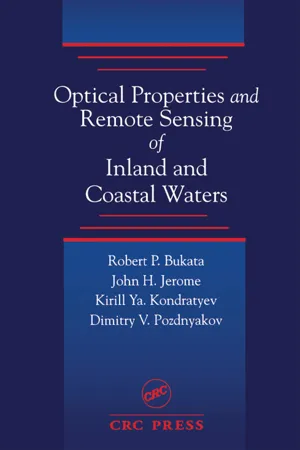
Optical Properties and Remote Sensing of Inland and Coastal Waters
- 384 pages
- English
- ePUB (mobile friendly)
- Available on iOS & Android
eBook - ePub
Optical Properties and Remote Sensing of Inland and Coastal Waters
About this book
Optical Properties and Remote Sensing of Inland and Coastal Waters discusses the methodology and the theoretical basis of remote sensing of water. It presents physical concepts of aquatic optics relevant to remote sensing techniques and outlines the problems of remote measurements of the concentrations of organic and inorganic matter in water. It also details the mathematical formulation of the processes governing water-radiation interactions and discusses the development of bio-optical models to incorporate optically complex bodies of water into remote sensing projects.
Optical Properties and Remote Sensing of Inland and Coastal Waters derives and evaluates the interrelationships among inherent optical properties of natural water, water color, water quality, primary production, volume reflectance spectra, and remote sensing. This timely and comprehensive text/reference addresses the increasing tendency toward multinational and multidisciplinary climate studies and programs.
Information
Chapter 1
INTRODUCTORY THEORY
1.1 AQUATIC OPTICS
In its broadest terms, optics is generally defined as that branch of physics concerned with the interactions of light with its containment medium as the light propagates through that medium. Aquatic optics generally restricts its definition of containment media to those found in naturally occurring water bodies. Since, however, the point of origin and/or final destination of the light propagation under study are very often in media other than those comprising the naturally occurring water bodies, aquatic optics must also contend with the transference of light among these adjacent media. The propagation of light through the atmosphere and the interaction of light with the solid matter containing the natural water body must, therefore, be appropriately incorporated into the principles of aquatic optics.
Aquatic optics can be subdivided according to whether the natural water body is salty (oceanographic), inland or fresh (limnological), or coastal. Oceanographic optics has long been recognized as an integral component of oceanography, and has benefitted from rapid advances in the development of sophisticated submersible spectro-optical devices and computer-based interpretative techniques. Limnological optics has not enjoyed the same longstanding recognition as has oceanographic optics, although the sophisticated spectro-optical devices and computer-based interpretative techniques offer comparable benefits. It is not the purpose of this book to dwell on the possible reasons for such an historical lack of recognition, but rather to address the nature of the limnological light field and the behavior of photons within such an aquatic environment. The fundamental theory of radiative transfer developed for atmospheric and oceanographic optics is directly applicable to the study of both the limnological and the coastal environments. However, due to the basic differences amongst oceanographic and limnological aquatic compositions, much of the interpretive techniques are not directly applicable. These similarities and differences will be discussed throughout this book.
The launch of ERTS-1 (the Earth Resources Technology Satellite, later renamed Landsat-1) in August 1972 introduced remote sensing as a potential tool to the protocols of environmental monitoring. Mounted onboard ERTS-1 was a broadband multispectral scanning device which recorded the radiation upwelling from the target contained within the field-of-view of the downward-looking multispectral scanning device. This target was an environmental ecosystem comprised of atmospheric, terrestrial, and/or aquatic regimes. Consequently, the satellite sensor recorded an integrated spectral signature representing the reflected portion of the solar and sky radiation impinging upon the earth (later sensors recorded a second signature representing the thermal energy generated by the ecosystem itself). Since the parameter recorded at the orbiting satellite was optical in nature, it logically followed that such optical data should be interpreted in terms of the optical properties of the environmental targets. Remote sensing and its potential role in environmental monitoring activities became, therefore, intimately linked with aquatic optics, providing, as it did, a need to understand the interactive nature of electromagnetic radiation and natural water bodies.
As subsequent satellites were launched (some such as Nimbus-7 and Seasat were dedicated predominantly to the study of oceans and ocean color), techniques to extract oceanographic information from the continuous streams of remotely-sensed data were rapidly developed. Understandably, these environmental satellites contained payloads of optical devices sensitive to various energy regions of the electromagnetic spectrum. It is the intention of this book to review the philosophy and scientific theory governing such information extraction within a restricted region of the electromagnetic spectrum, namely the visible wavelength region. While other regions of the electromagnetic spectrum (most notably microwave, radar, and thermal infrared) have been justifiably represented by the complements of sensors comprising both aircraft and satellite remote sensing missions dedicated to aquatic studies, measurement of water colour continues to comprise a major component of such remote sensing activities. For this reason, the major thrust of this book will be directed towards an interpretation of visible light (that is, radiation contained within the boundaries of the color wavelengths) emanating from inland and coastal natural water bodies (that is, natural waters influenced by their proximity to land masses).
To accommodate this thrust, the basic theory and general principles of aquatic optics and light propagation will first be briefly reviewed. A glossary is included at the end of this book defining the terminology that will be used throughout the text. Remote sensing will be treated as a parallel topic wi...
Table of contents
- Cover
- Half Title
- Title Page
- Copyright Page
- Table of Contents
- Chapter 1: Introductory Theory
- Chapter 2: Incident Radiation
- Chapter 3: The Propagation of Atmospheric Photon Fluxes into Natural Water Bodies
- Chapter 4: Composition of Natural Waters
- Chapter 5: The Effects of Chlorophyll, Suspended Minerals, and Dissolved Organic Carbon on Volume Reflectance
- Chapter 6: Chromaticity and the Color of Natural Water
- Chapter 7: Observations of Optical Properties of Natural Waters (the Laurentian Great Lakes)
- Chapter 8: Remote Sensing over Natural Water
- Chapter 9: Primary Production in Natural Water
- Chapter 10: Aquatic Remote Sensing in Regional and Global Environmental Monitoring
- References
- Glossary
- Index
Trusted by 375,005 students
Access to over 1.5 million titles for a fair monthly price.
Study more efficiently using our study tools.
Frequently asked questions
Yes, you can cancel anytime from the Subscription tab in your account settings on the Perlego website. Your subscription will stay active until the end of your current billing period. Learn how to cancel your subscription
No, books cannot be downloaded as external files, such as PDFs, for use outside of Perlego. However, you can download books within the Perlego app for offline reading on mobile or tablet. Learn how to download books offline
Perlego offers two plans: Essential and Complete
- Essential is ideal for learners and professionals who enjoy exploring a wide range of subjects. Access the Essential Library with 800,000+ trusted titles and best-sellers across business, personal growth, and the humanities. Includes unlimited reading time and Standard Read Aloud voice.
- Complete: Perfect for advanced learners and researchers needing full, unrestricted access. Unlock 1.5M+ books across hundreds of subjects, including academic and specialized titles. The Complete Plan also includes advanced features like Premium Read Aloud and Research Assistant.
We are an online textbook subscription service, where you can get access to an entire online library for less than the price of a single book per month. With over 1.5 million books across 990+ topics, we’ve got you covered! Learn about our mission
Look out for the read-aloud symbol on your next book to see if you can listen to it. The read-aloud tool reads text aloud for you, highlighting the text as it is being read. You can pause it, speed it up and slow it down. Learn more about Read Aloud
Yes! You can use the Perlego app on both iOS and Android devices to read anytime, anywhere — even offline. Perfect for commutes or when you’re on the go.
Please note we cannot support devices running on iOS 13 and Android 7 or earlier. Learn more about using the app
Please note we cannot support devices running on iOS 13 and Android 7 or earlier. Learn more about using the app
Yes, you can access Optical Properties and Remote Sensing of Inland and Coastal Waters by Robert P. Bukata,John H. Jerome,Alexander S. Kondratyev,Dimitry V. Pozdnyakov in PDF and/or ePUB format, as well as other popular books in Technology & Engineering & Oceanography. We have over 1.5 million books available in our catalogue for you to explore.