- 704 pages
- English
- ePUB (mobile friendly)
- Available on iOS & Android
eBook - ePub
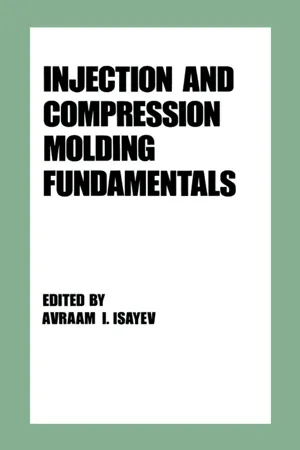
Injection and Compression Molding Fundamentals
About this book
This outstanding reference presents an up-to-date account of investigations during the last10 years in the area of injection and compression molding of polymers.Injection and Compression Molding Fundamentals considers simulation andexperimentation of flow dynamics in the cavity and delivery system . . . discussesrheology and viscoelastic modeling ... clarifies fiber orientation ... delineates residualstresses and processing-property relationships in molded parts ... and details computeraideddesign and manufacture of the mold.In addition, the book highlights specific features and problems related to the molding ofthermoplastics, rubbers, and thermosets ... and reveals the current status of the sciencebasedtechnology related to injection and compression molding.The most detailed and authoritative reference of its type, Injection and CompressionMolding Fundamentals is an invaluable resource for plastics, mechanical, andchemical engineers; colloid, oil, and color chemists; polymer engineers and scientists;mold designers and manufacturers; rheologists; and materials scientists. The book willalso be of value for use in graduate-level courses in plastics, mechanical, chemical, andpolymer engineering, and in short courses and seminars offered by professional societies.
Information
1
Melt-Viscosity Characterization and Its Application to Injection Molding
Sibley School of Mechanical and Aerospace Engineering
Cornell University
Ithaca, New York
I. INTRODUCTION
The scientific investigation of the injection-molding process can be traced back at least to the pioneering work of Gilmore and Spencer [1, 2] at Dow, during the early 1950s, and to Ballman and co-workers [3, 4] at Monsanto, during the late 1950s. A finite-difference formulation for numerical simulation was presented by Pearson [5] in the mid-1960s but not implemented until the early 1970s in the well-known works by Kamal and Kenig [6] and by Gogos and co-workers [[7, 8]. Since then, the application of computer simulations to the injection-molding process has clearly intensified, and its commercialization, pioneered by Austin 9], has resulted in viable computer-aided engineering (CAE) tools for mold design.
One main objective in this chapter is to present a detailed description of the basic elements involved in simulating the cavity-filling stage of the injection-molding process. This is done in Section III, with the formulation being given in terms of a fluid whose shear viscosity can have an arbitrary dependence upon shear rate, temperature, and pressure. Accordingly, a second objective is to present detailed results concerning the characterization of such viscosity. This is done in Section II. Thirdly, although a general viscosity model may not always be needed for the cavity-filling stage, Section IV shows that such a model is essential when extending the simulation to the postfilling stage.
II. MELT-VISCOSITY CHARACTERIZATION
A. Viscosity Fits Using Cross-Arrhenius Model
In modeling the flow dynamics in injection molding, the single most important polymer property is the shear viscosity η. Accordingly, this section is concerned with the characterization of η, making extensive use of a viscosity data bank which has recently been developed by the Cornell Injection Molding Program (CIMP). Currently, this data bank consists of approximately 300 sets of viscosity measurements with corresponding fits. Many of these sets are from the open literature, such as the well-known compendium of Westover [10] and the recent book Rheologie [11]. Arranged according to generic material, viscosity measurements from the following sources have been fitted: ...
Table of contents
- Cover
- Half Title
- Title Page
- Copyright Page
- Table of Contents
- Preface
- Introduction
- Contributors
- 1. Melt-Viscosity Characterization and Its Application to Injection Molding
- 2. Flow of Polymeric Melts in Junture Regions of Injection Molding
- 3. Orientation, Residual Stresses, and Volumetric Effects in Injection Molding
- 4. Thermoset Injection Molding
- 5. Rheological Behavior and Molding Technology of Elastomers
- 6. Injection Molding of Rubber Compounds
- 7. Compression Molding of Polymers and Composites
- 8. Design of Mold Cooling System
- 9. Computer-Aided Mold Design and Manufacturing
- Author Index
- Subject Index
Trusted by 375,005 students
Access to over 1.5 million titles for a fair monthly price.
Study more efficiently using our study tools.
Frequently asked questions
Yes, you can cancel anytime from the Subscription tab in your account settings on the Perlego website. Your subscription will stay active until the end of your current billing period. Learn how to cancel your subscription
No, books cannot be downloaded as external files, such as PDFs, for use outside of Perlego. However, you can download books within the Perlego app for offline reading on mobile or tablet. Learn how to download books offline
Perlego offers two plans: Essential and Complete
- Essential is ideal for learners and professionals who enjoy exploring a wide range of subjects. Access the Essential Library with 800,000+ trusted titles and best-sellers across business, personal growth, and the humanities. Includes unlimited reading time and Standard Read Aloud voice.
- Complete: Perfect for advanced learners and researchers needing full, unrestricted access. Unlock 1.5M+ books across hundreds of subjects, including academic and specialized titles. The Complete Plan also includes advanced features like Premium Read Aloud and Research Assistant.
We are an online textbook subscription service, where you can get access to an entire online library for less than the price of a single book per month. With over 1.5 million books across 990+ topics, we’ve got you covered! Learn about our mission
Look out for the read-aloud symbol on your next book to see if you can listen to it. The read-aloud tool reads text aloud for you, highlighting the text as it is being read. You can pause it, speed it up and slow it down. Learn more about Read Aloud
Yes! You can use the Perlego app on both iOS and Android devices to read anytime, anywhere — even offline. Perfect for commutes or when you’re on the go.
Please note we cannot support devices running on iOS 13 and Android 7 or earlier. Learn more about using the app
Please note we cannot support devices running on iOS 13 and Android 7 or earlier. Learn more about using the app
Yes, you can access Injection and Compression Molding Fundamentals by Avraam L. Isayev in PDF and/or ePUB format, as well as other popular books in Technology & Engineering & Materials Science. We have over 1.5 million books available in our catalogue for you to explore.