Global Resource Scarcity
eBook - ePub

Global Resource Scarcity

Catalyst for Conflict or Cooperation?

  1. 210 pages
  2. English
  3. ePUB (mobile friendly)
  4. Available on iOS & Android
eBook - ePub

Global Resource Scarcity

Catalyst for Conflict or Cooperation?

About this book

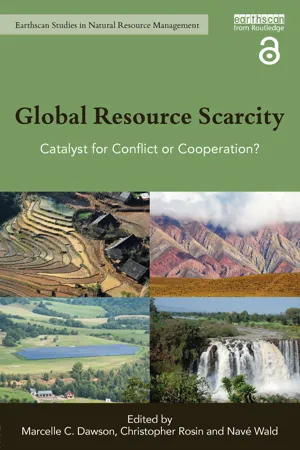
A common perception of global resource scarcity holds that it is inevitably a catalyst for conflict among nations; yet, paradoxically, incidents of such scarcity underlie some of the most important examples of international cooperation. This volume examines the wider potential for the experience of scarcity to promote cooperation in international relations and diplomacy beyond the traditional bounds of the interests of competitive nation states.

The interdisciplinary background of the book's contributors shifts the focus of the analysis beyond narrow theoretical treatments of international relations and resource diplomacy to broader examinations of the practicalities of cooperation in the context of competition and scarcity. Combining the insights of a range of social scientists with those of experts in the natural and bio-sciences—many of whom work as 'resource practitioners' outside the context of universities—the book works through the tensions between 'thinking/theory' and 'doing/practice', which so often plague the process of social change. These encounters with scarcity draw attention away from the myopic focus on market forces and allocation, and encourage us to recognise more fully the social nature of the tensions and opportunities that are associated with our shared dependence on resources that are not readily accessible to all.

The book brings together experts on theorising scarcity and those on the scarcity of specific resources. It begins with a theoretical reframing of both the contested concept of scarcity and the underlying dynamics of resource diplomacy. The authors then outline the current tensions around resource scarcity or degradation and examine existing progress towards cooperative international management of resources. These include food and water scarcity, mineral exploration and exploitation of the oceans. Overall, the contributors propose a more hopeful and positive engagement among the world's nations as they pursue the economic and social benefits derived from natural resources, while maintaining the ecological processes on which they depend.

Frequently asked questions

Yes, you can cancel anytime from the Subscription tab in your account settings on the Perlego website. Your subscription will stay active until the end of your current billing period. Learn how to cancel your subscription.
No, books cannot be downloaded as external files, such as PDFs, for use outside of Perlego. However, you can download books within the Perlego app for offline reading on mobile or tablet. Learn more here.
Perlego offers two plans: Essential and Complete
  • Essential is ideal for learners and professionals who enjoy exploring a wide range of subjects. Access the Essential Library with 800,000+ trusted titles and best-sellers across business, personal growth, and the humanities. Includes unlimited reading time and Standard Read Aloud voice.
  • Complete: Perfect for advanced learners and researchers needing full, unrestricted access. Unlock 1.4M+ books across hundreds of subjects, including academic and specialized titles. The Complete Plan also includes advanced features like Premium Read Aloud and Research Assistant.
Both plans are available with monthly, semester, or annual billing cycles.
We are an online textbook subscription service, where you can get access to an entire online library for less than the price of a single book per month. With over 1 million books across 1000+ topics, we’ve got you covered! Learn more here.
Look out for the read-aloud symbol on your next book to see if you can listen to it. The read-aloud tool reads text aloud for you, highlighting the text as it is being read. You can pause it, speed it up and slow it down. Learn more here.
Yes! You can use the Perlego app on both iOS or Android devices to read anytime, anywhere — even offline. Perfect for commutes or when you’re on the go.
Please note we cannot support devices running on iOS 13 and Android 7 or earlier. Learn more about using the app.
Yes, you can access Global Resource Scarcity by Marcelle C. Dawson, Christopher Rosin, Nave Wald, Marcelle C. Dawson,Christopher Rosin,Nave Wald in PDF and/or ePUB format, as well as other popular books in Biological Sciences & Ecology. We have over one million books available in our catalogue for you to explore.

Information

Part I
Reframing scarcity and resource diplomacy

2 Taking the scare out of scarcity

The case of water1
Lyla Mehta


Introduction

Ideas about resource scarcity and their implications for human wellbeing, economic growth and human security lie at the heart of global policy debates. Yet scarcity remains a contested concept, meaning different things to different groups. In this chapter, I demonstrate that spreading fear about the planet’s diminishing resources serves the status quo and can result in keeping poor people poor (see Rayner, 2010). I argue that the assumption that needs and wants are unlimited and the means to satisfy them are scarce has led to scarcity emerging as a totalising discourse in both the North and South (see Hildyard, 2010). The ‘scare’ of scarcity has led to scarcity emerging as a political strategy for powerful groups. But scarcity is not a natural condition: the problem lies in how we see scarcity and the ways in which it is socially generated (see Mehta, 2010). Thus, we need to focus on the fundamental issues of resource allocation, access, entitlements and social justice, rather than drawing on simplistic, neo-Malthusian and universalising notions of scarcity. These issues are developed in this chapter through the case of water in the context of global debates and experiences from the Global South.
Since the mid-1990s, I have been working on the politics and social construction of water scarcity and questioning how it has been naturalised in policy debates as well as programmes. This work began in western India in Kutch, Gujarat, where I looked at how large dams were made out to be the panacea of water scarcity (see Mehta, 2005). A few years later I was concerned with examining the intellectual history of scarcity and its application to current policy and practice (see Mehta, 2010). I will draw on both of these as well as more recent work. The discussion begins by providing a background of recent scarcity narratives. It then turns to mainstream debates of scarcity within economics, namely the scarcity postulate and alternative perspectives. It unpacks these issues within the water domain before ending with thoughts on ways forward.

The scare of scarcity

Of late, there has been a flurry of scarcity reports and concerns. In the late 2000s, the global financial crises, as well as dramatic increases in world food and fuel prices, were accompanied by growing concerns over climate change, population growth and increasing global inequalities in wealth and access to crucial resources. Dramatic increases in world food prices, causing much social unrest in both the South and North, coupled with processes of large scale land acquisitions—so called land and water grabs—have led to massive changes in local lives, livelihoods and reallocation of limited and life-sustaining resources (see Borras et al., 2012; Mehta et al., 2012). Since the 2008 World Economic Forum, key global players, including members of the corporate sector, have highlighted growing water, food, climate and energy security and scarcity threats and the need to resolve them through the so called ‘nexus’ approach (see Allouche et al., 2014; Hoff, 2011; SABMiller and WWF, 2014; World Economic Forum, 2014).
The past few years have also witnessed growing concerns about water scarcity and its threat to human wellbeing and livelihoods, economic and agricultural production, as well as the threat of ‘water wars’ having both national and international dimensions. Does all this suggest a dĂ©jĂ  vu perhaps of the 1970s, where resource scarcity was a prominent political concern due to the oil shocks and accompanying financial crises? The 1970s raised critical questions regarding the existence of scarcity among plenty and abundance, about the need to set ‘limits’ to growth (cf. Meadows et al., 1972) and about the imperative for all humankind to coexist on ‘spaceship earth’, our one planet, which was increasingly being viewed as fragile and vulnerable. More than 40 years on, and in the midst of another global financial crisis, climate change poses new challenges to both human existence and resource availability. ‘Water wars’ and food shortages still appear as news stories. Resource scarcity continues to be linked with population growth and growing environmental conflicts, and science and technology or innovation are usually evoked as the appropriate ‘solutions’. Scarcity remains an all-pervasive fact of our lives.
Take water scarcity, for instance. Water resources are under pressure from a number of competing uses, which cause different resource stress dynamics in different regions. These competing uses include domestic consumption, use in food production processes, urban demand, and use in industrial processes. According to the European Commission (2012), pressures on water availability will continue to grow, not only through the need to feed and hydrate a growing global population, but also as a result of changing patterns of consumption. Chatham House (2012) predicts that by 2030 global water demand could outstrip supply by 40 per cent. The Earth Security Group (2015) predicts that India will reach severe water stress by 2025, and that by 2030 both India and China will face severe water deficits. The OECD (2012) estimates that by 2050 there will be a 55 per cent increase in global water demand. Broken down by sector, that means a 400 per cent increase in demand for manufacturing, a 140 per cent increase for electricity generation and a 130 per cent increase for domestic use. All these reports call for innovative technologies, policy changes, regulation or water pricing as solutions to facilitate the market access of innovative water technologies. But with the endless call for solutions, we also need to step back and ask how the problem of scarcity is being framed in the first place. I now turn to the intellectual history of scarcity before moving on to scarcity debates in the water domain.

The legacy of the scarcity postulate: from scarcities to scarcity


the whole human existence, at least up to now, has been a bitter struggle against scarcity.2
(Jean-Paul Sartre)
Jean-Paul Sartre sums up nicely what is taken to be a given in dominant academic and policy thinking: scarcity is an all-pervasive fact of our lives and much of human existence has been caught up in struggles against scarcity.
According to popular opinion, scarcity is the creation of economists. In part, this has to do with Lionel Robbins’ famous definition: ‘Economics is the science which studies human behaviour as a relationship between given ends and scarce means which have alternative uses’ (Robbins, 1932: 16). But his conception was highly misleading for the 1930s when resources were not scarce but unavailable.
The scarcity postulate (i.e. that human wants are unlimited and the means to achieve these are scarce and limited) underpins modern economics, which, in turn, has helped promote a universalised notion of scarcity. Nicholas Xenos in Scarcity and Modernity (1989) systematically shows how certain attributes of modernity have given rise to the universal notion of scarcity. The etymological roots of the word ‘scarcity’ go back to the Old Northern French word escarctĂ©, which meant insufficiency of supply. Until the late nineteenth century, scarcity connoted a temporally bounded period of scarcity or a dearth. Scarcity was experienced cyclically, dependent usually on poor yields. After the industrial revolution—which led to cataclysmic changes creating new needs, desires and the frustration of desires—the concept acquired a new meaning, which culminated in its ‘invention’ in neoclassical economic thought of the eighteenth century (Xenos, 1989: 7). From scarcities, which were temporally bound and spatially differentiated, came the scourge of scarcity, ‘a kind of open-ended myth’ (ibid: 35) from which deliverance was sought. Scarcity, not a scarcity or scarcities, was essentialised and its simplistic universalisation led to the obscuring of ambiguities and regional variations. In modernity, the elusive twin of scarcity is abundance, making scarcity ‘the antagonist in the human story, a story with a happy ending; vanquishing of the antagonist and a life of happiness ever after and abundance for all’ (ibid: 35).
Universal notions of scarcity legitimise the need to allocate and manage property either through the means of the market or through formalising rights regimes (formalisation of water rights, for example, has gained much currency in contemporary donor discourses, not least due to ‘scarce’ water resources). It is thus economic goods, that is, goods that are scarce, that are made the objects of systematic human action. Of course, it is highly contested whether all ‘resources’ or goods can be viewed unproblematically as ‘economic’ goods. The declaration of water as an ‘economic good’ in 1992 at the Dublin conference on water and the environment (ICWE, 1992) is still deeply controversial in the water domain since many still feel that this legitimises the commodification of a life-giving resource and justifies its privatisation. This is because access may depend on one’s ability to pay (see Dawson, 2010 and Nicol et al., 2011 for a further discussion of these debates).
Dominant definitions tend to privilege certain material aspects of resources over other cultural and public good aspects. Moreover, aggregate and technical assessments of resources rarely capture their multifaceted nature and embeddedness in culture, history and politics. All of this has a bearing on how resources are valued and thus rendered scarce or not. For example, water is simultaneously a natural element or H2O, essential for the ecological cycle, a spiritual resource for millions who worship at holy river banks and oceans, a commodity which can be tapped, bottled, sold and traded, and a life-giving element without which human survival is not possible. These multiple purposes of water are rarely captured in global water assessments or dominant water scarcity and ‘water wars’ debates (which I will turn to shortly).
In the environmental security discourse, analysts such as Homer-Dixon (2001) and Baechler (1999) have made powerful links between resource scarcity, population growth and conflict. Often resource scarcity is seen as a constant variable in the context of environmental change and the cause for social and political conflicts. However, as argued by Dalby (2014) and Peluso and Watts (2001) the real problem may lie in distributional issues and ethnic rivalries as well as socio-political factors. Also, as the development literature suggests, violence often arises from resource abundance rather than scarcity. This is particularly true in regions where apart from resource extraction there are few other economic and livelihood options (see Le Billon, 2001).
Challenges to the scarcity postulate

These powerful framings of scarcity have been challenged by sectionerse thinkers and disciplines that I now briefly explore. I demonstrate that there are different ways to view scarcity from economic, institutional, socio-political and human development perspectives.
Karl Polanyi (1944; 1957) stands out as one of the few economists who argued that economic theory and several of its core tenets (such as scarcity) are not universally applicable. Instead, Polanyi underscores the principles of the distinction between ‘real’ and ‘fictitious’ commodities, the latter being linked to human existence and not produced for sale (e.g. land, labour, water). Thus, market mechanisms cannot be the sole regulators of these ‘fictitious commodities’. Crucial is the distinction between the formal and substantive meaning of ‘economic’. Substantive economics is concerned with ‘man’s dependence for his living upon nature and his fellows. It refers to the ways in which people interact with each other and nature to satisfy their basic material wants. By contrast, the formal meaning of economics draws on the choice between the alternative uses of insufficient means’ (Polanyi, 1957: 243). According to Polanyi, the two are quite ...

Table of contents

  1. Cover
  2. Half Title
  3. Title Page
  4. Copyright Page
  5. Table Of Contents
  6. List of figures and tables
  7. Acknowledgements
  8. Notes on contributors
  9. Introduction: resource scarcity between conflict and cooperation
  10. PART I Reframing scarcity and resource diplomacy
  11. PART II Resource scarcity and tensions in international relations
  12. PART III Building resilience through resource cooperation
  13. Index