- 100 pages
- English
- ePUB (mobile friendly)
- Available on iOS & Android
eBook - ePub
About this book
First published in 1991. CRC Press is an imprint of Taylor & Francis.
Information
1. CANARIUM
L., Herb. Amb.: 10 (1754) & Amoen. Acad. 4: 121 (1759); Leenh. in Blumea 9: 275–475 (1959)
Trees, usually dioecious but occasional ⚥ flowers may occur. Leave imparipinnate, with opposite, usually entire, leaflets; stipules present in the Flora species but usually very caducous. Inflorescences long-pedunculate axillary panicles of cymes, the cymules subtended by persistent or caducous bracts. Calyx funnel-, bell- or saucer-shaped, 3- lobed. Petals 3, usually imbricate below and valvate above. Stamens 6, inserted outside or on the edge of the disc, smaller and probably infertile in ♀ flowers. Disc variable, usually a short tube which, when the stamens are attached to its rim, could be taken for the united bases of the filaments. Ovary (absent or vestigial in ♂ flowers) 3-locular, with 2 ovules in each locule; style short; stigma subcapitate, ± 3-lobed. Fruit an indehiscent drupe, the fleshy pericarp (composed of the united ectocarp and mesocarp) enclosing a single ± trigonous 3-locular stone (the endocarp) whose sides open like lids when the seeds germinate. Seeds 3 (1 per locule) or fewer by abortion. Cotyledons digitately 3-foliolate or palmatifid, plicate or conduplicate.
77 species in high-rainfall areas of the old world tropics, commonest in SE. Asia and New Guinea; 2 species only in Africa and Madagascar. A fossil Canarium endocarp ± 17 m. years old, which differs from the endocarps of both modern species, has been discovered in K2 west of Lake Turkana (see Kabuye in Utafiti 1: 67, fig. 1 (1988)).
Two closely related asiatic species, easily distinguished from the native species by their glabrous leaves have been grown at Amani. C. vulgare Leenh. (C. commune auctt. non L.), Greenway 2884, has (5–)9–11-foliolate leaves with caducous stipules. C. indicum L. (C. commune L. sensu stricto, C. mehenbethene Gaertn.), Greenway 2885, has 7–17-foliolate leaves with persistent stipules.
Leaflets 17–25(–45); petiolules 1–6 mm. long; calyx ±10 mm. long |
1. C. schweinfurthii |
Leaflets 9–11(–19); petiolules ±11 mm. long; calyx 2–3 mm. long |
2. C. madagascariense |
1. C. schweinfurthii Engl. in A. & C. DC., Monogr. Phan. 4: 145 (1883), P.O.A. B: 412 & C: 230 (1895) & V.E. 3(1): 781, fig. 367 (1915); T.T.C.L.: 78 (1949); F.P.S. 2: 323 (1952); I.T.U., ed. 2: 51, photo. 6 (1952); F.W.T.A., ed. 2, 1: 697 (1958); Troupin in F.C.B. 7: 144 (1958); Leenh. in Blumea 9: 382, fig. 20 (1959); F.F.N.R.: 173 (1962); Wild in F.Z. 2: 283, t. 53 (1963); Hamilton, Ug. For. Trees: 210 (1981); Useful Pl. W. Trop. Afr., ed. 2, 1: 301 (1985); Vollesen in Fl. Eth. 3: 442 (1990). Type: Zaire, Niam Niam, ± 3°40’N 27°50’E, Schweinfurth 3324 (K, holo.!)
Tree up to 40 m. tall with a massive straight cylindrical trunk and widely spreading branches; bark grey, rough; young branches ferruginous-pubescent, soon glabrescent. Leaves up to 50 cm. long; petiole up to ± 5 cm., flattened above, slightly winged at the base, like the rhachis and petiolules ferruginous-pubescent, sometimes sparsely so; stipules oblong-spathulate, inserted on the petiole well above the base, enclosing the terminal bud, very caducous; petiolules 1–6 mm. long; leaflets 17–25(–45), stiff entire, dark brownish green when dry, oblong, cordate at the base, acute-acuminate at the apex, sparsely pubescent or glabrescent above, more densely pubescent beneath, especially on the nerves, up to 15(–18) cm. long × 4(–5.5) cm. wide; primary lateral nerves in ± 15 pairs; nerve network dense, prominent beneath, less so above. Panicles dense, ferruginous- tomentellous, less than 4 cm. wide, up to 30 cm. long, including a peduncle of up to 12 cm.; pedicels 1–5 mm. long, lengthening to 15 mm. in fruit. Calyx up to 10 mm. long, funnel-shaped, lobed about halfway, ferruginous tomentellous without and within. Petals creamy white, up to 12 mm. long, lanceolate, keeled, greyish-tomentellous outside, glabrous within. Stamens inserted on the pubescent tubular disc; anthers, filaments and disc each ± 2 mm. long in ♂ flowers, ± half as long in the♀. Ovary (absent in ♂flowers) ovoid, glabrous; style ± 2 mm. long; stigma subglobose, 3-lobed. Fruit purplish, ellipsoid, up to 4 cm. long and 2 cm. wide; stone trigonous-spindle-shaped, nearly as long as the fruit. Cotyledons divided into 3 linear-elliptic leaflets, each of the 2 lateral leaflets deeply bifid; first foliage leaves oblong, entire. Fig. 1/1–8.
UGANDA. Ankole District: Kalinzu Forest Reserve, Feb. 1953 (fr.), Osmaston 2842!; Masaka District: Sese, Bugala I., Nov. 1931 (fl.), Eggeling 79! & Jubiya Central Forest Reserve, Nov. 1962 (fl.), Styles 193!
TANZANIA. Bukoba District: Sept.–Oct. 1935 (fl.), Gillman 468!; Mwanza District: Rubondo [Luwondo] I., July 1926 (fl.), Wigg in F.H. 322!; Kigoma District: Kasakati area, June 1965 (fr.), Suzuki s.n.!
DISTR. U1–4; T1,4; Senegal to S. Sudan and possibly SW. Ethiopia (but not N. Ethiopia, see note), S. to Angola and Zambia
HAB. In cleared forests, rare except by lakes, in drier areas chiefly near rivers; often an isolated tree on cleared ground; 1000–1600 m.; rainfall 900–1400 mm.
NOTE. With its edible fruit and seeds this species is probably distributed largely by primates as well as by hornbills. The fruits are, in West Africa, sold in markets and the natural area of distribution may have been considerably extended by man.
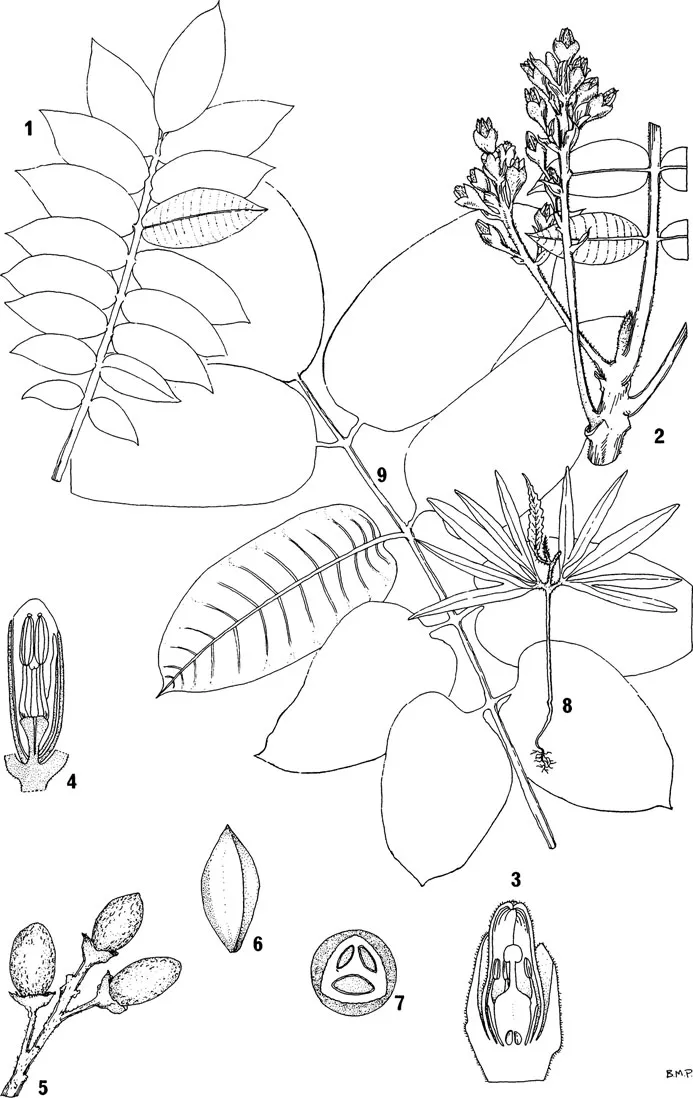
Fig. 1 CANARIUM SCHWEINFURTHH — 1, leaf,×¼ 2, shoot with inflorescences, x½ 3, ♀ flower, longitudinal section, × 2; 4, centre of ♂ flower, longitudinal section, × 4; 5, young fruit, × y2;×½ 6, stone, × 6/10; 7, fruit, transverse section, ×¾ 8, seedling,×½. C. MADAGASCARIENSE— 9, leaf,× ½–, after F.Z. t. 53 from Kerfoot 41; 4, after Leenhouts (1959), fig. 20C, from Stawd 507; 5, from Donis 3454; 6–8, after V.E. 3(1), fig. 367; 9, from Harris et al. 6738. Drawn by Bryan Poole.
Engler’s statement that this species is glabrous is incorrect. The type shows a densely tomentellous inflorescence and a sparsely tomentellous leaf and stem.
As is stated in Fl. Eth. 3:442 (1990) C. schweinfurthii has been recorded from Ethiopia though no specimen from that country has been traced. These reports are probably due to misinterpretation of a map published by Troupin in B.S.B.B. 83:125(1950) in which a circle representing Lake Tana resembles others which indicate occurrences of this species.
2. C. madagascariense Engl. in A. & C. DC., Monogr. Phan. 4: 111 (1883); Perrier in Fl. Madag. 106: 43, fig. 10 (1946); Leenh. in Blumea 9: 377 (1959); Wild in F.Z. 2: 283 (1963). Type: Madagascar, Nossi-Bé, Richard 340 (P, holo.!)
A large spreading tree, differing from C. schweinfurthii in its fewer leaflets, with ± 9 pairs of principal lateral veins on longer petiolules, and in its much smaller flowers in spreading panicles ± as broad as they are long. The stone of the fruit has less sharp angles than that of C. schweinfurthii and has 3 minor ridges between each of the angles instead of one only as illustrated by Kabuye in Utafiti 1(2), fig. 1/9 (1988), Fig. 1/9, p.3.
TANZANIA. Uzaramo District: Dar es Salaam–Kilwa, near Mkwanga, 12 Jan. 1973 (young fr.), Harris et al. 6738! & Mafia I., Utmaini, 3 Oct. 1937 (fl.), Greenway 5378!
DISTR. T 3 (see note), 6; Mozambique (Zambezia), Madagascar
HAB. Rare in forest remnants on sandy soil in shallow river valleys; 5–300 m.; rainfall ±1000 mm.
SYN. C. boivinii Engl. in A. & C. DC., Monogr. Phan. 4:110 (1883); Perrier in Fl. Madag. 106:45 (1946). Types: Madagascar, northern shore, Boivin (P, syn.) & Bernier 152 (P, syn.)
C. liebertianum Engl. in N.B.G.B. 2: 270 (1899) & V.E. 3(1): 782 (1915); T.T.C.L.: 78 (1949). Type:Tanzania, Uzaramo District, Mpafu [Mbaffu], Aug. 1898 (fl.), Stuhlmann (B, holo.†)
C. pulchrebracteatum Guillaumin in Lecomte, Not. Syst. 1:72 (1909); Perrier in Fl. Madag. 106:46 (1946). Type: Madagascar, Faratangana Prov., without collector’s name (P, holo.)
NOTE. I follow Leenhouts (1959) as treating all Canarium taxa from Madagascar as forms of a single variable species. He recognises 3 subspecies, of which subsp. madagascariense alone occurs on the mainland of Africa.
Although no specimen from T 3 has been seen Engler’s statement in 1915 that this species occurred on the banks of streams in West Usambara can hardly have been erroneous.
According to early collectors this fine tree was well known to the inhabitants of the coastal parts of Tanzania, although, even before 1914 not common, with the Swahili name Mpafu. It was collected at least 4 times in the 20 years before 1914 but only twice since then. It thus seems to be approaching extinction before its economic value has been assessed.
2. BOSWELLIA
Colebr. in Asiat. Res. 9: 379 (1807); Thulin & Warfa in KB. 42: 487 (1987)
Unarmed large bushes or small to medium-sized trees; outer bark often peeling in papery flakes, under-bark greenish with a watery aromatic exudate hardening to a resin; wood soft, often with a milky latex. Leaves usually clustered at the ends of branches, usually imparipinnate but 1-foliolate or hetero-3-foliolate in 2 Socotran species; stipules sometimes present, caducous; leaflets often subalternate, variously crenate or serrate, or entire. Inflorescence a panicle or raceme. Flowers bisexual or (in B. madagascariensis) dioecious. Calyx 5-lobed, persistent. Petals 5, free. Stamens inserted outside a conspicuous annular disc, 10 in 2 whorls of 5, the outer usually having broader filaments than the inner. Ovary (2–)3(–4–5)-locular or, in B. frereana Birdwood from N. Somalia, (5–)6(–8)-locular; style simple; stigma capitate. Fruit an obovoid pseudocapsule with (2–)3(–4–5) angles, the outer walls breaking away to disclose a (2–)3(–4–5)-winged axis with a 1-seeded nutlet in each compartment between the wings; nutlets at first surrounded by a fragile outer layer which may form a temporary wing. Cotyledons 3- or 5-lobed or 3-lobed with both lateral lobes bifid. Fig. 3/1,2, p. 10.
19–20 species extending from the Ivory Coast to India and south to NE. Tanzania and N. Madagascar; most numerous in NE. tropical Africa.
Leaflets 13–25, usually over 5 cm. long, with markedly crenate margins; inflorescence over 8 cm. long | 1. B. papyrifera |
Leaflets under 3 cm.; inflorescences under 8 cm. long: | |
Leaflets 13–25, crenate, pilose with suberect 0.2–0.4 mm. long hairs; petals 4–6 mm., filaments pilose, narrowly triangular or linear, ± 3 mm. long; fruit sparsely puberulous | 2. B. rivae |
Leaflets entire, or nea... |
Table of contents
- Cover
- Title Page
- Table of Contents
- 1. Canarium
- 2. Boswellia
- 3. Commiphora
- Index
Trusted by 375,005 students
Access to over 1.5 million titles for a fair monthly price.
Study more efficiently using our study tools.
Frequently asked questions
Yes, you can cancel anytime from the Subscription tab in your account settings on the Perlego website. Your subscription will stay active until the end of your current billing period. Learn how to cancel your subscription
No, books cannot be downloaded as external files, such as PDFs, for use outside of Perlego. However, you can download books within the Perlego app for offline reading on mobile or tablet. Learn how to download books offline
Perlego offers two plans: Essential and Complete
- Essential is ideal for learners and professionals who enjoy exploring a wide range of subjects. Access the Essential Library with 800,000+ trusted titles and best-sellers across business, personal growth, and the humanities. Includes unlimited reading time and Standard Read Aloud voice.
- Complete: Perfect for advanced learners and researchers needing full, unrestricted access. Unlock 1.5M+ books across hundreds of subjects, including academic and specialized titles. The Complete Plan also includes advanced features like Premium Read Aloud and Research Assistant.
We are an online textbook subscription service, where you can get access to an entire online library for less than the price of a single book per month. With over 1.5 million books across 990+ topics, we’ve got you covered! Learn about our mission
Look out for the read-aloud symbol on your next book to see if you can listen to it. The read-aloud tool reads text aloud for you, highlighting the text as it is being read. You can pause it, speed it up and slow it down. Learn more about Read Aloud
Yes! You can use the Perlego app on both iOS and Android devices to read anytime, anywhere — even offline. Perfect for commutes or when you’re on the go.
Please note we cannot support devices running on iOS 13 and Android 7 or earlier. Learn more about using the app
Please note we cannot support devices running on iOS 13 and Android 7 or earlier. Learn more about using the app
Yes, you can access Flora of Tropical East Africa by J.B. Gillett in PDF and/or ePUB format, as well as other popular books in Ciencias biológicas & Botánica. We have over 1.5 million books available in our catalogue for you to explore.