More than twenty-five years after the collapse of the Socialist bloc, the nature of the regimes in Eastern Europe between 1945 and 1989 continues to evade the attempts of political theorists and scholars of post-communism to define and classify them. Drawing on philosophical inquiry, jurisprudential analysis and intellectual history, this book traces the impact of communist ideology and practice on legal thought: from its critical roots in the midst of the nineteenth century to its reactionary stand in the later years of the twentieth. Exploring how the communist experience – both in its revolutionary and authoritarian guises – has been articulated within the legal theoretical field, the book addresses two central theoretical lacunae fostered by the historiography of authoritarianism in Central and Eastern Europe: the status of law, and its relationship to the broader ideological framework legitimising authoritarian regimes. Moving beyond the limits of the contemporary discourse on communism – particularly as it is channelled through transitional justice and memory studies – Cosmin Cercel develops a theoretical framework that is able to uncover law's complicity with the extreme ideologies that dominated Central and Eastern Europe. For it is, he argues, in its recourse to legal concepts that the communist experience raises important jurisprudential questions for our contemporary understanding of law, the limits of state sovereignty, and law's relationship to historical violence.
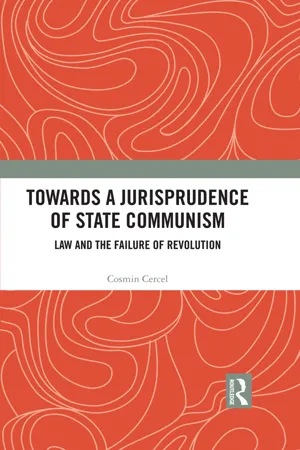
eBook - ePub
Towards A Jurisprudence of State Communism
Law and the Failure of Revolution
- 230 pages
- English
- ePUB (mobile friendly)
- Available on iOS & Android
eBook - ePub
Chapter 1
Law before communism
Modernity and the authoritarian drive
Ever since the collapse of state-steered communist projects all over Central and Eastern Europe, communism has been slowly but steadily brought before the law. Either under the guise of constitutional reconstruction,1 as a matter of retributive or restitutional transitional justice2 or purely and simply as a part of the construction of public, national or transnational memory,3 communism was read through legal lenses, analysed through the frames provided by legal discourse and ultimately transformed within a legal matter. Through a ruse of history, which this book aims to explore, communism was phagocytised by the law, enclosed in its seemingly rigid and stable categories, isolated and contained or simply criminalised.4
By the same historical turn, communism was forced to retreat to its initial position, that of a movement contesting and opposing the law, closing thus a circle of more than a century of struggle, compromises and delusions. In the ensuing process of dealing with this problematic past, one mustering a whole range of discourses aiming at rereading and thematising an uncomfortable history, a central topos continues to mark our contemporary perception of the communist experience: its inherent lawlessness. Indeed, while the fall of state communism was contemporary with a renewal of the concept of totalitarianism5 by an eerie historiographical and scholarly uchronia reminiscent of the times when the world revolution from above has reached its zenith and only a strong McCarthyist position was able to stop its spread,6 the jurisprudential conundrum of state lawlessness casted once again its shadow over the realms of law and history.
Too hastily and perhaps all too humanely, critics of the defunct regimes rushed to describe them under the already-known terms of “criminal”, “terrorist” or “total-itarian”. As a matter of political philosophy and equally as a dominant trope of the public discourse in Central Europe and beyond, all too easily communism was equated with totalitarianism, and by a sleight of hand disregarding a certain intellectual history of jurisprudential inquiry, it became consubstantial to lawlessness. To put it simply, at least during the first decade following its demise, communism was described as being putatively unlawful and certainly illegitimate.7 This external perspective of reading the communist experience, primarily reproaching communism for not abiding to the rules of liberal nomos,8 continues to colour our reckoning with the past. It exposes itself as an excessive penumbra that contours even refined and legally attuned renderings of communist rule. It is perhaps, not by mistake, that in the early stages of relating to communist law, national courts in Germany and Hungary have explicitly singled out its unlawful character,9 while memorial commissions have described communist regimes as being devoid of a legal system.10
The symbolic, political and memorial consequences entailed by such a juris-prudential stand should be obvious. While communism was devoid of law, our liberal present is law-full, that is protected by law and vested with its symbolic authority. However, this position is deeply problematic, not only in terms of being apologetic of a present status of law far from constituting a stable normative framework untainted by the past, but also primarily for circumventing and positively forgetting both the jurisprudential and historical meaning and unfolding of law, lawlessness and communism. To be sure, the comfortable dualism opposing a dark and lawless past to a bright, lawful or law-full, liberal or, more recently, illiberal present certainly had a political and ideological advantage of reducing to a relatively simple and seemingly unproblematic axis the manifold and resilient materiality of the historical debris left by the failure of communism. It might have had also some guiding role in what was commonly described as the long and painful process of transition from dictatorship to democracy by constitutional advisers and transitional justice experts dominating the scholarly debates over Central and Eastern Europe at the turn of the century. But it has positively prevented us from facing the radical failure at the core of state communism. It has done so not only by circulating and accommodating some very deep-seated cultural representations of the lawless East obscuring the inherently modern nature of Eastern communism11 but also by unwittingly offering a strange and embellished history of law implicit to this jurisprudential stand. According to this obscure and dream-like history, communism stops legal history, it cuts through legal continuity and positively suspends the law to the point of erasing it. The task of the newly democratic lawyer and of the body politic is to reconstruct this law from its ruins, while later it is to remind the legal subject the limits of its possible actions through a constant remembrance of this absolute dissolution of the law.
My endeavour within this chapter is to disturb precisely the Apollonian dream, and to traverse the fantasy12 sustaining this peculiar selective reading of law’s history by bringing the legal subject, that is the subject of the law, before the Real13 of its own history. For to be sure, if the communist attempt at cutting through the law and suspending its force was nonetheless real within the history of the communist movement, the law was never complete in itself even before the advent of communism. In this sense, the path I shall follow is the opposite of bringing communism before the law; rather it is of asking historically what law before communism meant for the continental jurisprudential and constitutional canon, and to an extent to explore theoretically the legal and philosophical implications of law’s inner cut, that is its inner possibility of self-erasure and suspension.
Law’s self-erasure: Kelsen with Kant
The starting point for this investigation rests within the confines of the continental jurisprudential tradition and explores one of its central yet enigmatic predicaments, namely law’s radical autonomy. It is, of course, to Hans Kelsen that we owe both the credit of bringing the unstated of the German-speaking legal scholarship and, more generally, that of the continental jurisprudence into an articulated discourse aimed at describing the law “as it is” alongside the opportunity of exposing clearly the inner tensions of a way of thinking prevalent in continental academia traceable to Kantian logic and the codification event.
In many respects, Kelsen’s theoretical move is foundational for modern positivism inasmuch as it aims at overcoming the already time-fashioned ‘jurisprudential antinomy’ opposing jusnaturalism and positivism.14 By a radical cut with the lengthy and often grey literature opposing ceaselessly the partisans of the tradition of natural law to the standard-bearers of the knowledge supplied by an emerging body of sociological research, Kelsen sets the new boundaries of the province of jurisprudence, and moreover of legal studies. This move should be understood in all its authoritative, strategic and symbolic power as a gesture aiming as nothing short of positing the limits of the law and isolating what is specifically legal within the discourses using or claiming the use of the concept of law. It should be also better understood in its political dimension, at least with regards to the micro-politics pertaining to the field of jurisprudence and its neighbouring fields for which a proper definition of the law counts as a guide within their respective grammar.15 As noted by Peter Goodrich, ‘from a frequently uncontested position of academic dominance, it has come to comprehensively predefine the terrain of legal study and to exclude and marginalize opposed models and conceptions of law’.16
To be sure, from the first pages of the Pure Theory of Law,17 Kelsen announces his project consisting in instituting law as a science with a proper methodology apt to analyse its specific object.18 In other words, the aim is that of assuring the coherence of legal knowledge and setting a specific series of registers of truth able to distinguish between valid and nonvalid statements, but moreover between what counts as meaningful and meaningless within the realm of the law. To this effect, the emerging science of law should be ‘free[d] of all foreign elements’19 in order to become a ‘pure’ theory whose only focus should be the realm of norms and normativity.20 While certainly offering a helpful conceptual map and indeed a theoretical grounding to a coherent analysis of the law qua normativity, limiting at the same time the scope of legal inquiry to a description of the relations between legal norms, Kelsen’s foundational gesture rests extremely ambiguously from a historical perspective.
Before embarking into a more detailed analysis of the frail edges of Kelsen’s theory which expose precisely some of the deadlocks of the continental legal thought of the interwar, let us rest a while by reflecting on the theoretical background against which this affirmation of law as science takes place. If the intellectual landscape in which this formulation is uttered is certainly not unrelated to the emergence of communism as an ideology sustaining at least a legally constituted polity, the USSR, its roots are unequivocally traceable in a time before communism. It is not news that Kelsen’s theoretical grounding lies within Kant’s affirmation of science and the subject of transcendental apperception. In this very way, it follows a Cartesian tradition of exclusion of experience from the ambit of knowledge inasmuch as it posits the point of reference for knowledge in the I of ‘a transcendental subject which cannot be any given subject or psychologised in any way’.21
Moreover, and more specifically in relation to the realm of law, the Kelsenian move continues even as to detail a line of understanding of the law as primarily a matter of interpretation and fidelity to the command of the text.22 While certainly moving away from a merely exegetical temptation,23 the place given to the norm as a norm derived from a textual interpretation remains important.24 In this sense, Kelsen follows closely the codification event that spread from France at the zenith of Napoleon’s rule as well as the long Romanist genealogy imagining the law as written law.25 His understanding of law as science continues a long-lasting thread of thought emblematic for the continental legal worldview, and in many respects it explicitly puts him at odds with other lost traditions within the German-speaking world valuing law as a historical or a hermeneutical enterprise. It is in this sense that his predicament of law as science becomes curious, insofar as from a purely intellectual history of law there is nothing new. It is a curious repetition that aims at stating something which perhaps seemed at that time forgotten. Clearly the origins of the Pure Theory of Law lie at some point before World War I and in the deve...
Table of contents
- Cover
- Title
- Copyright
- Dedication
- Contents
- Acknowledgements
- Abbreviations
- Introduction
- 1 Law before communism: modernity and the authoritarian drive
- 2 A criticism of the heaven: class struggle and the law in theory and practise
- 3 Revolution under siege: law, violence and Marxist legal theory
- 4 Revolution betrayed: the great retreat and the enduring legal canon
- 5 The discourse of the master: war, law and the communist takeover
- 6 Law as state truth: the law-preserving violence and the limits of communism
- 7 Exit communism: legal amnesia and the return of the repressed
- Conclusion
- Bibliography
- Index
Trusted by 375,005 students
Access to over 1.5 million titles for a fair monthly price.
Study more efficiently using our study tools.
Frequently asked questions
Yes, you can cancel anytime from the Subscription tab in your account settings on the Perlego website. Your subscription will stay active until the end of your current billing period. Learn how to cancel your subscription
No, books cannot be downloaded as external files, such as PDFs, for use outside of Perlego. However, you can download books within the Perlego app for offline reading on mobile or tablet. Learn how to download books offline
Perlego offers two plans: Essential and Complete
- Essential is ideal for learners and professionals who enjoy exploring a wide range of subjects. Access the Essential Library with 800,000+ trusted titles and best-sellers across business, personal growth, and the humanities. Includes unlimited reading time and Standard Read Aloud voice.
- Complete: Perfect for advanced learners and researchers needing full, unrestricted access. Unlock 1.5M+ books across hundreds of subjects, including academic and specialized titles. The Complete Plan also includes advanced features like Premium Read Aloud and Research Assistant.
We are an online textbook subscription service, where you can get access to an entire online library for less than the price of a single book per month. With over 1.5 million books across 990+ topics, we’ve got you covered! Learn about our mission
Look out for the read-aloud symbol on your next book to see if you can listen to it. The read-aloud tool reads text aloud for you, highlighting the text as it is being read. You can pause it, speed it up and slow it down. Learn more about Read Aloud
Yes! You can use the Perlego app on both iOS and Android devices to read anytime, anywhere — even offline. Perfect for commutes or when you’re on the go.
Please note we cannot support devices running on iOS 13 and Android 7 or earlier. Learn more about using the app
Please note we cannot support devices running on iOS 13 and Android 7 or earlier. Learn more about using the app
Yes, you can access Towards A Jurisprudence of State Communism by Cosmin Cercel in PDF and/or ePUB format, as well as other popular books in History & Baltic History. We have over 1.5 million books available in our catalogue for you to explore.