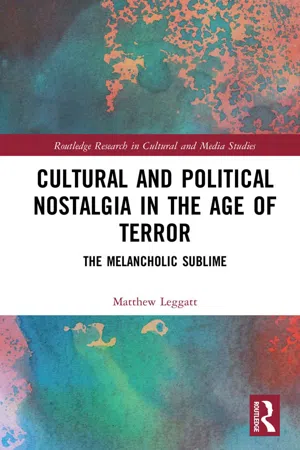
This book re-examines the role of the sublime across a range of disparate cultural texts, from architecture and art, to literature, digital technology, and film, detailing a worrying trend towards nostalgia and arguing that, although the sublime has the potential to be the most powerful uniting aesthetic force, it currently spreads fear, violence, and retrospection. In exploring contemporary culture, this book touches on the role of architecture to provoke feelings of sublimity, the role of art in the aftermath of destructive events, literature's establishment of the historical moment as a point of sublime transformation and change, and the place of nostalgia and the returning of past practices in digital culture from gaming to popular cinema.
eBook - ePub
Cultural and Political Nostalgia in the Age of Terror
The Melancholic Sublime
- 156 pages
- English
- ePUB (mobile friendly)
- Available on iOS & Android
eBook - ePub
About this book
Information
Part 1
Sublime Terror and Violence in the 21st Century
1 9/11, Sublimity, Ruination, and the War over Architecture
“In every culture, height – and its architectural expression, the tower – stands for power, control, lordship, and mastery” writes Wolfgang Schivelbusch in his epilogue to The Culture of Defeat (292). When the World Trade Center opened in 1973, its towers, standing at over 415 meters, were the tallest in the world, their spectacle magnified by their doubling. Today, America is seen as the home of the great metropolis. The skyscraper in particular, generally considered to originate with the Home Insurance Building in Chicago built in 1884, was the form that came to dominate the skylines of major U.S. cities during the course of the 20th century. For over a hundred years the world’s tallest building could always be found in America, and while this has changed since the late 20th century—the majority of the world’s tallest buildings are now situated in China or the UAE—it is, nevertheless, this history that has enshrined the U.S. as the cultural home of both the city and the skyscraper. This was certainly not always the case, however. The Founding Fathers, most notably Thomas Jefferson, saw cities as both dangerous and morally dubious. In a letter to James Madison in 1787, Jefferson wrote that “when [the American people] get piled upon one another in large cities, as in Europe, they will become corrupt as in Europe.” This was hardly surprising considering Jefferson’s belief that “those who labour in the earth are the chosen people of God” and that when he became President in 1801, some 95% of Americans lived on farms compared to around 2% today. The cultural transformation that would take place over the next 200 years would involve the reworking of ideologies associated with both rural and urban spaces and would eventually come to establish cities as the most ‘natural’ form of capitalist expression; the privileged site for the manufacture of the American Dream. The symbol for this cultural work became the skyscraper, its verticality echoing the democratic and meritocratic social mobility possible in this new urban landscape.
Robert Bevan highlights that, “for early Modernists […] the skyscraper was an architectural representation of the future and of confidence in the future” (66). How apt, then, that the destruction of such skyscrapers on September 11th of 2001 would prove for America, the very home of 20th-century modernity, the catalyst for nostalgia and regression. Rewind a mere decade or so, and as the Berlin Wall, another symbolic architectural edifice, was falling, scholars (and politicians) clamored to define a new era of American world dominance. Two texts in particular emerged, demonstrating the polarized and competing views on the shape of global politics to come. Francis Fukuyama seemed to blink first with his proclamation that in 1992 The End of History had arrived. In the 21st century, he argued, the world’s remaining dictatorships would fall at the hands of democracy; the power vacuum left by the end of the Cold War would clear away the fearful tyrants who remained, unable to resist American supremacy and the lure of new technologies that promised a more open and free world. Indeed, even today, as Mark Fisher highlights, “Fukuyama’s thesis that history has climaxed with liberal capitalism may have been widely derided, but it is accepted, even assumed, at the level of the cultural unconscious” (Capitalist Realism, 6). Thus, its influence is assured even while its premise has been undermined by world events. It has, as an idea, become representative of a kind of utopianist nostalgia for a pre-9/11 optimism about the future of the world. At the other end of the spectrum, just one year later, came Samuel P. Huntington’s now infamous article that warned that the next century would be dominated by what he described as the clash of civilizations. Fearing the spread of religious ideologies and their collisions in the increasingly multicultural global environment, Huntington cited directly the dangers of Islamic extremism. Just as Fukuyama’s thesis has since been regarded as idealistic, Huntington’s alternative narrative is the so-called ‘realism’ at the core of the politics of fear, which has been the hallmark of Western government since 9/11. Throw into this melting pot the rhetoric in academic circles surrounding the power and reach of globalization—the opportunities, as well as dangers, that came with what newly elected Democratic President Bill Clinton called the interdependency of nations—and we have some idea about the power of the competing discourses at the time, all of which were seeking to offer coherent visions of the future.
It was hardly surprising, then, that In 2000 Anna Tsing challenged the naïve optimism of academic discourse on globalization, which she cited as offering “globalist wishes and fantasies” rather than objective reality (51). Such a statement might seem alien to us today given the number of pages since 2001 that have been dedicated to critiques of Americanization, globalization, cultural imperialism, and the recent swing of popular politics toward right-wing antiglobalist groups in the U.S. and Europe. The debate seemed settled when on September 11, 2001, American Airlines Flight 11 and United Airlines Flight 175 were flown into the financial center of this globalist fantasy: New York’s World Trade Center. What seemed clear in this instance was that Huntington’s pessimism rather than Fukuyama’s optimism had won the argument. What had determined this prevailing vision of the future, then—one tainted by terror, in which nothing was safe and anyone could be instantly made a target—was in fact a rearrangement of American ideas around its own architecture.
Bevan relates that Mohammed Atta, one of the leaders of the terrorists involved in hijacking and flying American Airlines Flight 11 into the North Tower of the WTC, was an architectural scholar with a particular interest in Islamic style and history. According to Bevan, the Egyptian Atta
was horrified […] at the way Western skyscrapers and modernist development intruded upon and overshadowed the old quarters of Aleppo, Syria, which he had studied for his doctorate, and at Egyptian government plans to regenerate an historic neighbourhood of Cairo as an ‘Islamic Disneyland’ for Western tourists.
(65)
At the center of the attacks, then, was a young man who understood the power of architecture to both dominate a landscape and to act as a symbolic focal point for ideas about cultural identity and history. One might also note that the WTC buildings themselves were at least partly influenced by Islamic architecture and that their designer, Minoru Yamasaki, was known for his fusion of modernist and Islamic styles. For Atta, then, we could speculate that the Twin Towers were symbolic of a cultural appropriation by the West of a style he himself revered. They were also, of course, a symbol of American economic and cultural power that, with carefully orchestrated intervention, could be turned into a site of humiliation. Thus, when Atta’s plane flew into the WTC building it would become a literalization of Huntington’s clash or conflict between not just two ideologies, but two world orders that are defined by the very architectural foundations upon which they are built.
For Schivelbusch, “with the towers’ collapse, two other dimensions were made visible: the sheer violence of their physical mass, evident in the wreckage, and the extent of the hatred that had chosen them as symbols to be destroyed” (Schivelbusch, 292). The terrorists had managed to replace the powerful sense of wonder experienced by those who encounter objects of great architectural ambition and achievement with an equally powerful fear of such objects. If the skyscraper is the quintessence of late capitalism, with its emphasis on power, luxury, excess, vertical stratification, and a concurrent tendency toward efficiency—the maximization and optimization of space in overcrowded commercial hubs—the terrorists were determined to prove its ideological vacuity and emptiness through ruination. The towers’ subsequent absence from the skyline, they hoped, would always offer a reminder of the absence at the very heart of the ideology for which those same towers stood.
A quick excursion through Percy Bysshe Shelley’s famous 1818 poem “Ozymandias” hints at a way we might read this attempt at humiliation through ruination. Shelley’s poem about the ruined statue of an Egyptian King whose head lies “half sunken” in the desert sands next to a pair of enormous legs was written in competition with his contemporary Horace Smith whose lesser known poem of the same name opens with an image of “a gigantic leg, which far off throws/The only shadow that the Desert knows.” What is particularly relevant here is that in Smith’s poem, the ruin still has value and power. By choosing to focus on the creation of a shadow, Smith shows how even after its near complete destruction, the statue has an impact on the land around it and is able to speak of a power now passed. Thus, by the end of Smith’s poem a future character “stops to guess/What powerful but unrecorded race/Once dwelt in that annihilated place,” emphasizing a power that still speaks through the ages. Smith’s poem, then, can be seen as less a commentary on the ruination of power and its ephemerality and more an acknowledgment that even the ruin can give command and legacy.
In Shelley’s version a “traveller from an antique land” describes a scene witnessed in the desert of the ruined statue of this same Egyptian King. The “colossal wreck” also speaks through the ages, but only via a second-hand verbalized account. Shelley’s narrative viewpoint therefore suggests a certain mythicality to the traveler’s description. What is more, Shelley includes details of an inscription on the statue’s pedestal, which reads: “My name is Ozymandias, king of kings:/Look on my works, ye Mighty, and despair!” While it is certainly an intimidating message, its strength only serves to emphasize the impotence of the now-ruined force disappearing beneath the sands. The arrogance of the king, his self-proclaimed might and appeals to terror, his “sneer of cold command” are all ironized through the statue’s ruination and the agony of the slow-sinking decapitated head piece. While Smith uses “forgotten” to refer to the greatness of the civilization and the King that produced such a statue, Shelley refers instead to its “decay.” For Smith, the ruin produces a sense of wonder, whereas for Shelley the destruction of the statue undermines the very might professed to by the king. Thus, Shelley’s poem shows how through ruination history can be rewritten, the ‘mighty’ challenged, and narratives changed. Indeed, Robert Young recognizes the revolutionary potential of Shelley’s “Ozymandias,” arguing that the poem “demonstrates that meaning, like power, is not stable or fixed, and that even power cannot guarantee a tyranny of meaning” (238). Shelley, known for his radical politics, seems to suggest that in creating a ruin, one might be able to highlight the fragility of power and undermine its hold over the imagination. It is, perhaps, in this context that we can read Atta and the other terrorists’ attempts to humiliate and reduce American power. While far from being revolutionaries, the terrorists did seek to use the power of ruination to highlight the impotence of an empire they viewed as tyrannical.
It may seem somewhat odd to refer to the World Trade Center as a ruin, given that so little of it was left standing after the attacks and that it has been—in a notably lengthy process—now replaced as a structure both symbolically by the 9/11 memorial and functionally by the new WTC complex of buildings. However, in the 21st century the old WTC still occupies the imaginary space of the ruin. Indeed, it can be imagined as such not just because its destruction left a yawning chasm in the center of Lower Manhattan for almost a decade, but because in our mediated world the images of its destruction have been preserved forever and replayed so often they have come to override any image of the towers as they were before the moment of impact. Faced with images of its ruination, the twisted skeletal steel structure silhouetted hauntingly against a backdrop of dust, we are left with only a resonant fear of the violence that transformed such mighty towers into this wreckage or a retreat into nostalgia for the buildings as they were. Thus, what is recognized in both Shelley’s poem and in the lasting image of the vanquished WTC towers is that images of destruction and defeat appear more powerful and durable in the social unconscious than those of triumph or defiance.
The Violence of Sublime Architecture
Throughout the 1970s, 1980s, and 1990s, the WTC buildings were architecturally derided. As Harriet Senie describes, “over time, as postmodernism replaced modernism as the architectural style and mode of thinking, the towers seemed less objectionable but they never achieved the visually iconic status of the Empire State or Chrysler buildings” (3–4). Nevertheless, the towers did, during this period, feature in hundreds of movies and television shows, and this certainly had a significant impact on their reconfiguration after destruction as the nostalgic and romantic heart of New York City—their continued appearance in reruns of the 1990s hit sitcom Friends (1994–2004), for example, acting as a constant reminder of their absence long into the 21st century.
The sense of nostalgia the buildings now invoke is also induced by James Marsh’s arresting documentary Man on Wire (2008), which recounts Philippe Petit’s wire walk between the buildings in 1974. Offering what Bryan Appleyard has called “a mood of anticipatory sadness and nostalgia for a pre-9/11 world” (quoted in Martin Randall, 88), Marsh’s rather beautiful film highlights the towers’ sublimity as monuments to the power of not just architectural ambition and achievement but to the very concept of what David Nye has termed “the American Technological Sublime.” In the film, Petit, himself, rather theatrically describes his fascination, even obsession, with the towers, his inexplicable compulsion to conquer them. As the crowds gather below in astonishment, the performer’s elation at traversing the 200 feet between the two buildings is written on his face. Indeed, the Frenchman appears entirely fearless as he dances, smiling from ear to ear and even taking the time to lie down on his wire all the while taunting the New York cops who watch helplessly—and rather comically—from the adjoining rooftops. Referred to by the documentary’s narrator as “the most sublime and transcendent episode in the entire history of the World Trade Center”—a statement that reads as part tragedy—Petit’s stunt is positioned as a key moment in the buildings’ transformation from lifeless and commercialized objects of ridicule to a romanticized focal point.
Man on Wire closes its account of the walk with a reference to Petit signing his name in “indelible ink” on a steel beam overlooking the chasm across which he performed. It is a particularly vivid example of the way in which the text aims to capture something of the towers that can never be demolished. By refusing to reference the events of 2001, Man on Wire enshrines the Twin Towers as monolithic objects of nostalgia that cannot be wiped from memory. Writing for The Telegraph on the more recent dramatized version of the film, Robert Zemeckis’ The Walk (2015), Robbie Collin argues that the film “takes two buildings that have become emblematic of everything that’s frightening and uncertain about 21st century life in the West and redeems them” (2). Indeed Zemeckis aestheticizes Petit’s story in a startling way—his use of 3D, for example, reportedly caused some moviegoers to experience vertigo-induced vomiting in the cinema auditorium. What is, perhaps, most interesting about the recent film, however, is the underlying desire to revisit Petit’s story again some fourteen years after the destruction of the towers, which seems to attest to a cultural longing to somehow resurrect, or at least pay homage to, the World Trade Center.
While Petit initially refers to the South Tower as “monster” and “beast”—not unlike Baudrillard who, in The Spirit of Terrorism, describes the towers as “architectural monsters” (41)—eventually the wire walker comes to see them as his “friends,” another “ally” in his caper. This sentimentality toward the WTC buildings is further echoed in Baudrillard’s articulation of the significance of the buildings’ destruction as part of the shifting narrative of the New York skyline. Prior to the building of the WTC towers, he notes,
all Manhattan’s tall buildings had been content to confront each other in a competitive verticality, and the product of this was an architectural panorama reflecting the capitalist system itself – a pyramidal jungle, whose famous image stretched out before you as you arrived from the sea.
(38)
For Baudrillard, it was the WTC that changed this:
the effigy of the system was no longer the obelisk and the pyramid, but the punch card and the statistical graph. This architectural graphism is the embodiment of a system that is no longer competitive, but digital and countable, and from which competition has disappeared in favour of networks and monopoly.
(39)
What, then, can be made of Daniel Libeskind’s designs for the new WTC complex? These new towers—resembling not punch cards or bar charts but rather an obsession with the fragment, a concentration on surface and reflection—withdraw into the sky echoing the absence and loss of the originals.
This sentiment is repeated through the symbolism of Reflecting Absence, the memorial located at the feet of the new WTC towers in the hollowed footprints of their predecessors. The two pools of water that form its centerpiece are described by their designer as “large voids, open and visible reminders of the absence” (Arad, 1). David Simpson explains that, “the very title of the project, “Reflecting Absence,” mimics and pays homage to Lutyen’s great memorial at Thiepval, also composed of names where no bodies could be found, also evocative of an emptiness both physical and metaphysical, an “embodiment of nothingness”” [Jay Winter’s phrase in Sites of Memory, Sites of Mourning] (Culture of Commemoration, 78–79). In its aesthetic, however, a more worthwhile comparison might be Maya Lin’s hugely successful Vietnam memorial that opened in Washington DC in 1982, which also displays names engraved on a reflective black granite that recedes from view. The central difference, perhaps, is that whereas Lin’s memorial commemorates actions that took place much further afield, and therefore maintains a ‘reflective’ distance, the 9/11 memorial is—while admittedly located on a prime piece of real estate at the heart of Lower Manhattan—a haunted space, the space where the victims actually perished.
In architect Michael Arad’s proposal for Reflecting Absence, he claims that the memorial is designed to articulate the sense that the destruction of 9/11, and the deep outpouring of emotion that followed, is somehow unattainable; it cannot be assimilated in...
Table of contents
- Cover
- Half Title
- Title Page
- Copyright Page
- Table of Contents
- Acknowledgments
- Jump Number Ten
- Introduction: Theorizing the Sublime
- PART 1 Sublime Terror and Violence in the 21st Century
- PART 2 The Sublime in the Digital Age and Nostalgia for the Real
- Conclusion: “Show Me the Way to Go Home”: Sublime Apathy and Nostalgia
- Bibliography
- Index
Trusted by 375,005 students
Access to over 1.5 million titles for a fair monthly price.
Study more efficiently using our study tools.
Frequently asked questions
Yes, you can cancel anytime from the Subscription tab in your account settings on the Perlego website. Your subscription will stay active until the end of your current billing period. Learn how to cancel your subscription
No, books cannot be downloaded as external files, such as PDFs, for use outside of Perlego. However, you can download books within the Perlego app for offline reading on mobile or tablet. Learn how to download books offline
Perlego offers two plans: Essential and Complete
- Essential is ideal for learners and professionals who enjoy exploring a wide range of subjects. Access the Essential Library with 800,000+ trusted titles and best-sellers across business, personal growth, and the humanities. Includes unlimited reading time and Standard Read Aloud voice.
- Complete: Perfect for advanced learners and researchers needing full, unrestricted access. Unlock 1.5M+ books across hundreds of subjects, including academic and specialized titles. The Complete Plan also includes advanced features like Premium Read Aloud and Research Assistant.
We are an online textbook subscription service, where you can get access to an entire online library for less than the price of a single book per month. With over 1.5 million books across 990+ topics, we’ve got you covered! Learn about our mission
Look out for the read-aloud symbol on your next book to see if you can listen to it. The read-aloud tool reads text aloud for you, highlighting the text as it is being read. You can pause it, speed it up and slow it down. Learn more about Read Aloud
Yes! You can use the Perlego app on both iOS and Android devices to read anytime, anywhere — even offline. Perfect for commutes or when you’re on the go.
Please note we cannot support devices running on iOS 13 and Android 7 or earlier. Learn more about using the app
Please note we cannot support devices running on iOS 13 and Android 7 or earlier. Learn more about using the app
Yes, you can access Cultural and Political Nostalgia in the Age of Terror by Matthew Leggatt in PDF and/or ePUB format, as well as other popular books in Social Sciences & Architecture General. We have over 1.5 million books available in our catalogue for you to explore.