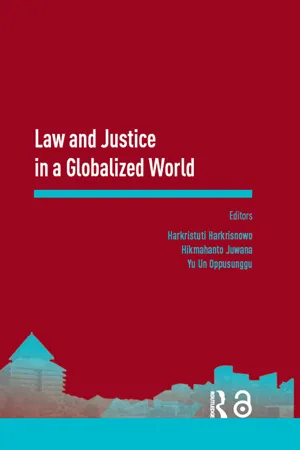
The book consists of a selection of papers presented at the Asia-Pacific Research Conference on Social Sciences and Humanities. It contains essays on current legal issues in law and justice, and their role and transformation in a globalizing world. Topics covered include human rights, criminal law, good governance, democracy, foreign investment, and regional integration. The conference focused on Asia and the Pacific, two regions where law has taken an important position in creating and shaping the regional integrations, new legal institutions, and norms. This reconfirms the idea that the legal system is extremely important in the global world. This book provides new insights and new horizons on how law and justice took part in globalizing human interaction, especially in the Asia-Pacific region.
eBook - ePub
Law and Justice in a Globalized World
Proceedings of the Asia-Pacific Research in Social Sciences and Humanities, Depok, Indonesia, November 7-9, 2016: Topics in Law and Justice
- 272 pages
- English
- ePUB (mobile friendly)
- Available on iOS & Android
eBook - ePub
Law and Justice in a Globalized World
Proceedings of the Asia-Pacific Research in Social Sciences and Humanities, Depok, Indonesia, November 7-9, 2016: Topics in Law and Justice
About this book
Information
Review of the implementation of murabahah financing in sharia banks in the Greater Jakarta area
Faculty of Law, Universitas Indonesia, Depok, Indonesia
ABSTRACT: Banks are financial institutions that play a vital role in the economic system. In Indonesia, ‘bank’ may refer to a conventional bank or a sharia bank. There are a number of legal issues associated with the implementation of murabahah financing, which in certain cases are deemed to be no longer in accordance with the sharia principles. This situation has prompted this research, with the following topics as its main focus: 1) what is the murabahah concept and principles of sharia in murabahah financing? 2) what are the murabahah financing arrangements in Indonesia? 3) how does murabahah financing apply consistently in accordance with sharia banking principles in the Greater Jakarta area? The research method employed in this paper was the legal normative review. Implementation of murabahah financing still shows non-conformities with the sharia principles. These measures include the following: 1) the State through the Bank Indonesia-Central Bank/Otoritas Jasa Keuangan-Financial Service Authority) has made improvements to various regulations and enhanced external supervision of sharia banks; 2) sharia banks should self-evaluate to improve themselves and enhance the Dewan Pengawas Shariah (Sharia Supervisory Board); 3) the public as customers have to take the public as customers have to take on the responsibilities of their payment obligations, and become a part of social control on murabahah financing.
1 INTRODUCTION
Banks are financial institutions that play a vital role in a country’s system of economy. Generally, banks are institutions that carry out the function of collecting and disbursing the public’s money in order to assist society in keeping its economy running.
Looking into its history, the institution of banks has already existed since the seventh century B.C. in Babylon and/or during the Hammurabie reign. In Indonesia, banking was introduced during the Dutch Indies colonial period in the eighteenth century. During such period, in order to facilitate the Verenigde Oostindische Compagnie’s (commonly known as the Dutch East Indies Company) commercial activities, the bank De Bank van Leening was established in 1746. Its name was subsequently changed into De Bank Courant en Bank van Leening in 1752. This bank was a conventional banking institution and its presence has continued to this day.
In addition to conventional banks, there are also other banking institutions that are more specific in nature, including the sharia banks. Looking at its history, sharia banks have operated since the founding of the Mit-Ghamr Bank in Egypt in 1963. Since that time, sharia banking has been practised in various countries (Ahmad, 2000, pp. 59–60).
The first sharia bank in Indonesia was established in 1992. Its growth however, has not been as rapid as conventional banks. The Deputy Commissioner for Bank Oversight of the Indonesia Financial Services Authority reported that the market share of sharia banks in the country with respect to other banks fell short of 5per cent (an indicator of industry development by regulators), experienced a drop in 2014, and again in 2015 (OJK RI, 2016). This condition raises a question given that the majority of Indonesia’s population are Muslims. As such it was deemed necessary to conduct a legal analysis of the implementation of sharia banking.
A legal research on the implementation of sharia banking is important because of at least three reasons: 1) the role of banks is critical in Indonesia’s economic system, including sharia banks. Sarwer et al. (2013) showed that Islamic banks have a significant effect on economic growth for a country such as in Pakistan and the presence of sharia banks is very important and needed in Indonesia because the vast majority of Indonesian people are of the Islamic faith (BPS-Biro Pusat Statistik (Statistic Center Bureau), 2010); 2) the growth of sharia banks is not as rapid as that of conventional banks due to a number of issues (Ismal, 2011, pp. 7–9) and the implementation of sharia banking in Indonesia, which was introduced in 1992, still faces problems relating to its supporting regulations; and 3) issues relating to ‘transition’ that must be undergone by the Indonesian people when they intend to move from conventional banking to sharia banking (Muhammad, 2011, pp. 139–140).
For members of the public who choose to adopt sharia banking, the currently most preferred sharia banking product is murabahah. This concerns the sale of goods for the cost of acquiring such goods, plus a margin agreed upon by the parties; however the seller has to first inform the cost of acquisition to the buyer. The high interest of the public in using the murabahah transaction (57per cent of total sharia bank financing) can be seen in the sharia banking statistics issued by OJK for May 2016. This is in line with research conducted by Alsoud and Abdalah (2013) within the Islamic Bank of Kuwait, which indicated that the product users of murabahah was the highest compared to other financing products.
In fact, during the sharia banks’ early days of operation, their activities were more focused on primary products, namely mudharabah (trust financing) and/or musyarakah (joint financing) financing (Usmani, 2002, pp. 104–105). However, subsequently it was felt that their growth has been extremely languid, and thus there was an idea to develop a secondary product constituting a financing scheme outside the mudharabah and/or musyarakah, such as the murabahah with all of its variants which is deemed to be a replication of conventional banking practices.
The secondary product, murabahah, turned out to experience a more dominant growth and sharia banks’ operations deviated from the form that was originally intended at the time of their inception. Currently it is possible for sharia banks to be managed and owned by non-Muslims, but there is concern that their operation does not strictly follow the sharia principle.
On the other hand, the length of sharia banks’ historical presence in Indonesia is vastly different from that of conventional banks. Sharia banks began to be established in 1992, whereas conventional banks have been operating since the colonial era. This fact, among others, has caused sharia banking to encounter a number of impediments. From a cultural aspect, it is not easy to alter the habit or perspective of the public as customers of general/conventional banks and get them to embrace sharia banking.
The various problems described above, among others, have made sharia banks’ lag behind in performance when compared to conventional banks. For that reason, sharia banks have taken various measures to overcome the problem, including modifying a number of products that they offer; one of which is the murabahah financing scheme.
Table 1. (Otoritas Jasa Keuangan Republik Indonesia, 2016).
Akad | 1.1 Billions of Indonesian Rupiah (IDR) |
Mudharabah | 14,856 |
Musyarakah | 64,516 |
Murabahah | 124,339 |
Salam | 0 |
Istishna | 780 |
Ijarah | 9,616 |
Qardh | 3,752 |
Others | 0 |
Total | 217,859 |
In some cases, modification to the implementation of sharia banking was done to make the banking public interested in becoming customers. The problem however, is whether sharia banking as is currently being implemented, still follows the sharia principles as laid down in the Al-Qur’an, hadiths, and ijma fuqaha?
In practical terms, it is still questionable as to whether Islamic banking is consistently applying the principles of sharia or whether there have been irregularities (Noor, 2006, pp. 311–312). Therefore, it was identified as necessary to research the consistent implementation of corresponding murabahah financing principles of sharia banks based on the Qur’an, hadith, and fiqh muamalah. This research uses a qualitative method with the normative juridical approach, and also uses empirical or quantitative data from murabahah implementation practices as supporting information.
The purpose of this research was to analyse the implementation of murabahah financing in accordance with the principles of sharia. Samples were taken from Islamic banks in Jakarta, Bogor, Depok, Tangerang and Bekasi (in Greater Jakarta or also known as Jabodetabek). The reasons for selection of this region were based on the level of murabahah financing in the Greater Jakarta area which covers around 58per cent of the total national murabahah financing (OJK, 2014). Therefore, the research questions were: 1) what are the murabahah concept and principles of sharia in murabahah financing? 2) are there murabahah financing arrangements in Indonesia? and 3) how does murabahah financing apply consistently in accordance with sharia banking principles in the Greater Jakarta area?
In order to answer the above problems, this article is divided into several sections: 1) the murabahah concept and principles of sharia in murabahah financing; 2) arrangements of murabahah financing in Indonesia; and 3) murabahah financing in Islamic banking in the Greater Jakarta area. The first section will discuss the murabahah concept and principles of sharia in the implementation of murabahah in accordance with fiqh muamalah; these principles refer to legal sources namely the Qur’an, hadith, and ijtihad. Secondly, there will be description of the murabahah financing arrangement according to the fatwa of the National Sharia Board (Dewan Syariah Nasional or DSN) and regulations applicable in Indonesia. The description of the fatwa of DSN covers its legality and related murabahah fatwa products. Other descriptions of legislation include murabahah financing arrangements in accordance with Law No. 21 2008 concerning Islamic banking and supporting implementing regulations. Thirdly, there will be discussion on the implementation of Islamic banking in the Greater Jakarta area which includes: a) the background of the customers who choose murabahah products; b) the sharia implementation process and irregularities in murabahah financing; and c) the efforts of sharia application in the implementation of a consistent and beneficial murabahah financing system.
Based on preliminary data of this research, the hypothesis formulation is: ‘If the stakeholders in the implementation of murabahah financing does not carry out their role in accordance with the sharia principles, hence there are irregularities in the implementation of the of murabahah financing’. Therefore, the thesis has to be tested through this research.
2 MURABAHAH CONCEPT AN...
Table of contents
- Cover
- Half Title
- Title Page
- Copyright Page
- Table of Contents
- Foreword
- Organizing committee
- Keynote speech: On local wisdom and the pursuit of justice through criminal law reform: The Indonesian experience in deliberating the Bill of the penal code
- Principle of balance in health services in Indonesia
- Research report on the knowledge, experience, and attitude of consumers towards counterfeit medicine in Jakarta: A legal analysis
- Research report on protection of geographical indications in Indonesia: Advantages and challenges
- The politics of laws in the establishment of the Human Rights Court in Indonesia
- Indonesian pretrial: Can it fulfil the rights of the victims of an unfair trial to restoration?
- The substance of good governance principles on government decisions in Indonesia
- Does sanctity of contract exist in oil and gas contracts in Indonesia?
- Protection of personal information: The state’s obligation to guarantee the right to privacy in Indonesia
- The enforcement of payment of restitution in criminal proceedings as the base for filing of tort charges
- Repeat offence as aggravating circumstances in a criminal case: Differences in the definitions under the Criminal Code (KUHP) and the anti-corruption law
- A new paradigm of the justice of outsourcing in Indonesia
- Role of fiscal measures in financing responses to the financial crisis in Indonesia and their effects on fiscal sustainability
- Abuse of substance, restorative justice and diversion
- Waqf shares to create equitable economic distribution in Islam in relation to the Law Number 41 of 2004 on Waqf
- Paradox of groundwater tax collection
- The concept of a regulation of collateral under the mudharabah financing contract according to the Law No. 21 of 2008 on sharia banking in Indonesia
- Mediation as a means to provide ishlah (peace and harmony) in the resolution of sharia banking disputes in Indonesia
- Waqf banks under the Indonesian legal system
- Presentation of suspects: The paradox of presumption of innocence
- The risk of joining the Trans-Pacific partnership for Indonesia: An investment perspective
- The establishment of small claims court in Indonesia: Expectation and challenge in encountering the globalisation era
- Causation in the context of environmental pollution crime
- Public official recruitment system: Towards creation of a rule of law based on Pancasila
- A waqf and musyarakah implementation model in takaful ijtima’i as an alternative sharia insurance system: An experiment to maximise the realisation of the social justice principle in sharia insurance in Indonesia
- The implementation of Indonesia’s penal sanctions to the increased illegal trade of endangered species
- Analysis of the water resource regulation under the ordinance of the Greater Jakarta area
- Review of the implementation of murabahah financing in sharia banks in the Greater Jakarta area
- Environmental damage and liability in Indonesia: Fancy words under conventional wisdom
- Review of the principles of the criminal law on the ancient archipelago law book: The study of the Book of Kutara Manawa Darma Sastra of the Majapahit Kingdom and the Laws on Simbur Tjahaja of the Sultanate of Palembang in the context of criminal law development and condemnation in Indonesia
- The existence of arbitration principles in commercial agreements: Lessons learned from an Indonesian court
- Cross-border child adoption: Protection and challenges in Indonesia
- Electronic identity management in ensuring national cyber security and resilience: Legal aspects of online identity and its secured transaction
- The legal impact of the signing of the multilateral competent authority agreement on automatic exchange of financial account information: A banking law perspective
- The unfair rules of intellectual property rights section of the trans-pacific partnership agreement
- Author index
Trusted by 375,005 students
Access to over 1.5 million titles for a fair monthly price.
Study more efficiently using our study tools.
Frequently asked questions
Yes, you can cancel anytime from the Subscription tab in your account settings on the Perlego website. Your subscription will stay active until the end of your current billing period. Learn how to cancel your subscription
No, books cannot be downloaded as external files, such as PDFs, for use outside of Perlego. However, you can download books within the Perlego app for offline reading on mobile or tablet. Learn how to download books offline
Perlego offers two plans: Essential and Complete
- Essential is ideal for learners and professionals who enjoy exploring a wide range of subjects. Access the Essential Library with 800,000+ trusted titles and best-sellers across business, personal growth, and the humanities. Includes unlimited reading time and Standard Read Aloud voice.
- Complete: Perfect for advanced learners and researchers needing full, unrestricted access. Unlock 1.5M+ books across hundreds of subjects, including academic and specialized titles. The Complete Plan also includes advanced features like Premium Read Aloud and Research Assistant.
We are an online textbook subscription service, where you can get access to an entire online library for less than the price of a single book per month. With over 1.5 million books across 990+ topics, we’ve got you covered! Learn about our mission
Look out for the read-aloud symbol on your next book to see if you can listen to it. The read-aloud tool reads text aloud for you, highlighting the text as it is being read. You can pause it, speed it up and slow it down. Learn more about Read Aloud
Yes! You can use the Perlego app on both iOS and Android devices to read anytime, anywhere — even offline. Perfect for commutes or when you’re on the go.
Please note we cannot support devices running on iOS 13 and Android 7 or earlier. Learn more about using the app
Please note we cannot support devices running on iOS 13 and Android 7 or earlier. Learn more about using the app
Yes, you can access Law and Justice in a Globalized World by Harkristuti Harkrisnowo, Hikmahanto Juwana, Yu Un Oppusunggu, Harkristuti Harkrisnowo,Hikmahanto Juwana,Yu Un Oppusunggu in PDF and/or ePUB format, as well as other popular books in Social Sciences & Sociology. We have over 1.5 million books available in our catalogue for you to explore.