In Ecocinema in the City, Murray and Heumann argue that urban ecocinema both reveals and critiques visions of urban environmentalism. The book emphasizes the increasingly transformative power of nature in urban settings, explored in both documentaries and fictional films such as Children Underground, White Dog, Hatari! and Lives Worth Living. The first two sections—"Evolutionary Myths Under the City" and "Urban Eco-trauma"—take more traditional ecocinema approaches and emphasize the city as a dangerous constructed space. The last two sections—"Urban Nature and Interdependence" and "The Sustainable City"—however, bring to life the vibrant relationships between human and nonhuman nature. Ecocinema in the City provides a space to explore these relationships, revealing how ecocinema shows that both human and nonhuman nature can interact sustainably and thrive.
- 214 pages
- English
- ePUB (mobile friendly)
- Available on iOS & Android
eBook - ePub
Ecocinema in the City
About this book
Information
Part I
Evolutionary Myths under the City
1 The City, The Sewers, The Underground
Reconstructing Urban Space in Film Noir
With her focus on the Los Angeles River as both natural and constructed space, Jenny Price reveals the evolutionary narratives underpinning the river and the environmental movement. This focus on artificial and natural evolution begins to highlight the eroding binaries “that separate natural and manmade environments” (Fabricius 175). On the one hand, Price’s work recalls multiple film noirs set in L.A. Films from Double Indemnity (1944) to Kiss Me Deadly (1955) promote the city as lifeless. But a few L.A. film noirs explicitly connect with the Los Angeles River as a constructed and reconstructed site born of nature. For us, He Walked by Night (1948) most effectively elucidates both the eroding binaries between natural and artificial environments and the evolutionary narratives reinforcing them. By showcasing the Los Angeles River storm drains as space constructed from nature, He Walked by Night (1948) begins to illustrate Price’s focus on “the use of nature to sustain our lives” (553).
With a map of L.A. as its opening title card, He Walked by Night puts L.A. up front as its main character; “a bunch of suburbs in search of a city,” the voiceover claims. After opening aerial shots of L.A., however, the setting opens up to include narrative, “a true story.” With this prologue, He Walked by Night places film noir into the space of L.A. and of criminal history. This history is also based on the story of an actual World War II veteran on a post-war crime spree in 1946 L.A. and draws on a filmic history that builds from gangster films of the 1920s and 1930s to television procedural shows like Dragnet, which was inspired by this film. He Walked by Night fits well into criminal, cultural, and filmic history of the period and uses all three to demonstrate that the urban ecology above ground is a constructed rather than natural space, built on the storm drains and infrastructure (sewage and water systems, subways, natural gas, and conduits for electricity, telegraphs, and telephones) below it.
He Walked by Night examines the idea of the city as a social and cultural construct. It also highlights how and why not genetics but social, cultural, and historical forces construct “gangsters.” But what sets the film apart from other noir films is the attention it gives to the urban infrastructure hidden below its progressive construction. By foregrounding sewers as constructions, escape routes, and seemingly safe havens for noir characters, the film demystifies what seem like “givens” and calls into question the idea of the city as natural. He Walked by Night constructs Roy (Richard Basehart) as a talented criminal whose death is justifiable punishment for his crimes. The film provides enough backstory during the police investigation to explain Roy’s technological abilities and interests—the radar unit in which he served during World War II. But further explanation of his behavior—both murder and theft—rests solely on his intention to open his own technology lab. Walker’s use of the storm drains beneath L.A., however, are maintained in the film to highlight how underground space, too, can be both constructed and reconstructed to serve a new purpose.1
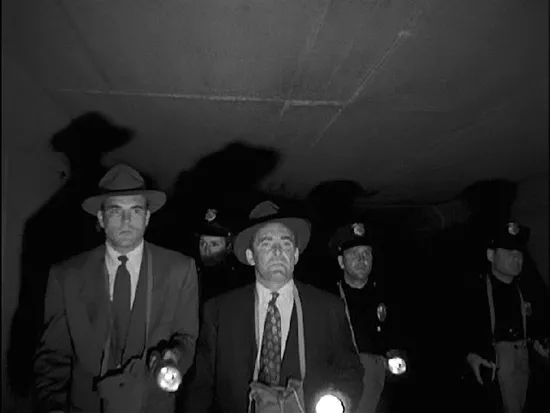
Figure 1.1 He Walked by Night.
A Brief History of the L.A. Storm Drain System
The Los Angeles River is, “as David Letterman allegedly has said, the last two-lane river left in North America. A joke, a laughingstock” (Price 542). Despite being such a butt of jokes, the Los Angeles River is prolific, running 51 miles through the city and draining portions of the runoff from three mountain ranges surrounding L.A. The storm drains aiding this are part of a system constructed to combat flooding, a construction that literally reconstructs the landscape of L.A. The storm drain system was developed in the 1930s after a devastating flood in February 1914 and increasing flooding in the 1920s (Gumprecht 174, 201). This system is one of the most extensive in the world, according to Gumprecht, who notes Brownlie and Taylor’s study of sediment management (174, 1333). As early as 1862, flooding forced the city to build flood control dikes (Gumprecht 174), but after the 1914 floods, flood control plans began in earnest with the passage of a flood control bill that included proposals to construct “five dams in the mountains, [build] basins for the spreading of floodwaters at the mouths of five canyons, [and implement] channel rectification, and the reforestation of mountain slopes,” as well as levee construction (Gumprecht 181).
These flood control plans, however, could not keep up with the increasing urban development in the area, and flooding along the river continued. To offset flooding resulting from such urban growth (and counter possible astronomical economic damage), a more comprehensive plan was proposed, but money to support it was limited until after another flood on New Year’s Day in 1934 destroyed streets and homes in L.A. suburbs, including the city of Glendale (Gumprecht 203). Although the Los Angeles River was not necessarily the culprit for these floods, the devastation caught national attention, and the federal government intervened in projects underfunded by the Los Angeles County Board of Supervisors (Gumprecht 205). With help from the Works Progress Administration (WPA) and the U.S. Army Corp of Engineers (along with an additional $70 million), a three-pronged plan was put in place beginning in 1938:
Debris basins were to be built at the mouths of mountain canyons…. Large flood control basins were to be constructed on the major rivers and their tributary streams…. The stream channels themselves were to be deepened, widened, and lined with levees or concrete to enable floodwaters to be transported to the ocean as quickly as possible.
(Gumprecht 208)
After another flood in March 1938, engineers opted for reinforced concrete channels as replacements for uncontrolled riverbeds. After years of work,
The Los Angeles River watershed today is protected by three major flood control reservoirs, debris basins at the mouths of fifteen canyons and countless smaller structures in the mountains. Channels have been enlarged and reinforced on 47.9 miles of the river and 53.2 miles of its tributary streams.
(Gumprecht 227)
The Los Angeles County Drainage Area Project extends this number to 100 miles of rivers and creeks and 370 miles of tributaries (232). The county’s website describes this storm drain system as a “vast network of underground pipes and open channels that were designed to prevent flooding …. and is completely separate from Los Angeles’s sewer system.” Today there are more than 1500 miles of underground pipes in this system.
Modern L.A. was established in 1781 with three main boundaries—mountains, the ocean shore to the west, and the Los Angeles River, which served as the city’s parameter. The shoreline and mountains are still an integral part of the urban landscape, with construction reshaping each, but the river has disappeared under concrete, completely transformed into a system of drainage pipes and concrete basins. According to Arthur Golding, the Los Angeles River today is a relic “of the physical, economic and intellectual landscape of the 1930s that shaped it.” Gumprecht notes how lush the land was along the river when the Spanish arrived in the mid-eighteenth century. What was once a
rich habitat for wildlife … [with] one of the largest concentrations of Indians in North America” has been transformed into a concrete landscape. One early visitor, Juan Crespi, wrote that the area around the river “was so green and lush it seems as though it has been planted.
(Quoted in Gumprecht 9)
Descriptions of the Los Angeles River found in Juan Crespi’s 1769 journal highlight the fecundity of the Los Angeles River and its surroundings:
This plain where the river runs is very extensive. It has good land for planting all kinds of grain and seeds, and is the most suitable site of all that we have seen for a mission, for it has all the requisites for a large settlement…. [Indians] live in this delightful place among the trees on the river…. [Across the river, we] entered a large vineyard of wild grapes and infinity of rosebushes in full bloom. All the soil is black and loamy, and is capable of producing every kind of grain and fruit which may be planted.
By 1938, however, after a series of floods caused by erosion of the land since at least the 1850s and a county-wide flood that killed 113 people, the Army Corps of Engineers began “channelizing the river with 10,000 workers applying 3,000,000 barrels of concrete by hand” (Los Angeles River History). Ten years later, the storm drains built to stem floods and control the Los Angeles River are further transformed to assist Roy in his crime wave and produce a suspenseful noir, He Walked by Night. Shot by John Alton, the low-ceilinged and low-lit round and square drains serve as sinister frames for Roy’s escape attempt. They foreground how trapped Roy has become—both literally and figuratively. But they also remind us that the urban space of L.A. has become transformed twice, first from a natural fertile basin to concrete, and now from a drainage system to an escape route.
The Los Angeles River in Film
Multiple films use the Los Angeles River and drainage system as both setting and integral plot device. Some of the most popular films highlighting this L.A. system connect this reconstructed river to science fiction creatures, which are also transformed, typically by a variety of human-caused eco-disasters. In Them! (1954), for example, giant queen ants mutated when they are exposed to atomic tests in New Mexico enter the L.A. drains to build nests for their enormous eggs. The juxtaposition of two types of transformed nature—concrete river drains and radiated ants—amplifies the film’s argument against exploiting the natural world. In more recent science fiction films, the connection between the transformed natural environment of the Los Angeles River and some kind of monster merges with technology and the modern city. Both Transformers (2007) and In Time (2011) primarily use the river as a backdrop that accentuates the films’ sci-fi themes. Terminator 2: Judgment Day (1991), however, highlights the environmental consequences and ultimate human costs of war. In Earth’s near future, ultimate cyborg weapons turn against their human creators. In a battle for the planet played out in the L.A. drains, two of these cyborgs travel back in time to either destroy or save John Connor (Edward Furlong), the future leader of the human resistance.
Most of the films that transform the Los Angeles River and drainage system, however, demonstrate that the environmental impact of this concrete-covered waterway has been treated as natural and desirable. Characters in a variety of films set in L.A. conform to this view of urban culture through their acceptance of environmental degradation in the form of both a transformation of natural and man-made landscapes. In these films, the Los Angeles River is transformed again for multiple uses. It becomes a racetrack for car chases and drag races in films as diverse as Grease (1978), Blue Thunder (1983), The Italian Job (2003), and Drive (2011). It serves as a gun range in films such as Point Blank (1967), Cleopatra Jones (1973), Gumball Rally (1976), Repo Man (1984), and Last Action Hero (1993). Most recently, the third installment of the Taken franchise, Taken 3 (2014) is set in L.A., where the hero on the run from the police discovers the storm drain system underneath a suburban home’s garage and escapes undetected into its swirling waters.
The neo-noir Chinatown (1974), on the other hand, uses the Los Angeles River and drainage system to showcase a water rights theme. In Chinatown, murder, infidelity, and incest all become integrally connected with water as a commodity in 1930s L.A., a context established by an FDR picture in the opening shot of the J.J (Jake) Gittes (Jack Nicholson) private investigator’s office. Jake is introduced to an infidelity case but discovers the perpetrator is Hollis Mulwray (Darrell Zwerling), the chief engineer of L.A.’s Water and Power. According to Water and Power, L.A. is on the edge of the desert. Without water, the valley would turn to dust, and the Alto Valley Dam will save it, but Mulwray opposes the dam because it is shoddy and ineffective and because he discovers his former partner Noah Cross (John Huston) is dumping water from the L.A. reservoir into the ocean to prove the need for the dam. Ultimately, Mulwray is murdered by the very water he serves. “Los Angeles is dying of thirst,” says a sticker near Jake’s car, but, as one police officer explains, “Can you believe it? We’re in the middle of a drought, and the water commissioner drowns. Only in L.A.”
Film Noir and the Underground
Despite this plethora of films showcasing the Los Angeles River and drainage system, the underground infrastructure showcased in Chinatown seems to be ignored by most film critics studying film noir and the city. Instead, when critics examine what have been defined as noir films in relation to the city and its modern foundation, they highlight the spaces above this underground, especially in relation to cultural context rather than filmic history. In Film Noir and the Spaces of Modernity, for example, Edward Dimendberg explores “How … film noir illuminate[s] the late-modern spaces of the 1940s and 1950s to which it provided unique access…. [and] What lessons might its spatial representations offer in the present” (3). Dimendberg concludes that film noir does not fit into the filmic history that comes before and after the noir period and argues,
the nonsynchronous character of film noir is best apprehended as a tension between a residual American culture and urbanism of the 1920s and 1930s and its liquidation by the technological and social innovations accompanying World War II, as well as the simultaneous dissolution of this new social compact of the 1940s and 1950s by the society emerging in the 1960s, in which the simulacra and spectacles of contemporary post-modern culture are clearly visible in retrospect.
(3)
For Dimendberg, although nonsynchronous with filmic history, film noir and its representation of the city stand out as a transition between a modernist urban (centripetal) world and a post-modern fragmented world that grows out of post-World War II “innovations.” In the film noir world, bifurcations remain, so good and evil is more easily discerned. In the post-noir world, “the dark cities of film noir” are “eclipsed by the dispersal of space in the suburbs and the geographic ubiquity and impersonality of the large corporation and the more opaque social and economic relations developing in its wake” (Dimendberg 4).
Dimendberg’s argument makes sense from a visible architectural perspective, where prior to the Interstate Highway System of the 1950s, the city center served as the space of focus in wartime and post-World War II U.S. cities—thus a centripetal urge. Centrifugal forces stimulated suburban growth and, in film noir, action moved outside the city from the 1950s forward, according to Dimendberg. But Dimendberg begins from the perspective that the cityscape and its evolution are a given, a “natural” response to changes in social and cultural conditions rather than an environmental adaptation that effects change at the level of an ecosystem. Instead of simply an element of the mise–en–scène, we suggest that film noir’s cityscape is a constructed space resting on the sewer system and underground infrastructure below it. We argue, then, that in He Walked by Night, the hero both adapts and is adapted by an underground built to sustain the city above them, all in response to a war-torn world around them.
Underground rail systems play a big part in film noir. Subways, like the underground sewer and water drainage systems in other films, are first constructed and then reconstructed to serve the needs of the films’ protagonists. In Pickup on South Street (1953 Sam Fuller), Murder by Contract (1958 Irving Lerner), and Dark City (1998 Alex Proyas), for example, a noir underworld becomes a literal underworld in scenes shot in a dark angled subway or sewer used primarily as a hiding place for protagonists and/or their enemies. In film, the underground serves as a cinematographic wonderland, an aesthetic as well as ecological space that serves both function and form for noir films like He Walked by Night.
Visually, film noir suggests that a constructed urban environment may both literally and figuratively trap characters in a chaos they seek to escape. This need to escape becomes heightened when characters leave the city for either a rural setting or an underground, as we s...
Table of contents
- Cover
- Half Title
- Title Page
- Copyright Page
- Contents
- List of Figures
- Acknowledgements
- Introduction: Urban Nature on Film
- Part I: Evolutionary Myths under the City
- Part II: Urban Eco-Trauma
- Part III: Urban Nature and Interdependence
- Part IV: The Sustainable City
- Conclusion: The “Absent City” of the Future
- Filmography
- Works Cited
- Index
Trusted by 375,005 students
Access to over 1.5 million titles for a fair monthly price.
Study more efficiently using our study tools.
Frequently asked questions
Yes, you can cancel anytime from the Subscription tab in your account settings on the Perlego website. Your subscription will stay active until the end of your current billing period. Learn how to cancel your subscription
No, books cannot be downloaded as external files, such as PDFs, for use outside of Perlego. However, you can download books within the Perlego app for offline reading on mobile or tablet. Learn how to download books offline
Perlego offers two plans: Essential and Complete
- Essential is ideal for learners and professionals who enjoy exploring a wide range of subjects. Access the Essential Library with 800,000+ trusted titles and best-sellers across business, personal growth, and the humanities. Includes unlimited reading time and Standard Read Aloud voice.
- Complete: Perfect for advanced learners and researchers needing full, unrestricted access. Unlock 1.5M+ books across hundreds of subjects, including academic and specialized titles. The Complete Plan also includes advanced features like Premium Read Aloud and Research Assistant.
We are an online textbook subscription service, where you can get access to an entire online library for less than the price of a single book per month. With over 1.5 million books across 990+ topics, we’ve got you covered! Learn about our mission
Look out for the read-aloud symbol on your next book to see if you can listen to it. The read-aloud tool reads text aloud for you, highlighting the text as it is being read. You can pause it, speed it up and slow it down. Learn more about Read Aloud
Yes! You can use the Perlego app on both iOS and Android devices to read anytime, anywhere — even offline. Perfect for commutes or when you’re on the go.
Please note we cannot support devices running on iOS 13 and Android 7 or earlier. Learn more about using the app
Please note we cannot support devices running on iOS 13 and Android 7 or earlier. Learn more about using the app
Yes, you can access Ecocinema in the City by Robin L. Murray,Joseph K. Heumann in PDF and/or ePUB format, as well as other popular books in Media & Performing Arts & Film & Video. We have over 1.5 million books available in our catalogue for you to explore.