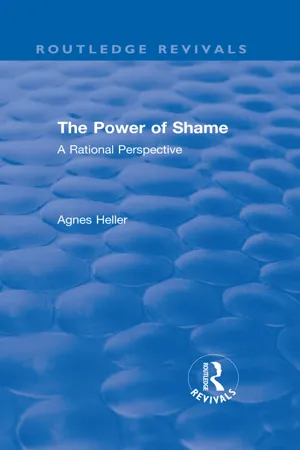
First published in 1985, this book provides a stimulating series of inter-connected essays which address the theme of shame, which, unlike the problem of conscience, has been seldom discussed by moral philosophers. The essays focus on the ethical regulation of human action and judgement, examining both its constant and varying elements and concentrating on contemporary types of moral regulation. Professor Heller uses Aristotelian categories, such as the good life, in her discourse to present a new conception of rationality, distinguishing between shame regulation and conscience regulation of moral conduct, and arguing that shame regulation cannot be completely overcome even in an age of rationalism.
- 318 pages
- English
- ePUB (mobile friendly)
- Available on iOS & Android
eBook - ePub
About this book
Information
Chapter 1
The Power of Shame
Introduction
The problem of shame, in marked contrast with the problem of conscience, has seldom been thematized in modern moral philosophy, while discussion of shame as a phenomenon has been mainly confined within the frameworks of psychology and anthropology. (In anthropology, the counterposition of ‘shame cultures’ and ‘guilt cultures’ has become widespread.) Although it is true that certain advocates of Kulturkritik and of anthropology have noticed that consideration of the shame regulation of human conduct has gained ground in our times, the manifold implications of this recognition have been left unexplored. The following study attempts to fill the gap by offering a general theory of shame. The main issue under scrutiny will be the ethical regulation of human action and judgment, examining both its constant and varying elements. I am aware of the inherent difficulties in the task I have undertaken. A thorough analysis of the changing patterns in the system of ethical regulation calls for an historical interpretation, whereas a thorough analysis of the system’s constant patterns requires a structural interpretation. Should one undertake both simultaneously, one has to work with an historical typology inevitably selective in character. I wish to make it clear from the start that my selection is oriented towards the understanding (and the critique) of contemporary types of moral regulation. Such an undertaking implies the criticism of certain ethical theories which express and endorse these types of regulation, and this will be done in the text usually without explicit reference to these theories. I am going to argue that the over-rationalization of moral regulation (i) contributes to the erosion of the pillars of that same regulation; (ii) opens the way to the emergence of an irrational external authority; and (iii) that completely formalized moral philosophies not only cannot cope with these dangers but, on occasion, even reinforce them. A postulate, combining material (substantive) with formal ethics, will be formulated as a conclusion.
In what follows, I substitute a distinction between shame and conscience for the more usual division of moral feelings into shame and guilt. Certain distinguished scholars of modern anthropology based their counterposition of shame and guilt on a particular interpretation of Freud’s psychology, and although not a follower of Freud, I certainly read his analysis of the problem under scrutiny as a corroboration more of my theory than theirs. In Civilization and its Discontents, Freud distinguished two types of guilt. The historically primary type of guilt was essentially a reaction to the fear of external authority, whereas the historically secondary type of guilt was essentially a reaction to the fear of internalized authority. In making this distinction, Freud obviously attributed guilt feelings to people whose cultures were later to be mislead-ingly identified as ‘shame’ as opposed to ‘guilt’ cultures. I do not wish to disparage the merits of great anthropologists like Margaret Mead or Ruth Benedict. Even less do I wish to test their Freudian ‘orthodoxy’. But the truth of the matter is that shame and guilt cannot sensibly be related to the same genus proximum. Guilt is the perpetuation of either shame or the pangs of conscience; it is the consciousness of a moral debt which has to be repaid. The less it can or will be repaid, the more tormenting the guilt feeling becomes. Benedict herself describes a traditional Japanese shame feeling as the feeling of ‘being in debt’, and the German word for guilt,lSchuld\ literally means ‘being in debt’. Works of art testify that guilt can (and often does) pertain to shame. Masaccio’s celebrated Adam and Eve is one example among many. Adam covers his face, Eve her nakedness–both typical gestures of shame–because they had committed a sin which had to be requited by both them and the whole human race through the burden of hard work and the punishment of mortality.
I
Both shame and conscience are feelings. As such, they are involvements of persons in the judgments made by the authorities of human conduct. Feeling can be defined as ‘being involved in something’. (In my book A Theory of Feelings, I have argued at length for this theoretical proposal. As I cannot repeat my arguments here, I simply refer the reader for details to the first two chapters of the book.) As a result, involvement of persons’ means feeling, and the phrase ‘in the judgments made by the authorities of human conduct’ qualifies the feeling. As any ‘authority of human conduct’ is a normative authority, involvement in such an authority can properly be called moral feeling.
Shame and conscience differ insofar as the authority in which one is involved is different. In the case of shame, the authority is social custom – rituals, habits, codes or rosters of behaviour – represented by the ‘eye of others’. In the case of conscience, the authority is practical reason which can become manifest as the ‘internal voice’. Both authorities can approve as well as disapprove. A clear conscience is not simply an absence of the pangs of conscience. It is also a highly pleasant feeling, and when we are praised in public and blush in modesty, it is a magnificent experience of happy embarrassment.
The disapproval of either authority may elicit feelings which range from simple uneasiness to the torments of guilt. The intensity and quality of the feeling certainly depends on the character of the violated norm, but only partly. The various shades of guilt feeling have been amply analysed in psychology, and I simply cannot enter into this problem within the context of this paper. But what has to be emphasized is the fact that the intensity of guilt feeling does not depend on the particular authority of judgment in which one is involved. The disapproval of the external authority can trigger guilt feelings which make life completely intolerable, while the disapproval of the internal authority may (on occasion) be easily overcome.
To assert that shame is involvement in the judgment of the external authority is not to support the widely held theory that shame is not internalized. For the question as to whether shame is internalized becomes irrelevant once it is seen that shame is a feeling and, as such, an internal occurrence. The proper question then is whether or not the occurrence of the feeling signifies the internalization (not of shame) but of the external authority. If not, shame can only be reactive and would not imply the recognition of the validity of the norms of the external authority by the members of the community. But if the members of a community did not consider certain actions and modes of behaviour as ‘shameful’, the fear of being put to shame would not make people avoid transgressing against the external authority of conduct, and no one would be put to shame at all. But different types and levels of internalization are (and have to be) distinguished in every community. A member of a New Guinea tribe explained the different notions of shame to an anthropologist in the following way. Shame is either ‘shame on the skin’ or ‘deep shame’. If urinating or sexual intercourse is witnessed by others, the shame felt is ‘shame on the skin’; if someone offends ancestral spirits, the shame felt is ‘deep shame’. Here it is the character of the norms infringed that determines the intensity of shame, and it is taken for granted that the infringement of norms that elicits ‘shame on the skin’ is always unintentional. In our society, the intensity of shame does not depend only on the norms but also to a great extent on the individual’s relation to these norms. If two industrialists go bankrupt, one might commit suicide not because of the loss of wealth but because of being unable to face the ‘eye of others’, while the other may not experience shame at all. When norms are pluralistic, or when they can be interpreted in a pluralistic way, not everyone will be ashamed, or at least not with the same intensity in cases of transgression against the external authority.
Some scholars argue that it is not the lack of internalization but rather the character of the sanction (in cases of transgression) that distinguishes shame from guilt. Shame calls for an external sanction whereas guilt is an internal sanction. Although the counter-position of shame and guilt has already been rejected, additional comments are appropriate. If sanction means punishment, the distinction between shame and guilt on grounds of their respective sanctions cannot be reasonably supported. In some shameful situations there are no punitive sanctions at all, being ashamed is punishment in itself. (If one wishes, one can speak of ‘internal sanctions’ in such cases. Of course, there are people who do not feel shame even if, in terms of the given expectations, they should. But there are also others who do not feel guilty even if they are in fact guilty.) If sanction does not mean punishment but the torments of the self, again the distinction cannot be supported. When we recall situations in which we were ashamed, a burning feeling of mortification or of being ridiculed is still with us even if our conscience is clear. In cases of shame, it is not the sanction but the authority that is external. If the external authority has been internalized, and if we transgress its norms or rituals, we lose our honour. Losing honour means losing face. The expression ‘losing face’ aptly describes the visual character of shame. As has been mentioned, the violation of external authority is disapproved of by the ‘eye of others’. If the norm violated by our actions is highly placed in the value structure of our community, then the sentence of the ‘eye of others’ is isolation and expulsion. Banished by and from the ‘eye’ we can no longer look at others with disap-probation when they fail to conform with the norms of conduct, for we no longer have face. If we lose our honour, we feel guilty; the torments of lost honour are the torments of ‘shame-guilt’.
Before any further analysis, I wish to argue for the primogeniture of shame over conscience.
The feeling of shame originates in the ‘shame affect’. Affects are empirical human universals, inborn in every healthy specimen of our species. They are expressive, communicative, and may be displayed in facial expressions, modulations of voice and in gestures. Basic expressions of affect are not acquired but ‘natural’ feeling-responses to fairly complex structures of stimuli. However, the stimuli empowered to evoke the affects may change over time. Affect intensity can be diminished by habit and by turning away from the objects of affect. The following belong to the affects: fear (with the expression of fear), shame (with the expression of shame), rage, disgust, curiosity, gaiety, sadness (with their respective expressions). Even though bodily pain is not an affect proper, it belongs to the same family. Darwin, who made a comprehensive study of the affects, concluded that they were the remnants of instincts produced by the erosion of instinct regulation and its replacement by cultural regulation. It is culture that provides the principal objects of affect for humans. However, shame (with the expression of shame) has to be distinguished within the realm of affects. Unlike fear, for instance, shame affect cannot be conceived of prior to culture. In fact, shame and culture are coeval. One can corroborate this statement if one considers that shame affect occurs only in domestic (and not feral) animals, in other words, in animals confronted with the norms of human culture (for example, dogs), whereas other affects can be observed in animals living in a natural environment if the instinct regulation is somewhat eroded and complemented by learning and intelligence.
The feeling of shame is the very affect which makes us conform to our own cultural environment. The ‘eye of others’ triggers the feeling and the expression of shame: it makes us blush and hide our faces; it arouses the desire to run away, to sink into the earth, to disappear. Needless to say, the shame affect, like all other affects, is integrated into cognition (and vice versa) during socializ– ation. It is in childhood and in situations which we are not prepared to face that we can best observe the pure shame affect. If shame affect is already integrated into cognition, it is no longer a ‘pure’ affect but more or less an emotion. Thus shame-guilt is an emotion.
When speaking of the integration of cognition and the shame affect, I have in mind a continuous process. The first step is the division of the affect into ‘good’ and ‘bad’ shame. It only seems to be odd that the expression of shame is identical in both cases. Whether someone is acclaimed or reprimanded in public, the spontaneous reaction can be similar–blushing, hiding one’s face and the like, particularly if the person in question is taken by surprise. One obvious explanation of the phenomenon is that, over a very long period of time, excelling over one’s fellow-men was trespassing to the same extent as falling below the standard, and both were shameful. An analysis of the Greek notion of hubris may support this speculation.
The shame affect can be justly called a moral feeling for it is a response of approbation or disapprobation. It is the only inborn moral feeling in us. No wonder then that it has played (and still plays) an enormous part in the process of socialization. Since the emergence of practical reason as an independent authority of human conduct and conscience, the power of shame has become more and more ambiguous. But because of its inborn character, shame affect will never be truly overcome. Whether we should try to overcome it is a question I will try to answer later on.
Of course, it is not shame affect alone, but all our affects that are used as a kind of ‘natural material’ during the course of socialization. Disgust, eroticism, fear, gaiety and sadness, as well as bodily pain and rage, are not only ‘socialized’ but serve as means for socialization at the same time. They are instruments and weapons of culture, directed and used against each other. Disgust is ‘used’ against eroticism, eroticism is ‘used’ against fear, bodily pain against rage, rage against fear and so on. But whichever affects serve as the means for the socialization of others, whether they are used as instruments or as weapons, they are all related to the affect of shame. If a person is not disgusted by something he or she ought to be disgusted by, the person will be put to shame. Bodily pain, the other main ‘socializer’, is mostly effectual only if accompanied by shame.
It is with some hesitation that I describe the shame affect as the moral feeling par excellence, as we often respond with shame to types of disapproval which we do not consider to be related to moral issues* But in identifying the shame affect with the inborn moral feeling I mean a simple but crucial thing: shame affect is the very feeling which regulates a person’s actions and general behaviour in conformity with the norms and rituals of his or her community. Given that we are social beings, yet born into a world in which the norms and values are external to us, coming to conform to these norms is identical with becoming human. Of course in societies with heterogeneous norms of conduct, conforming also means ‘selecting’. But in all societies with homogeneous norms of conduct–a condition presumably true for 99 per cent of Man’s history–it is the shame response which is (and has been) the primary regulator of socialization. For it is the response that expresses that the person has either not acted in keeping with the norms or exceeded others in observing them. The shame affect expresses deviation or deflection from the system of conduct in both cases and feeling the shame affect is (in itself) a recognition of the validity of the system. Ongka, the New Guinean Aborigine who explained the notion of shame to the anthropologist, made the following remark about ‘shame on the skin’ (pipil): ‘AH sensible people feel this pipil. If someone does not his relatives will tell him: you have no shame on your skin, you are crazy.’ But if deviation from the norms means wrongdoing, the recognition of the validity of customs through shame feeling alone is insufficient to put things right. Shame expresses a debt either to the community or to the gods of the community–according to Durkheim these amount to the same thing–a debt which has to be repaid. What kind of deviation it is that cannot be put right by shame, how great a debt is and how (and to what extent) it can be repaid, are matters not decided by the debtor but by the creditor–by the system of conduct, the embodiment of the community.
External authority can regulate human conduct on its own only if: (a) the norms of conduct are homogeneous–in other words, if the same norms apply to everyone belonging to the same ‘cluster’ (age, sex and the like); (b) the community is small; and (c) social change is not noticeable for co-existing generations.
Under the above conditions everyone knows what proper conduct is and what kinds of conduct apply to his or her ‘cluster’. It is action (not motivation) that counts. If these conditions are not met, however, internal regulation must supplement external regulation. And I mean ‘supplementing’, not ‘replacing’. (The development of such a double authority system can be observed in ontogenesis as well. Due to the thorough and fundamental research of Piaget, we now have a considerable amount of knowledge about the moral development of the child in societies which have a long tradition in supplementary internal regulation.)
If the norms of conduct do not encompass all possible social situations which may occur...
Table of contents
- Cover
- Title
- Copyright
- Original Title
- Original Copyright
- Contents
- Preface
- Chapter 1 The Power of Shame
- Chapter 2 Paradigm of Work – Paradigm of Production
- Chapter 3 Everyday Life, Rationality of Reason, Rationality of Intellect
- Chapter 4 Rationality and Democracy
- Chapter 5 Can ‘True’ and ‘False’ Needs be Posited?
- Chapter 6 The Dissatisfied Society
- Index
Trusted by 375,005 students
Access to over 1.5 million titles for a fair monthly price.
Study more efficiently using our study tools.
Frequently asked questions
Yes, you can cancel anytime from the Subscription tab in your account settings on the Perlego website. Your subscription will stay active until the end of your current billing period. Learn how to cancel your subscription
No, books cannot be downloaded as external files, such as PDFs, for use outside of Perlego. However, you can download books within the Perlego app for offline reading on mobile or tablet. Learn how to download books offline
Perlego offers two plans: Essential and Complete
- Essential is ideal for learners and professionals who enjoy exploring a wide range of subjects. Access the Essential Library with 800,000+ trusted titles and best-sellers across business, personal growth, and the humanities. Includes unlimited reading time and Standard Read Aloud voice.
- Complete: Perfect for advanced learners and researchers needing full, unrestricted access. Unlock 1.5M+ books across hundreds of subjects, including academic and specialized titles. The Complete Plan also includes advanced features like Premium Read Aloud and Research Assistant.
We are an online textbook subscription service, where you can get access to an entire online library for less than the price of a single book per month. With over 1.5 million books across 990+ topics, we’ve got you covered! Learn about our mission
Look out for the read-aloud symbol on your next book to see if you can listen to it. The read-aloud tool reads text aloud for you, highlighting the text as it is being read. You can pause it, speed it up and slow it down. Learn more about Read Aloud
Yes! You can use the Perlego app on both iOS and Android devices to read anytime, anywhere — even offline. Perfect for commutes or when you’re on the go.
Please note we cannot support devices running on iOS 13 and Android 7 or earlier. Learn more about using the app
Please note we cannot support devices running on iOS 13 and Android 7 or earlier. Learn more about using the app
Yes, you can access Routledge Revivals: The Power of Shame (1985) by Agnes Heller in PDF and/or ePUB format, as well as other popular books in Philosophy & Philosophy History & Theory. We have over 1.5 million books available in our catalogue for you to explore.