- 272 pages
- English
- ePUB (mobile friendly)
- Available on iOS & Android
eBook - ePub
Handbook of Bioremediation (1993)
About this book
Written by leading soil and ground-water remediation scientists, Handbook of Bioremediation presents information regarding the processes, application, and limitations of using remediation technologies to restore contaminated soil and ground water. It covers field-tested technologies, site characterization requirements for each remediation technology, and the costs associated with their implementation. In addition to discussions and examples of developed technologies, the book provides insights into technologies ranging from theoretical concepts to limited field-scale investigations. In situ remediation systems, air sparging and bioventing, the use of electron acceptors other than oxygen, natural bioremediation, and the introduction of organisms into the subsurface are among the specific topics covered in this invaluable handbook.
Information
SECTION 1
1.1. Introduction
The purpose of this report is to provide the reader with a detailed background of the fundamentals involved in the bioremediation of contaminated surface soils, subsurface materials, and ground water. A number of bioremediation technologies are discussed along with the biological processes driving those technologies. The application and performance of these technologies are also presented. These discussions include in-situ remediation systems, air sparging and bioventing, use of electron acceptors alternate to oxygen, natural bioremediation, and the introduction of organisms into the subsurface. The contaminants of major focus in this report are petroleum hydrocarbons and chlorinated solvents.
Location of the contamination in the subsurface is critical to the implementation and success of in-situ bioremediation. Also important to success is the chemical nature and physical properties of the contaminant(s) and their interactions with geological materials.
In the unsaturated zone, contamination may exist in four phases (Huling and Weaver, 1991): (1) air phase - vapor in the pore spaces; (2) adsorbed phase - sorbed to subsurface solids; (3) aqueous phase - dissolved in water; and (4) liquid phase -nonaqueous phase liquids (NAPLs). Contamination in saturated material can exist as residual saturation sorbed to the aquifer solids, dissolved in the water, or as a NAPL. Contaminant transport occurs in the vapor, aqueous, and NAPL phases. The interactions between the physical properties of the contaminant influencing transport (density, vapor pressure, viscosity, and hydrophobicity) and those of the subsurface environment (geology, aquifer mineralogy and organic matter, and hydrology) determine the nature and extent of transport.
NAPL existing as a continuous immiscible phase has the potential to be mobile, resulting in widespread contamination. Residual saturation is the portion of the bulk liquid retained by capillary forces in the pores of the subsurface material; the NAPL is no longer a continuous phase but exists as isolated, residual globules. Residual phase saturation will act as a continuous source of contamination in either saturated or unsaturated materials due to dissolution into infiltrating water or ground water, or volatilization into pore spaces.
Liquids less dense than water, such as petroleum hydrocarbons, are termed light nonaqueous phase liquids (LNAPLs). LNAPLs will migrate vertically until residual saturation depletes the liquid or until the capillary fringe is reached (Figure 1.1). Some spreading of the bulk liquid will occur until the head from the infiltrating liquid is sufficient to penetrate to the water table. The hydrocarbons will spread laterally and float on the surface of the water table, forming a mound that becomes compressed into a spreading lens due to upward pressure of the water (Hinchee and Reisinger, 1987). Fluctuations of the water table due to seasonal variations, pumping, or recharge can result in movement of bulk liquid further into the subsurface with significant residual contamination present beneath the water table. The more soluble constituents will dissolve from the bulk liquid into the water and will be transported with the migrating ground water.
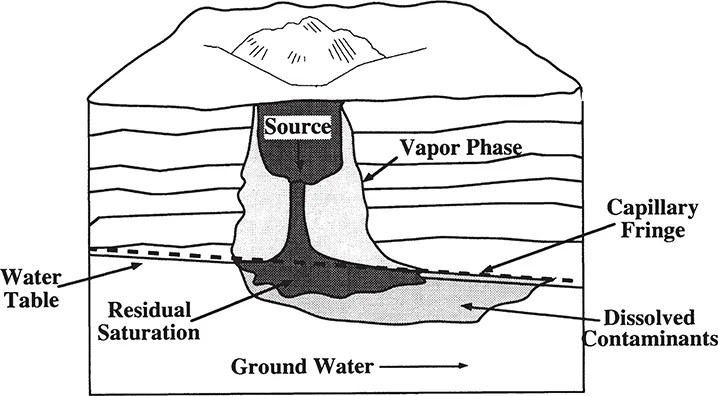
Figure 1.1. Distribution of petroleum hydrocarbons in the subsurface.
Vertical migration of dense nonaqueous phase liquids (DNAPLs) will continue through soils and unsaturated materials under the forces of gravity and capillary attraction until the capillary fringe or a zone of lower permeability is reached. The bulk liquid spreads until sufficient head is reached for penetration into the capillary fringe to the water table. Because the density of chlorinated solvents is greater than that of water, DNAPLs will continue to sink within the aquifer until an impermeable layer is reached (Figure 1.2). The chlorinated solvents will then collect in pools or pond in depressions on top of the impermeable layer. DNAPL contamination in heterogeneous subsurface environments (Figure 1.3) is difficult to both identify and remediate.
Bioremediation of ground waters, aquifer solids, and unsaturated subsurface materials is widely practiced for contaminants derived from petroleum products. Currently, the most important techniques for bioremediating petroleum-derived contaminants are based on enhancement of indigenous microorganisms by delivery of an appropriate electron acceptor plus nutrients to the subsurface. These techniques are in-situ bioremediation, bioventing, and air sparging; natural bioremediation of petroleum hydrocarbons is also discussed. This paper presents sections devoted to each of the above-mentioned techniques authored by experts actively engaged in bioremediation and research. The sections are: Section 2, In-situ Bioremediation of Soils and Ground Water Contaminated With Petroleum Hydrocarbons; Section 3, Bioventing of Petroleum Hydrocarbons; Section 4, Treatment of Petroleum Hydrocarbons in Ground Water By Air Sparging; Section 7, In-situ Bioremediation Technologies for Petroleum-Derived Hydrocarbons Based on Alternate Electron Acceptors (other than molecular oxygen); and Section 9, Natural Bioremediation of Hydrocarbon-Contaminated Ground Water.
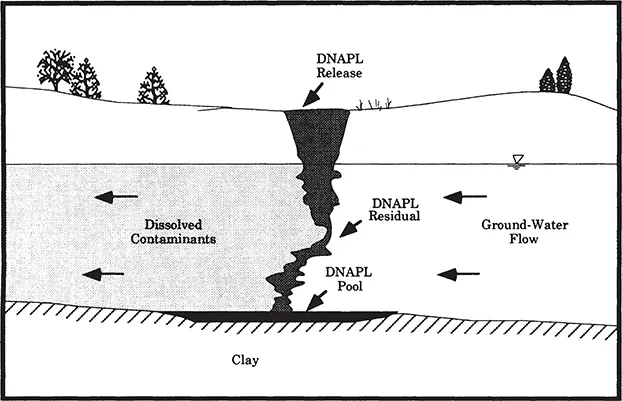
Figure 1.2. Migration of DNAPL through the vadose zone to an impermeable boundary in relatively homogenous subsurface materials (Huling and Weaver, 1991).
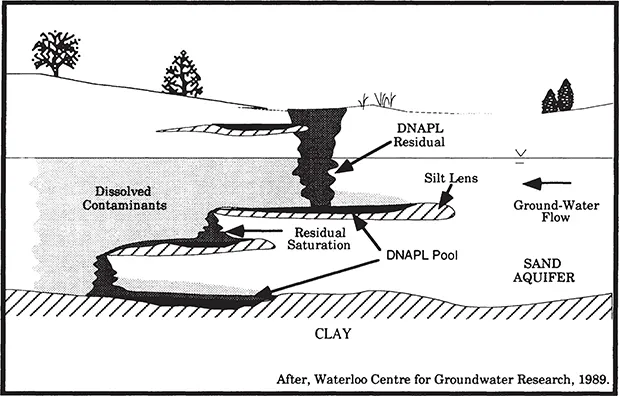
Figure 1.3. Perched and deep DNAPL reservoirs from migration through heterogeneous subsurface materials (Huling and Weaver, 1991).
Chlorinated solvents are more difficult to bioremediate than petroleum hydrocarbons, and bioremediation efforts are still in the research and development stage. Biological processes for most chlorinated compounds, whether aerobic or anaerobic, require the presence of a primary substrate for cometabolism. Both enhanced and natural bioremediation of chlorinated compounds are widely investigated in laboratory, pilot-scale, and field-scale studies. Results of these efforts are presented in the following sections: Section 5, Ground-water Treatment for Chlorinated Solvents; Section 6, Bioventing of Chlorinated Solvents for Ground-water Cleanup through Bioremediation; Section 8, Bioremediation of Chlorinated Solvents Using Alternate Electron Acceptors; and Section 10, Natural Bioremediation of Chlorinated Solvents.
The introduction of microorganisms to the subsurface for bioremediation purposes is discussed in Section 11, Introduced Organisms for Subsurface Bioremediation. Although not considered a successful technique at this time due to concerns about survivability of introduced microorganisms, this method may someday be useful at sites sterilized by contamination.
Discussed in each section are basic biological and nonbiological processes affecting the fate of the compounds of interest, documented field experience, performance, repositories of expertise, primary knowledge gaps and research opportunities favorable and unfavorable site conditions, regulatory acceptance, special requirements for site characterization, and problems encountered with the technology. Although the focus of this paper is bioremediation, remediation of most sites will require use of other technologies not discussed, such as pump and treat, soil washing, etc. The place ofbioremediation in the cleanup of hazardous waste sites is still evolving, and evaluation of its effectiveness is under investigation by regulators, researchers, and remediation firms.
References
Hinchee, R. E., and H.J. Reisinger. 1987. A practical application of multiphase transport theory to ground water contamination problems. Ground Water Monitoring Review. 7(1):84–92.
Huling, S. G., and J.W. Weaver. 1991. Dense Nonaqueous Phase Liquids. Ground Water Issue Paper. EPA/540/4-91-002. Robert S. Kerr Environmental Research Laboratory. Ada, Oklahoma.
SECTION 2
In-Situ Bioremediation of Soils and Ground Water Contaminated with Petroleum Hydrocarbons
Robert D. Norris
Eckenfelder, Inc.,
227 French Landing Drive
Nashville, Tennessee 37228
Telephone: (615)255-2288
Fax: (615)256-8332
Eckenfelder, Inc.,
227 French Landing Drive
Nashville, Tennessee 37228
Telephone: (615)255-2288
Fax: (615)256-8332
2.1. Introduction
This chapter discusses the use of in-situ bioremediation processes to treat ground water and aquifer solids contaminated with petroleum hydrocarbons under aerobic conditions using indigenous microorganisms. Natural bioremediation, the use of nitrate as an electron acceptor, introduced organisms, air sparging to provide oxygen, and treatment of the unsaturated zone are all addressed in other sections. Still other sections address the same topics for chlorinated solvents. Discussions of issues covered in the other sections are included in this document only to the extent that is necessary to adequately address some topics.
2.2. Fundamental Principles
Bioremediation, whether of excavated soils, aquifer solids or unsaturated subsurface materials, is the use of microorganisms to convert harmful chemical compounds to less harmful chemical compounds in order to effect remediation of a site or a portion of a site. The microorganisms are generally bacteria but can be fungi. Indigenous bacteria that can degrade a variety of organic compounds are present in nearly all subsurface materials. The use of introduced microorganisms, as discussed in Section 11, has not been shown to be of significant benefit. Microorganisms require certain minerals, usually referred to as nutrients, and an electron acceptor. While a variety of minerals such as iron, magnesium, and sulfur are required by the microorganisms, it is usually only necessary to add nitrogen and phosphorus sources. The other minerals are needed in trace amounts, and adequate amounts are normally found in most ground waters and subsurface materials. The most common electron acceptor used in commercial bioremediation processes is oxygen. Other electron acceptors such as nitrate can be used for some contaminants such as most aromatic hydrocarbons, although restrictions may apply to the levels of nitrate that may be introduced to ground water. This topic is covered in Sections 7 and 8.
Bioremediation systems supply nitrogen, phosphorus, and/or oxygen to bacteria that are present in the contaminated aquifer solids and ground water. Stoichiometrically, it would take approximately three pounds of oxygen to convert one pound of hydrocarbon to carbon dioxide and water. Experience with wastewater treatment indicates that the expressed oxygen requirements are usually near half of the stoichiometric amount. Conversely, some of the oxygen introduced for biooxidation of the contaminants may be consumed by other reactions or is lost through inefficient distribution. As a result, first approximations of oxygen requirements are typically based on the three-to-one ratio.
Nutrient requirements are less easily predicted. If all of the hydrocarbon mass were converted to cell material, the nutrient requirements based on the mass of hydrocarbon to be consumed would be approximated by a ratio of carbon to nitrogen to phosphorous of 100:10:1. The nutrient requirement will be less than this ratio to the extent that direct conversion of hydrocarbons to carbon dioxide and water occurs. Nutrients already exist in the subsurface materials and ground water, nitrogen is fixed by the indigenous bacteria, and nutrients are recycled from dead bacteria. However, adsorption of nutrients by geologic materials can substantially increase the amount of nutrients that have to be introduced in order to distribute nutrients across the contaminated zone. Adsorption may be modest in clean sands but may consume most of the nutrients in silts and clays, especially if the solids have a high natural organic content.
In some instances, nitrogen, phosphorus, or oxygen may be present in sufficient quantities to support degradation of the constituents of interest. In those cases, only one or two of the three elements would need to be added. This is most likely to be the case where low levels of contamination are present. In such cases there may be sufficient nitrogen a...
Table of contents
- Cover Page
- Title Page
- Copyright Page
- Foreword
- Dedication
- Contents
- Foreword
- Figures
- Tables
- Executive Summary
- Section 1. Introduction
- Section 2. In-Situ Bioremediation of Soils and Ground Water Contaminated with Petroleum Hydrocarbons
- Section 3. Bioventing of Petroleum Hydrocarbons
- Section 4. Treatment of Petroleum Hydrocarbons in Ground Water by Air Sparging
- Section 5. Ground-Water Treatment for Chlorinated Solvents
- Section 6. Bioventing of Chlorinated Solvents for Ground-Water Cleanup through Bioremediation
- Section 7. In-Situ Bioremediation Technologies for Petroleum-Derived Hydrocarbons Based on Alternate Electron Acceptors (Other than Molecular Oxygen)
- Section 8. Bioremediation of Chlorinated Solvents Using Alternate Electron Acceptors
- Section 9. Natural Bioremediation of Hydrocarbon-Contaminated Ground Water
- Section 10. Natural Bioremediation of Chlorinated Solvents
- Section 11. Introduced Organisms for Subsurface Bioremediation
Trusted by 375,005 students
Access to over 1.5 million titles for a fair monthly price.
Study more efficiently using our study tools.
Frequently asked questions
Yes, you can cancel anytime from the Subscription tab in your account settings on the Perlego website. Your subscription will stay active until the end of your current billing period. Learn how to cancel your subscription
No, books cannot be downloaded as external files, such as PDFs, for use outside of Perlego. However, you can download books within the Perlego app for offline reading on mobile or tablet. Learn how to download books offline
Perlego offers two plans: Essential and Complete
- Essential is ideal for learners and professionals who enjoy exploring a wide range of subjects. Access the Essential Library with 800,000+ trusted titles and best-sellers across business, personal growth, and the humanities. Includes unlimited reading time and Standard Read Aloud voice.
- Complete: Perfect for advanced learners and researchers needing full, unrestricted access. Unlock 1.5M+ books across hundreds of subjects, including academic and specialized titles. The Complete Plan also includes advanced features like Premium Read Aloud and Research Assistant.
We are an online textbook subscription service, where you can get access to an entire online library for less than the price of a single book per month. With over 1.5 million books across 990+ topics, we’ve got you covered! Learn about our mission
Look out for the read-aloud symbol on your next book to see if you can listen to it. The read-aloud tool reads text aloud for you, highlighting the text as it is being read. You can pause it, speed it up and slow it down. Learn more about Read Aloud
Yes! You can use the Perlego app on both iOS and Android devices to read anytime, anywhere — even offline. Perfect for commutes or when you’re on the go.
Please note we cannot support devices running on iOS 13 and Android 7 or earlier. Learn more about using the app
Please note we cannot support devices running on iOS 13 and Android 7 or earlier. Learn more about using the app
Yes, you can access Handbook of Bioremediation (1993) by Robert D. Norris in PDF and/or ePUB format, as well as other popular books in Biological Sciences & Environmental Science. We have over 1.5 million books available in our catalogue for you to explore.