- 832 pages
- English
- ePUB (mobile friendly)
- Available on iOS & Android
eBook - ePub
Wellington Sears Handbook of Industrial Textiles
About this book
The Wellington Sears Handbook of Industrial Textiles has been a widely used textile industry reference for more than 50 years. Now a completely updated new edition has been published. It was prepared by a team of industrial textile specialists at Auburn University to provide both technical and management personnel with a comprehensive resource on the current technology and applications of today's industrial textiles.
All aspects of industrial textiles are covered: man-made and natural materials, manufacturing and finishing methods, and all applications. There are also sections on properties, testing, waste management, computers and automation, and standards and regulations. The appendices provide extensive reference data: properties, specifications, manufacturers and trade names, mathematical equations and measurement units. The text is organized for easy reference, and well illustrated with hundreds of schematics and photographs.
Information
1.0
OVERVIEW OF INDUSTRIAL TEXTILES
1.1
Overview of Industrial Textiles
S. ADANUR
“… textiles go to war, textiles go to space, become roof, choke an oil spill, imitate a heart, hold you safely in your seat, hoist tea bags, support tires, diaper babies, line roads, keep you dry, wrap wounds …”
American Textile Manufacturers Institute (ATMI)
1 Definition of Industrial Textiles
Industrial textiles are specially designed and engineered structures that are used in products, processes or services of mostly non-textile industries.
According to this definition, an industrial textile product can be used in three different ways:
- An industrial textile can be a component part of another product and directly contribute to the strength, performance and other properties of that product, e.g., tire cord fabric in tires.
- An industrial textile can be used as a tool in a process to manufacture another product, e.g., filtration textiles in food production, paper machine clothing in paper manufacturing.
- An industrial product can be used alone to perform one or several specific functions, e.g., coated fabrics to cover stadiums.
Another indication of the definition above is that unlike ordinary textiles which have traditionally been used by the consumer for clothing and furnishing, industrial textiles are generally used by professionals from industries of non-textile character in various high-performance or heavy duty applications.
The term “industrial textiles” is the most widely used term for non-traditional textiles. Other terms used are “technical textiles,” “high performance textiles,” “high tech textiles,” “engineered textiles,” “industrial fabrics” and “technical fabrics.”
2 History
Although the beginning of industrial textiles may be as old as traditional textiles dating back to several thousand years ago, industrial textiles are considered to be a little “younger” than traditional textiles. The history of modern industrial textiles probably began with the canvas cloth used to sail ships from the old world to the new across the ocean. Later, hemp canvas was used on covered wagons to protect families and their possessions across the land. Fabrics were used in early cars as “rag-tops” to keep out the weather and as seat cushions for passenger comfort. Fabrics offered the advantage of light weight and strength for early flying crafts in the air. The wings of the earliest airplanes were made of fabrics. Industrial textiles are still used in hot air balloons and dirigibles.
The invention of man-made fibers in the first half of the 20th century changed the industrial textiles market forever. The first truly man-made fiber, Nylon, was introduced in 1939. By development of exceptionally strong high performance fibers in the 1950s and 1960s, the application areas of industrial fibers and fabrics were widened. Man-made fibers not only replaced the natural fibers in many applications, but also opened up completely new application areas for industrial textiles. Synthetic fibers offered high strength, elasticity, uniformity, chemical resistance, flame resistance and abrasion resistance among other things. New fabrication techniques also contributed to the improved performance and service life of industrial textiles. Application of new chemicals help the design engineers to tailor their products for special uses.
Industrial textiles have played a critical role in space exploration. Spacesuits are made of a layered fabric system to provide protection and comfort for the astronaut. Engineered textiles provided strong and lightweight materials for the lunar landing module and for the parachutes used to return the astronauts to earth in 1969.
Military applications, especially during the global conflicts, expedited the development of technical textiles to better protect the soldiers. Today technical textiles are used extensively in military equipment and protective structures.
Technical textiles have met the various challenges created by the advancement of the society and by the ever increasing needs of mankind. Industrial textiles have been entering every aspect of human life. Thanks to advanced medical technology, today minute bundles of fibers are implanted in human bodies to replace or reinforce parts of the human body. Specially engineered textiles are used in airplanes, under highways, in transportation, and for environmental protection to name a few.
3 Significance of Industrial Textiles
Industrial textiles make a vital contribution to the performance and success of products that are used in non-textile industries. For example, 75 % of the strength of an automobile tire comes from the tire cord fabric used in the tire. Pure carbon fibers that are used in textile structural composite parts for aerospace, civil and mechanical engineering applications are on average four times lighter and five times stronger than steel.
Some of the modern industries simply would not be the same without industrial textiles. For example, the U.S. Department of Defense (DOD) has in its inventory some 10,000 items which are made entirely or partially from industrial textiles. The artificial kidney used in dialysis is made of 7,000 hollow fibers and has a diameter of only two inches. Heat shields on space vehicles are made of textile fibers that can withstand several thousand degrees Fahrenheit. These are just some of the many examples which show the significance of industrial textiles in the journey of mankind.
Table 1.1 Percent Share of Technical Textiles Production in Total Textile Production.
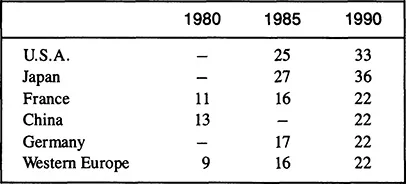
Table 1.1 shows the percent share of technical textiles in total textile production for some industrialized countries. Industrial textiles account for one-third of the total textile production in highly industrialized countries such as the United States and Japan. The rapid increase of industrial textiles’ share within the last two decades is a good indication of their significance.
4 Principles of Industrial Textiles
Industrial textiles are truly engineered structures. These materials offer several advantages simultaneously in the same product that no other industrial product could provide: flexibility, elasticity and strength. Another beauty of the industrial textiles is that they have so many variables at the disposal of the designer which theoretically offer an infinite number of design possibilities. An industrial textile product involves several variables.
4.1 Polymers (Chapter 2.0)
Man-made fibers are made of polymers. Polymers can be classified in different ways such as thermoset and thermoplastic. By using different polymer types and fiber manufacturing conditions, certain properties can be programmed into the fiber. Crystallinity and molecular weight are among the typical characteristics that influence fiber properties.
4.2 Fiber Type and Stru...
Table of contents
- Cover Page
- Title Page
- Copyright Page
- Contents
- Foreword
- Preface
- Acknowledgements
- Introduction
- 1.0 Overview of Industrial Textiles
- 2.0 Polymers and Fibers
- 3.0 Fiber and Yarn Manufacturing
- 4.0 Fabric Manufacturing
- 5.0 Fabric Finishing And Coating
- 6.0 Architectural And Construction Textiles
- 7.0 Textile Structural Composites
- 8.0 Filtration Textiles
- 9.0 Geotextiles
- 10.0 Medical Textiles
- 11.0 Military and Defense Textiles
- 12.0 Paper Machine Clothing
- 13.0 Safety and Protective Textiles
- 14.0 Sports and Recreation Textiles
- 15.0 Transportation Textiles
- 16.0 General Industrial Textiles
- 17.0 Fiber Properties and Technology
- 18.0 Yarn Nomenclature, Properties and Technology
- 19.0 Fabric Properties and Technology
- 20.0 Textile Testing
- 21.0 Textile Waste Management
- 22.0 Computers and Automation in Textiles
- 23.0 Standards and Regulations
- 24.0 Future of Industrial Textiles
- Appendix 1: Air, Tent, and Tensile Structures—Fabric Specification Table
- Appendix 2: Awnings and Canopies—Fabric Specification Table
- Appendix 3: Geotextile Fabric Properties
- Appendix 4: Characteristics, Industrial Uses, and Manufacturers of Major Generic Fibers and Trade Names
- Appendix 5: Derivation of Mathematical Equations .
- Appendix 6: Measurement Units
Trusted by 375,005 students
Access to over 1.5 million titles for a fair monthly price.
Study more efficiently using our study tools.
Frequently asked questions
Yes, you can cancel anytime from the Subscription tab in your account settings on the Perlego website. Your subscription will stay active until the end of your current billing period. Learn how to cancel your subscription
No, books cannot be downloaded as external files, such as PDFs, for use outside of Perlego. However, you can download books within the Perlego app for offline reading on mobile or tablet. Learn how to download books offline
Perlego offers two plans: Essential and Complete
- Essential is ideal for learners and professionals who enjoy exploring a wide range of subjects. Access the Essential Library with 800,000+ trusted titles and best-sellers across business, personal growth, and the humanities. Includes unlimited reading time and Standard Read Aloud voice.
- Complete: Perfect for advanced learners and researchers needing full, unrestricted access. Unlock 1.5M+ books across hundreds of subjects, including academic and specialized titles. The Complete Plan also includes advanced features like Premium Read Aloud and Research Assistant.
We are an online textbook subscription service, where you can get access to an entire online library for less than the price of a single book per month. With over 1.5 million books across 990+ topics, we’ve got you covered! Learn about our mission
Look out for the read-aloud symbol on your next book to see if you can listen to it. The read-aloud tool reads text aloud for you, highlighting the text as it is being read. You can pause it, speed it up and slow it down. Learn more about Read Aloud
Yes! You can use the Perlego app on both iOS and Android devices to read anytime, anywhere — even offline. Perfect for commutes or when you’re on the go.
Please note we cannot support devices running on iOS 13 and Android 7 or earlier. Learn more about using the app
Please note we cannot support devices running on iOS 13 and Android 7 or earlier. Learn more about using the app
Yes, you can access Wellington Sears Handbook of Industrial Textiles by Sabit Adanur in PDF and/or ePUB format, as well as other popular books in Technology & Engineering & Industrial Engineering. We have over 1.5 million books available in our catalogue for you to explore.