- 384 pages
- English
- ePUB (mobile friendly)
- Available on iOS & Android
eBook - ePub
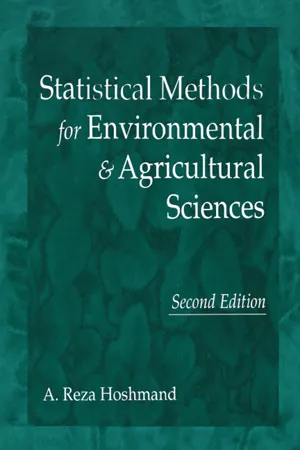
Statistical Methods for Environmental and Agricultural Sciences
About this book
The first edition of this book, popular around the world, is surpassed only by this new Second Edition. Improvements such as new and revised exercises, a broad range of practical and relevant case studies, and expanded theoretical concepts make this even better for users of statistics. The book emphasizes the practical application of statistics and provides examples in various fields of environmental and agriculture sciences. Because it uses simple, non-mathematical language to present statistical techniques, the reader requires only a familiarity with elementary algebra and mathematical notations to understand and apply the concepts described.
This logically organized book covers the following topics: Part 1 introduces statistical concepts as they apply to different fields of environmental and agriculture sciences and provides descriptive measures of central tendency and variability; Part 2 covers probability and sampling concepts used in inferential statistics; Part 3 presents parametric methods in hypothesis testing, which include research designs; Part 4 discusses a number of nonparametric techniques; Part 5 explains tests of association and prediction; and lastly, analysis of change over time is detailed in Part 6. The appendices contain statistical tables for reference purposes.
Information
PART I
Descriptive Statistics in Environmental and Agricultural Sciences
chapter one
The What and Why of Statistics for Environmental and Agricultural Sciences
1.1 What is statistics?
1.2 Why study statistics for environmental and agricultural sciences
Chapter summary
References and suggested reading
Students of environmental and agricultural sciences often question the value of statistics to their field of study. To address this question, it is important to understand the nature of statistics and its impact on policy decisions. Statistical analyses provide policy makers a means by which they can gauge the impact of policy choices. Environmental and agricultural policies sometimes appear to be in conflict with each other. With the advent of the Green Revolution, increased food and fiber production became highly dependent on the use of fertilizers, insecticides, herbicides, and industrialized agricultural implements. In the last few decades, nations around the world have adopted these technologies and as a consequence they have affected the environment negatively. As nations around the globe continue economic development projects, it becomes critical to assess the impact of these projects on the environment. Statistical models and techniques have an irreplaceable role in analyzing ways of reconciling long-term economic growth with the conservation of renewable natural resources, such as water, forests, soils, and living organisms, and the preservation of human health (Barnett and Turkman, 1993).
Statistics has a major role to play in quantifying effects, assessing consequences, measuring risks, and interpreting the evidence.
The objective of this text is to provide students with an understanding of the basic concepts of statistics in environmental and agricultural sciences.
1.1 What is statistics?
The word “statistics” can be singular or plural. In singular form it refers to a field of study, as one would refer to agronomy and soils, animal science, environmental sciences, etc. In the plural form it represents a group of numbers or a collection of data. The field of statistics is composed of both theory and methods that govern its application. In this text we shall look on statistics as a methodological tool in analyzing numerical data to make better decisions.
Statistics was developed to assist in those areas where laws of cause and effect are not apparent to the observer and where an objective approach is needed (Steel and Torrie, 1980). The field of statistics has contributed substantially to the evolution of agricultural research. While the history of statistics is long, we can look to the very recent past to see its contributions to agriculture and other sciences. To appreciate the important role that statistics has played in agriculture, we need look no further than the writings of Charles Darw...
Table of contents
- Cover
- Half Title
- Title Page
- Copyright Page
- Table of Contents
- Preface
- Mathematical symbols and notations
- General mathematical symbols
- Part I: Descriptive statistics in environmental and agricultural sciences
- Part II: Inferential statistics in environmental and agricultural sciences
- Part III: Tests of comparison: parametric methods
- Part IV: Nonparametric methods
- Part V: Test of association and prediction
- Part VI: Analysis of change over time
- Appendices
- Index
Trusted by 375,005 students
Access to over 1.5 million titles for a fair monthly price.
Study more efficiently using our study tools.
Frequently asked questions
Yes, you can cancel anytime from the Subscription tab in your account settings on the Perlego website. Your subscription will stay active until the end of your current billing period. Learn how to cancel your subscription
No, books cannot be downloaded as external files, such as PDFs, for use outside of Perlego. However, you can download books within the Perlego app for offline reading on mobile or tablet. Learn how to download books offline
Perlego offers two plans: Essential and Complete
- Essential is ideal for learners and professionals who enjoy exploring a wide range of subjects. Access the Essential Library with 800,000+ trusted titles and best-sellers across business, personal growth, and the humanities. Includes unlimited reading time and Standard Read Aloud voice.
- Complete: Perfect for advanced learners and researchers needing full, unrestricted access. Unlock 1.5M+ books across hundreds of subjects, including academic and specialized titles. The Complete Plan also includes advanced features like Premium Read Aloud and Research Assistant.
We are an online textbook subscription service, where you can get access to an entire online library for less than the price of a single book per month. With over 1.5 million books across 990+ topics, we’ve got you covered! Learn about our mission
Look out for the read-aloud symbol on your next book to see if you can listen to it. The read-aloud tool reads text aloud for you, highlighting the text as it is being read. You can pause it, speed it up and slow it down. Learn more about Read Aloud
Yes! You can use the Perlego app on both iOS and Android devices to read anytime, anywhere — even offline. Perfect for commutes or when you’re on the go.
Please note we cannot support devices running on iOS 13 and Android 7 or earlier. Learn more about using the app
Please note we cannot support devices running on iOS 13 and Android 7 or earlier. Learn more about using the app
Yes, you can access Statistical Methods for Environmental and Agricultural Sciences by Reza Hoshmand in PDF and/or ePUB format, as well as other popular books in Mathematics & Probability & Statistics. We have over 1.5 million books available in our catalogue for you to explore.