- 848 pages
- English
- ePUB (mobile friendly)
- Available on iOS & Android
eBook - ePub
Standard Potentials in Aqueous Solution
About this book
The best available collection of thermodynamic data!The first-of-its-kind in over thirty years, this up-to-date book presents the current knowledgeon Standard Potentials in Aqueous Solution.Written by leading international experts and initiated by the IUPAC Commissions onElectrochemistry and Electroanalytical Chemistry, this remarkable work begins with athorough review of basic concepts and methods for determining standard electrodepotentials. Building upon this solid foundation, this convenient source proceeds to discussthe various redox couples for every known element.The chapters of this practical, time-saving guide are organized in order of the groups ofelements on the periodic table, for easy reference to vital material . AND each chapteralso contains the fundamental chemistry of elements ... numerous equations of chemicalreactions .. . easy-to-read tables of thermodynamic data . . . and useful oxidation-statediagrams.Standard Potentials in Aqueous Solution is an ideal, handy reference for analytical andphysical chemists, electrochemists, electroanalytical chemists, chemical engineers, biochemists,inorganic and organic chemists, and spectroscopists needing information onreactions and thermodynamic data in inorganic chemistry . And it is a valuable supplementarytext for undergraduate- and graduate-level chemistry students.
Information
1
Standard Electrode Potentials: Units, Conventions, and Methods of Determination*
ROGER PARSONS† Laboratoire d'Electrochimie Interfaciale du CNRS, Meudon, France
I. Symbols
The standard electrode potential is a physical quantity and, like all physical quantities, it is the product of a numerical value (a pure number) and a unit (volt). It is represented by the symbol E°, the superscript indicating the standard nature of the quantity. More precisely, E° in the context of this book is the standard potential of a cell reaction when that reaction involves the oxidation of molecular hydrogen to solvated protons. When necessary the reaction will be indicated in parentheses or brackets after the symbol E°, for example,
which may be abbreviated [assuming that the reaction H(g) → 2H+ (aq) + 2e” is always present]
or
Other important physical quantities to be used in this work are:
T Thermodynamic temperature
G Molar Gibbs energy
S Molar entropy
Cp Molar heat capacity
H Molar enthalpy
xA Mole fraction of species A
mA Molality of species A (number of moles of A dissolved in 1 kg of solvent
cA Concentration of species A, also indicated as [A] (number of moles of A contained in 1 liter of solution, formerly called molarity)
pA Partial pressure of species A
Fugacity of species A
aA Activity of species A
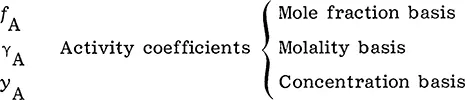
K Thermodynamic equilibrium constant of a reaction
n Charge number of a cell reaction [see Section III, following (1.8)]
II. Units and Constants
The units of energy and potential employed are those adopted by the Confèrence Gènèrale des Poids et Mesures and known as SI (Système International) units. The primary energy unit is the joule, defined in terms of the SI base units, the kilogram, meter, and second:
Many data in the literature are quoted in calories. They have been converted into joules using the conversion factor 4.1840 J cal−1. Also, 1 eV = 1.6021892 × 10⁻¹⁹ J. The unit of electrical potential difference is the volt, defined in terms of these SI base units together with the ampere:
Pressure, molality, and concentration units have most usually been
and these will continue to be used here. Conversion of pressure or concentration units to the coherent SI units of 1 N m−2 and 1 mol m−3 involves recalculation of the values of standard thermodynamic quantities [se...
Table of contents
- Cover Page
- Half title
- Title Page
- Copyright
- Preface
- COMMISSIONS ON ELECTROCHEMISTRY AND ELECTROANALYTICAL CHEMISTRY
- Contents
- Contributors
- 1 Standard Electrode Potentials: Units, Conventions, and Methods of Determination
- 2 The Single Electrode Potential: Its Significance and Calculation
- 3 Hydrogen
- 4 Oxygen
- 5 The Halogens
- 6 Sulfur, Selenium, Tellurium, and Polonium
- 7 Nitrogen, Phosphorus, Arsenic, Antimony, and Bismuth
- 8 Carbon, Silicon, Germanium, Tin, and Lead*
- 9 Gallium, Indium, and Thallium*
- 10 Zinc, Cadmium, and Mercury
- 11 Copper, Silver, and Gold
- 12 Nickel, Palladium, and Platinum
- 13 Cobalt, Rhodium, and Iridium
- 14 Iron, Ruthenium, and Osmium
- 15 Manganese, Technetium, and Rhenium
- 16 Chromium, Molybdenum, and Tungsten
- 17 Vanadium, Niobium, and Tantalum
- 18 Titanium, Zirconium, and Hafnium
- 19 Boron, Aluminum, and Scandium
- 20 Yttrium, Lanthanum, and the Lanthanide Elements
- 21 The Actinides
- 22 Beryllium, Magnesium, Calcium, Strontium, Barium, and Radium
- 23 Lithium, Sodium, Potassium, Rubidium, Cesium, and Francium*
- 24 Inert Cases*
- Index
- Subject Index
Trusted by 375,005 students
Access to over 1.5 million titles for a fair monthly price.
Study more efficiently using our study tools.
Frequently asked questions
Yes, you can cancel anytime from the Subscription tab in your account settings on the Perlego website. Your subscription will stay active until the end of your current billing period. Learn how to cancel your subscription
No, books cannot be downloaded as external files, such as PDFs, for use outside of Perlego. However, you can download books within the Perlego app for offline reading on mobile or tablet. Learn how to download books offline
Perlego offers two plans: Essential and Complete
- Essential is ideal for learners and professionals who enjoy exploring a wide range of subjects. Access the Essential Library with 800,000+ trusted titles and best-sellers across business, personal growth, and the humanities. Includes unlimited reading time and Standard Read Aloud voice.
- Complete: Perfect for advanced learners and researchers needing full, unrestricted access. Unlock 1.5M+ books across hundreds of subjects, including academic and specialized titles. The Complete Plan also includes advanced features like Premium Read Aloud and Research Assistant.
We are an online textbook subscription service, where you can get access to an entire online library for less than the price of a single book per month. With over 1.5 million books across 990+ topics, we’ve got you covered! Learn about our mission
Look out for the read-aloud symbol on your next book to see if you can listen to it. The read-aloud tool reads text aloud for you, highlighting the text as it is being read. You can pause it, speed it up and slow it down. Learn more about Read Aloud
Yes! You can use the Perlego app on both iOS and Android devices to read anytime, anywhere — even offline. Perfect for commutes or when you’re on the go.
Please note we cannot support devices running on iOS 13 and Android 7 or earlier. Learn more about using the app
Please note we cannot support devices running on iOS 13 and Android 7 or earlier. Learn more about using the app
Yes, you can access Standard Potentials in Aqueous Solution by Allen J. Bard,Roger Parsons,Joseph Jordan in PDF and/or ePUB format, as well as other popular books in Sciences biologiques & Biologie. We have over 1.5 million books available in our catalogue for you to explore.