eBook - ePub
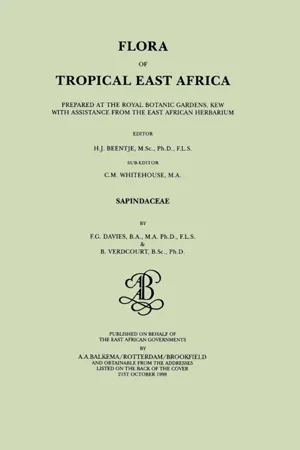
Flora of Tropical East Africa - Sapindaceae (1998)
- 552 pages
- English
- ePUB (mobile friendly)
- Available on iOS & Android
eBook - ePub
Flora of Tropical East Africa - Sapindaceae (1998)
About this book
The flora is prepared at Royal Botanic Gardens, Kew, in close collaboration with East African Herbarium and in liaison with the University of Dar es Salaam, the University of Nairobi and the Makerere University. Significant contributions are also made by specialists elsewhere. The flora is designed to a high academic standard and should be a useful resource reference for anyone concerned with the identification and utilization of plants in eastern Africa. Each family is published as a separate part.
Information
FLORA TROPICAL EAST AFRICA
_______
SAPINDACEAE
Trees, shrubs or rarely herbs, sometimes climbing by tendrils. Indumentum commonly of simple hairs, sometimes in tufts in the axils of leaf-veins, rarely fasciculate; glands of several kinds occurring on both vegetative and flowering parts. Leaves alternate, sometimes crowded (palm-like) at the apex of the tree, variously simple, ternate, biternate, pinnate or bipinnate, in the latter two kinds most often without a terminal leaflet at maturity; stipules lacking or small. Inflorescences axillary or cauliflorous, thyrsoidal, paniculate or racemose. Flowers regular or slightly zygomorphic, unisexual except in some Dodonaea but with non-functional organs of the other sex usually present. Calyx of (3–)4–5(−7) free or partially united imbricate or valvate sepals. Petals absent or 4–5, often with a basal claw, usually with a simple or elaborated scale on the inner face. Disk conspicuous, simple, or rarely a double ring, or reduced to a pair of glands. Stamens 5–20 (−74), often 8, but sometimes variable in number within a species, inserted in most cases inside the disk or occasionally on its surface; filaments free, terete or barely flattened, glabrous or hairy; anthers variously ovoid-sagittate to spherical, sometimes pilose, the connective rarely glandular, dehiscing introrsely by longitudinal slits; pollen grains tricolporate. Ovary 1–8-locular; ovules usually 1–2 (rarely several) per locule; style apical, except in Allophylus where semi-gynobasic, entire or 2–3-lobed. Fruit a capsule, sometimes lobed, or drupe, often composed of one matured mericarp with the aborted remaining carpels visible at its base. Seed usually with a hard black or brown testa, which in one case contains stomata, often with a conspicuous fleshy aril or sarcotesta, without endosperm.
About 147 genera and 2000 species, typically tropical and strongly represented in the American, African and Asian tropical areas; a number of species are cultivated for their edible fleshy fruits.
Radlkofer (E.P. IV, 165: 1–1539 (1931–4)) devoted a lifetime to the monographing of the family. Recently Leenhouts, in preparation for Flora Malesiana, has revised many genera and reappraised the tribes erected by Radlkofer. In 1976 (Muller & Leenh. in The evolutionary significance of the exine) he suggested that Radlkofer’s more primitive tribes, the Sapindeae, Thouineae and Paullineae, are actually the most derived, and the Dodonaeae are not derived but a relict group. In effect this reverses the sequence of Radlkofer, and this is the order adopted here. Leenhouts (1976) further considers that the Aceraceae and Hippocastanaceae are no more than tribes of the Sapindaceae. [This is probably basically correct but these groups are of such horticultural importance I would not wish to tamper with their position – B.V.]
The flowering biology of the Sapindaceae in East Africa is very poorly known and field observations are urgently needed for all genera and species. There are two main classes of sexual arrangement: dioecy, generally constant for a genus (but Allophylus has only some dioecious species) and monoecy. In the latter the tree has mass-flowering of all its inflorescences simultaneously, each inflorescence starting with male flowers which drop off by abscission of the pedicel shortly after anthesis. The next flowers to open are female, which if fertilised remain on the inflorescence, which then reverts to male flowers, sometimes in large numbers and continuing for a long season. However, this sequence may be imperfect through one or more stages being absent in any particular individual in any given season. The sex of the flower bud appears to be determined at least partly by environmental factors and at a late stage, and the sex of an immature inflorescence is impossible to determine in those genera where flowers are morphologically hermaphrodite – more than half those in East Africa. The term staminode is used here for a stamen which fails to dehisce. However, a small percentage of pollen in the staminodes of at least one species has been shown to be fertile.
The structure of the fleshy seed-appendage has been the subject of some disagreements. Van der Pijl (Acta. Bot. Neerl. 6: 608 (1957)) argues that the structure is not homologous with the aril in other families and should be called an ‘arillode’. Corner (The seeds of Dicotyledons, 1976) disagrees and continues to use the term aril, while considering it sarcotestal in origin in some genera. The term aril will be used here regardless of ontogeny. Fruits of several species are quite unknown and should be looked for in the field.
The East African genera belong to the following subfamilies and tribes:
Subfamily Dodonaeoideae (Dyssapindaceae of Radlkofer)
Tribe Dodonaeeae – 1, Dodonaea
Tribe Doratoxyleae – 2, Filicium; 3, Zanha
Tribe Harpullieae – 4, Majidea
Subfamily Sapindoideae (Eusapindaceae of Radlk.)
Tribe Cupanieae – 5, Aporrhiza; 6, Lychnodiscus; 7, Blighia; 8, EHocoelum; 9, Hapbcoelopsis
Tribe Nephelieae – 10, Stadmania; Litchi; Nephelium,; 11, Pappea
Tribe Schleichereae – 12, Macphersonia; 13, Lecaniodiscus; 14, Haplocoelum; 15, Camptolepis
Tribe Melicocceae – Tnstiropsis; Melicoccus
Tribe Lepisantheae – 16, Lepisanthes; 17, Glenniea; 18, Placodiscus; 19, Pancovia; 20, Chytranthus
Tribe Sapindeae – 21, Deinbollia; 22, Sapindus
Tribe Thouinieae – 23, Allophylus
Tribe Paullinieae – 24, Cardiospermum; 25, Paullinia
Several species have been or are cultivated in East Africa, including several well known fruits; all are included in the keys below. Cultivated species belonging to genera dealt within the text will be found there.
Litchi chinensis Sonn, subsp. chinensis (Nephelium litchi Cambess.) (T.T.C.L.: 559 (1949); U.O.P.Z.: 332 (1949)) the lychee (litchee) has been cultivated at Kenya, Kiambu District, Nairobi, Closeburn, Gillett 22754, Kilifi District, 34 km. N. of Mombasa, Vipingo, Bally 8854 and Tanzania, Lushoto District, Amani, Greenway 949 & Magogo 736 & Ngonyani 16 & Furuya 139 and Morogoro, Greenway & Eggeling 8601 and Mengo District, Entebbe (Dale, Introd. Trees Uganda: 48 (1953); also Jex-Blake (Gard. E. Afr., ed. 4: 302 (1957)) mentions that ‘trees grow well and fruit abundantly near Nairobi’). Monoecious evergreen tree to 35 m. Leaflets in 2–4(−5) pairs, elliptic or ± obovate, (3–) 8–11 (−16) cm. long, 1.8–4 cm. wide, mostly acuminate at the apex, cuneate at the base, ± glaucous beneath. Inflorescences 15–30 cm. long with individual cymules 5–12-flowered; flowers yellow. Fruit bright red to purplish when ripe, subglobose, ± 3 cm. long, nearly smooth to densely covered with flat pyramidal acute tubercles up to 1 mm. high. Seeds polished blackish brown, very minutely rugulose, ellipsoid, with slight neck near hilum, ± 1.8–2.5 cm. long, 1.2–1.8 cm. wide, shining, partly or completely enveloped in a pinkish, bluish white or pale yellow juicy aril up to ± 5 mm. thick; hilum circular, 5 mm. diameter, straw-coloured. Morton, Fruits of Warm Climates: 250 (1987) deals with some of the better known cultivars; seedless varieties exist. A full account of the genus is given in Fl. Males., ser. 1,11: 653–658 (1994).
Nephelium lappaceum L. var. lappaceum (T.T.C.L.: 559 (1949); U.O.P.Z.: 377, fig. on 378 (1949)) the rambutan has been grown for its edible fruit at Lushoto District, Amani, Greenway 746; 952; Soleman in A.H. 6184; and Mengo District, Entebbe (Dale, Introd. Trees Uganda: 52 (1953)). Tree 10.5–27 m.; twigs glabrescent to persistently hairy. Leaves 1-foliolate or with 1–7, mostly 5, leaflets; petiole 1.5–12 cm. long; leaflets relatively broad, obovate-oblong, 5–30 cm. long, 2.5–11 cm. wide, obtuse, rounded, truncate to slightly emarginate at the apex or sometimes apiculate to slightly acuminate or rarely distinctly acuminate, mostly widest above the middle, the sides very curved, glabrous above, hairy on midrib or ± all over beneath. Inflorescences axillary or terminal, lax; petals absent. Fruits very variable in colour, crimson, purple, maroon, greenish, yellowish or orange-yellow, ellipsoid to subglobose, (3.5–)6–8 cm. long, 3.5 cm. wide, covered with soft fleshy ± curved, strap-shaped or spine-like appendages 0.5–2 cm. long from tubercles; aril white, tran...
Table of contents
- Cover
- Table of Contents
- FLORA TROPICAL EAST AFRICA
- INDEX TO SAPINDACEAE
Trusted by 375,005 students
Access to over 1.5 million titles for a fair monthly price.
Study more efficiently using our study tools.
Frequently asked questions
Yes, you can cancel anytime from the Subscription tab in your account settings on the Perlego website. Your subscription will stay active until the end of your current billing period. Learn how to cancel your subscription
No, books cannot be downloaded as external files, such as PDFs, for use outside of Perlego. However, you can download books within the Perlego app for offline reading on mobile or tablet. Learn how to download books offline
Perlego offers two plans: Essential and Complete
- Essential is ideal for learners and professionals who enjoy exploring a wide range of subjects. Access the Essential Library with 800,000+ trusted titles and best-sellers across business, personal growth, and the humanities. Includes unlimited reading time and Standard Read Aloud voice.
- Complete: Perfect for advanced learners and researchers needing full, unrestricted access. Unlock 1.5M+ books across hundreds of subjects, including academic and specialized titles. The Complete Plan also includes advanced features like Premium Read Aloud and Research Assistant.
We are an online textbook subscription service, where you can get access to an entire online library for less than the price of a single book per month. With over 1.5 million books across 990+ topics, we’ve got you covered! Learn about our mission
Look out for the read-aloud symbol on your next book to see if you can listen to it. The read-aloud tool reads text aloud for you, highlighting the text as it is being read. You can pause it, speed it up and slow it down. Learn more about Read Aloud
Yes! You can use the Perlego app on both iOS and Android devices to read anytime, anywhere — even offline. Perfect for commutes or when you’re on the go.
Please note we cannot support devices running on iOS 13 and Android 7 or earlier. Learn more about using the app
Please note we cannot support devices running on iOS 13 and Android 7 or earlier. Learn more about using the app
Yes, you can access Flora of Tropical East Africa - Sapindaceae (1998) by Bernard Verdcourt,Frances G.Davies,B. Verdcourt in PDF and/or ePUB format, as well as other popular books in Biological Sciences & Biology. We have over 1.5 million books available in our catalogue for you to explore.