eBook - ePub
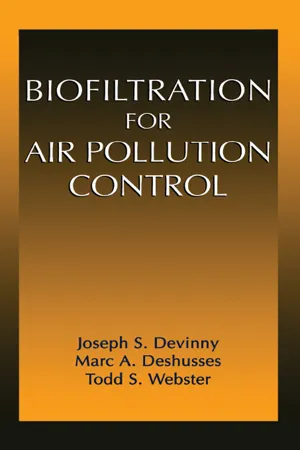
Biofiltration for Air Pollution Control
- 318 pages
- English
- ePUB (mobile friendly)
- Available on iOS & Android
eBook - ePub
Biofiltration for Air Pollution Control
About this book
The number-one environmental threat to public health, air pollution remains a pressing problem-made even more complicated by the massive quantity and diversity of air pollution sources.
Biofiltration technology (using micro-organisms growing on porous media) is being recognized as one of the most advantageous means to convert pollutants to harmless products. Done properly, biofiltration works at a reasonable cost-utilizing inexpensive components, without requiring fuel or generating hazardous by-products.
Firmly established in Europe, biofiltration techniques are being increasingly applied in North America: Biofiltration for Air Pollution Control offers the necessary knowledge to "do it right."
Information
chapter one
Introduction
Within the past 40 years, the medical and scientific communities have begun to comprehend the deleterious chronic effects of air pollution. Whether it is volatile organic compounds (VOCs) acting as catalysts for smog formation, chlorinated compounds depleting the ozone layer, or odorous compounds becoming a human nuisance, the need to control and treat air pollution has become an urgent environmental and medical concern. The urgency of the matter is clearly evident in the numerous global, national, and regional environmental air pollution control regulations developed to maintain healthful air quality. Such stringent regulations have driven both the industrial and commercial sectors to rely on the technologies of carbon adsorption, incineration, or scrubbing to lessen the environmental damage caused by technological advances. However, as regulations are further refined to control air emissions under stricter standards, such air pollution control technologies will become more costly. As health risks for additional air phase contaminants are discovered, regulations restricting the emissions of these contaminants will also be introduced. For these reasons, industrial and commercial sectors that have had limited need for air pollution control in the past will suddenly find themselves immersed in regulatory compliance activities.
Since the early twentieth century, biological treatment processes have found wide application in wastewater and solid waste pollution control. The need for alternative cost-effective waste gas treatment technologies has led to similar biological treatment processes for waste gas streams. One such treatment technology is biofiltration. In biofiltration, a humid, contaminated air stream is passed through a porous support material on which pollutant-degrading cultures are immobilized. Like most biological treatment processes, biofiltration relies on microbial catabolic reactions for the degradation of waste compounds. Biofilters have found most of their success in the treatment of dilute, high-flow waste gas streams containing odors or volatile organic compounds. Under optimal conditions, the pollutants can be degraded completely to carbon dioxide, water, and excess biomass. Such a system holds promise to treat many of the same contaminants that have been handled by wastewater treatment plants over the past 100 years. However, like all emerging technologies, biofiltration has an appropriate niche in the industrial and commercial sectors. It cannot be considered a panacea for all operations and every industry.
This first chapter serves as an introduction to biofiltration, explaining the forces that have led to its development and further advancement in the waste gas treatment market. In order to assist the reader in understanding the focus of the book, air pollution control regulatory issues, the alternative control technologies available, a brief history of biofiltration, the current marketplace for biofiltration, common biofilter terminology, and additional resources are described in the first chapter.
1.1 Air pollution legislation
As the effects of air pollution on all life forms have become better understood, environmental legislation controlling the emission of volatile organic compounds, toxics, and odors has proliferated. Enforcement of such regulations by federal, state, and regional government agencies has forced industry to comply. In general, the role of federal agencies is to establish baseline emission standards. These standards reflect potential health risks (cancer, respiratory damage, etc.) and environmental degradation (smog precursors, greenhouse gas effects, ozone depletion, acid rain, etc.) that the contaminant emissions create. The state and local governments may establish stricter standards as needed to ease the effects of contamination on more populated areas of the country. Such a trickle-down effect of regulation provides adequate enforcement from a national to a local level and prevents some companies from avoiding participation in air pollution control while others are forced to comply. Though regulations differ from country to country, all nations are finding a growing need for air quality control.
In the U.S., the enactment of the federal Clean Air Act Amendments of 1990 has brought about a strict regulation of air emissions. The regulation, under section Title III, calls for 189 chemicals to be considered air toxics. A 90% reduction in the production of these contaminants is required by the year 2000 (Zahodiakin, 1995). Any facility which emits at least 10 tons per year of a listed pollutant or a total of 25 tons of listed pollutants will be required to install “maximum achievable control technologies” (MACT). The measure also calls for a 15% reduction in ground-level ozone for the country’s most polluted areas and a phase-out of chlorinated fluorocarbons (CFCs), carbon tetrachloride, and hydrochlorofluorocarbons (HCFCs).
Though not all countries use the same emission standards, the trend towards stricter regulation of air emissions is general throughout the world. As groups such as the World Health Organization (WHO) chronicle the harmful effects of chemicals on human health, the public and their respective governments will continue to take action to prevent exposure to these harmful contaminants. As technology and industry throughout the world advance, complete elimination of such chemicals seems impossible. In the future, effective air contaminant reduction through “end of the pipe” control technologies will be used by companies to achieve economic growth while minimizing environmental contamination.
1.2 Types of waste gas treatment
There are two forms of applicable air emissions control. Source control involves the reduction of emissions through raw product substitution, reduction, or recycling. However, these reduction mechanisms may reduce the quality of the product or may increase costs. Secondary control involves treatment of the waste gas after it has been produced. The choice of technology is often dictated by economic and ecological constraints. Such constraints arise from the nature of the compound being treated, the concentration, the flow rate, and the mode of emission of the gaseous waste stream. Combinations of various technologies may often be required to meet regulatory standards.
1.2.1 Condensation
Waste gas contaminants that are concentrated and have a high boiling point may be partially recovered by simultaneous cooling and compressing of the gaseous vapors. This technique is only economical for concentrated vapors where there is some recycle or recovery value. If the waste gas is a mixed pollutant stream, recycling will be virtually i...
Table of contents
- Cover
- Half Title
- Title Page
- Copyright Page
- Table of Contents
- 1 Introduction
- 2 Mechanisms of biofiltration
- 3 Biofilter media
- 4 Controlling factors and operation of biofilters
- 5 Microbial ecology of biofiltration
- 6 Modeling biofiltration
- 7 Design of biofilters
- 8 Biofilter startup and monitoring
- 9 Application of biofilters
- Appendix A. Symbols
- Appendix B. Selected elimination capacity values
- Appendix C. Conversion factors
- Appendix D. Absolute humidity of air saturated with water
- Appendix E. Approximate conversion of selected currencies
- Glossary
- References
- Index
Trusted by 375,005 students
Access to over 1.5 million titles for a fair monthly price.
Study more efficiently using our study tools.
Frequently asked questions
Yes, you can cancel anytime from the Subscription tab in your account settings on the Perlego website. Your subscription will stay active until the end of your current billing period. Learn how to cancel your subscription
No, books cannot be downloaded as external files, such as PDFs, for use outside of Perlego. However, you can download books within the Perlego app for offline reading on mobile or tablet. Learn how to download books offline
Perlego offers two plans: Essential and Complete
- Essential is ideal for learners and professionals who enjoy exploring a wide range of subjects. Access the Essential Library with 800,000+ trusted titles and best-sellers across business, personal growth, and the humanities. Includes unlimited reading time and Standard Read Aloud voice.
- Complete: Perfect for advanced learners and researchers needing full, unrestricted access. Unlock 1.5M+ books across hundreds of subjects, including academic and specialized titles. The Complete Plan also includes advanced features like Premium Read Aloud and Research Assistant.
We are an online textbook subscription service, where you can get access to an entire online library for less than the price of a single book per month. With over 1.5 million books across 990+ topics, we’ve got you covered! Learn about our mission
Look out for the read-aloud symbol on your next book to see if you can listen to it. The read-aloud tool reads text aloud for you, highlighting the text as it is being read. You can pause it, speed it up and slow it down. Learn more about Read Aloud
Yes! You can use the Perlego app on both iOS and Android devices to read anytime, anywhere — even offline. Perfect for commutes or when you’re on the go.
Please note we cannot support devices running on iOS 13 and Android 7 or earlier. Learn more about using the app
Please note we cannot support devices running on iOS 13 and Android 7 or earlier. Learn more about using the app
Yes, you can access Biofiltration for Air Pollution Control by Joseph S. Devinny,Marc A. Deshusses,Todd Stephen Webster in PDF and/or ePUB format, as well as other popular books in Technology & Engineering & Environmental Science. We have over 1.5 million books available in our catalogue for you to explore.