eBook - ePub
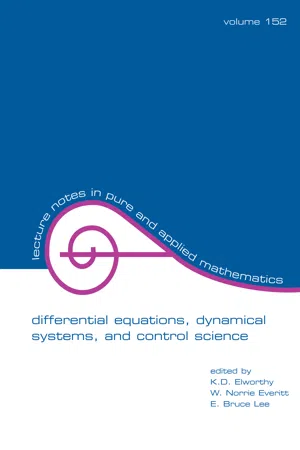
Differential Equations
Dynamical Systems, and Control Science: Lecture Notes in Pure and Applied Mathematics Series/152
- 984 pages
- English
- ePUB (mobile friendly)
- Available on iOS & Android
eBook - ePub
Differential Equations
Dynamical Systems, and Control Science: Lecture Notes in Pure and Applied Mathematics Series/152
About this book
Presents recent developments in the areas of differential equations, dynamical systems, and control of finke and infinite dimensional systems. Focuses on current trends in differential equations and dynamical system research-from Darameterdependence of solutions to robui control laws for inflnite dimensional systems.
Information
1 De Motu Arietum (On the Motion of Battering Rams)
Rutherford Aris University of Minnesota, Minneapolis, Minnesota
BernardS. Bachrach University of Minnesota, Minneapolis, Minnesota
Introduction.
Of the many virtues of Larry Markus none is more widely appreciated than his willingness to transgress departmental barriers and cooperate freely and fruitfully with colleagues in other disciplines. This is natural enough in the physical sciences, where there is a mode of thought sympathetic to “the euristic vision of mathematical trance”, but rare indeed in the social sciences, where the writ of natural law runs haltingly and the concepts are much less amenable to the niceties of mathematics. Nevertheless, for some years Markus ran a seminar jointly with Holt, a distinguished colleague in political philosophy, and, as his bibliography will show, has published in this area. The following paper, which essays to use mathematical modelling as an ancillary science in the study of an historical question, is dedicated to Larry Markus by two of his colleagues who esteem his disciplinary transgressions as highly as they regard his mathematical rectitude.
This is no place to launch into a full-scale defense of mathematical modelling as a valuable element in the graith of the historian, but a few words of apology are in order. For the historian of science a knowledge of mathematics is, of course, absolutely necessary and, though the general historian should not have this exacted of him in addition to the traditional ancillary disciplines (languages, law, diplomatic, palaeography, etc.), some appreciation of what mathematical modelling is about may prove more enlightening than might at first be suspected. A mathematical model is a system of equations that purports to represent some phenomenon in a way that gives insight into the origins and consequences of its behavior. Being mathematical, it is patient of a precision in the statement of its assumptions and the exposition of its results that can be stimulating and suggestive to the historian. A model must not be so venerated as to be allowed to impose a spurious exactness, or to be found wanting if it does not predict values to N decimal places, but it can show the relative importance of various factors and lead the historian to examine them, using, indeed, the traditional tools of historical study, but with a fresh perception of their relevance. The model does not detract from the primacy of historical thought, but seeks to serve it as a true ancilla, perhaps even as an ancilla ancillarum rerum scriptoris - a possibility that should drive the politically correct of our day straight up the wall!
Rightly understood, a mathematical model can guard against impossibilities being considered (to use the ram as an informal example, there are natural limits to the energy that can be ‘pumped’ into the ram's motion), can reveal sensitivities and instabilities (the tendency of the ram to wobble if suspended in certain ways) and suggest lines of enquiry (is there any evidence as to how the ram was suspended?). Because the model has a life of its own, it can present alternatives (such as different regimes of ‘pumping up’ the ram) and seek out optimal strategies which might well have been discovered by the trial and error of experience. Models can give ranges to quantities, saying, for example, that if such a wall were battered down the ram must have been at least this big and, if it were manageable on such a terrain it could not have been bigger than that. Models introduce the dimensionless parameters of the situation, one of the greatest intellectual beauties of natural philosophy, in which quantities attain significance by being compared, not with an arbitrary s...
Table of contents
- Cover Page
- Half title
- Title Page
- Copyright
- Dedication
- Preface
- Acknowledgments
- Contributors
- A Brief History of Control
- 1 De Motu Arietum (On the Motion of Battering Rams)
- 2 A Note on Continuation Algorithms for Periodic Orbits
- 3 Uniformly Isochronous Centers of Polynomial Systems in R2
- 4 Some Remarks on the Titchmarsh-Weyl m-Coeffìcient and Associated Differential Operators
- 5 Periodic Solutions of Single Species Models with Delay
- 6 Asymptotic Estimates for a Nonstandard Second Order Differential Equation
- 7 Asymptotic Phase, Shadowing and Reaction-Diffusion Systems
- 8 Numerical Methods for Studying Parameter Dependence of Solutions to Schrödinger's Equation
- 9 Differential Systems and Algebras
- 10 Limit Cycles and Centres: An Example
- 11 Stability Criteria with a Symmetric Operator Occurring in Linear and Nonlinear Delay-Differential Equations
- 12 Approximating Piston-Driven Flow of a Non-Newtonian Fluid
- 13 A Necessary and Sufficient Condition for Exponential Stability of Large-Scale Stochastic Delay Systems in Hierarchical Form
- 14 The Averaging Method and the Problem on Separation of Variables
- 15 Construction of Lyapunov Functions Using Integration by Parts
- 16 Remarks on Williams' Problem
- 17 Approximations of the Long-Time Dynamics of the Navier-Stokes Equations
- 18 About the Solution of Some Inverse Problems in Differential Galois Theory by Hamburger Equations
- 19 A Remark on Bessel Functions
- 20 The Broadwell System, Self-Similar Ordinary Differential Equations, and Fluid Dynamical Limits
- 21 The Statistical Mechanics of Asset Prices
- 22 The Winding Problem for Stochastic Oscillators
- 23 On the Convexity of Carrying Simplices in Competitive Lotka-Volterra Systems
- 24 The Shuffle Product and Symmetric Groups
- 25 Optimal Control of Infinite Dimensional Systems Governed by Integro Differential Equations
- 26 Data Analysis of a Lumped System
- 27 Ergodic Bellman Systems for Stochastic Games
- 28 Some Results on Feedback Stabilizability of Nonlinear Systems in Dimension Three or Higher
- 29 Robust Stabilization of Infinite-Dimensional Systems with Respect to Coprime Factor Perturbations
- 30 Time-Delayed Perturbations and Robust Stability
- 31 Positive Controllability of Linear Systems with Delay
- 32 Discrete Time Partially Observed Control
- 33 Symmetries of Differential Systems
- 34 Relaxation in Semilinear Infinite Dimensional Control Systems
- 35 An Algebraic Approach to Hankel Norm Approximation Problems
- 36 Stabilizing Solutions to Riccati Inequalities and Stabilizing Compensators with Disturbance Attenuation
- 37 Vector Field Approximations Preserving Structural Properties
- 38 Nonlinear Boundary Stabilization of a von Kármán Plate Equation
- 39 Global Null Controllability of Linear Control Processes with Positive Lyapunov Exponents
- 40 Linear Two-Dimensional Systems with Deviating Arguments
- 41 Boundary Controllability in Transmission Problems for Thin Plates
- 42 Approximation of Linear Input/Output Delay-Differential Systems
- 43 Local Smoothing and Energy Decay for a Semi-Infinite Beam Pinned at Several Points, and Applications to Boundary Control
- 44 Abnormal Sub-Riemannian Minimizers
- 45 Some Algebraic Approaches for Stability Analysis of Two-Dimensional Systems and Digital Filters
- 46 A Control-Theoretic Banach Lie Group GA.B—The Stability Group
- 47 Min-Max Game Theory and Algebraic Riccati Equations for Boundary Control Problems with Analytic Semigroups: The Stable Case
- 48 Approximate Controllability of Linear Functional-Differential Systems: A State Space Independent Approach
- 49 The Attainability Order in Control Systems
- 50 Extending Linear-Quadratic Optimal Control Laws to Nonlinear Systems and/or Nonquadratic Cost Criteria
- 51 Existence of Optimal Controls for a Free Boundary Problem
- 52 Maximum Principle for Optimal Control of Distributed Parameter Stochastic Systems with Random Jumps
- 53 Spillover Problem and Global Dynamics of Nonlinear Beam Equations
- 54 A Dynamical Systems Approach to Solving Linear Programming Problems
Trusted by 375,005 students
Access to over 1.5 million titles for a fair monthly price.
Study more efficiently using our study tools.
Frequently asked questions
Yes, you can cancel anytime from the Subscription tab in your account settings on the Perlego website. Your subscription will stay active until the end of your current billing period. Learn how to cancel your subscription
No, books cannot be downloaded as external files, such as PDFs, for use outside of Perlego. However, you can download books within the Perlego app for offline reading on mobile or tablet. Learn how to download books offline
Perlego offers two plans: Essential and Complete
- Essential is ideal for learners and professionals who enjoy exploring a wide range of subjects. Access the Essential Library with 800,000+ trusted titles and best-sellers across business, personal growth, and the humanities. Includes unlimited reading time and Standard Read Aloud voice.
- Complete: Perfect for advanced learners and researchers needing full, unrestricted access. Unlock 1.5M+ books across hundreds of subjects, including academic and specialized titles. The Complete Plan also includes advanced features like Premium Read Aloud and Research Assistant.
We are an online textbook subscription service, where you can get access to an entire online library for less than the price of a single book per month. With over 1.5 million books across 990+ topics, we’ve got you covered! Learn about our mission
Look out for the read-aloud symbol on your next book to see if you can listen to it. The read-aloud tool reads text aloud for you, highlighting the text as it is being read. You can pause it, speed it up and slow it down. Learn more about Read Aloud
Yes! You can use the Perlego app on both iOS and Android devices to read anytime, anywhere — even offline. Perfect for commutes or when you’re on the go.
Please note we cannot support devices running on iOS 13 and Android 7 or earlier. Learn more about using the app
Please note we cannot support devices running on iOS 13 and Android 7 or earlier. Learn more about using the app
Yes, you can access Differential Equations by K.D. Elworthy,W.N. Everitt,E.B. Lee in PDF and/or ePUB format, as well as other popular books in Mathematics & Applied Mathematics. We have over 1.5 million books available in our catalogue for you to explore.