- 212 pages
- English
- ePUB (mobile friendly)
- Available on iOS & Android
eBook - ePub
Digital Logic Techniques
About this book
The third edition of Digital Logic Techniques provides a clear and comprehensive treatment of the representation of data, operations on data, combinational logic design, sequential logic, computer architecture, and practical digital circuits. A wealth of exercises and worked examples in each chapter give students valuable experience in applying the concepts and techniques discussed.Beginning with an objective comparison between analogue and digital representation of data, the author presents the Boolean algebra framework for digital electronics, develops combinational logic design from first principles, and presents cellular logic as an alternative structure more relevant than canonical forms to VLSI implementation. He then addresses sequential logic design and develops a strategy for designing finite state machines, giving students a solid foundation for more advanced studies in automata theory.The second half of the book focuses on the digital system as an entity. Here the author examines the implementation of logic systems in programmable hardware, outlines the specification of a system, explores arithmetic processors, and elucidates fault diagnosis. The final chapter examines the electrical properties of logic components, compares the different logic families, and highlights the problems that can arise in constructing practical hardware systems.
Information
Numerical representation of information 1
Objectives
□ To distinguish between analogue and digital quantities.
□ To investigate the binary number system.
□ To define and examine binary-coded decimal numbers.
□ To specify the essential properties of a position sensing code.
□ To introduce the concepts of error detection and correction in binary data.
In almost all activities, we are constantly dealing with quantities or measurements. This information is expressed in the form of numbers and can be processed in a digital system, provided it can be represented in an electronic form.
Information is almost always encoded in binary in a digital system and a wide range of codes exist. The choice of a particular code is influenced by the type of operation to be carried out on the data.
In this chapter, methods of representing numerical data in binary will be introduced. It is essential that the designer is familiar with fundamental coding techniques, as the form in which information is represented has significant influence on the design, performance and reliability of a digital system.
Analogue and digital data
The first step in any data processing operation is to obtain information about the objects or phenomena of interest. The acquisition of information usually involves taking measurements on some property or characteristic of a system under investigation. In order to evaluate and assess the system, the measurements are monitored, scaled, compared, combined, or operated on in various ways. It is therefore essential that we have standard ways of representing our information.
Measurements can be divided into two broad categories. An analogue measurement is continuous and is a function of the parameter being measured. Conversely, a digital quantity is discrete and it can only change by fixed units.
All drips are assumed to be the same size
Figure 1.1 shows two beakers being filled, one from a dripping tap and the other from a trickling tap. The build-up of water in the first beaker is typically digital, as the smallest change in volume is equal to one drip and the value increases in steps. In the second beaker, the volume of water increases continuously with time. It has an analogue property.
Analogue and digital electronic circuits can be devised to process data. Analogue circuits such as operational amplifiers are cheap and powerful, but the analogue approach has two main disadvantages. The real world problem must have a precise electronic model and accurate measurements need to be made on that model.
For details on op-amps, refer to Horrocks, D.H. Feedback circuits and Op-amps (2nd edn, Chapman & Hall, 1990)
In digital electronic circuits, there is no need to make precise time-dependent measurements as a problem is modelled by a set of rules based on logic, which will be developed throughout this book. One major drawback of digital circuits is resolution. If the resolution is increased by reducing the minimum step changes allowed in the parameters, the amount of electronic circuitry must increase.
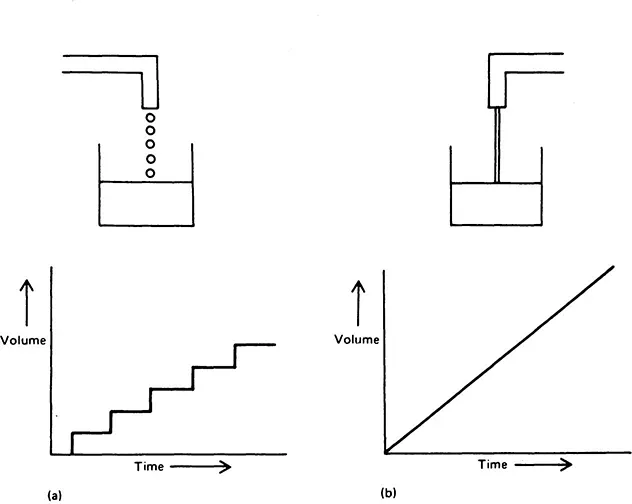
Fig. 1.1 (a) A digital or discrete system, (b) An analogue or continuous system.
The resolution of a digital system determines the smallest detectable change in its parameters. It is dependent on the number of bits used to represent quantities.
The electronics engineer should be aware that analogue, digital or a hybrid combination of both methods may be relevant to a particular information processing operation. Neither approach should be precluded as any one method may provide a significantly simpler solution to a given problem.
Information is all about numbers. A number is a label with a unique meaning, and the remainder of this chapter will examine ways of representing information.
Exercise 1.1
Which of the following items invol...
Table of contents
- Cover
- Half Title
- Title Page
- Copyright Page
- Table of Contents
- Preface to the third edition
- Preface to the first edition
- 1 Numerical representation of information
- 2 Operations on binary data
- 3 Combinational logic design
- 4 Sequential logic fundamentals
- 5 Design of sequential logic circuits
- 6 The digital system
- 7 Design of arithmetic processors
- 8 Practical digital circuits
- Answers to problems
- Index
Trusted by 375,005 students
Access to over 1.5 million titles for a fair monthly price.
Study more efficiently using our study tools.
Frequently asked questions
Yes, you can cancel anytime from the Subscription tab in your account settings on the Perlego website. Your subscription will stay active until the end of your current billing period. Learn how to cancel your subscription
No, books cannot be downloaded as external files, such as PDFs, for use outside of Perlego. However, you can download books within the Perlego app for offline reading on mobile or tablet. Learn how to download books offline
Perlego offers two plans: Essential and Complete
- Essential is ideal for learners and professionals who enjoy exploring a wide range of subjects. Access the Essential Library with 800,000+ trusted titles and best-sellers across business, personal growth, and the humanities. Includes unlimited reading time and Standard Read Aloud voice.
- Complete: Perfect for advanced learners and researchers needing full, unrestricted access. Unlock 1.5M+ books across hundreds of subjects, including academic and specialized titles. The Complete Plan also includes advanced features like Premium Read Aloud and Research Assistant.
We are an online textbook subscription service, where you can get access to an entire online library for less than the price of a single book per month. With over 1.5 million books across 990+ topics, we’ve got you covered! Learn about our mission
Look out for the read-aloud symbol on your next book to see if you can listen to it. The read-aloud tool reads text aloud for you, highlighting the text as it is being read. You can pause it, speed it up and slow it down. Learn more about Read Aloud
Yes! You can use the Perlego app on both iOS and Android devices to read anytime, anywhere — even offline. Perfect for commutes or when you’re on the go.
Please note we cannot support devices running on iOS 13 and Android 7 or earlier. Learn more about using the app
Please note we cannot support devices running on iOS 13 and Android 7 or earlier. Learn more about using the app
Yes, you can access Digital Logic Techniques by John Stonham in PDF and/or ePUB format, as well as other popular books in Technology & Engineering & Systems Architecture. We have over 1.5 million books available in our catalogue for you to explore.