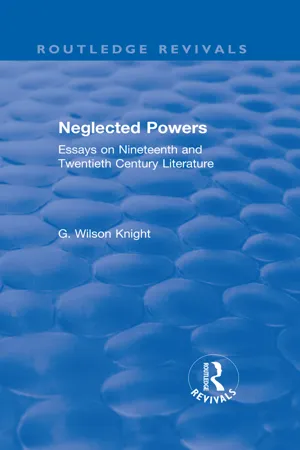
First published in 1971, Professor Knight's book draws analytic attention to poets including Tennyson, Masefield, and Brooke, who are shown to hold a dimension of meaning previously ignored or misunderstood. Homage is paid to John Cowper Powys as one of the foremost seers of the modern age. A comprehensive review of the work of Francis Berry claims to establish him as our foremost living poet. Professor Knight urges, and goes far to prove, that modern literary criticism up until the 1970s failed to touch upon the richer meanings of contemporary literature – he stresses the relation between such acclaimed poets as Yeats and Eliot and the spiritualistic movements of contemporary times. Knight regards youth-revolts as a sign of a healthy dissatisfaction with an irreligious and directionless culture, and believes that hope lies in the neglected powers pressing for acceptance.
eBook - ePub
Routledge Revivals: Neglected Powers (1971)
Essays on Nineteenth and Twentieth Century Literature
- 500 pages
- English
- ePUB (mobile friendly)
- Available on iOS & Android
eBook - ePub
Routledge Revivals: Neglected Powers (1971)
Essays on Nineteenth and Twentieth Century Literature
About this book
Information
Part One
Introduction
Chapter I
Poetry and Magic
Then, as I watched, lo, suddenly, the truth
Enlightened him, as it enlightened me:
I was received into the Land of Youth
All understanding, utter ecstasy,
All music, colour, form,
Niamh and I were spirits linked together
With Sun and Stars, the Seasons and the Weather
All moods and modes of life, earth, air and sea.
Enlightened him, as it enlightened me:
I was received into the Land of Youth
All understanding, utter ecstasy,
All music, colour, form,
Niamh and I were spirits linked together
With Sun and Stars, the Seasons and the Weather
All moods and modes of life, earth, air and sea.
(John Masefield, ‘Ossian’, III, The Bluebells and other Verse, 1961)
1
IN PUTTING FOR WARD what is probably the last of my books of literary interpretation it is natural to review yet again the difficulties which they have encountered. I have already, in Essays in Criticism (’The New Interpretation’, III. 4, October 1953; see also IV. 2, April 1954; and IV. 4, October 1954, 430–1), firmly stated their claims. These I repeat: again and again my new approach has revealed the key symbol or theme in poem, drama, life-work, or personal life which, once recognized, throws the rest into focus. This has been done for British poets and dramatists and for whole periods of our drama, for Goethe’s Faust, Ibsen, and Nietzsche’s Thus Spake Zarathustra, and for the New Testament. What is revealed is of enduring use for subsequent investigators. Future students of the life-work of John Cowper Powys will not fail to be guided by his ‘Saturnian’ and Cerne Giant recurrences. Large areas, including the true significance of Lord Byron as both man and writer, have been illuminated. And yet, while workers in each field in turn use these discoveries, a general and admitted response does not appear.1
When, as sometimes happens, authoritative articles are composed on the literary theories today active, well-known and justly honoured names are listed and their contributions reviewed: T. S. Eliot, I. A. Richards, F. R. Leavis, William Empson, L. C. Knights. These have their differences, but are all recognized and placed. Meanwhile my own labours on such occasions are not; nor, for that matter, are Middleton Murry’s.
Interpretative writing of a high order, such as C. S. Lewis’s on Spenser in The Allegory of Love, Charles Williams’s on Dante in The Figure of Beatrice, Northrop Frye’s on Blake in Fearful Symmetry, and, on Shakespeare, D. G. James’s Scepticism and Poetry, Roy Walker’s The Time is Out of Joint and The Time is Free, and Francis Berry’s The Shakespeare Inset, exist in our ‘literary situation’ as isolated units without mutual reinforcement. There is no open recognition of what started over forty years ago and has continued, exerting a submerged yet vigorous influence, ever since. It was new and of great importance. In 1864, in an essay ‘Wordsworth, Tennyson and Browning’, Walter Bagehot wrote:
All about and around us a faith in poetry struggles to be extricated, but it is not extricated. Some day, at the touch of the true word, the whole confusion will by magic cease; the broken and shapeless notions cohere and crystallize into a bright and true theory. But this cannot be yet.
He looked, rightly, to the time of ‘our children’s children’ for the new advance. It has come, but remains veiled. Veiled, that is, despite the many instances of support and encouragement which I have received and for which my gratitude is warm, from an open and creative understanding.2
I shall attempt once again to clarify the issue: I call these labours ‘interpretation’.
Interpretation submits the intellect to the imagination. The ‘imagination’ I regard as the sovereign faculty, following Coleridge and Shelley. In the Biographia Literaria (XIII) Coleridge divided imagination into two categories, ‘primary’ and ‘secondary’; the one standing for ordinary perception, the other, of the same kind and differing only in ‘degree’ and ‘mode’, for poetic creation. The latter contains an element of ‘conscious will’, intellect and judgement being included:
The poet, described in ideal perfection, brings the whole soul of man into activity, with the subordination of its faculties to each other according to their relative worth and dignity. He diffuses a tone and spirit of unity that blends, and (as it were) fuses, each into each, by that synthetic and magical power to which I would exclusively appropriate the name of Imagination.
(XIV)
’Magical’: ‘will’ and ‘understanding’ put this ‘power’ which he calls magical into ‘action’; and they still, he says, unobtrusively, ‘control’ it. The result is a blending of opposites, including the ‘general’ and the ‘concrete’. ‘Judgement’ remains awake, joined to ‘profound’ feelings. Though the ‘natural’ and the ‘artificial’ are both present, ‘art’ is nevertheless subordinated to ‘nature’, and ‘manner’ to ‘matter’; that is, there is a reality being apprehended as surely as in ordinary sense-perception.
Coleridge adduces some lines by Sir John Davies on the soul, which, he says, may be roughly, and ‘even more appropriately’, applied to ‘the poetic Imagination’:
Doubtless this could not be, but that she turns
Bodies to spirit by sublimation strange,
As fire converts to fire the things it burns,
As we our food into our nature change.
From their gross matter she abstracts their forms
And draws a kind of quintessence from things;
Which to her proper nature she transforms
To bear them light on her celestial wings.
Thus does she, when from individual states
She doth abstract the universal kinds;
Which then re-clothed in divers names and fates
Steal access through the senses to our minds.
’Sublimation’ is a term from alchemy (for alchemy, see pp. 43–4 below). Piercing through ‘matter’ to essential ‘forms’, imagination grips what is ‘universal’, which is then ‘re-clothed’. The result is addressed to a new sense-perception, resembling yet transcending ordinary sense-perception. Coleridge continues:
Finally, Good Sense is the Body of poetic genius, Fancy its Drapery, Motion its Life, and Imagination the Soul that is everywhere, and in each; and forms all into one graceful and intelligent whole.
(XIV)
’Intelligent’ suggests that the result holds meaning. ‘Fancy’ Coleridge defines as a use of ‘fixities and definites’ (i.e. objective entities) without any necessary relation to ‘time and space’; that is, to normal experience (XIII). By itself it may have little value; all depends on how, and for what purpose, it is used.
John Heath-Stubbs, in his admirable poem Ars Poetica, makes a neat, Coleridgean, statement:
But poetry is not “emotional truth’.
The emotions have much less to do with the business
Than is commonly supposed. No more than the intellect.
The intellect shapes, the emotions feed the poem,
Whose roots are in the senses, whose flower is imagination.
The emotions have much less to do with the business
Than is commonly supposed. No more than the intellect.
The intellect shapes, the emotions feed the poem,
Whose roots are in the senses, whose flower is imagination.
The senses flower into the beyond-sensory or extra-sensory, intellect and emotions being no more than aids to the process.
Interpretation uses the same faculty that made, and constitutes, the poem. Intellect and judgement, though active, are nevertheless used in submission to the imaginative whole being inspected. This will not be a proper approach unless we regard the poem as authentic: if our imaginative response, which will already contain, as does all true imagination, elements of reason and judgement, has ratified the poem, then our duty will be submission; but there is no obligation to submit intelligence to writing which has not been so ratified. It is we ourselves who have put the greater writers on their pedestals, and I ask only that we remain true to our own recognition. What so often happens, however, is that after a genuine imaginative experience – and that means an experience of the whole self – the abstracting and memorizing intelligence proceeds to shrivel it, becomes ‘critical’, unaware that the critical faculty has already been active within the imaginative response, and that there is no call for it to do more, usurping a sovereignty to which it has no right. There is a barrier between imaginative response and critical judgement that must be broken: that is my main contention.
Where matters of deepest import are concerned, I would deny that the philosophic or scientific intelligence is equipped to cope directly with life. Rather, its business is, as Heath-Stubbs said of emotion, to feed the imagination, in which, as Sir John Davies suggests, it is transmuted, like food. A scientific thought may have to wait many generations before it can be imaginatively assimilated. Occult science is in this position today. The greater poets and dramatists from the ancients onwards have tended to leave it to the mystery religions or other secret societies – ‘occult’ means ‘hidden’ – while themselves favouring mythology, superstition and magic, which arouse a more traditional and earthly response; though the life-work of John Masefield indicates what may be the more direct approach of future poets. Meanwhile, the philosophic or scientific intelligence, so often at a loss with life, and still more with death, is well enough equipped – and this discovery is my main contribution – to approach the symbolisms of established literature, provided that this intelligence is used in correct imaginative subjection. It will then find the mysteries not so intransigent after all.
Such a use of the intelligence does not reduce the poem to philosophy. If interpretation tells us that the dome of ‘Kubla Khan’ corresponds to the “eternal dimension’, this is not to turn a specific symbol into an abstract concept. Rather, a link has been made with discursive thought, with the abstracting intellect which rules so much of our waking existence, so that we can henceforth read the poem with a richer awareness of its content and a full intellectual collaboration; and intelligence is, as Coleridge tells us, a contained part of the poetic imagination, which is not less than intellectual, but more. Often such a collaboration is needed to perceive the poem’s unity, or the unity of a great writer’s life-work, such as Ibsen’s. In ‘Kubla Khan’, interpretation alone makes sense of the conclusion, and never since the interpretation was first offered (in Programme, Oxford, October 1935; The Starlit Dome, 1941) has it been safe for commentators to regard it as a meaningless fragment. It is sometimes objected that interpretation takes poems ‘to pieces’; but it is doing precisely the opposite. After reading a poem the sieve of memory leaves one with only certain favoured, because congenial, bits. It is already now ‘in pieces’. The aim of interpretation is to put it together again. When it is all put together, the instinctively rejected bits are seen in place, and the result may be embarrassing. That is why interpretation is feared. It may be embarrassing to some admirers of Eliot’s poetry to discover that its final key is less theological than spiritualistic; but such is the fact.
Within limits interpretations may differ; but the limits are there, and errors may be dangerous. In Eliot’s The Waste hand, to regard ‘death by water’ as a step in spiritual progress rather than the one impediment to spiritual progress – and it has been done – is a blunder. Or, if I am wrong, then I myself am blundering; there is no case here for an ‘ambiguity’. I have heard a renowned literary expert expound a difficult modern poem in abstract, ‘critical’, terms in order to inculcate an ‘appreciation’. Questioned by a student on one, factual, point concerning a precise meaning, he was, so far as I could judge, wrong. It is generally assumed that such errors do not matter, and much modern poetry is composed on this assumption; but they do matter. We cannot say that definable meanings are irrelevant. If someone who did not know the play arrived a little late for the first scene of Hamlet and did not realize that the Ghost was a ghost, would not his response to Horatio’s address be affected? Failure to understand the references in many a modern lyric is just like that: one has no introduction, no context, and allusions are missed. To ask a poet for his meanings is, in the best literary circles, bad form. All one can do is to read the unique creation, and remain silent. But no one really wants this, least of all the poet. Silence is an admission that poetry lacks communal relevance, that its proper home is the Ivory Tower. If, however, we admit a relation, we must think and talk of meanings: interpretation is a statement of relevance.
We have made a transition from critical theory to poetic practice. The two may be closely related, especially today when the critical consciousness tends to usurp the place of imagination; which itself, as already noted, contains, or should contain, all the intellectual categories and critical judgements which concern the creative act. The trouble is that we are today more conscious than ever of complexities in both literature and life. Great poets of the past may be difficult but their difficulty derives not from an absence of meaning but from a plethora of meanings; and yet this is not to assert chaos. On one level they are, or should be, reasonably simple; other levels are assimilated by close reading and study. But today, under the stresses of modern sophistication and modern complications, with scientific theory becoming more and more intangible and no generally accepted religious faith to assist us, literature, faced as never before by a chaos of meaningless and unco-ordinated facts and fancies, is turned in on itself and becomes too often more aware of the need for complexity than of the subject in hand. Trying to remain true at all costs to the modern sense of complexity, it renounces lucidity and logic; obscurity becomes a fetish and simplicity a vice. Critics...
Table of contents
- Cover
- Title
- Copyright
- Original Title
- Original Copyright
- Dedication
- Contents
- ACKNOWLEDGMENTS
- PREFACE
- PART ONE Introduction
- PART TWO Obscenities
- PART THREE Spiritualities
- PART FOUR Totalities
- PART FIVE Epilogue
- APPENDIX: T. S. Eliot and Pericles
- INDEXES
Trusted by 375,005 students
Access to over 1.5 million titles for a fair monthly price.
Study more efficiently using our study tools.
Frequently asked questions
Yes, you can cancel anytime from the Subscription tab in your account settings on the Perlego website. Your subscription will stay active until the end of your current billing period. Learn how to cancel your subscription
No, books cannot be downloaded as external files, such as PDFs, for use outside of Perlego. However, you can download books within the Perlego app for offline reading on mobile or tablet. Learn how to download books offline
Perlego offers two plans: Essential and Complete
- Essential is ideal for learners and professionals who enjoy exploring a wide range of subjects. Access the Essential Library with 800,000+ trusted titles and best-sellers across business, personal growth, and the humanities. Includes unlimited reading time and Standard Read Aloud voice.
- Complete: Perfect for advanced learners and researchers needing full, unrestricted access. Unlock 1.5M+ books across hundreds of subjects, including academic and specialized titles. The Complete Plan also includes advanced features like Premium Read Aloud and Research Assistant.
We are an online textbook subscription service, where you can get access to an entire online library for less than the price of a single book per month. With over 1.5 million books across 990+ topics, we’ve got you covered! Learn about our mission
Look out for the read-aloud symbol on your next book to see if you can listen to it. The read-aloud tool reads text aloud for you, highlighting the text as it is being read. You can pause it, speed it up and slow it down. Learn more about Read Aloud
Yes! You can use the Perlego app on both iOS and Android devices to read anytime, anywhere — even offline. Perfect for commutes or when you’re on the go.
Please note we cannot support devices running on iOS 13 and Android 7 or earlier. Learn more about using the app
Please note we cannot support devices running on iOS 13 and Android 7 or earlier. Learn more about using the app
Yes, you can access Routledge Revivals: Neglected Powers (1971) by G. Wilson Knight in PDF and/or ePUB format, as well as other popular books in Literature & Literary Criticism. We have over 1.5 million books available in our catalogue for you to explore.