- 256 pages
- English
- ePUB (mobile friendly)
- Available on iOS & Android
eBook - ePub
About this book
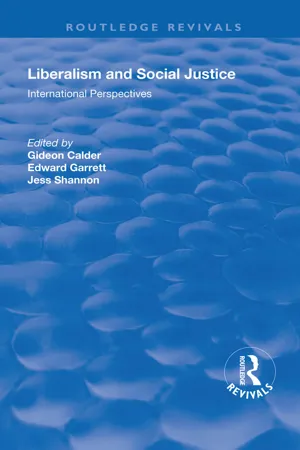
This title was first published in 2000: Bringing oes liberalism have either the theoretical capacity or the political durability to provide for social justice, particularly given the challenges of the new millennium? From a diverse array of disciplinary, cultural and critical perspectives, the contributors to this timely and incisive collection of essays cover ground ranging from the philosophical adequacy of liberalism's central tenets, to the treatment of minority and alternative cultures in contemporary Europe, to the future of welfare provision, to the continued tenability of traditional ideological distinctions and labels amid the social conditions and demands of the new millennium. The book will be of particular interest to philosophers, political scientists and social and legal theorists - and to anyone with a general interest in the present and future horizons of social justice in theory and practice.
Information
1 Liberal Democracy in Transitional Azerbaijan: Challenges and Prospects
GULIA TAGHIYEVA
Introduction
Liberalism was developed as a philosophical theoiy with the aim of defending the individual in the face of growing power of the state in the sixteenth and seventeenth centuries. Within liberalism, social justice is mainly understood ta terms of individual rights, freedoms and choices. In a conflict between interests of an individual and those of the community or the society in which the individual exists, liberals have traditionally tended to protect the former against the latter. Hence liberalism is inevitably antagonistic towards a non-liberal society such as a traditional Islamic community where majority interests are seen as superior to those of an individual, or an authoritarian type of the state regime where the individual's will is subordinate to that of the ruling elites.1
The liberal-democratic type of the state where both strong liberal traditions and culture are developed is widely believed to provide the best conditions for the protection of human rights. Indeed, as theoretical discourse and empirical evidence have shown, democratic states seldom fight wars, at least against each other (Huntingdon, 1991); state violence is less likely to occur in democratic states (Gurr, 1986) and they are based on free and peaceful competition for power (Linz, 1992). Furthermore, democratization in Western countries took centuries; it was an extended process often involving coercion and violence and passed through bloody revolutions and numerous civil wars. Nevertheless the longevity and gradual character of this process ensured the profound character of democratic culture and the enhancement of liberal traditions, which are now deeply embedded in the state system and institutions and in the minds of private citizens.
This paper focuses on transitional Azerbaijan, which presents an example of a society where neither cultural traditions nor the type of the political regime inherited by the country is favourable for promotion of human rights.
The country has yet to accomplish the processes of political liberalization which is defined
in terms of protecting and promoting civil rights such as freedom from torture and degrading punishment, arbitrary arrest, and imprisonment; freedom of speech, faith, opinion, and assembly; and also the right to life, security and the ownership of property. A broader definition of political liberalization includes the right to seek or nominate for public office and the right to form and join political parties through an orderly electoral process. Thus conceived, political liberalization means democratization (Monshipouri, 1995, p. 12).
There are many factors conditioning the tumultuous and peculiar character of Azerbaijan's and other Newly Independent States' (NIS)2 transition to democracy.3 The necessity of simultaneously carrying out democratic and economic reforms appeared to be a formidable task for the former Soviet republics, for their communist legacy provided neither conditions for a market economy, nor respect for democratic principles and individual rights. The third issue which made transition in the NIS a unique and complicated process was that of territory and state-building, issues not faced by most other countries undergoing democratization.
The three issues (i.e. the territorial issue, including state-building, the issue of democratization and that of transition to a market economy) composing the well known phenomenon of the 'triple transition' (Offe, 1996b) challenged virtually all of the NIS and generated common problems for the newly democratizing states. Nonetheless, in spite of the common legacy and the common challenges, these countries differ radically from each other in terms of the speed and character of their transformation, for 'all of them have their own specific problems, stemming from historic or religious traditions, their demographic situation, the gravity of inter-ethnic tensions, etc' (Miillerson, 1995, p. 61).
The peculiar character of democratization in Azerbaijan has been determined by a cluster of pre-transitional and transitional factors. These include the task of building a strong and stable state, the division among its elites, the country's cultural and ethnic diversity and its involvement in the aimed conflict caused by the secessionist movement of ethnic Armenians in Nagorno Karabakh that threatens its independence, statehood and territorial integrity. Among other factors historical experience, cultural traditions and religion play crucial roles for they appear to be the very foundation upon which the whole structure of new democracy is being built and upon which its durability will depend in many respects.
As I suggest in this paper, the issue of state-building (which in transitional Azerbaijan is inseparable from, and indispensable to, national issues and democratization) is a formidable task for the country's current and future elites. In this regard, the elites' attitudes to the tasks which are to be accomplished in the course of transition play a crucial role; for elites are a determining factor in the transformation of the regime, influencing democratization significantly. I will also suggest that there are cultural peculiarities that conditioned lack of popular support and a lack of commitment by the elites to the goals of democratization in Azerbaijan. Finally I will argue that a gradual progress in their promotion may bring about better results and that some changes in the Western approach towards transitional Azerbaijan are needed to facilitate this process.
Given the environment within which democratization in Azerbaijan is occurring, it is still not clear what type of society is emerging in the course of transition. However, I will attempt to draw some tentative conclusions about perspectives on liberalism, democracy and human rights in Azerbaijan.
Democratization and problems of 'stateness'
Virtually all scholars who address the conflicting logic between 'stateness' and democratization, point out the dependency of the latter on the former, holding that the existence of an independent state is a pre-requisite to democracy (Huntington, 1991; Linz and Stepan, 1996; Offe, 1996a.). In the case of Azerbaijan, the very existence of a modem state with its institutions and procedures, and the legitimate authority over its territory is open to question. Although Azerbaijan is recognized by the UN and the international community as a sovereign state with the borders and territory the republic had before the collapse of the USSR, the tasks of creating a state and (concomitant with it) the formation of the nation which have yet to be accomplished.
Having no experience in state-building, let alone nation-state-building.4 Azerbaijan was forced to begin its existence as an independent state in 1991 in a situation where part of its population (ethnic Armenians living in Nagorno-Karabakh) refused to acknowledge the state's authority over the territory they occupied. By 1993, 20 per cent of the republic - including not only Nagorno Karabakh but also a few neighboring districts - were beyond the control of the Azerbaijani state. Separatist movements took shape in 1993-1994 in the north and the south of the country, occupied by Lezgis and Talishs respectively, indicating that not all ethnic groups in Azerbaijan were willing to accept citizenship of the new state. Thus territorial and national issues were added to the state project and reform agenda, putting into question the legitimacy of the state's authority over its territory and undermining the opportunity to carry out democratic reforms. It is considered that 'if there is no significant irredenta outside the state's boundaries, if there is only one nation existing ... in the state, and if there is low cultural diversity within the state ... [only then] can leaders of the government simultaneously pursue democratization policies and nation-state policies' (Linz and Stepan, 1996, p. 25).
As historical experience shows,5 a liberal democratic state with its institutions and procedures protecting both individual and minority rights contributes to political stability and allows for peaceful resolution of political, social and ethnic conflicts in society. Introducing democratic measures, such as enforcing individual rights and granting equal citizenship, presumably produces a similar effect in a democratizing multicultural society too (Linz and Stepan, 1996, p. 33). If so this would allow for a gradual accomplishment of the tasks of the state's project and require from the elites a balanced and cautious policy approach. Yet, the elites in Azerbaijan have often had to act under emergency circumstances malting decisions influenced not as much by the interests of the democratizing state as by the demands of 'stateness'6 and by their own struggle for power. Moreover, this has created more favourable conditions for those rulers following authoritarian trends in their governance to gain support of a public longing for 'strong power'.
Under these circumstances, creating a strong, 'Weberian' type of the state inevitably became a primary task for the Azerbaijani elites. It became less important whether assertion of the state's authority was ensured through repression, violation of human rights, coercion and forcible subjugation of different political community groups (ethnic minorities, political parties, or contending elites) or through voluntary cooperation and overall consensus, so long as this could guarantee political stability and guard against potential challenges.
Elites in transition
The exclusive role of the elites in the newly democratizing states stem from the fact that public control of the government and public participation in governance have yet to be established through developing civil and political society, democratic institutions and procedures and 'constitutional checks and balances and the free marketplace of ideas' (Mansfield and Snyder, 1998, p. 317). Given that transition in these countries was evidently controlled by elites from the very beginning, elites became either a driving force of, or an impediment to, the regimes' transfomation. In terms of the prospects of democratization, elites7 in the transitional states probably play the most crucial role compared to other determinants of the process for all newly democratizing states. This is irrespective of whether the transition was initiated by the elites or imposed on the country in question. The former Soviet Union is an example of both cases, where republican elites had to follow reforms initiated by the elites at the 'centre'. In other cases, 'serving as primary agents of change at the time of transition, Eastern European elites enjoyed an unprecedented autonomy' (Wasilewski, 1998, p. 163), In other countries, Azerbaijan included, elites had the role of reformers thrust upon them from Moscow and they eagerly accepted it in the face of emerging political forces struggling for power.
In short, a theoretical model of the least turbulent democratic transition in terms of change among the elites, would involve appearance of new leaders in politics, the economy, the social sphere and imply the readiness of old elites to cooperate with them in order to accomplish transitional tasks. It should be noted that consensus among elites implies an agreement not only about the goals of democratization and ways of attaining them, but also about the fundamental rules of political competition. This implies that 'at the individual level... [a] 11 must adhere to democratic procedures and a priori accept the uncertain outcomes of competition. At the level of political organizations this consensus means that none of the major political parties challenges the system of government' (ibid., p. 171). Finally, as a result of discrete elite change, democratic forces would prevail in all the main positions in the government, the economy and the judiciary, which would contribute to the stability of the new regime and, facilitate the process of democratic and economic reforms.
As often happens, reality differs from this 'outline'. In Azerbaijan, as in some other former Soviet republics with relatively strong authoritarian traditions in politics,8 the elites were less inclined to promote democratization. In addition, the formidable task of solving the Nagorno-Karabakh conflict affected the process of state building and made Azerbaijan communist elites look on the new opposition as an additional destructive and destabilizing factor. For the elites it was a choice between compromise with new political forces and repression against them.
The choice of either democratic or non-democratic methods of state-building became one of the key issues in the dispute between the contending elites, notably between the communists and democrats. While in power, the communist elites and the democrats demonstrated different approaches to the democratization project and sought their own ways of legitimizing their authority and strengthening power with fluctuating success. Faced with the dilemma posed by the need to pursue the goals of democratization and state- building simultaneously, they either intended to promote democracy and were not able to, or they gave priority to strengthening the state's power and left democratization goals behind. However, the struggle for power and absence of consensus regarding power sharing among the old and the new elites delayed both the creation of modern state and democratization of Azerbaijan.
Thus, it is not surprising that the course of democratization in Azerbaijan since 1988 has been a continuous struggle between old party elites and new ones, where temporary victory of one side or another was often predetermined by the escalation of the Nagorno-Karabakh conflict and social turmoil concomitant with it. This struggle finally resulted in the return of Aliyev, the former communist leader of Azerbaijan, to power in 1993.9 Despite the negative attitude of the internal opposition and foreign states to this return, Aliyev's 'triumph was welcomed by the general public ...' (Zinin and Maleshenko, 1994, p. 114). This phenomenon can be partly explained by the fact that the Azerbaijani people were exhausted by losses in war, economic hardships and political turmoil, and received Aliyev as a saviour who brought about long-awaited civil peace and political stability. Within six years of Aliyev's presidency, the republic had been through a series of events vital to both its political and economic development. The latest ceasefire agreement, which came into force in May 1994, is mainly observed, although no tangible success in the talks over Nagorno Karabakh's status and the return home of Azerbaijani refugees has been achieved.10
The strengthening of state authority during the six years of Aliyev's presidency presents a sharp contrast with the situation between 1988 and 1993, when the country experienced three enforced changes of its leaders, one civilian and two military coups, social and ethnic turmoil, continuous defeats in the war over Nagorno-Karabakh and a worsening economic situation. According to official statements, the country has been successfully moving towards creating a stable democracy, a market economy and a secular state governed by law. However, attainments in the sphere of state-building and economic reforms have evidently been achieved by 'sacrificing' the goals of democracy to political stability and safety of the ruling elites.11
In spite of a series of concessions made by the government under pressure from the opposition as well as from die international a...
Table of contents
- Cover
- Half Title
- Title
- Copyright
- Contents
- Foreword
- Acknowledgements
- Introduction
- 1 Liberal Democracy in Transitional Azerbaijan: Challenges and Prospects
- 2 Unemployment Benefits: Social Justice or 'Social Hammock'?
- 3 Liberalism and Social Justice: Voyaging between Conceptual Antipodes in the Good Ship Democracy
- 4 Why Pluralism?
- 5 Reasonableness, Pluralism and Democracy: A Pragmatic Approach
- 6 The Freeman and his Doubles: Reading Mill's On Liberty
- 7 The Liberalist 'Esprit analytique' as a Hindrance to Social Justice
- 8 From Metaphysics to Pragmatism: Rorty on Liberalism and Social Justice
- 9 The Individual at the End of History
- 10 'Community' - An Instrument of Social Order other than the State? A Rhetorical Perspective on Contemporary American Critiques of Liberalism
- 11 Communitarianism and Immigration: Walzer on 'Members and Strangers'
- 12 Liberal State and Polity in the Era of Globalisation: Social Injustice, Governance and Resistance in the Global-Local Nexus
- 13 Territorial States: What Are They Good For? Who Needs Them?
- 14 Sentiment or Duty? Liberalism and International Justice
- Contributors
Trusted by 375,005 students
Access to over 1.5 million titles for a fair monthly price.
Study more efficiently using our study tools.
Frequently asked questions
Yes, you can cancel anytime from the Subscription tab in your account settings on the Perlego website. Your subscription will stay active until the end of your current billing period. Learn how to cancel your subscription
No, books cannot be downloaded as external files, such as PDFs, for use outside of Perlego. However, you can download books within the Perlego app for offline reading on mobile or tablet. Learn how to download books offline
Perlego offers two plans: Essential and Complete
- Essential is ideal for learners and professionals who enjoy exploring a wide range of subjects. Access the Essential Library with 800,000+ trusted titles and best-sellers across business, personal growth, and the humanities. Includes unlimited reading time and Standard Read Aloud voice.
- Complete: Perfect for advanced learners and researchers needing full, unrestricted access. Unlock 1.5M+ books across hundreds of subjects, including academic and specialized titles. The Complete Plan also includes advanced features like Premium Read Aloud and Research Assistant.
We are an online textbook subscription service, where you can get access to an entire online library for less than the price of a single book per month. With over 1.5 million books across 990+ topics, we’ve got you covered! Learn about our mission
Look out for the read-aloud symbol on your next book to see if you can listen to it. The read-aloud tool reads text aloud for you, highlighting the text as it is being read. You can pause it, speed it up and slow it down. Learn more about Read Aloud
Yes! You can use the Perlego app on both iOS and Android devices to read anytime, anywhere — even offline. Perfect for commutes or when you’re on the go.
Please note we cannot support devices running on iOS 13 and Android 7 or earlier. Learn more about using the app
Please note we cannot support devices running on iOS 13 and Android 7 or earlier. Learn more about using the app
Yes, you can access Liberalism and Social Justice by Gideon Calder,Edward Garrett in PDF and/or ePUB format, as well as other popular books in Philosophy & Philosophy History & Theory. We have over 1.5 million books available in our catalogue for you to explore.