eBook - ePub
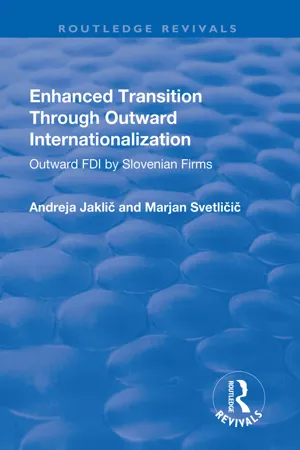
Enhanced Transition Through Outward Internationalization
Outward FDI by Slovenian Firms
- 370 pages
- English
- ePUB (mobile friendly)
- Available on iOS & Android
eBook - ePub
Enhanced Transition Through Outward Internationalization
Outward FDI by Slovenian Firms
About this book
This title was first published in 2003. Among the major challenges transition economies are facing is how to cope with globalization. Foreign direct investment (FDI) has proved the most dynamic (defensive and offensive) response, as an integration and network tool, yet outward FDI has so far been overlooked in research. The vitality of outward FDI as an entry mode to the global economy is discussed in this authoritative volume from various angles, beginning with the context of the development strategy and the transition process. The experiences of the Slovene way of internationalization are compared with those of other transition economies. Readers will learn about the size, geographical distribution, trends and sectoral allocation of such outward FDI (OFDI) as well as the major motives, barriers and problems. The book also responds to questions about the extent to which outward FDI is instrumental in development/transition, EU accession and competitiveness strengthening. Based on extensive empirical research and focused case studies, the volume provides valuable lessons for other EU candidate countries and transition economies, while managerial experiences in entering Central and Eastern European markets offer universal internationalization lessons.
Part I
Origins of Slovenia and its Outward Internationalization
Chapter 1
Introduction
In facing the many challenges when starting to prepare this book, the authors agreed that the vitality of outward FDI as an entry mode to the global economy should first be discussed in the context of a development strategy and the transition process. The Slovenian experience of internationalization must be compared with the experiences of other transition economies in order to see to what extent it is unique. Analysis should be based on in-depth evaluations of the size, trends, geographical distribution, and sectoral allocation of such outward FDI as well as the chief motives, barriers and problems. Third, the book should provide empirical insights into issues like the development impact of such outbound internationalization, and the extent to which outward FDI is instrumental in development/transition, EU accession and competitiveness strengthening. In short, the link between internationalization and transition has to be explained.
The book's theoretical framework is a set of theories proven to have the strongest power in explaining outward FDI by Slovenian firms and firms from other transition economies for that matter. They comprise: (i) the investment development path paradigm (Dunning, 1981, 1993; and Dunning and Narula, 1996); (ii) the Scandinavian sequential internationalization pattern that reflects increasing international involvement in terms of entry mode, product and market diversification (Welch, Luostarinen, 1988; Johanson, Vahlne, 1977); (iii) the eclectic paradigm (Dunning, 1993) that synthesizes the three necessary conditions (ownership, location and internalization advantages – OLI) for firms to undertake outward FDI; (iv) life cycle theory (Vernon, 1966); and (v) Ozawa's dynamic paradigm of transnational corporations assisted development (1992).
Despite their claims to be generally relevant, we should in addition consider whether these theories can also explain outward FDI by transition economies or whether their explanatory power is limited. There are so many specific, system-based characteristics that make applying theories based on the market economy tradition very difficult, at least to the initial stage of development of such investments. Industry and firm-specific characteristics and the stage of their development (previous experience) are very important explanatory variables that vary from case to case. Any generalizing of the experiences of outward FDI by Slovenian companies or even by other investors from transition economies has to be undertaken with caution.
In line with the rationale, we decided to divide the book up into five parts. The first is devoted to Slovenia's origins, its economy, history and the beginning of outward internationalization. The second part discloses the development of the outward investing in the nineties at the macroeconomic level by introducing the evolution of legal framework, analysing outward FDI trends, their geographical and sectoral distribution, particularities of outward FDI in the successors to the SFRY and the importance of outward investors in the Slovenian economy in general. The third part focuses on the firm-level perspective of outward direct investing; it analyzes the characteristics of investing companies and their affiliates, the motivations for investment, the barriers they are facing in internationalising their business and, finally, the impacts of such activities abroad. In the fourth part, selected cases of Slovenian multinational companies are evaluated. The last, fifth, part of the book concentrates on the lessons the Slovenian case could hold for other transition economies. It examines what the response of governments should be in regulating or promoting this new type of international activities of firms from transition economies and assesses the relevance of the Slovenian case.
When preparing the empirical part of the book in particular, the real problem was the availability of data. In transition economies, the statistical base on outward FDI is very poor, in some cases it did not exist until recently. If data is available, problems remain of their reliability, short time series, non-comprehensiveness etc. The only way around such limitations was to employ various data sources. Our empirical analysis is therefore based on secondary data available on outward FDI and primary data collected through surveys. Interviews of managers and case studies support the interpretation of results.
Table 1.1 Data sources for the study
| Secondary data | Primary data |
| • Bank of Slovenia | • Survey among companies investing abroad, June to September 1999 |
| • Ministry of Finance | |
| • Media, business press | • Survey among the biggest exporters and the fastest growing firms, June to August 1999 |
| • Survey among leading investors, June 2000 | |
| • Survey among companies investing abroad, June to September 2001 | |
| • Interviews | |
The main source of secondary data on outward FDI (and FDI in general) is official data from the Bank of Slovenia. It provides a set of aggregate data (such as time series data on the volume of outward FDI, stocks and flows of investments, geographical distribution, breakdowns by activity,...) published in a specialized annual publication entitled Direct Investment. Another secondary data source of outward FDI statistics is the Ministry of Finance that runs a register of announced investments abroad1. For the purpose of firm-level analysis, data from the Bank of Slovenia were combined with the database of the Agency of the Republic of Slovenia for Payment Transactions (AP) that provides financial data (balance sheets, income statements) on companies.
The lack of qualitative information led us to collect primary data on outward FDI. We aimed to provide additional information on outward FDI within firms through structured questionnaires. Four surveys were launched for this purpose.
- Survey on outward FDI of Slovenian companies (Survey 1999), carried out from June to October 1999 on a sample of companies that involve outward direct investment. As a sample framework, we used the sample of all non-financial sector companies registered in 1997 and analyzed at the aggregate level2. The Survey 1999 sample included 32 companies or 7.7 per cent of Slovenian companies with outward FDI. The sample companies had a 15.9 per cent share in the total value of capital of Slovenian companies abroad and 17.4 per cent of all Slovenian outward FDI (in terms of number). Since the financial sector has about 30 per cent of all Slovenian outward FDI stock, the sample companies represent 22.7 per cent of the outward FDI of the non-financial corporate sector. The questionnaire gathered elementary data on an investing company and its foreign affiliate(s), as well as the main determinants of outward FDI such as the motivation for, effects of and barriers to outward FDI. Since this was the most extensive survey, it represents the main data source for this country study.
- Survey on potential outward FDI of Slovenian companies, carried out from June to October 1999 on a sample of potential investors. Lists of the biggest exporters and the fastest growing firms in Slovenia, which had not yet been registered as direct investors abroad, were used as the sample framework. The questionnaire was very similar to the former one, but shorter. The analyzed sample included 32 companies.
- Survey on managers on internationalization through outward FDI, carried out on 1 June 2000 on a sample of the leading direct investors abroad. Top managers responded to the questionnaire at a workshop on 'Slovenian Investments Abroad; Why, How and Where?' held at the Chamber of Commerce and Industry in Ljubljana. This survey aimed to analyze attitudes, experiences and knowledge about internationalization. Again, the sample included 32 companies (a 64 per cent response rate).
- A second survey on outward FDI of Slovenian companies (Survey 2001) was carried out from June to September 2001. As a sample framework, we used a list of companies registered as direct investors abroad in 1999. The questionnaire was sent by post to 407 companies. Up until September 2001,52 questionnaires had been returned; meaning a 13 per cent response rate however, of those, 10 questionnaires were not sufficiently completed and consequently only 37 (9 per cent) were included in the sample for analysis. To a large extent, the sample in Survey 2001 matched the sample in Survey 1999. Eighty per cent of the sample companies included in the first survey repeated the questionnaire again and panel data are available.
In spite of all of these efforts, the many data and statistical problems did limit the scope of our research. A very important one is the short histories of both Slovenia as an independent state and this phenomenon (outward FDI as an internationalization mode) and, consequently, the shortness of time series that prevents us conducting trend and time-series analysis. Initially, before transition they followed a different rationale and were not considered an important issue deserving regular statistical coverage. The obvious result is the non-developed and incomplete statistical coverage. Consistent time series only begin in 1993 when the Bank of Slovenia started the required reporting on direct investment. The data on previous outward FDI differ in their comprehensiveness due to methodological changes. The 'youthfulness of outward FDI' itself causes most of the data difficulties presented below.
Data is also very limited in terms of scope which narrows the possibilities of qualitatively evaluating this phenomenon. Aggregate data on outward FDI flows and stocks and the number of outward FDI is available, as are stock breakdowns by country and activity (of investing firms not affiliations). Coverage is still incomplete. As a result, differences may occur when comparing different statistical sources.
Missing categories especially involve foreign affiliates, as to which the official statistics keep few records. With the exception of the total number of foreign affiliates established (or acquired) by Slovenian companies and a breakdown by country, there is also no data on the activity or product specialization of foreign affiliates, their performance or legal status to allow any more complete picture of intra-firm relations (such as intra-firm trade).
To overcome the barriers to a qualitative analysis, we had to rely on surveys, interviews a...
Table of contents
- Cover
- Half Title
- Title
- Copyright
- Contents
- List of Figures
- List of Tables
- List of Boxes
- About the Authors
- Preface
- Acknowledgements
- List of Abbreviations
- PART I ORIGINS OF SLOVENIA AND ITS OUTWARD INTERNATIONALIZATION
- PART II OUTWARD FOREIGN DIRECT INVESTMENT IN THE 1990s
- PART III INVESTING ABROAD: FROM IDEA TO RESULTS
- PART IV CASE STUDIES
- PART V LESSONS FROM SLOVENIA
- Bibliography
- Name Index
- Subject Index
Trusted by 375,005 students
Access to over 1.5 million titles for a fair monthly price.
Study more efficiently using our study tools.
Frequently asked questions
Yes, you can cancel anytime from the Subscription tab in your account settings on the Perlego website. Your subscription will stay active until the end of your current billing period. Learn how to cancel your subscription
No, books cannot be downloaded as external files, such as PDFs, for use outside of Perlego. However, you can download books within the Perlego app for offline reading on mobile or tablet. Learn how to download books offline
Perlego offers two plans: Essential and Complete
- Essential is ideal for learners and professionals who enjoy exploring a wide range of subjects. Access the Essential Library with 800,000+ trusted titles and best-sellers across business, personal growth, and the humanities. Includes unlimited reading time and Standard Read Aloud voice.
- Complete: Perfect for advanced learners and researchers needing full, unrestricted access. Unlock 1.5M+ books across hundreds of subjects, including academic and specialized titles. The Complete Plan also includes advanced features like Premium Read Aloud and Research Assistant.
We are an online textbook subscription service, where you can get access to an entire online library for less than the price of a single book per month. With over 1.5 million books across 990+ topics, we’ve got you covered! Learn about our mission
Look out for the read-aloud symbol on your next book to see if you can listen to it. The read-aloud tool reads text aloud for you, highlighting the text as it is being read. You can pause it, speed it up and slow it down. Learn more about Read Aloud
Yes! You can use the Perlego app on both iOS and Android devices to read anytime, anywhere — even offline. Perfect for commutes or when you’re on the go.
Please note we cannot support devices running on iOS 13 and Android 7 or earlier. Learn more about using the app
Please note we cannot support devices running on iOS 13 and Android 7 or earlier. Learn more about using the app
Yes, you can access Enhanced Transition Through Outward Internationalization by Andreja Jaklic,Marjan Svetlicic in PDF and/or ePUB format, as well as other popular books in Business & Business General. We have over 1.5 million books available in our catalogue for you to explore.