eBook - ePub
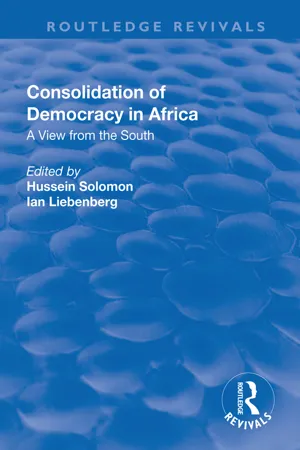
Consolidation of Democracy in Africa
A View from the South
- 380 pages
- English
- ePUB (mobile friendly)
- Available on iOS & Android
eBook - ePub
About this book
This title was first published in 2000: The continent of Africa is undergoing great change. While on the one hand there is talk of a re-awakening of Africa or Renaissance various countries in Africa are still plagued by poverty, intra- and interstate violence. In some countries the legacy of neo-colonialism and under development contributed to social strife and the potential criminalization of the State. This book addresses the topic of democratization and sustainable democracy in Africa against this background.
Information
1 Democracy versus State: The African Dilemma?
IRINA FILATOVA
'A struggle for political power during 1998 and 1999 was dragging the Kingdom of Lesotho towards the abyss of a violent conflict. The Democratic Republic of Congo is sliding back into conflict of arms from which its people had hoped they had escaped forever — the outcome of negotiations between conflicting parties remain uncertain.
The silence of peace has died on the borders of Eritrea and Ethiopia because, in a debate about an acre or two of land, guns have usurped the place of reason.
Those who had risked death in Guinea Bissau as they fought as comrades to evict the Portuguese colonialists, today stand behind opposing ramparts speaking to one another in the deadly language of bazooka and mortar shells and the fearsome rhythm of the beat of machine-gun fire. A war seemingly without mercy rages in Algeria, more horrifying by a savagery which seeks to anoint itself with the sanctity of a religious faith.
Thus can we say that the children of Africa, from north to south, from the east and the west and at the very centre of our continent, continue to be consumed by death dealt out by those who have proclaimed a sentence of death on dialogue and reason and on the children of Africa whose limbs are too weak to run away from the rage of adults.
Both of these, the harbingers of death and the victims of their wrath are as African as you and I.
For that reason, for the reason that we are the disembowelled African mothers and the decapitated African children of Rwanda, we have to say enough and no more.'
Introduction
The powerful, almost poetic, account of samples of 'misbehaviour' of African states and societies in the quotation above comes not from a poet, nor from a writer, but from a politician — from South Africa's new president, Thabo Mbeki (1998a). All Mbeki's speeches on the African Renaissance — his brainchild and his programme for the continent — contain compelling descriptions of Africa's faults and failures, many of which are connected with the state: corruption and embezzlement, tyranny and dictatorship, civil war and violent conflict. For Mbeki the way forward, away from these evils, is 'emancipation from the deadly clutches of neo-colonialism', truly democratic elections, 'resulting in governments which the people would accept as being genuinely representative of the will of the people' (Mbeki, 1998b) and — the core of the African Renaissance — 'a rediscovery of ourselves', 'our own rediscovery of our soul' (Mbeki, 1998c).
What has to be rediscovered, Mbeki believes, is self-esteem — pride in the historical and cultural achievements of the continent: the scholarship of Timbuktu, the wonders of the pyramids of Egypt, the stone buildings of Axum, the ruins of Carthage and Zimbabwe, the rock paintings of the San, the Benin bronzes, the carvings of the Makonde and the stone sculptures of the Shona; the victories of African armies at Omdurman and Isandlwana on the eve of the colonial era, and the liberation of the entire continent through an anti-colonial effort of enormous vigour and power; and the works of famous contemporaries such as Zao and Franco of the Congos, Mazisi Kunene and Dumile Feni of South Africa and Malangatane of Mozambique (Mbeki, 1998a & c).
The value of these historical and cultural achievements of the continent for defining its future can hardly be disputed. Are they, however, sufficient to achieve Mbeki's proclaimed ideal of a better, wealthier and healthier, more peaceful and democratic Africa? Or are there other elements of Africa's legacy that counter internationally accepted norms of political behaviour (if we assume that these exist) and human values, and if so, what are these elements?
Since about 1970 the international Africanist community has been debating the legacy of the state in Africa, apparently without approaching conclusive answers. A vast academic literature exists on the state in Africa and on the correlation, or rather on the perceived incompatibility, between the state and democracy.1 Consensus seems to be emerging among researchers as to the roots and scope of the problem. There is, however, much less accord on what the situation currently is, on the direction in which it is evolving, and on what, if anything, should or could be done to tackle it.
It is hardly possible to present a comprehensive range of views on the historical legacy of the state in Africa within the limited space of this chapter. It is still less possible to come up with an original study of this subject when dozens of such studies of both concrete and theoretical nature have been published all over the world. What I shall try to do here is to outline what seems to be the consensual view of the parameters and the scope of the problem; and to contextualise the problem within the discourse on its social historicity and against the background of international involvement and interaction.
The Parameters of the Problem
The historical record of 'misbehaviour' of the state in Africa, of its noncompliance with the norms of democratic governance, as they are understood and accepted by institutionalised international public opinion, is well known. It may nevertheless be worthwhile to outline various aspects of this phenomenon.
One of the most obvious aspects is the fact that until recently democratically elected governments have been an exception rather than a characteristic of the political scene on the African continent. The overthrow of Kwame Nkruma's government in Ghana in 1966 was not the first coup against a democratically elected government in Africa (it was preceded by the coup in Togo in 1963) but it became a sensation because of Nkruma's high regard as president of the first African country to gain independence. It was also the first blot on the previously unsullied mantle of the anti-colonial forces which had been perceived as democratic by virtue of they were fighting against the undemocratic colonial and neocolonial order. Since then coups, counter-coups and attempted coups (all either military or supported by the military), which few African countries were spared, became such a common phenomenon that they stopped to make news anywhere except in the country concerned and its closest neighbours. Nigeria, which in the thirty years after its first coup in 1966 had less than five years of civilian rule (1979-1983), may be the most notorious example. Only recently Nigeria made an attempt at another democratisation process.
Civil wars became a common feature of the African political landscape (Nigeria, Angola, Mozambique, Chad, Somalia, Liberia, the Democratic Republic of Congo (DRC) and the People's Republic of Congo). Military conflicts and interventions sometimes led to the toppling of neighbouring regimes and sometimes supported them (Ethiopia-Eritrea, Somalia-Kenya, Somalia-Ethiopia, Tanzania-Uganda and the DRC, the latter characterised by multi-national intervention). Although these conflicts and interventions are perceived as abnormal in the context of the continent's quest for unity, their occurrence is on the increase. Compared to these, the military interventions of African regional organisations such as the Economic Community of West African States (ECOWAS) (with the Nigerian military constituting the majority of its military wing, Ecomog) and the Southern African Development Community (with South Africa as the strongest regional power) into the internal politics of member states (Sierra Leone, Liberia, Lesotho) seem to be much milder.
Perhaps the most terrifying phenomenon is the mass ethnic cleansings, the worst, both in scale and mode, having taken place in 1994 in Rwanda. This inevitably resulted in the mass exodus of refugees, the proliferation of military conflict and enormous human suffering.
Coups, military interventions, civil wars and massacres may have been the most obvious but by no means the only African forms of departure from what is perceived as norms of democracy. Military or authoritarian regimes and one-party systems, flawed or fraudulent elections; intolerance towards all kinds of opposition and media, and sometimes physical assaults on and assassinations of opponents and journalists; the suppression of basic political and personal freedoms; the ignorance or suppression of human rights and the low value of human life — all these add to the perception that democracy is non-viable in Africa.
Massive embezzlement of state funds and assets by state office holders and massive corruption on the part of all levels of state employees seem to be the foundation of a number of states defined by Robert Jackson and Carl Rosberg (1994, pp. 300-304) as 'personally appropriated states'. The best-known cases are Zaire, where during the 1980s Mobutu Sese Seko's wealth was estimated at approximately the same sum as the whole national debt, and Nigeria, where the eight-year tenure of Ibrahim Babangida alone saw the disappearance of US$12.4 billion in oil receipts (a third of which is believed to have been stolen by the general himself) (Maja-Pearce, 1999, p. 10).
Economic incompetence and the inability or unwillingness of state institutions to stimulate economic growth are common features of Africa, as are the decay of basic social services and of the economy as a whole, and finally a failure on the part of the state to exercise meaningful control over its own territory — a phenomenon which John Iliffe (1995, p. 263) called 'state contraction'. In extreme cases 'state contraction' can lead to a complete collapse of state structures, as happened in the DRC and Somalia. The combination of over-centralisation and authoritarianism on the one hand and 'state contraction' on the other hand seems to be a contradiction in terms but only at first sight, for they co-exist harmoniously, representing two sides of a coin.
The dismal performance of the state in Africa has always been attributed to the lack of democracy as it is understood by Western schools of thinking. Therefore democratic elections and the introduction of multiparty systems have been expected to drastically change the situation. As Daniel Simpson put it, 'if people have a legitimate and peaceful means of changing their governors, theoretically those governors — wishing not to be turned out of office — have reasons not to steal, not to install their relatives and ethnic kin exclusively at the trough, and not to abuse human and civil rights or otherwise torment the governed. Instead, the governors will rule wisely and will pursue constructive long-term economic policies' (Simpson, 1997, pp. 165-166). Hence the enthusiasm of the 1990s when one African leader after another announced 'the transition to democracy'. This enthusiasm, however, has been short-lived.
The democratic elections that swept through the continent (for example, in Zambia, Ghana, the Congo, Malawi, Sierra Leone, Uganda, Ethiopia and now Nigeria) have often been nullified by ensuing coups. The spirit of democratisation, which seemed to be gaining momentum in the wake of the Cold War, receded and then suffered severe blows from the massacres in Rwanda and Burundi, the civil wars in Liberia, the Congo, Zaire2 and the DRC, the coup in Sierra Leone, and the attempted coup in Zambia. Moreover, it soon became obvious that new democratically elected leaders do not necessarily act democratically themselves — the treatment of the opposition by Zambia's Frederick Chiluba being one example. Even the character and the parameters of the newly born democracies themselves seem to be very different from the known patterns.
Explanations for the state of democracy in Africa and of the role of the state in creating this situation were aplenty. The most popular explanation was offered by the now unanimously denounced 'dependency and underdevelopment' school of thought which dominated the debate on the subject both in Marxist and non-Marxist circles during the 1970s and early 1980s.3 Its main thrust was the idea that African countries were economically weak and still dependent on former colonial and 'neocolonial' powers. Their social structures were 'underdeveloped' compared to the 'developed' 'first' (Western) and 'second' ('socialist') worlds, and they could not incorporate institutions of the developed democracies organically. Therefore democratic institutions were seen to be imposed on African societies in the same fashion as colonial institutions, and sometimes together with them, and were unacceptable for this reason. This explained the weakness or absence of institutionalised civil society, of democratic traditions (the 'habit' of democratic behaviour) and, more important, of the appropriate classes and social structures which could generate them. In other words, as Patrick Chabal (1986, p. 2) puts it, the weakness of the state was blamed on its 'artificial' construction on colonial foundations, on the lack of an 'organic' growth from the entrails of civil society.
Not that there has ever been an accepted set of social prerequisites for democracy, but there was a theoretical perception (shared, again, by many Marxists and non-Marxists alike) that 'contemporary' democracy could only emerge from the classes of 'contemporary' (capitalist) society. Therefore, the main question was to what extent African societies were capitalist at the end of the colonial era and how long it would take them to 'modernise' their social, economic and political structures in order 'to catch up' with the 'modern' world.
The theory may seem to have Eurocentric connotations in the present historico-political discourse. However, two decades ago it did not have these connotations because the theory was a) anti-colonialist; b) non-racist, or at least was not meant to be racist because African 'backwardness' was seen only in social (formational) and not in cultural or political terms — and was mainly blamed on colonialism; c) its authors and adherents assumed that African societies were in the process of 'modernisation' and would gradually develop classes of the 'contemporary society' (capitalist or socialist). Thus they would one day 'catch up' with the 'modern' world and in the process would democratise themselves with the assistance of either the 'progressive' (socialist) or 'democratic' (capitalist) international community.
Because Western institutionalised democracy with parliaments, multi-party elections, parliamentary oppositions etc. was seen as alien to Africa, the state itself, designed as a replica of that system at the end of the colonial era, was looked upon as fragile, weak and thus unable to cope with the general task of governance and with the concrete problems of each particular country. This led to perennial crises, instability and disorder, with 'ethnicity' being regarded as a major rationale for the conflict. The 'weak state' thesis seemed to the confirmed by the worst cases of collapsed states, such as Mozambique at the end of its incessant civil war, and Somalia and the DRC where armed bands of no particular political affiliation controlled vast areas in a manner established entirely by themselves.
As years went by it became increasingly clear that the predicted model of socio-political transformation failed to materialise. African societies proved resistant to the pre-determined direction of change, and the changes in their political behaviour re-defined but confirmed the existing pattern. It also became clear that while the political situation in different countries remained unstable, the instability itself became an established feature on the African landscape. Moreover, despite the obvious weakness, ungovernability and turmoil, the state itself as a sovereign political entity demonstrated an enviable degree of resilience and proved to be much more stable than had been envisaged.
Artificial colonial borders which divided well-established 'ethnicities' or clubbed together alien and often hostile entities — another reason for conflicts — remained intact and even became better entrenched. The few changes that occurred were insignificant. The struggles for power, the wars and civil wars were apparently for, not against, the state; for straddling but not for ruining the state (or part of it) in its present borders. The structures of governance may have collapsed in the process, but the state as a political entity survived.
Significantly, the mode of functioning of the state has remained stable as well. Generalisations are, of course, inappropriate, for each African state has accumulated its own unique historical memory and lives within the constraints of its own unique historical experience. Nevertheless, the pattern of 'abnormality', of corruption, violence, instability and ungovernability in combination with authoritarianism and non-democratic principles seems to be well entrenched, normal, almost stable.
The 'dependency and underdevelopment' theory di...
Table of contents
- Cover
- Half Title
- Dedication
- Title
- Copyright
- Contents
- List of Contributors
- Acknowledgements
- Acronyms
- Introduction
- 1 Democracy versus State: The African Dilemma?
- 2 Africa's Constitutional Renaissance? Stocktaking in the '90s
- 3 The Consolidation of Democracy — Debate in Africa: Challenges for the Civil Community
- 4 The Changing Roles of Civil Society in African Democratisation Processes
- 5 Civil-Military Relations in Africa: Soldier, State and Society in Transition
- 6 Gender, Development and Democracy
- 7 Globalisation and Dominant Discourses
- 8 Human Rights and the Consolidation of Democracy in South Africa
- 9 Sharing Power?: Intergovernmental Relations in Democratic Transitions
- 10 Conclusion
- Appendix — Ninety-two Days in the Life of a Continent
- List for Further Reading
- Index
Trusted by 375,005 students
Access to over 1.5 million titles for a fair monthly price.
Study more efficiently using our study tools.
Frequently asked questions
Yes, you can cancel anytime from the Subscription tab in your account settings on the Perlego website. Your subscription will stay active until the end of your current billing period. Learn how to cancel your subscription
No, books cannot be downloaded as external files, such as PDFs, for use outside of Perlego. However, you can download books within the Perlego app for offline reading on mobile or tablet. Learn how to download books offline
Perlego offers two plans: Essential and Complete
- Essential is ideal for learners and professionals who enjoy exploring a wide range of subjects. Access the Essential Library with 800,000+ trusted titles and best-sellers across business, personal growth, and the humanities. Includes unlimited reading time and Standard Read Aloud voice.
- Complete: Perfect for advanced learners and researchers needing full, unrestricted access. Unlock 1.5M+ books across hundreds of subjects, including academic and specialized titles. The Complete Plan also includes advanced features like Premium Read Aloud and Research Assistant.
We are an online textbook subscription service, where you can get access to an entire online library for less than the price of a single book per month. With over 1.5 million books across 990+ topics, we’ve got you covered! Learn about our mission
Look out for the read-aloud symbol on your next book to see if you can listen to it. The read-aloud tool reads text aloud for you, highlighting the text as it is being read. You can pause it, speed it up and slow it down. Learn more about Read Aloud
Yes! You can use the Perlego app on both iOS and Android devices to read anytime, anywhere — even offline. Perfect for commutes or when you’re on the go.
Please note we cannot support devices running on iOS 13 and Android 7 or earlier. Learn more about using the app
Please note we cannot support devices running on iOS 13 and Android 7 or earlier. Learn more about using the app
Yes, you can access Consolidation of Democracy in Africa by Hussein Solomon,Ian Liebenberg in PDF and/or ePUB format, as well as other popular books in Politics & International Relations & Politics. We have over 1.5 million books available in our catalogue for you to explore.