This title was first publiished in 2000: A hierarchy is an organization system that is structured in a treelike manner, with levels of status or authority stacked one above the other. The classical and best known example of a hierarchy is probably the typical diagram that describes the structure of a company or business, also known as the corporate ladder. This text argues that hierarchies are one of the most important concepts we have in order to understand the world around us, and looks at hierarchies in a wide variety of areas of interest to everybody, such as companies, educational systems, transport systems, retail stores, corporations, communities, population migrations, medical systems, and many other real-world phenomena. From a Canadian perspective, the text examines these hierarchies and their effects at a variety of scales. It discusses how to understand the system around us and the ones in which we are immersed every day. The central theme is that it is possible to get a better grip on the past, present and future of the world, if it is viewed through an understanding of hierarchies.

- 240 pages
- English
- ePUB (mobile friendly)
- Available on iOS & Android
eBook - ePub
Hierarchical Organization in Society
About this book
Information
1 Introduction
Hierarchies are one of the most important concepts we have in order to understand the world around us. They affect us as individuals. They determine the nature of the social and economic systems in which we live. At the same time most of these hierarchies are almost invisible. People do not see them until their attention is drawn to them. But once they see them, it is hard for them to look at the world again without seeing it from the unique perspective that hierarchies provide.
A hierarchy is an organizational system that is structured in a treelike manner, with levels of status or authority stacked one above the other. The classical and best known example of a hierarchy is probably the typical diagram that describes the structure of a company or business, also known as The Corporate Ladder (see Figure 1.1). The essence of the inverted "tree" of a hierarchy is that it is typically broad at the bottom and narrow at the top.

Figure 1.1 Basic Hierarchy or Corporate Ladder
All kinds of things of interest to human beings are organized as hierarchies. Companies, educational systems, transport systems, retail stores, corporations, communities, population migrations, medical systems, and all other sorts of real world phenomena can be thought of as being hierarchical.
This book is about all kinds of hierarchies and their effects at a variety of scales. It is about understanding the hierarchical systems around us, and the ones in which we are immersed every day. The central theme is that it is possible to get a better grip on the past, present, and future of the world, if it is viewed through the point of view of hierarchies.
Anyone who is interested in planning for the future needs to understand and appreciate the hierarchical nature of the systems around us. Schools, small businesses, large corporations, government and non-government organizations, and even individuals need to be cognizant of the hierarchies that surround us, and respectful of their significance in our society. Legitimate planning for the future recognizes hierarchies and gives due attention to their significant place in the planning process.
Hierarchical thinking is for all people. Appreciating the existence of hierarchies tells individuals a great deal about their place in their personal and professional lives. You, and the world around you, are positioned in, and defined by, a wide variety of hierarchical systems that are constantly shaping the form of your existence. Like invisible hands these forces work to determine the course of your life and the course of the world around you.
Unlike many other books, it is not the purpose of this one to forecast or predict social or economic trends. Instead, this book is intended to promote a new perspective; a new point of view; a new way of looking at things. Out of this comes a new way of solving problems or dealing with situations that are intrinsically hierarchical but that were not perceived that way in the past. In other words, this book presents a new way of looking at old problems. In the chapters that follow, the perspective of hierarchies is applied in greater detail to a multitude of topics, and it is through this diversity that readers will come to see the wide ranging applicability of hierarchical thinking.
Everyday Hierarchies
Every one of us is an everyday participant in a very large number of hierarchies. Hierarchies are employed to organize things, and almost every organized thing, from a tree leaf to a corporate structure, is a form of hierarchy. To understand how the world around us functions from day-today is to understand how virtually everything is organized hierarchically.
Most people think of themselves as living in an isolated world where they are masters of their own fate. Little are they aware of the fact that they are emerged in hierarchical organizations all day long, and that these organizations have a direct effect on guiding and organizing their daily lives and activities. Consider some examples. When you are at work you are normally part of a corporate or institutional work hierarchy (see Figure 1.2). A hierarchical organization will normally come into place whenever any business has more than a few employees. Hierarchies occur whenever there is a task to be accomplished that is too big for a few individuals to handle. When tasks are delegated to a number of people or employees, a hierarchical system of organization will tend to arise. Employees move from the bottom toward the top as they earn promotions.

Figure 1.2 Typical, Simple Corporate Hierarchy
Regardless of whether you choose to shop at a convenience store, a mall, or in the downtown area, you are doing your shopping in a hierarchical retail system. Figure 1.3 indicates how stores, businesses, and shopping centres are organized as a hierarchy within a typical city. As is the case with all hierarchies, this is a shopping system that is broad at the bottom and narrow at the top. There is always a single large downtown shopping area, followed by a sprinkling of very large suburban malls, dozens and dozens of minor neighbourhood and strip malls, and hundreds of individual and neighbourhood convenience stores. Shoppers advance from the bottom toward the top as they seek out more specialized goods and services.
Not only do hierarchies exist all around us, but they are also rapidly changing the way we live. Consider the retail hierarchy of hardware stores, for example. Although the hardware retail hierarchy may still look somewhat like the pattern illustrated in Figure 1.4, it is apparent that the structure of this hierarchy is changing through time. In particular, we are all aware that the presence of the "big box" stores at the top is causing the smaller neighbourhood retailers, and even the other franchisees, to go out of business. In fact, the bottom levels of the hierarchy of Figure 1.4 may have already started to disappear. As we shall see, this ominous pattern of hierarchical shift is happening in several sectors of our economy.
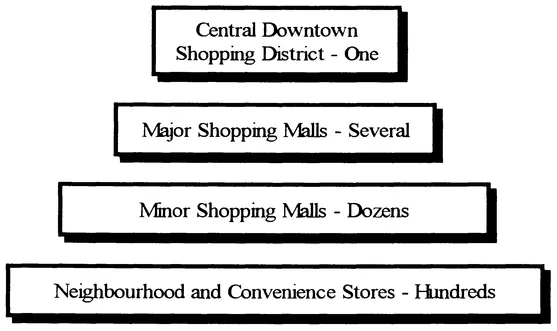
Figure 1.3 Shopping Hierarchy
If your kids go to school, the school system is organized as a hierarchy all the way from the elementary to the post-secondary level. Consider Figure 1.5, which illustrates the hierarchy of the national educational system. Once again there is the typical inverted treelike structure with fewer branches at the top and many branches at the bottom.
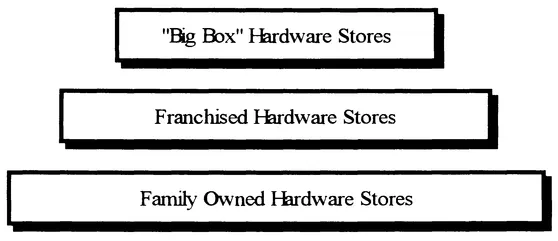
Figure 1.4 Hardware Store Hierarchy
There are good reasons why hierarchies have this characteristic pyramid shape, as will be discussed in the chapters that follow.
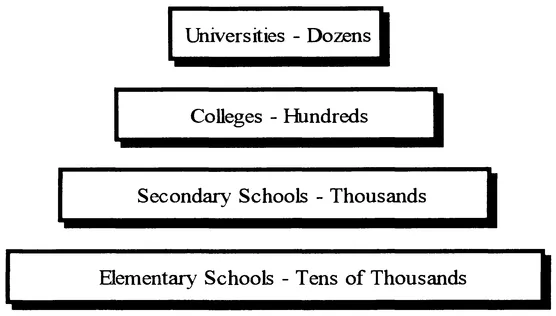
Figure 1.5 Canada's Educational Hierarchy
In addition to the classic educational hierarchy laid out in Figure 1.5, it is interesting to note that the organization within each school or institution can also be seen as being hierarchical, from the principal on down (see Figure 1.6). In most such hierarchies there is an element of "control" or authority that emanates from the top and spreads towards the bottom.

Figure 1.6 Typical Within-School Hierarchy
Hierarchies are so prevalent in our lives that they not only literally dominate our day-to-day activities, but they also control the world around us. Most businesses and corporations can be considered as being parts of hierarchies. For example, consider airlines in Canada. Obviously the company atop the Canadian hierarchy is Air Canada. But below it there are other "levels" of other airlines in Canada (see Figure 1.7).

Figure 1.7 Airline Hierarchy
Are you following any of the big corporate mergers or acquisitions in the news? If so, you are watching the corporate system transform itself into a more efficient economic hierarchy. Are you interested in the changing face of Canada's industrial and economic future? For it to be truly understood, Canada's economy must be considered to be but a small part, a minor player, in the North American, and global, industrial hierarchy. Ever wonder why there are so many new trade agreements that are being pursued around the world? It is because the old borders and boundaries do not accurately reflect the new international trade hierarchy.
Do you follow the stock markets? Stocks sort themselves into a hierarchy by company size, where size is often measured as market capitalization (that is, number of stock shares multiplied by their value). There are Blue Chip stocks (really big companies), Large-Cap stocks (big companies), and Common stocks (average companies), (see Figure 1.8).
Interested in investing in mutual funds? You will be putting your money into a relatively young and immature hierarchy that has yet to evolve into its optimal form. There should be many more mergers to come as the youthful mutual fund industry sorts itself into clearer, separate hierarchical levels. What is clear at the moment is that the Fidelity Company is on top of the hierarchy, as the biggest mutual fund company in the world, with over 12 million investors and over $900 billion (U.S.) in assets.
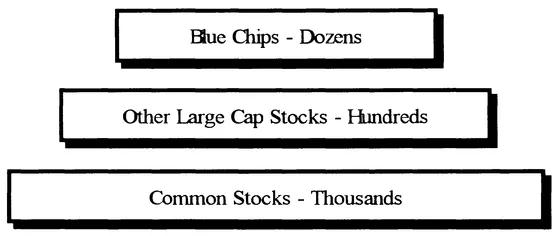
Figure 1.8 Canadian Stock Market Hierarchy
Villages, small towns, and cities, wherever they are located geographically, are all parts of a hierarchy of communities, shown in Figure 1.9. Consider a typical Canadian province. At the bottom level there are several hundred small communities, or villages. Next come hundreds of larger towns. The top level consists of dozens of still larger cities. We shall see later the importance of living within this hierarchy of communities and how it shapes our daily lives in innumerable and almost invisible ways. When you travel among these communities, whether on the road, by rail, or by air, you travel also within a transportation hierarchy.
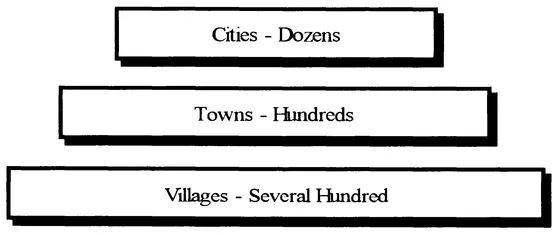
Figure 1.9 The Hierarchy of Cities, Towns and Villages
It becomes a challenge to think of activities and events that do not involve hierarchies. Almost all of them do. If you seek out medical treatment today you will participate in the medical hierarchy. If you watch professional sports on TV you are looking at one particular level of a sports hierarchy. In addition, sports event playoffs are usually organized as hierarchies. This type of elimination hierarchy will be familiar to most readers (see Figure 1.10). Going to church this week? You are participating in another organized system with a rigidly hierarchical framework. Are you part of a sports team? If you are, you are part of a team hierarchy. Hoping for a promotion at work? This is a desire on your part to move up in the hierarchy. Don't like your boss? Too bad. He or she is higher than you in the hierarchy. Do your kids play minor sports? If so, they're in a hierarchic system where control, just like most things in life, runs from the top down.

Figure 1.10 Sports Playoffs Elimination Hierarchy
When you travel around a city by automobile you are driving in a street hierarchy. At the bottom of this tree are the smallest lanes and alleys, and at the top are the major arteries and expressways. The street network serves as a conduit to direct traffic flows through a treelike hierarchy, like water through a funnel.
The postal address of every Canadian is also part of a hierarchical system of ordering information. Consider the address:
The Prime Minister
24 Sussex Drive
Ottawa
Ontario
Canada
What most people see here is a simple, traditional street address. What you should see instead is a system for organizing hierarchical information about the location of individuals (Figure 1.11).
This is a highly effective system; it enables us to locate a single individual from among the 30 million individuals in Canada in just five lines of text or levels in a hierarchy. That is very efficient. Think of the address as being part of the Windows program on a computer screen. Canada is like the Start button. At the next level the user chooses a province, at the next level a city, at the next level a street, and finally an individual at th...
Table of contents
- Cover
- Half Title
- Dedication
- Title
- Copyright
- Contents
- List of Figures
- List of Tables
- 1 Introduction
- 2 All about Hierarchies
- 3 Up the Corporate Ladder
- 4 Education and Inequity
- 5 The Future of Communities
- 6 Travel, Transport and Continentalization
- 7 Getting Around in the City
- 8 Retail in the City and the Countryside
- 9 Leaving Home
- 10 How Our Communities Shape the Quality of Our Lives
- 11 Canadian Medical Care - Equal Treatment for All?
- Index
Trusted by 375,005 students
Access to over 1.5 million titles for a fair monthly price.
Study more efficiently using our study tools.
Frequently asked questions
Yes, you can cancel anytime from the Subscription tab in your account settings on the Perlego website. Your subscription will stay active until the end of your current billing period. Learn how to cancel your subscription
No, books cannot be downloaded as external files, such as PDFs, for use outside of Perlego. However, you can download books within the Perlego app for offline reading on mobile or tablet. Learn how to download books offline
Perlego offers two plans: Essential and Complete
- Essential is ideal for learners and professionals who enjoy exploring a wide range of subjects. Access the Essential Library with 800,000+ trusted titles and best-sellers across business, personal growth, and the humanities. Includes unlimited reading time and Standard Read Aloud voice.
- Complete: Perfect for advanced learners and researchers needing full, unrestricted access. Unlock 1.5M+ books across hundreds of subjects, including academic and specialized titles. The Complete Plan also includes advanced features like Premium Read Aloud and Research Assistant.
We are an online textbook subscription service, where you can get access to an entire online library for less than the price of a single book per month. With over 1.5 million books across 990+ topics, we’ve got you covered! Learn about our mission
Look out for the read-aloud symbol on your next book to see if you can listen to it. The read-aloud tool reads text aloud for you, highlighting the text as it is being read. You can pause it, speed it up and slow it down. Learn more about Read Aloud
Yes! You can use the Perlego app on both iOS and Android devices to read anytime, anywhere — even offline. Perfect for commutes or when you’re on the go.
Please note we cannot support devices running on iOS 13 and Android 7 or earlier. Learn more about using the app
Please note we cannot support devices running on iOS 13 and Android 7 or earlier. Learn more about using the app
Yes, you can access Hierarchical Organization in Society by James Pooler in PDF and/or ePUB format, as well as other popular books in Social Sciences & Sociology. We have over 1.5 million books available in our catalogue for you to explore.