- 304 pages
- English
- ePUB (mobile friendly)
- Available on iOS & Android
eBook - ePub
About this book
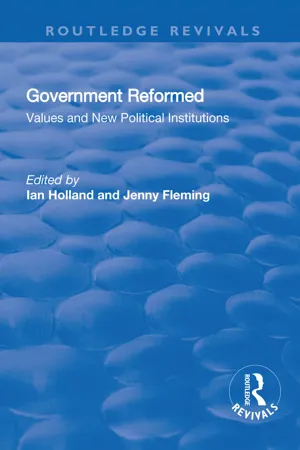
This title was first published in 2003. This insightful work examines institutional formation and change as evidence of the major re-shaping of government internationally over the last two decades. It is based on a series of case studies of institutional reform and ranges across institutions in countries including the UK, China, Australia and the USA. Each case study considers questions concerning the establishment of institutions, such as: what have been the objectives of institutional changes? What are the principles and values on which new institutions are founded? In addition to looking at broad hypotheses regarding the state and new institutions, the book also draws together practical lessons regarding institutional reform. Thus the cases are analysed as a group to throw light on a number of issues: are there patterns discernible in the formation of new political institutions? What do the cases reveal about what works, and what does not work, in forming new institutions? What predictions can be made about the relationship between values and governance structures?
Information
Chapter 1
Values, Institutions and the State
Ian Holland
Rationalist bureaucracy has been one of the greatest inventions of the modern age. In the nineteenth century the Weberian state allowed the rationalism of elites to prevail over the whims of monarchs. In the twentieth century it allowed rationalist democratic discourses to prevail over the whims of elites. It enabled the organization and delivery of services by the state on an unprecedented scale (Peters, 1996, p. 13). It ensured the state could match forces with the emerging industrial economy, though critics certainly say that, having done so, it became merely industrialization's handmaiden. The liberal, impersonal state slowly but steadily mitigated the deadly appetite of Britain's dark satanic mills. The Weberian model gave birth to the appropriate phrase 'machinery of government', and the machine's capacity for governing at a distance made possible state enterprises as diverse as world war, social welfare for millions, and journeying to the moon.
This technocratic, industrial machinery of administration has always had its 'dark side'. The capacity to administer warfare on a global scale is its hideous exemplar. The impersonal nature of the welfare state brings personal tragedy, through the rigid application of rules that turn out to be inappropriate for some individuals. Sometimes systemic tragedy is also brought about. The Aboriginal Welfare Boards that operated in Australia for much of the last hundred years, which were so castigated by the Stolen Generations Inquiry, are such a case. The findings of that Inquiry are relevant because they demonstrated the awesome potential of the Weberian state to implement values. It showed how the system of Aboriginal 'welfare' was implemented overwhelmingly by dedicated professionals, whose mandate was influenced by ideas about eugenics and race, and whose impartial operation of the machinery of aboriginal policy created a generation of misery and dislocation.
But despite this dark side, as long as the controls remained in the hands of liberal democrats, by and large few questioned the efficacy of the machine-state. That machine-state came to administer an apparatus that pervaded the daily lives of every citizen in ways that would have been impossible to comprehend two hundred years earlier.
The New Institutional Imperative
Unlike most inventions of the modern era, the rationalist, hierarchical Weberian state is seldom admired. For many reasons, its traditional government structures are no longer regarded as appropriate in a growing range of policy settings. One reason for this critique is the perceived unsuitability of traditional governance strategies. This is partly about the growing need for adaptability: in a modern environment, governments confront rapid change, and they need to be able to deal with it. The critique is also based on the need to operate in an increasingly internationalized policy-making context, in which the nation-state is less authoritatively sovereign than was the case throughout the twentieth century (Hobsbawm, 2000). More and more policy issues are addressed across national boundaries, bilaterally, multilaterally, and also between states and non-state actors. This necessarily leads to utterly different foundations for inter-organizational relationships from those of a Weberian bureaucracy. There are significant differences between strategies that can be used to get the paid employees of the state to perform their jobs according to policy objectives, and the strategies that can be used to achieve the same ends with non-state actors or other countries.
Another reason that traditional bureaucracy is under the microscope is the retreat of some old problems and the emergence of new problems to which governments are expected to respond. Some changes, such as growth in the global economy, increasing trade, and technological innovation, produce solutions to problems that in the past it had been the responsibility of government to address. Technological changes in telecommunications, for example, are allowing governments to abandon the role of monopoly service providers they once felt compelled to undertake. However, these same technological changes are producing whole new problems that governments are struggling to grapple with. In telecommunications these include allocation of increasingly scarce broadcast spectra, new health issues, trans-jurisdictional content regulation questions, and more. The growing demands for telecommunications regulation in many different forms is revealing that 'far from a rolling back of government responsibilities, the social and cultural changes in post-industrial societies are producing a new and extended range of problems which demand governmental solutions' (Keating, 2000, p. 26).
A third reason that traditional government machinery is in question is that governments are expected to reflect greater diversity than they used to, in their memberships and their employment practices (Peters, 1996, p. 15). They are expected to offer more diverse programs to meet growing recognition of how different are the needs of their citizens. They are expected to reflect a greater range of values that impinge on how government should work, and about what it should do. And states must increasingly deal with jurisdictional diversity, implementing or recognizing forms of regional or ethnic self-government (or both): in Denmark and Greenland, the Balkan region, Canada, Indonesia, Australia, the UK, the former Czechoslovakia: the list of such settings is long. This emerging diversity is a recurring theme in this book.
These reasons bring together a confluence of new problems, new politics, and new policy ideas (Kingdon, 1995). The result has been an avalanche of institutional experimentation. Privatization, corporatization, partnerships, devolution, re-regulation, contracting out, home rule: the technologies of governing are diversifying. Not everyone is pleased with either the new directions or the results, but no one is arguing the reality of the scale of transformation. This transformation represents a revolutionary proliferation of new policy ideas. If it does not seem like a revolution, it is because it is happening over decades rather than days, and it is not a single movement (though there are some large-scale trends embedded in these shifts, such as the suffusion of neo-liberal practices). This book is about what happens once these opportunities for new institutional directions emerge and are grabbed by governments under pressure to perform in new social, economic, and political settings. It aims to demonstrate different ways in which the process of change can be analyzed and what the analyses reveal about some of the recent experiments in governance, particularly about role of values in these experiments.
This chapter establishes the main themes underpinning the research. The next section explains the emphasis on change in this project. The chapter then turns to one of the principal themes of the project, arguing that the recent questioning of the machinery of government has enhanced the prominence of values in debate about governance. Values underpin questions that both citizens and governments pose about governance; many of the studies in this volume analyze states' attempts at answers. This chapter then considers the different ways in which institutional change can be understood. There are many forces at work in institutional change, and many ways of analysing the change process. Some of these are discussed, and the roles of values or ideas are considered in the context of analysing institutional change. Different objectives for institutional change are then described, and the particular role of value conflict is highlighted. The chapter finally turns to sketching different ways in which the state can be involved in changing institutions, a distinction which forms the basis of the way the chapters have been grouped in this study.
Why the Focus on Change?
All of the studies are focused on institutional transformation. Why does the project not consider institutions 'at equilibrium'? After all, it is not as though there are no stable political institutions, and there is no argument with the study of policy continuity as well as policy change (Davis et al, 1988). Stable policy communities create structure and continuity in the policy process that privilege some ideas, interests and policy problems while marginalizing others (Blowers, 1983). Stability, therefore, reveals just as much about the roles of ideas, interests and institutions as does change.
One reason to focus on institutional change is to address the concerns of historical institutionalists. They have argued that 'the critical inadequacy of institutional analysis to date has been a tendency toward mechanical, static accounts that largely bracket the issue of change and sometimes lapse inadvertently into institutional determinism' (Thelen and Steinmo, 1992, p. 16), The studies assembled for this project make change the focus of analysis in order better to understand its institutional causes and consequences.
There are other more pragmatic reasons to focus on the formation and change of institutions. The aims and practices of governance are most obscured from the investigator - and the public - when policy is at its most stable, inconspicuous and uncontroversial. Our interest in change rather than continuity is thus pragmatic and methodological. It is pragmatic in that the most contested and contemporaneous policy issues hold the interest of the widest audience. Our interest is methodological in that novelty and instability bring into focus the sorts of data with which we are concerned. Values, for example, cannot be directly observed, but as governments respond to new challenges, whether implementing the sustainable development concept in forest management or regulating Internet content, their response necessarily involves the establishment of new institutional arrangements or significant reform of the state apparatus. The underlying forces that drive change are revealed in these processes of institutional transformation. Evidence of the roles played by different factors that contribute to the process of institutional change appears in debates inside and outside parliament, in attitudes and utterances of interested parties, in the structures of legislation and operational plans, and in the views of participants in policy implementation. By looking at institutional transformation we open a window on the forces shaping governance that might otherwise be shut.
Finally, institutional change is linked to changes in society, but the nature of the linkages is the subject of debate. Low and Gleeson argue that 'the creation of new institutions must be accompanied by the further development of human values' (Low and Gleeson, 2001, p. 2), suggesting institutional change causes changes in the values held by civil society. In contrast, North (1990) argues institutional change is the result of 'more fundamental change' (Dugger, 1995, p. 454). Like North, van Deth and Scarbrough (1995) propose that value change in western society is affecting its institutions. Whether institutional change is a cause of value change (Low and Gleeson) or an effect (North; van Deth and Scarbrough), it confirms that institutional transformation is the locus of the interplay between value shifts and the ways political life is organized. The studies in this volume draw out some of these relationships in more detail.
The Machinery of Government in Question
In the transformation of political institutions, analysis of the role of interests is common enough, but increasingly attention is focused elsewhere, on what will be termed 'values'. The role of values in institutional change is a recurring theme in the studies assembled for this project. Values, however, are far less well understood than either interests or the role of policy problems in affecting institutions. They therefore deserve some closer consideration.
In analysing political institutions and their transformation, some scholars discuss values (van Deth and Scarbrough, 1995; Greenwood and Hinings, 1996), some ideology (Manning and Carlisle, 1995), some political ideas (Manzer, 1994) and others ideas (Hall, 1989a; Yee, 1996; Campbell, 1998). These related concepts are sometimes captured under the umbrella of 'ideas' (though see Bell, this volume, for discussion of the relationship between the various concepts). There are different approaches to what these terms mean, but there are some common themes. Values can be thought of as normative constructs which affect the framing of political claims: they are 'conceptions of the desirable' (van Deth and Scarbrough, 1995) to which citizens adhere. The articulation of values is an important part of political processes, though as will be seen from many chapters in this book, there are different views about how values or ideas matter in processes of institutional transformation. Manzer's 'political ideas' in education policy for example are normative frames that both influence the policy preferences of actors in education policy networks, and are used to constitute meaning within the policy arena (1994, pp. 5-7). Ideas according to Campbell are ideational constructs that come in several different forms, of which values might be a subset1 that are normative in nature, in contrast to those which are 'cognitive' (1998, p. 385). There are two important points to note about values. First, all of the approaches discussed here treat values as ideational constructs that have a normative orientation. They are ideas, but in particular they are ideas about what is good or desirable, not just about what is. The second point is that if values are not necessarily independent of material interests, equally this project does not presume they are necessarily congruent with, or perfect reflections of, material interests.
Why do values feature so prominently in the study or institutional transformation? I would argue that the increased attention to values is not primarily a product of a changing theoretical focus, which attempts to give more emphasis to ideational constructs at the expense of material interests. The focus on values is not a product of an institutionalist argument that 'ideas matter', although many of the analyses here are influenced by authors' readings of these debates. Rather, the studies assembled for this project arise out of a growing emphasis on values 'in the field': values in public administration are more prominent and more contested than in the past, partly as a result of the fragmentation of the consensus around the efficacy of Weberian bureaucracy.
There are several ways in which changes in the world of governance are linked to a need to focus more on values. First, values can be particularly prominent when novel policy problems create challenges to the existing machinery of government. New policy problems create new arenas in which interests marshal their arguments and present their views afresh. This process is more likely to bring out value debates than incremental adjustment of existing policy regimes. This is partly because novel combinations of interests can require groups to explain their positions to others who may be unfamiliar with their interests. It can also be because new problems require solutions to be worked out from 'first principles'. Consider for example the emergence of the Internet as an important medium for communication and business, which brought a range of existing organizations and interests (and some new ones) together in new combinations, creating a new institutional setting in which they had to articulate their values (Airo-Farulla, this volume).
Second, emerging values in society can spawn novel moral stances on issues that confront existing policy orders. These novel moral stances are in turn likely to conflict with existing institutional rationales, and the recognition and resolution of that conflict may require values to be articulated and embedded in governance structures in new and explicit ways. Consider for example the rise of environmentalism, which introduced the idea that other species might have rights or preferences, which in turn introduced a whole new set of ideas and interests into existing policy arenas that conflicted with the prevailing utilitarian attitude to nature. Similarly, the idea of a right of indigenous self-determination conflicted with existing institutional rationales for indigenous policy in Australia and overseas (Ivanitz and McPhail, this volume). Changing views about relationships, and about the role of the state in relationships, have confronted the post-war institutional framework of marriage in most countries, 'forcing' states to engage in value-driven debate about what interventions they should make and why (van Acker, this volume).
There is a third force at work that is making values more visible in policy debate, Hobsbawm (2000) and others have argued that the twentieth century saw a 'high water mark' in the capacity and authority of the nation-state. This has two dimensions: the authority of the state as a sovereign entity; and the importance of the state as a governing entity. Both are being challenged. The state is becoming less autonomous in the international arena, as multilateral agreements become more common and sub-national factions become assertive regarding their autonomy from their 'parent' states. At the same time there is increasing recognition of the importance of markets and of networks of actors (including non-state agencies and interests) in formulating policy and delivering services (Rhodes, 1997a). The increasing permeability of states as sovereign entities, and the growing recognition that not only states govern, have conspired to diffuse the actions associated with governing and to place increasing emphasis on the roles of many different sorts of actors. Consider for example the increasingly multilateral regulation of trade and trade-related issues, such as food safety (Skogstad, this volume), or the international policy diffusion and complex multi-layered governance matrix characterizing change in the Chinese electricity industry (Xu, this volume).
These forces contribute to a shift from an emphasis on government by the state, toward the idea of governance that involves the state, amongst other actors. Why does this increase the visibility of values in the policy process? This shift has seen a greater emphasis than at any previous time in the last century on the values and objectives of non-state actors, and of policy negotiated 'amongst equals' in multilateral settings. In other words, values have become a more explicit part of the policy process in part because the nation-state has lost its stranglehold on governing its citizens. Whereas once the primary locus of debate and competition amongst values was the democratic process that chose the elites that formed governments, values now emerge as a pivotal theme wherever governance is engendered.
To recap: rapid change, globalization, the widespread emergence of new value systems amongst citizens, and the declining authority of the nation-state, have combined to call into question traditional forms of state action and the Weberian model of bureaucracy. This has given greater prominence to values in governance debate, as basic assumptions about the functions and modes of operation of the state have been challenged.
Values and Institutional Change
Typical of the analysis of institutional change in political science is the study of privatization by Feigenbaum et al. (1999). Influenced by Kingdon (1995), they suggest that institutions are changed by policy reforms when particular theories (what Campbell, 1998 terms 'paradigms') are consistent with the values and the 'material interests' of a constituency (p. 152). Institutional change is a product of material interests, values, and exogenous forces working in parallel. Ascribing a role to values in contradistinction to other factors is not formally pursued, but there is no question that values somehow influence institutional change. The studies in this volume begin with institutional change as the focus, and discuss the factors that have played a role in the processes of change. The principal theme of this project, outlined above, is that values or ideas figure prominently in processes of change. There are however different stances that can be taken on the relationship between values and institutions. First, values can be thought of as embedded in institutions, either directly or mediated by their relationship to other factors that structure institutions, like economic forces (North, 1990, 1991; Dugger, 1995; Rutherford, 1995). Second, causal power may be attributed to values in processes of institutional change. Third, values may be expressed at different levels of institutional structures.
Values may be embedded in institutions. What Peters refers to as normative institutionalism (1999, p. 25) exemplifies this idea. When March and Olsen (1989) contrast their approach to politics with that of pluralists, they argue institutions 'define and defend values, norms, interests, identities, and beliefs' (p. 17). Institutions thus embody values, and the expression of those values accounts for behaviour of actors within organizations (Peters, 1999, p. 26). North takes a different approach, arguing that 'ideology' is a constraint that sets boundaries within which institutions are created (Rutherford, 1995). Values thus set the boundaries of the possible institutional space, an idea reflected in North's recognition of informal institutional rules as including 'sanctions, taboos, customs [and] traditions' (1991, p. 97). Institutional change is related to value change, particularly changes in tastes (Dugger, 1995), but this does not mean institutional change is caused by value shifts. Rather, both instituti...
Table of contents
- Cover
- Half Title
- Title
- Copyright
- Contents
- List of Contributors
- Acknowledgements
- 1 values, Institutions and the State
- PART I: REFORMING INSTITUTIONS
- PART II: NEW INSTITUTIONS
- PART III: SOCIETY-CENTRED INSTITUTIONS
- PART IV: CONCLUSIONS
- Bibliography
- Index
Trusted by 375,005 students
Access to over 1.5 million titles for a fair monthly price.
Study more efficiently using our study tools.
Frequently asked questions
Yes, you can cancel anytime from the Subscription tab in your account settings on the Perlego website. Your subscription will stay active until the end of your current billing period. Learn how to cancel your subscription
No, books cannot be downloaded as external files, such as PDFs, for use outside of Perlego. However, you can download books within the Perlego app for offline reading on mobile or tablet. Learn how to download books offline
We are an online textbook subscription service, where you can get access to an entire online library for less than the price of a single book per month. With over 1.5 million books across 990+ topics, we’ve got you covered! Learn about our mission
Look out for the read-aloud symbol on your next book to see if you can listen to it. The read-aloud tool reads text aloud for you, highlighting the text as it is being read. You can pause it, speed it up and slow it down. Learn more about Read Aloud
Yes! You can use the Perlego app on both iOS and Android devices to read anytime, anywhere — even offline. Perfect for commutes or when you’re on the go.
Please note we cannot support devices running on iOS 13 and Android 7 or earlier. Learn more about using the app
Please note we cannot support devices running on iOS 13 and Android 7 or earlier. Learn more about using the app
Yes, you can access Government Reformed by Jenny Fleming, Ian Holland in PDF and/or ePUB format, as well as other popular books in Politics & International Relations & Politics. We have over 1.5 million books available in our catalogue for you to explore.