In the history of British patent law, the role of Parliament is often side-lined. This is largely due to the raft of failed or timid attempts at patent law reform. Yet there was another way of seeking change. By the end of the nineteenth century, private legislation had become a mechanism or testing ground for more general law reforms. The evolution of the law had essentially been privatised and was handled in the committee rooms in Westminster. This is known in relation to many great industrial movements such as the creating of railways, canals and roads, or political movements such as the powers and duties of local authorities, but it has thus far been largely ignored in the development of patent law. This book addresses this shortfall and examines how private legislation played an important role in the birth of modern patent law.
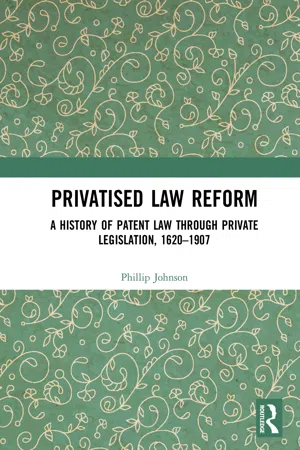
eBook - ePub
Privatised Law Reform: A History of Patent Law through Private Legislation, 1620-1907
- 208 pages
- English
- ePUB (mobile friendly)
- Available on iOS & Android
eBook - ePub
Privatised Law Reform: A History of Patent Law through Private Legislation, 1620-1907
p.1
1 A history of patents
Introduction
The law of patents is a modern invention. This does not mean, however, that the history of patents is short or uneventful. It is history which could still begin at many points and provide fruitful and original debate. This is because “patent history is a subject that is still largely waiting to be written”.1 Where the expanse of uncharted territory is so vast it might seem strange to begin with the role of private legislation: a relatively esoteric area which even when a common part of the legal landscape was described as something of which the public were “profoundly ignorant, and possibly, if they knew, they would be callously indifferent”.2 Yet the role of private legislation in the development of patent law has been largely unexplored or overlooked. Indeed, it has often been dismissed with a few notable highlights being used to demonstrate matters which are often beyond their scope. The history so far presents numerous accounts relating to the passage of the Statute of Monopolies in 16243 and there are notable studies of the economic history of patents from the late seventeenth century to the nineteenth.4 In addition there are studies which were attempting to use history to address the (then) present day issues with the patent system5 or deal with particular issues, such as Parliamentary rewards6 or the movement for the abolition of the patent system.7
p.2
The history of patents, however, is noted by its periods of silence. It remains a patchwork of discussions, often about similar matters. It is also littered with simplification. This discussion will attempt to challenge one of the commonly held views, typified by Boehm and Silberston’s statement:8
After the Statute of Monopolies there was no important patent statute for over two hundred years.
This statement, at one level, is true. But it misses the rich tapestry of activity where Parliamentarians considered patents and inventions. Indeed, in one sense, it is just plain wrong as there were numerous patent statutes during the seventeenth and eighteenth century – but they were private legislation. While the form and nature of private legislation will be discussed below, in summary, it is an Act of Parliament which creates a special rule for an individual – an exception to general regulation. This discussion will consider whether, and the extent to which, those exceptions became the general rule.
The exception becomes the rule
In the simplest terms, each and every person has the right to petition Parliament and ask for a statute to help just them. If something was prohibited by an Act of Parliament (any Act) you could ask Parliament to exclude you from its application.9 Similarly, if you wanted to override another person’s rights you could ask Parliament to let you (and just you) do it. Just because you could ask Parliament to make a special law for you, it does not mean it will do so or where it does it might impose certain conditions upon you. As one successful private Act would usually, although not always, lead others to petitioning Parliament for the same thing or something similar, so there was a process of evolution and with it a development of law. Put simply, private legislation, as it could relate to anything, became a testing ground for policy. As Clifford puts it in his seminal work10 on the history of private legislation published in 1885:
Year by year the records of Parliament show that nearly every great industrial and social movement during the present century has stood in need of private legislation. As one subject of legislation becomes obsolete, or the necessity for it was avoided by general legislation, a successor was never wanting. . . . In dealing with. . .private Bills, Parliament accumulated an experience of the utmost value, and was able from time to time to modify and correct local provisions upon proof of their failure, and at last found them on a safe basis for general legislation.11
p.3
In relation to local Acts relating to local government a similar point was made by Frederick Spencer in 1911:
As regards the constitutional structure of governing bodies, the local Acts of the period 1700–1835 formed probably the largest mass political experiment which has ever been carried out in a particular period of time within the limits of a single State. No one who wishes to create a fancy constitution could find better material for suggestion than the eighteenth century local Acts would afford. At first sight the variety of experiment is bewildering. But, though there is little cause for believing that Parliament consciously followed any defined principles in the construction of the bodies it created, or that those who desired their creation had any views of political architecture based on anything firmer than temporary or local expediency, yet, on analysis, the apparent incoherency can be made to yield some kind of order.12
It is possible to go further than Clifford and Spencer, however, as sometimes individuals sought special exemptions from rules and Parliament considered why a rule existed and then decided whether the Bill should be passed or not. Thus, private legislation not only provides a testing ground for laws which were later relaxed, but also for laws which Parliament refused to loosen. Indeed, where Parliament spoke on an issue the judges often followed. Just as the common law went through an “evolution” or, as the Solicitor General (the future Lord Mansfield) suggested in Omychund v Barker,13 “the common law. . . works itself pure”14 so did legislation through a prism of private Bills.
The role of private legislation in patent history
This discussion looks at private legislation, or more precisely individual private petitions, Bills and Acts, and to the extent possible it seeks to establish whether, or at least the extent to which, private legislation shaped the general law of patents. It will also look at the significance, if any, the courts placed on private Acts when they began interpreting the general rules Parliament finally enacted. In other words, it will seek to establish the extent to which Clifford’s general statement about private legislation applies to the development of patent law. In contrast to other histories of patent law, it will put private legislation centre stage. This is not to suggest that private legislation has been ignored in other histories of patent law. But usually it has given little or no weight.15 Typical is a statement by Christine MacLeod:
Parliament occasionally discussed individual patents, when the patentee sought an extension of his term or a private Act to give him stronger powers. . .16
p.4
Accordingly, while MacLeod17 and others18 make reference to private legislation it is only occasionally that commentators19 have seen those Acts as demonstrating Parliament’s role in developing wider patent policy.20 The histories that have been written have concentrated on the grant of patents, and the practice of the law officers, as well as the number or type of patent being granted rather than the legislation governing practice. In this story, the theatre is firmly Parliament and the actors who directed patent policy are shown to be both within the Houses of Parliament and without in the form of petitioners. It is a story which involves men of influence, power and money. Yet, as with many Parliamentary stories, and particularly those which often were played out in committee rooms rather than on the floor of the Houses we have a canvas with many gaps – often gaps which can never be properly filled. It starts in the session of Parliament in 1621 where the Bill of Monopolies passed in the Commons, but was defeated by the Lords as this was also the year in which two private Bills relating to patent law were promoted albeit one was of a very strange nature as will be seen. Our story reaches its conclusion in the final session of Parliament where a private Act relating to patent law was enacted (or indeed, sought), namely in 1907. Over most of the first two hundred years of this period, patents went from being a rare exclusive privilege granted to the few (in fact, the very few) to being available on equal terms to everyone who met clear rules. There are difficulties however, over this same near three-hundred-year period, when the records of Parliament were developing with some periods having detailed Parliamentary diaries and others having few records beyond that recorded in the journals of Parliament.21
A series of stories
The role of private legislation in the development of patent law is not part of a generally progressive history towards a new enlightened era, rather it...
Table of contents
- Cover Page
- Privatised Law Reform: A History of Patent Law through Private Legislation, 1620–1907
- Title
- Copright
- Contents
- Acknowledgements
- Notes on Sources
- Table of Cases
- Tables of Legislation
- 1 A History of Patents
- 2 Private Bill Procedure
- 3 The Beginnings
- 4 The Protection of Inventions By Enactment
- 5 The Non Obstante Clause and the Right to Work
- 6 The Restriction and Regulation of Company Patents
- 7 The Specification and Its Concealment
- 8 The Prolongation of Patents
- 9 The Grant of Parliamentary Rewards: An Alternative
- 10 Restoration and Renewal Fees
- 11 Re-Dating and Priority Fights
- 12 The End of Private Business
- Bibliography
- Index
Trusted by 375,005 students
Access to over 1.5 million titles for a fair monthly price.
Study more efficiently using our study tools.
Frequently asked questions
Yes, you can cancel anytime from the Subscription tab in your account settings on the Perlego website. Your subscription will stay active until the end of your current billing period. Learn how to cancel your subscription
No, books cannot be downloaded as external files, such as PDFs, for use outside of Perlego. However, you can download books within the Perlego app for offline reading on mobile or tablet. Learn how to download books offline
Perlego offers two plans: Essential and Complete
- Essential is ideal for learners and professionals who enjoy exploring a wide range of subjects. Access the Essential Library with 800,000+ trusted titles and best-sellers across business, personal growth, and the humanities. Includes unlimited reading time and Standard Read Aloud voice.
- Complete: Perfect for advanced learners and researchers needing full, unrestricted access. Unlock 1.5M+ books across hundreds of subjects, including academic and specialized titles. The Complete Plan also includes advanced features like Premium Read Aloud and Research Assistant.
We are an online textbook subscription service, where you can get access to an entire online library for less than the price of a single book per month. With over 1.5 million books across 990+ topics, we’ve got you covered! Learn about our mission
Look out for the read-aloud symbol on your next book to see if you can listen to it. The read-aloud tool reads text aloud for you, highlighting the text as it is being read. You can pause it, speed it up and slow it down. Learn more about Read Aloud
Yes! You can use the Perlego app on both iOS and Android devices to read anytime, anywhere — even offline. Perfect for commutes or when you’re on the go.
Please note we cannot support devices running on iOS 13 and Android 7 or earlier. Learn more about using the app
Please note we cannot support devices running on iOS 13 and Android 7 or earlier. Learn more about using the app
Yes, you can access Privatised Law Reform: A History of Patent Law through Private Legislation, 1620-1907 by Phillip Johnson in PDF and/or ePUB format, as well as other popular books in Business & Business Law. We have over 1.5 million books available in our catalogue for you to explore.