eBook - ePub
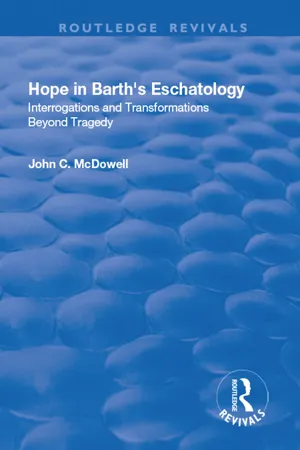
Hope in Barth's Eschatology
Interrogations and Transformations Beyond Tragedy
- 276 pages
- English
- ePUB (mobile friendly)
- Available on iOS & Android
eBook - ePub
About this book
This title was first published in 2000. Hope in Barth's Eschatology presents a critical investigation and survey of Karl Barth's writings, particularly his Church Dogmatics IV.3, in order to locate the character and nature of 'hope' within Barth's eschatology. Arguing that Barth, with his form of hope that refuses to shy away from the dark themes of the 'tragic vision', could be seen to undermine certain tragic sensibilities necessary for a healthy account of hope, John McDowell locates Barth within the context of larger traditions of theological thinking, and influential accounts of Christian hope, examining the work of Steiner, MacKinnon, Pannenberg, Rahner, Moltmanm and others. Addressing the relative neglect that Barth commentators have paid to eschatological themes, McDowell maintains that to miss what Barth is doing in his eschatology, is to seriously misunderstand Barth's broader theological sense. This book offers a significant contribution to the ongoing task of understanding Barth's theology whilst developing a way of reading hope and eschatology that, ultimately, places some critical questions at Barth's door.
Information
Chapter 1
Silenus’ Wisdom and the ‘Crime of Being’: George Steiner on the Untragic Nature of Christian Hope
Count no mortal happy till
he has passed the final limit of his life secure from pain
(Chorus in Oedipus Tyrannus, lines 1529f)
he has passed the final limit of his life secure from pain
(Chorus in Oedipus Tyrannus, lines 1529f)
Introduction
‘All’s Well …’? Edgar’s Untragic Theology
Given the play’s tragic events there is a sense in which Edgar’s extolling of the divine cosmic justice heightens the sense of tragedy and waste [L, V.iii. 168]. Reverberating in one’s memory, at this point, is the fatalistic admission of that other theist in King Lear, Edgar’s father (Gloucester), that “the gods kill for their sport as wanton boys do flies” [L, IV.i.35-6]. What kind of justice uses and abuses human lives for divine pleasure? Such a question constitutes a harkening back to some of the Attic tragedies, with their catastrophic clashes with the gods. Significant, in this regard, is Euripides’ The Bacchae, with its amoral presentation of the Dionysian hedonistic-style excess. Yet, what Edgar intends appears to be significantly different from this despairing recognition. His blaming his father’s misfortunes on the latter’s carnal sins, wherein Gloucester ironically bore the agent of his misfortune (Edmund), suggests that he precisely understands cosmic justice as the retribution of the gods on human sins.
The gods are just, and of our pleasant vices
Make instruments to plague us:
The dark and vicious place where thee [Edmund] he [Gloucester] got Cost him his eyes [L, V.iii. 168-171].
Bradley describes L as “the most terrible picture that Shakespeare painted of the world”, and Hunter portrays it as a “final nothing, not only of death, but of a world emptied of meaningful content”.1 Certainly the kingdom could now be stronger with the deaths of Lear’s two manipulative daughters (Goneril and Regan) and Edmund. But this is by no means a simple providential restoration of justice. What sin has Cordelia, in particular, committed? She appears to be an innocent, almost, entangled in the unfolding tragedy. At most she is a victim of her own lovingly honest silence to a father who indulges in the dishonest flattery from his other two ambitious daughters [see L, I.1.62-119]. Moreover, Gloucester pays the price of loyalty to his self-deposed king, and thereby suffers the wrath of these megalomaniacs. Indeed, albeit without any explicit revision of his theology, Edgar’s emotions force him to conclude with a partial recognition of the loss [L, V.3.321f.].
It is difficult to adequately assess the significance of L’s pre-Christian setting. Is Edgar’s theology a link between this pagan context and its post-Christum composition? Is tragedy the play’s genre precisely because it is pre-Christian? Speaight, for example, suggests that the play indicates “the fallibility of pagan heavenly reliance”.2 Kent and Gloucester’s pagan superstitiousness, for instance, quickly relapses into a despairing fatalism, followed eventually by stoical acceptance of fate;3 and Edgar’s aptitude for believing in divine providence strikes one as misplaced rather than as an indication of real Shakespearean hope in divine justice, as Cavell incorrectly imagines.4 If this was the case, however, then little sense could be made of the Christian settings of the tragedies Hamlet and Romeo and Juliet, for example. Or do the tragic heroes ‘fall’ precisely because they lack Christian sensibilities and consciousnesses? Is there even a hint of Shakespearean agnosticism in the face of the barrage of ‘evil’? So Edwards argues that Shakespeare’s tragedies, and L in particular, “are full of religious anxiety and have little religious confidence”.5
These questions raise the general problem of the relationship of Christian hope and the tragic vision, one on which it has become almost commonplace to draw a contrast, as an explication of the work on tragic drama by George Steiner will indicate.
The climax of Steiner’s presentation of the tragic comes in the strong connection between his darkened Jewish consciousness and his bleak picture of existence, mediated through high Attic tragic drama, and to a great extent echoing the general philosophy of Arthur Schopenhauer. Hence, pervading his oeuvre is a vision of the ‘tragic’, an understanding of existence’s destructive potentialities informing the events of ‘tragic drama’ that raises complex issues of living in a hostile environment; the very legitimacy of hope itself; and of theology’s place in lighting our way through this darkness. For it is in this tragic sensibility that Steiner leaves his reader gasping for some form of hope - one that is not provided, and whose potential shape he explicitly denies to Christian theology.
However, Padel’s statement that “Tragedy is the basis of Steiner’s work” needs to be unpacked and qualified, however, lest it suggest that tragedy is the primary reference point for all of Steiner’s work.6
As will be narrated later, hope does lighten the mood, arriving in the form of a faint echo of the early Nietzschean account - artistic creativity and the act of reception of the aesthetic, particularly that of the act of reading. Herein is suggested certain possible ways of presenting a hope capable of facing the tragic vision. Hence he does not follow the nihilistic advocating of aesthetic silence in Adorno’s stark admission of “No poetry after Auschwitz”.7 Where Nietzsche’s reflection particularly significantly recedes is in the fact that Steiner portrays this aesthetic and hermeneutic transcendence in theological colours. This sits uneasily alongside his presentation of the tragic vision, perhaps being an example of Steiner’s own refusal of simple conceptual resolution [RP, 86]. However, without providing any resolution to the problem of the tragic, it may be argued that in one sense this discontinuity need not be quite so pronounced since more careful attention to the complexity of the tragic dramas themselves could render this antithesis, along with a more modest claim concerning the incompatibility between the tragic vision and Christian hope, too simple.
George Steiner: After Auschwitz …! Divine Silence
In one way or another, questions concerning the tragic vision and Christian hope are not novel. Nietzsche had suggested a parallel between Christian belief and the Socratic-style optimism of the Enlightenment.8 Marx had famously damned Christianity, in particular eschatology and its resultant hope, as ideological and ‘other-worldly’ escapism.9 Moreover, D. Daiches Raphael had raised the issue of post-Hebraic religions’ anti-tragic nature.10
Unlike the rhetorical violence and hyperbole of Nietzsche’s anti-Christianity, however, Steiner’s discussion appears to treat the tragic’s relation to Christian hope from a literary perspective. There is here, therefore, no Nietzschean attempt to joyfully (albeit this is not a naive joy) proclaim “the greatest recent event” of the death of God at humanity’s hands; or to “vanquish God’s shadow” through providing a Zarathustrian replacement which necessarily learns “the art of this-worldly comfort first”.11 Nevertheless, Steiner’s writing, in which there is a fluidity of borders between the literary and the philosophical, does raise some important philosophical and theological questions. After all, he laments the paucity of philosophical approaches to tragedy, which are regarded as, “of course, of the essence” [TPS, 545nl].
The particularly interesting note in Steiner’s reflections, however, is not primarily sounded in the admission of an incompatibility, which is almost a commonplace in late twentieth-century literary criticism. Although, on saying that, it is significant that he appears to soften the tone of this, even to the point of withdrawing it, in his tribute to Donald MacKinnon. In MacKinnon, Steiner discovers a voice in which Auschwitz puts in question “the resurrection itself’.12 The particularly important note can be heard rather in the fact that this philosophically informed literary critic is a Jew expressing moral indignancy over all versions of hope that cannot bear to look into the tragic, whatever sight one may see there. In other words, this philosophically informed literary critic’s identity has been formed with the haunting death knells of Auschwitz and Belsen ringing in his ears. “We cannot pretend,” he exclaims, “that Belsen is irrelevant to the responsible life of the imagination” [LS, 22]. Almost in shock, Steiner recalls that
Barbarism prevailed on the very ground of Christian humanism, of Renaissance culture and classic rationalism. We know that some of the men who devised and administered Auschwitz had been trained to read Shakespeare or Goethe, and continued to do so [LS, 23].
Without intending to conceive of bygone eras after the manner of Edenic golden ages, Steiner indicates that this particularly horrific recent story of human self-mutilation that pummels his imagination leaves its indelible mark by calling into question the whole humanist heritage of the most recent centuries, particularly this recently past one. Smashed are the liberal dreams of human progress through technological advance. After all, Steiner emphasises, as well as being incapable of making the “future less vulnerable to the inhuman”
Science may have given tools and insane pretences of rationality to those who devise mass murder [LS, 25].
These statements are left without further elaboration or justification, as if the mere mention of twentieth-century history clearly supports Steiner’s claims. Indeed, David Tracy argues that
this interruption of the Holocaust is a frightening disclosure of the real history within which we have lived.13
Steiner’s question of what it is that reduces human beings, particularly those who pride themselves on their rational, and aesthetic heritages to the status of beasts, poses itself as intractable [LS, 23]. And yet consciousness of it places an intolerable strain on late twentieth-century speech and culture. If Nietzsche’s madman called into question the legitimacy of living as if God was not dead, Steiner calls into question procedures of avoidance of the carnage in the contemporary formation of human identity: “We come after, and that is the nerve of our condition” [LS, 22].
Particularly troublesome religious imagery and symbolism haunt his reflections on the human disaster that was the Shoah, and this from one conscious of his place as a secular Jew. Those dark days of the mid- twentieth century raise the whole question of God in a manner that renders any attempt at a theodicy problematically facile. If, as Moltmann claims,
The suffering of a single innocent child is an irrefutable rebuttal of the notion of the almighty and kin...
Table of contents
- Cover
- Half Title
- Title Page
- Copyright Page
- Dedication
- Table of Contents
- Acknowledgements
- List of Abbreviations
- Introduction
- 1 Silenus’ Wisdom and the ‘Crime of Being’: George Steiner on the Untragic Nature of Christian Hope
- 2 Escaping Contingency: Barth’s Eschatological Actuality
- 3 Barth’s Developing Eschatology (1909-1924)
- 4 Barth’s Christological Hermeneutic of Eschatological Assertions (GD-CD, I)
- 5 Contriving Creation Eschatologically under Christological Control: The Doctrine of Election (CD, II-III)
- 6 Being Placed in Hope: Christ’s Prophetic Work (CD, IV.3, IV.4)
- 7 Hope’s Performance in Anticipating the Coming Dawn (CD, IV.3, IV.4, CL)
- 8 Conclusion: Faintly Detecting Edgar’s Voice in Barth
- Select Bibliography
- Index of Names
Trusted by 375,005 students
Access to over 1.5 million titles for a fair monthly price.
Study more efficiently using our study tools.
Frequently asked questions
Yes, you can cancel anytime from the Subscription tab in your account settings on the Perlego website. Your subscription will stay active until the end of your current billing period. Learn how to cancel your subscription
No, books cannot be downloaded as external files, such as PDFs, for use outside of Perlego. However, you can download books within the Perlego app for offline reading on mobile or tablet. Learn how to download books offline
Perlego offers two plans: Essential and Complete
- Essential is ideal for learners and professionals who enjoy exploring a wide range of subjects. Access the Essential Library with 800,000+ trusted titles and best-sellers across business, personal growth, and the humanities. Includes unlimited reading time and Standard Read Aloud voice.
- Complete: Perfect for advanced learners and researchers needing full, unrestricted access. Unlock 1.5M+ books across hundreds of subjects, including academic and specialized titles. The Complete Plan also includes advanced features like Premium Read Aloud and Research Assistant.
We are an online textbook subscription service, where you can get access to an entire online library for less than the price of a single book per month. With over 1.5 million books across 990+ topics, we’ve got you covered! Learn about our mission
Look out for the read-aloud symbol on your next book to see if you can listen to it. The read-aloud tool reads text aloud for you, highlighting the text as it is being read. You can pause it, speed it up and slow it down. Learn more about Read Aloud
Yes! You can use the Perlego app on both iOS and Android devices to read anytime, anywhere — even offline. Perfect for commutes or when you’re on the go.
Please note we cannot support devices running on iOS 13 and Android 7 or earlier. Learn more about using the app
Please note we cannot support devices running on iOS 13 and Android 7 or earlier. Learn more about using the app
Yes, you can access Hope in Barth's Eschatology by John C. McDowell in PDF and/or ePUB format, as well as other popular books in Theology & Religion & Religion. We have over 1.5 million books available in our catalogue for you to explore.