Open Space New Media Documentary examines an emerging and significant area of documentary practice in the twenty-first century: community-based new media documentary projects that move across platforms and utilize participatory modalities. The book offers an innovative theorization of these collaborative and collective new media practices, which the authors term "open space," gesturing towards a more contextual critical nexus of technology, form, histories, community, convenings, collaborations, and mobilities. It looks at a variety of low cost, sustainable and scalable documentary projects from across the globe, where new technologies meet places and people in Argentina, Canada, India, Indonesia, Peru, South Africa, Ukraine, and the USA.
eBook - ePub
Open Space New Media Documentary
A Toolkit for Theory and Practice
- 120 pages
- English
- ePUB (mobile friendly)
- Available on iOS & Android
eBook - ePub
Open Space New Media Documentary
A Toolkit for Theory and Practice
About this book
Information
1 Why Open Space?
Openings
In open space documentary, technologies meet places and people. The documentary triangle of subject, filmmaker, and audience is a central metaphor informing traditional documentary studies. In contrast, the open space documentary paradigm is circular, with media makers becoming place-based designers and audiences becoming engaged participants in ongoing discourse.
Open Space New Media Documentary: A Toolkit for Theory and Practice analyzes collaborative documentary practices that move across the analog, digital, and embodied. These practices are reconfigured as strategies to produce collaborative environments for the participatory encounters of open space documentary. Earlier theoretical models focusing on representation and aesthetics cannot account for new collaborative documentaries sited in the lived experiences of particular individuals in specific places. The evolving forms, transmedia structures, and multiple interfaces of open space documentary require interdisciplinary theoretical and methodological foundations to analyze with more precision how these projects function and what they contribute to the documentary field.
In this book, openness invokes multiple meanings across different domains: art practices, cultural production, data and information, design, ethnography, historiography, literary theory, politics, and technology. Digital theorists Matthew Longshore Smith and Ruhiya Seward contend that the term open proliferates in the digital age, suggesting a praxis of collaborative production, social action, and sharing, existing in specific domains rather than in artifacts.1
Open space practices draw on interdisciplinary conceptualizations of the term “open.” Across ethnography, historiography, new media theory, and social practice art, the concept of open suggests transparency of practice and freedom of movement. Before open space, there were collaborative models of production, distribution, and exhibition that rejected enclosure and hierarchies. These animate the many theories and practices of open space new media documentary and operate in marked contrast to market-driven models that often trap documentary in commercial media systems. Open space new media documentary projects gesture in a different direction, building a critical nexus of collaborations, community, convenings, histories, and technologies.
As social media applications and platforms proliferate, new media makers design ways to work in these open spaces, boosting documentary practice into a robust dialogic sphere. Projects function as laboratories to experiment within the new digital landscape, reinventing documentary practice to reach for specific audiences and users. As possibilities for aggregated storytelling expand, makers weave on-the-ground stories into larger spaces that have been colonized by conflicts, corporations, or nation-states, amplifying the local with community engagement and user-generated histories. They produce micro-documentaries and other media artifacts grounded in particular places, which circulate through and across communities. Rather than deductive arguments or grand narratives, these practices build mosaics that are localized, multivoiced, and reciprocal, informing the toolkit for open space documentary theory and practice.
With the global rise of authoritarian politics and the concomitant diminishment of public spheres, collaborative, collective, and participatory documentary practices must be reconsidered, reenergized, and revived from their marginalized histories. As theorist Okwui Enwezor observes,
In the modern era, artistic and intellectual collectives tend to emerge during moments of crisis. This crisis can be social, cultural, political, or economic; however, its effects seem always to generate environments of disillusion and disaffection, leading to counter challenge by artists.2
Emerging technologies, political crises, and shifting social relations call for fresh theoretical examination of the changing role of documentary practice.
Open Space New Media Documentary: A Toolkit for Theory and Practice argues for interdisciplinary theoretical models to account for the significance of these new works and the way in which they expand documentary ecologies. Each chapter applies these theories to specific case studies to analyze how open space modalities work in practice and to assess their contributions, innovations, and challenges. From the analog and embodied into digital realms and back again, these projects push documentary theory and practice into new productive relations. They reroute the documentary project into responsive environments for critical dialectical encounters among forms and technologies, communities and histories, participants and permutations.
Open Space New Media Documentary: A Toolkit for Theory and Practice unpacks and analyzes place-based collaborative new media documentary projects that traverse across platforms. Within diverse and complex media ecologies, open space documentary projects journey through multiple sectors: archives, community conversations, embodied events, large and small screens, mobile media, and performance. These projects leverage both historical collective documentary legacies and emerging participatory new media practices into open space. These new media documentary domains require interdisciplinary theorization and analysis to reconceive conceptual models, reframe the analysis of practice, and develop toolkits for future theoretical and practice-based work.
Theorizing and Defining Open Space Documentary
The term open represents a highly complex, multifaceted concept. It suggests the removal of barriers, borders, and doors, marking a space of accessibility and circulation. Its antonym, closed, is defined as that which cannot be accessed or entered, a forbidden, sequestered, and private territory. Open is both a noun and a verb: it implies the removal of barriers and identifies a process of moving from closed and restricted to that which can be entered without constraints.
The term open implies interaction and exchange. In architecture, open space design as articulated in examples like the open floor plans of Frank Lloyd Wright homes, denotes a public place for interaction rather than private rooms or closed spaces.3 Rejecting exclusion, openings engender movement of bodies, ideas, and materials and suggest exchanges between people. Opening a wrapped gift allows for finding something unexpected within, revealing that which was concealed. Open also refers to a generous style of interpersonal interaction, where one individual is available to another, listening and sharing without preconceptions or hesitation. In new media technologies, the term open implies not only access to software and hardware, but also uncharted spaces for experimentation and creation.
The term open contains three interrelated concepts: the first, rejecting enclosure; the second, permeating borders; and the third, abandoning entrenched positions in favor of dialogic relationships. These meanings of open inform theories that have defined and enacted the concept of open space across several different disciplines. This book uses the term “open space” to explore an emerging new media documentary practice. The definitional, logistical, and theoretical framework in this book engages concepts from environmentalism, urban planning, landscape design, literary theory, relational aesthetics, design theory, social practice art, political theory, and new media theory. The term open space constitutes both a theory and a practice of relationships among people, places, and politics.
In The Solace of Open Spaces, author Gretel Ehrlich uses the term to reflect on her experiences on a ranch in the American West where she developed an appreciation of the environment without enclosures. Describing the wide expanses of Wyoming, she writes, “To live and work in this kind of open country, with its hundred-mile views, is to lose the distinction between background and foreground.”4 Open space in the West engenders a way of thinking that defies stasis: Ehrlich calls it “a geography of possibility.”5 She points out that such spaces have inspired certain ideologies and fantasies that the experience of the natural environment can heal divisions, accommodating “intelligently to any idea or situation.”6 Ehrlich’s writing suggests that the dynamics of open space comes from the vacillation between small gestures and large expanses.
The concept of open space as environment can also be seen as a political response to the increasing way in which militarism and neoliberalism destroy public spheres of engagement. Responding to the first attacks on the World Trade Center in September 2001 and the subsequent escalation of wars in Afghanistan and Iraq, environmentalist and nature writer Terry Tempest Williams delivered a controversial commencement address titled “The Open Space of Democracy” at the University of Utah, which later evolved into her book of the same title. For Williams, democracy is neither essentialized nor inert; it is enacted through a continual process of debate and discussion that battles against enclosure. She explains,
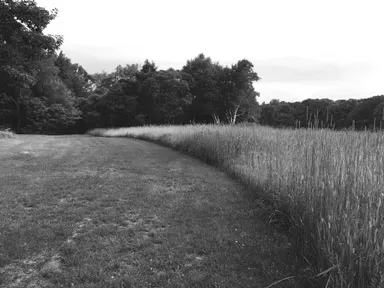
Figure 1.1Vermont Field, Summer 2015.
Photograph by Helen De Michiel. Courtesy of Helen De Michiel.
I have always believed that democracy is best practiced through its construction, not its completion, a never ending project where the windows and doors remain open, a reminder to never close ourselves off to the sensory impulses of eyes and ears alert toward justice.7
After 9/11, she lamented that “fear replaced discussion.”8 In this argument, open space acts through dialogue with others to imagine new futures: “Our insistence on democracy is based on our resistance to complacency. To be engaged. To participate. To create alternatives together.”9 In Williams’ analysis, the open spaces of democracy involve three coordinates: dissent, difference, and a healthy environment.
Landscape architecture contains a long history with open space ideas and design, functioning as a central principle for organizing relationships between natural and built environments. As a design concept that balances enclosure with access, open space provides green spaces without roads and buildings; it counters the verticality of urban places with a horizontal natural environment. Here, an open space constitutes a place to enter, move through, wander, encounter, and slow down. As early as 1857, when Frederick Law Olmstead designed Central Park in New York City, he postulated that open space could alter citizens’ relationships in congested urban areas.10
A half-century later, the UK instituted the Open Space Act of Britain. It stipulated the need for spaces without buildings such as gardens, public parks, and waterfronts.11 By the 1920s, open space landscape design in the UK was linked directly to public health and recreation, a policy bulwarking against enclosure.12 In the 1950s US, postwar economic growth, a building boom, and the invention of the bulldozer gave rise to massive suburban development. Articulated by William Whyte and eventually linked to activist environmental movements, organized efforts to save the nation’s open space emerged in response to uncontrolled growth. This movement for the preservation of open space in the built environment named aesthetics, conservation, and recreational space as talking points. It propelled publi...
Table of contents
- Cover
- Title
- Copyright
- Contents
- List of Figures
- Introduction: Documentary Ecologies and Histories
- Acknowledgments
- 1 Why Open Space?
- 2 Small Places
- 3 Designing Encounters
- 4 Polyphonic Collaborations
- 5 Inviting Spaces
- 6 Working Principles
- Index
Trusted by 375,005 students
Access to over 1.5 million titles for a fair monthly price.
Study more efficiently using our study tools.
Frequently asked questions
Yes, you can cancel anytime from the Subscription tab in your account settings on the Perlego website. Your subscription will stay active until the end of your current billing period. Learn how to cancel your subscription
No, books cannot be downloaded as external files, such as PDFs, for use outside of Perlego. However, you can download books within the Perlego app for offline reading on mobile or tablet. Learn how to download books offline
Perlego offers two plans: Essential and Complete
- Essential is ideal for learners and professionals who enjoy exploring a wide range of subjects. Access the Essential Library with 800,000+ trusted titles and best-sellers across business, personal growth, and the humanities. Includes unlimited reading time and Standard Read Aloud voice.
- Complete: Perfect for advanced learners and researchers needing full, unrestricted access. Unlock 1.5M+ books across hundreds of subjects, including academic and specialized titles. The Complete Plan also includes advanced features like Premium Read Aloud and Research Assistant.
We are an online textbook subscription service, where you can get access to an entire online library for less than the price of a single book per month. With over 1.5 million books across 990+ topics, we’ve got you covered! Learn about our mission
Look out for the read-aloud symbol on your next book to see if you can listen to it. The read-aloud tool reads text aloud for you, highlighting the text as it is being read. You can pause it, speed it up and slow it down. Learn more about Read Aloud
Yes! You can use the Perlego app on both iOS and Android devices to read anytime, anywhere — even offline. Perfect for commutes or when you’re on the go.
Please note we cannot support devices running on iOS 13 and Android 7 or earlier. Learn more about using the app
Please note we cannot support devices running on iOS 13 and Android 7 or earlier. Learn more about using the app
Yes, you can access Open Space New Media Documentary by Patricia R. Zimmermann,Helen De Michiel in PDF and/or ePUB format, as well as other popular books in Media & Performing Arts & Film & Video. We have over 1.5 million books available in our catalogue for you to explore.