![]()
Chapter 1
Introduction to SQL and Relational Databases
Relational database management systems (RDBMS) have become the standard database type for various industries since the 1980s. These systems allow the users to store data and access data in graphic user interfaces. It also allows users to set security rules.
Structured Query Language (SQL) is a standard computer language for relational database management systems. SQL has different dialects. For example, Oracle SQL is called PL/SQL, MS SQL Server SQL is called T-SQL (Transact-SQL).
SQL is a very useful tool for database developers and database administrators. Database developers use SQL to select, insert, and update data. Database administrators (DBAs) apply their SQL skills to support Oracle, SQL Server, MySQL and other database systems.
The highlights of this chapter include
• Brief History of SQL and Database Systems
• SQL Standards
• Oracle, SQL Server and MySQL Versions
• Introduction to RDBMSs
• Relational Database Basic Concepts
• Entity Relational Diagram Used in This Book
Brief History of SQL and Database Systems
Table 1.1 History of SQL and Database Systems
Year | SQL and Database Development |
1970 to 1972 | Dr. E.F. Codd in IBM introduced in his paper the term “A Relational Model of Data for Large Shared Data Banks”. In the paper he defined RDBMs by Codd’s 12 rules. |
1970s | Ingres and System R were created at IBM San Jose. System R used the SEQUEL query language. The development of SQL/DS, DB2, and Oracle were based on the SEQUEL query language. |
1976 | Dr. Peter Chen developed the entity-relationship model. This model becomes the foundation of many systems analysis and design methods. |
1980s | Structured Query Language became the standard query language. Computer sales increased rapidly. Relational database systems became a commercial success. IBM’s DB2 and IBM PC resulted in the launches of many new developments of database systems such as PARADOX, dBase III and IV. |
1990s | Successful Online businesses let to demand for database accessing tools. MySQL and Apache became open source solution for the Internet. Application development tools including Oracle Developer, Power Builder, and Visual Basic were released. |
2000s | The three leading relational database systems in the world are Oracle, Microsoft SQL Server and MySQL. |
SQL Standards
Table 1.2 SQL Standards
Year | SQL Standard |
1974 | Original SQL (SEQUEL) |
1986 | SQL became a standard by ANSI (American National Standards Institute) and ISO (International Standards Organization) |
SQL/96 | Major modification (ISO 9075) |
SQL/99 | Added many features including recursive queries, triggers, procedural and control-of-flow statements, and some object-oriented structures |
SQL/2003 | Introduced XML-related features |
SQL/2006 | Defined ways for importing and storing XML data in database |
SQL/2008 | Added TRUNCATE TABLE statement and INSTEAD OF triggers |
Oracle, SQL Server and MySQL Versions
Table 1.3 Different versions for the three database systems
Oracle | SQL Server | MySQL |
1979–Oracle 2 | 1989–SQL Server 1.0 | 1995–First Release |
1983–Oracle 3 | 1991–SQL Server 1.1 | 1996–MySQL 3.19 |
1984–Oracle 4 | 1993–SQL Server 4.21 | 1997–MySQL 3.20 |
1985–Oracle 5 | 1995–SQL Server 6.0 | 1998–MySQL 3.21 |
1988–Oracle 6 | 1996–SQL Server 6.5 | 2000–MySQL 3.23 |
1992–Oracle 7 | 1998–SQL Server 7.0 | 2002–MySQL 4.0 |
1997–Oracle 8 | 2000–SQL Server 2000 | 2003–MySQL 4.01 |
1998–Oracle 8i | 2005–SQL Server 2005 | 2004–MySQL 4.1 |
2001–Oracle 9i | 2008–SQL Server 2008 | 2005–MySQL 5.0 |
2003–Oracle 10g | 2010–SQL Server 2008 R2 | 2010–MySQL 5.5 |
2007–Oracle 11g | 2012–SQL Server 2012 | 2013–MySQL 5.6 |
2013–Oracle 12C | 2014–SQL Server 2014 | 2015–MySQL 5.7 |
| 2016–SQL Server 2016 | 2016–MySQL 8.0 |
Relational Database Basic Concepts
■ Databases
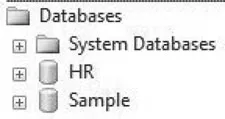
Relational Database Management System consists of one or more databases. For example, the following SQL Server has HR and Sample databases.
Figure 1.1 Data...