- 150 pages
- English
- ePUB (mobile friendly)
- Available on iOS & Android
eBook - ePub
About this book
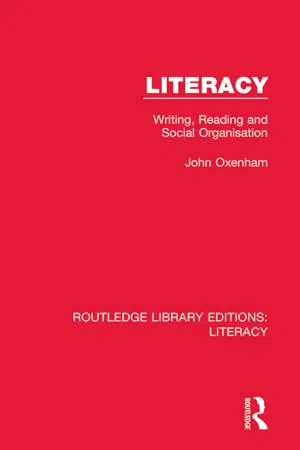
Originally published in 1980. The skills of reading and writing have been proclaimed as universal human rights. This book explores why this should be so. In particular, it examines whether or not the possession of reading or writing skills has, or has not, influenced the values and organisation of society. Viewing literacy as a technology, the author maintains that like all technologies, it is created by man for limited purposes. Nevertheless, given the right conditions, it can be used by man to change not only other technologies, but also himself and (in the end) all of his society. But like other technologies, literacy too may be subject to obsolescence which poses the all-important question of whether the advent of universal literacy has coincided with the redundancy of the written word.
Information
Chapter one
Illiteracy today
Helping others to achieve literacy has been a concern of some people not for decades, nor even for centuries, but for millennia. Their effectiveness has waxed and waned at different times in different societies. The high point of their success is the present century. Writing and reading were invented five thousand years ago. Only now are they proclaimed as part of the inalienable rights of man and only now is universal literacy on national and international agendas. Indeed, literacy had to wait until the nineteenth century A.D. before it was even collected as an item of social statistics; and until the twentieth century before a government – the communists of Russia – embarked on a specific crusade to spread it swiftly among the entire population, school-age and adult. The crescendo of the drive for literacy is reflected in three facts: first, in the mid-nineteenth century, less than one in ten of the world’s adult population could read and write; second, by the third quarter of the twentieth century, the proportion which had gained literacy was very nearly seven in ten; third, this progress occurred not with a static population, but, as has been urgently bruited, with a population that has itself been expanding at an exponential rate – from 1.2 billion in 1850 to 2.4 billion in 1950 to almost 4 billion in 1975. Clearly the ‘struggle against illiteracy’, as it is often termed, has been fairly successful. Though still incomplete by a considerable margin, it has more than coped both with the desire that more and more people should be literate and with the problem that the number of people to learn literacy has been growing all the time.
What I want to explore in the rest of this book is why there should have been such a prodigious effort to spread literacy, and whether the reasons were sound. Before doing so, I want to set out the situation on literacy, as it was estimated in 1970, and to remark some of its characteristics. For the moment, I shall use the terms ‘literate’ and ‘illiterate’ imprecisely, because giving them a definition that is at once universally valid and easily grasped has long been a bane of educational statisticians. ‘Literate’ here means ‘able to read and write’, and ‘illiterate’ means ‘not so able’. Whether ‘able to read’ might include the comprehension of learned treatises or just the gist of a poster advertising a jumble sale is a point we shall neglect for the time being, together with the issue whether ‘able to write’ implies merely the ability to sign one’s own name or expressive skills somewhat more developed than that.
In 1971, some 780 million people over the age of fifteen all over the world were classed as illiterate. Their number will probably increase slightly every year, so that by 1980 they will total perhaps 820 million. This calculation assumes a growth rate of one-half of one per cent annually. For the sake of comparison, the growth rate of whole populations of the world will be slightly under two per cent annually. That is, the numbers of illiterates will be growing more slowly than the rest of the population, which means of course that the proportion of illiterates will continue to decline steadily. Such a cheerful assertion will hold only if the assumptions behind it hold. As will be noted later, there have been times when societies have actually lost their literacy.
Whatever proportion they form of the total population of the world, 800 million are a lot of people. Even if they were distributed evenly over the face of the earth, they would constitute a noticeable minority group. What makes them more noticeable is that they tend to be concentrated in certain regions. The United Nations Educational, Scientific and Cultural Organisation (UNESCO), pointed out in 1965 that the world map of illiteracy coincided very closely with the world map of poverty. The poorer countries of the world tend to have the highest proportions of illiterates, though there are a few exceptions. Africa, taken as a whole, is almost three-quarters illiterate, and so is half of Asia. The twenty-five poorest countries show rates of illiteracy in excess of 80 per cent. The rich countries of America and Europe, on the other hand, have achieved almost universal literacy – although, indeed, even that statement will have to be modified.
The unevenness in global distribution has its counterpart within the regions and within countries also. In Asia, rates of adult illiteracy range from 12 per cent in South Korea to 77 per cent in Bangladesh; among the Arab states from 14 per cent in the Lebanon to 90 per cent in the Yemen; in Africa from 20 per cent in Mauritius to 95 per cent in Somalia; in Latin America from 10 per cent in Chile to 62 per cent in Guatemala.
For the situation inside countries, South Korea provides an illustration. Her overall rate of illiteracy, 12 per cent, is very low, but even so, it masks some wide discrepancies. Only 5 per cent of the males are illiterate: for practical purposes, South Korea could claim universal literacy for the men. The corollary of that, though, is that nearly four times as many women as men are illiterate! The gap between the men and the women is substantial. We shall return to it in a moment.
Between the men themselves, two further general gaps appear. Among the urban men, only two of every hundred are classed as illiterate. Four times as many of their rural compatriots carry the label. A similar contrast exists between the men of the upper income groups and those of the lower.
South Korea provides a neat paradigm of the rest of the world, even though it is in many respects an advanced country. The gap between the men and the women is echoed in nearly all developing countries. Particularly marked examples occur in Africa and among the Arab states. To extend this observation: the higher the overall rate of illiteracy for a country, the wider will be the absolute gap between men and women. Of course, where illiteracy is nearly universal, there will be small differences between the sexes. Even so, the few who would be literate in such circumstances will be overwhelmingly male. The men learn literacy first; their womenfolk are kept or linger some way behind them. The fact may simply be noted here. It will recur when we consider the economic and political uses of literacy. As would be expected, the differences among the women are as great as those among the men. Although slightly worse off even than the rural men, the urban women of South Korea class only 9 per cent of themselves as illiterate. By contrast, fully three times that proportion of their rural sisters are similarly described. The male:female, urban:rural disparities are most starkly captured by setting the South Korean urban males alongside the rural females: 2 per cent of the former and 27 per cent of the latter – thirteen times the proportion – are illiterate.
Similarly echoed is the gap between the rural and urban populations: the higher the country’s rate of illiteracy, the greater will be the disparity between the villages and the towns. The towns learn literacy first. This fact, too, is connected with the roles of literacy in a society. So also is the fact that the richer groups of a community tend to make more rapid and more thorough use of the institutions through which literacy is acquired. For one reason or another, the poorer groups cannot avail themselves fully either of schools for their children or of compensatory programmes for themselves. In passing we may note that the richer groups tend to include the rulers and more influential sections of a society.
The pattern of inequalities in literacy is of course not a new phenomenon. It was noted within Europe in the mid-nineteenth century. Whereas Sweden and Scotland were respectively 90 and 80 per cent literate, Spain and Italy could boast only 25 per cent. And in Italy in 1871, while only 42 per cent of the people of Piedmont were illiterate, 68 of the Tuscans were, and so were 88 per cent of the people in the southern region of Basilicata. Further, in all the regions of Italy the men showed higher rates of literacy than the women. On the whole, too, the contrasts held between town and village and between income groups (Cipolla, 1969). Such exceptions as there were – Scotland, Sweden and Switzerland were all more literate than England, yet poorer, less industrialised and less urbanised – can be plausibly explained by the uses made of literacy within the society.
I have hinted several times at the roles and uses of literacy within societies; I have indicated that in the past 100 years there has been a drive towards universal literacy; and I have at least implied that, where illiteracy now exists, it is considered a problem and, a fortiori, that, where it looms large, it is officially felt to be a grave disadvantage. Evidence for the last statement is to be found abundantly in the publications of UNESCO and in the development plans of perhaps a hundred countries. It is also to be seen in the numerous literacy campaigns mounted by governments and private organisations, and perhaps at its clearest in the resources expended by the United Nations Development Programme (UNDP), UNESCO and a dozen or so governments – Algeria, Ecuador, Iran, Tanzania among them – on the Experimental World Literacy Programme. Why should this be so? In the next chapter, the various reasons why illiteracy has been transformed, so to speak, from the normal and unexceptionable state of most human beings to one of the scourges of human society, will be explored.
Further reading
Leon Bataille, ed. (1976), A Turning Point for Literacy, London, Pergamon Press. Chapter 1 (Working Document 1) – ‘Literacy in the World since 1969’ is a survey by the UNESCO Secretariat of progress and trends in the eradication of illiteracy around the world.
Carlo Cipolla (1969), Literacy And Development In The West, Harmondsworth, Pelican Books.
Chapter two
The demand for literacy
A qualification needs to be made about the present-day concern for universal literacy: it is not equally distributed. It is perhaps least felt – if it is felt at all – in communities and societies where literacy is entirely superfluous to ordinary life. The small mountain tribes of New Guinea or villagers living in the inaccessible regions of a number of African states make no use of literacy in their routines of hunting, subsistence agriculture, house-keeping, litigation, story-telling or dancing. Nor, if offered the bald opportunity to read and write, would they necessarily jump at it eagerly. Like the Fijians in the nineteenth century and others, they might need to suspect that the mysterious symbols possessed magic powers or some other desirable value, before they made any effort to master them (Clammer, 1975). While these certainly are extreme examples, marginal to our purpose, they help explain why so many of the campaigns to make small communities and even whole nations literate have been so ill-rewarded. It seems to be true that illiterate people with little contact with the doings of literate societies experience small need or desire for literacy. Indeed, it may be the case that the greater the degree of illiteracy in a society, the less will be the concern of the illiterates about being illiterate. Conversely, the greater the degree of literacy, the greater will be the anxiety of the illiterate either to acquire literacy or to disguise his illiteracy and operate as though literate.
These observations imply an essential point about the skills of reading and writing: they are means to various ends. If the ends are not perceived or, being perceived, are not of much importance to the perceiver, then there is neither ground nor motivation to acquire the means to them. It would follow then that any pressure to promote literacy would usually accompany some larger purpose: literacy would be for something.
A second point implied by these observations is that the presence and utilisation of literacy depend on the nature of the society in question. It is patently possible for societies of hunters, gatherers, subsistence cultivators, nomadic cattle-herders, and even, as in the cases of the Kikuyu of Kenya and the market mammies of West Africa, for traders to get along to their own large satisfaction without being able to read and write at all. It is also possible, as in the case of Europe up until the seventeenth and eighteenth centuries and, say India or Indonesia even now, for urban and commercial societies to function with an illiterate majority, and a tiny class of literates to man the apparatuses of state, religion, commerce and industry.
This second illustration returns us to the unevenness of concerns for universal literacy. In largely illiterate nations, where rulers are in no pressing hurry to share power – or, put differently, to introduce the chaos and inefficiencies of some form of democracy, in so far as literacy is perceived as a wedge for democracy – its spread will either be discouraged or at least not helped. To say this is, of course, to indicate again the instrumental nature of literacy.
Besides being bound up with purposes, however, literacy is nearly always associated with some notion of education, enlightenment and mental expansion. To point this out is to remind ourselves that the most important vehicle of literacy is the school. Campaigns to make adults literate tend to be given more publicity than the humdrum routines of the school – though the content and direction of these routines are currently and nearly everywhere at the centre of public debate – but it is the school which is allocated even more than a lion’s share of resources of money, materials and personnel. A random review of the educational expenditures of almost any government – perhaps especially those with high rates of illiteracy – will show that schools and universities account in most cases for more than 95 per cent of the allocations. Consequently, when we talk of the push for literacy, we mean in bulk the spread of schooling, which of course involves more than merely learning to read and write. If we hark back to the fact that the majority, 70 per cent, of the world’s population is now literate, we are acknowledging the prodigious efforts and resources which have been devoted all over the world – but with varying intensity and sincerity – to getting children into school. Again, a random review of educational budgets since about 1950 will illustrate concretely just how heavily education weighs in the policies of governments. By 1975, indeed, some countries were pouring as much as a third of their annual budgets into their schools and universities. I mention these facts simply to stress that literacy has generally been part of wider programmes of education and has not been a self-sufficient goal on its own; and hence to repeat both that literacy is always for something and that it is related to the way a society directs its functioning. At the same time, I must be careful not to understate the importance of literacy: it remains a foundation stone of most current education.
We may now take up the question posed at the end of the last chapter: what explains the present general concern for literacy (and education)? In the light of the preceding paragraphs the query may be rephrased: what purpose or set of purposes has brought literacy into such prominent focus? As with all human affairs, the answer is composed of not one, but of several coinciding factors. Over the past four centuries a variety of needs and pressures have been gathering force to require that most people in most of today’s societies should be schooled and literate to at least some degree. Some of the pressures spring from each other and are mutually reinforcing, but it will be useful to review them one by one.
Writing in its fullest sense – as word and sound symbols...
Table of contents
- Cover
- Half Title
- Title Page
- Copyright Page
- Table of Contents
- General editor’s preface
- Introductory note
- Chapter one: Illiteracy today
- two: The demand for literacy
- three: Literacy and the individual
- four: Literacy and society
- five: A human right to literacy?
- six: The costs and the future of literacy?
- Bibliography
Trusted by 375,005 students
Access to over 1.5 million titles for a fair monthly price.
Study more efficiently using our study tools.
Frequently asked questions
Yes, you can cancel anytime from the Subscription tab in your account settings on the Perlego website. Your subscription will stay active until the end of your current billing period. Learn how to cancel your subscription
No, books cannot be downloaded as external files, such as PDFs, for use outside of Perlego. However, you can download books within the Perlego app for offline reading on mobile or tablet. Learn how to download books offline
Perlego offers two plans: Essential and Complete
- Essential is ideal for learners and professionals who enjoy exploring a wide range of subjects. Access the Essential Library with 800,000+ trusted titles and best-sellers across business, personal growth, and the humanities. Includes unlimited reading time and Standard Read Aloud voice.
- Complete: Perfect for advanced learners and researchers needing full, unrestricted access. Unlock 1.5M+ books across hundreds of subjects, including academic and specialized titles. The Complete Plan also includes advanced features like Premium Read Aloud and Research Assistant.
We are an online textbook subscription service, where you can get access to an entire online library for less than the price of a single book per month. With over 1.5 million books across 990+ topics, we’ve got you covered! Learn about our mission
Look out for the read-aloud symbol on your next book to see if you can listen to it. The read-aloud tool reads text aloud for you, highlighting the text as it is being read. You can pause it, speed it up and slow it down. Learn more about Read Aloud
Yes! You can use the Perlego app on both iOS and Android devices to read anytime, anywhere — even offline. Perfect for commutes or when you’re on the go.
Please note we cannot support devices running on iOS 13 and Android 7 or earlier. Learn more about using the app
Please note we cannot support devices running on iOS 13 and Android 7 or earlier. Learn more about using the app
Yes, you can access Literacy by John Oxenham in PDF and/or ePUB format, as well as other popular books in Education & Education General. We have over 1.5 million books available in our catalogue for you to explore.