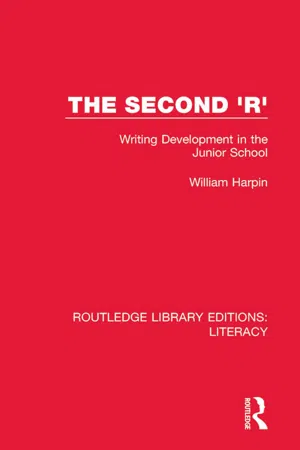
Originally published in 1976. How do children learn to write? What stages to they pass through in mastering this skill? What part can teachers play in aiding their development? These are some of the questions that this book sets out to answer. This book offers a perspective on writing which places children's language resources and their development at its centre. It discusses the purpose of writing, ways of classifying its variety, providing contexts for writing, its treatment in schools and methods for helping children to overcome difficulties. A section explores the arguments for a writing policy or programme in schools, and offering guidance on considerations that shape policy making.
- 162 pages
- English
- ePUB (mobile friendly)
- Available on iOS & Android
eBook - ePub
About this book
Information
1
Introduction
‘We need to ask more often of everything we do in school, “Where are we trying to get, and is this thing we are doing helping us to get there?”’ (John Holt – How Children Fail)
Asking questions and attempting to discover answers to them are activities at the centre of both learning and teaching. Much of a child’s early learning, often to the exasperation of his parents, is a seemingly inexhaustible succession of experiments, physical and verbal, to make satisfying sense of the world he is in. A teacher, too, is impelled to employ similar methods in an attempt to understand the whole process he is engaged in. A powerful, wide-ranging curiosity is fundamental to both roles; without it the learner makes no advances, the teacher relies more and more heavily on the mechanical application of ready-made solutions.
There is, of course, nothing startlingly new or revolutionary in this. At a time when discontent was beginning to mount about the effects of ‘payment by results’ on learning and teaching, in the early 1880s, Professor Armstrong advocated with some success what he called the ‘heuristic’ method of teaching science. In essence this was a form of discovery learning, in which the pupil was placed in the position of the original investigator, faced his problems, formulated questions, tested hypotheses and began to piece together a living understanding of scientific principles. Though Armstrong’s methods were warmly supported by the British Association, teachers were less enthusiastic, partly perhaps because it represented such a radical change in their function, but more because child and scientist could not be said to occupy the same starting point. Only in recent years has educational practice begun seriously to take account of the principle underlying Armstrong’s experiments: that teaching is an enabling process, creating conditions in which a child can develop his understanding of experience in the most effective ways possible. The ‘discovery’ method, individualised learning, topic work, project-based teaching, integrated day organisation, family grouping are reflections in organisation and method of the principle; changes in the curriculum to take account of it have occurred most notably in mathematics and the sciences, but interdisciplinary experiment is affecting the traditional humanities subjects more and more.
If children are increasingly being allowed and encouraged to be active in discovering their own understandings, what of the teachers? Most would agree that identifying problems and testing solutions to them are vital to their business. Equally, those same teachers would point to a formidable array of obstacles preventing these processes from occurring in anything more than a fragmentary way. Quite apart from over-large classes and over-burdened timetables, coping with absences and adjusting to organisational changes, one obstacle is more unscalable than most others. For all but the most immediate questions (and not always for these), the evidence on which to base possible solutions is incomplete. Teachers become remarkably adept at using intuition, inspired guesswork and imaginative inference to produce answers, but the procedure is wasteful of time and energy for those who can ill-afford either.
One solution to this dilemma is to find ready-made answers elsewhere. The Schools Council, particularly on curriculum change and development, has been an invaluable source in recent years. More generally, educational research has been expected to offer this kind of help. Its findings, though, are not always accessible and the questions it seeks to explore not necessarily those exercising teachers most frequently and urgently.
The work reported on in this book arose as an attempt to find a more direct way of encouraging teachers to ask questions and to participate directly in the efforts to discover answers to them.
In 1966, a group of college of education lecturers met to discuss the state of English language teaching in schools, intending to prepare a research enquiry. Two conclusions emerged very quickly from those early meetings: the group needed time to inform itself more fully of the current state of the art, and teachers from a full range of schools were vitally necessary additions for fulfilling the group’s original aims.
The year was significant, though this was not apparent at the time. It represented, in English teaching, a pause between early efforts at establishing new directions and emphases in a variety of areas and the still-continuing attempts to consolidate those ideas and to spread them more widely among teachers. Examinations had been under scrutiny: ‘O’ level language had been found wanting (The Examining of English Language 1964); CSE courses in English were taking the first tentative steps towards an independent existence. ‘Oracy’ had become a topic of study and concern, as a result of the work of Wilkinson and others (in 1965), but the implications were still being digested. Children’s writing, under the banner of the ‘creative’ writing movement, was being taken seriously and it is possible to see The Excitement of Writing (Clegg 1964) as a definitive statement of its new position. It was the year of the Dartmouth Seminar, at which English and American teachers argued productively over the state of English teaching and ways of improving it (admirably reported in John Dixon’s Growth through English in 1967).
With the generous assistance of their employing authorities, the group, now a working party of lecturers and teachers twenty-six strong, embarked on a programme of self-education. Distinguished speakers were invited to describe and interpret the latest advances in linguistics, in the psychology and sociology of language and in explorations of their applications to the classroom. The group also sought to learn from research and development enquiries then in being, and was fortunate in being able to forge links with the Schools Council project at University College, London, acting as a development centre for the materials which later became Breakthrough to Literacy and Language in Use. The group drew widely on the experience and expertise of its own members to explore the implications of this range of enquiries for children talking and listening, reading and writing.
The research proposal which eventually emerged from these proceedings was very different from that envisaged at the start. In a real sense, the participants had used the opportunity to re-examine their teaching problems, to distinguish profitable from unprofitable areas, questions from pseudo-questions and to estimate with some accuracy the strengths and limitations of different approaches in the search for answers. Even so, with so large and varied a group, no one was surprised to find a great range of suggestions put forward to provide a focus for the members’ efforts.
The first idea was to study intensively the development of a range of language abilities in children aged 6, 8, 10 and 12 in an attempt to track down the causes of the enormous variations in language skills. A great variety of other proposals followed, reflecting the range of teaching interests represented by the contributing teachers. They included:
(1) an investigation of the relationship between speech and writing;
(2) the evaluation and assessment of children’s written work;
(3) the standards of English encouraged by textbooks, the status of the ‘rules’ they offer and the language in which they are expressed;
(4) the effects of the media, particularly television, in a child’s language;
(5) the relationship between auditory and visual perception and language learning;
(6) the problem of ‘language deficit’;
(7) the effectiveness of direct teaching techniques for certain language skills (spelling, punctuation, sentence structure);
(8) creativity and language;
(9) the way in which children learn to fit their language to different situations;
(10) language skills and reading.
The final choice among these rival possibilities was a difficult one for the group to make. Each had enthusiastic advocates for its intrinsic interest and its importance to teachers. In reaching a decision, group members applied a series of tests to each idea. How well was the group equipped with the specialist skills demanded? For a lengthy study, was the group able to guarantee its own stability? Was there a possibility of wasteful overlap with the efforts of other groups? Would the school and teaching resources of members be fully made use of? What difficulties would there be in formulating a workable design for the enquiry?
After these processes had been applied, a favoured theme had emerged: the development of writing in the junior school. A detailed plan was then prepared which took into account the possibility of attracting financial support for the work; assistance for this was generously provided by the Social Science Research Council.
Four interlocking objectives determined the shape of the final proposal:
(1) to study the language resources displayed in writing by children of widely-differing abilities in the junior school, and to follow the order and manner of development of those resources over a period of two years;
(2) to attempt to explain observed differences by reference to elements in school-writing situations, teaching methods and organisation, the language exchanges of teachers and pupils, school resources, the expectations of both teachers and schools;
(3) to attempt an estimate of the influence of the wider social context on this development – the nature of the local community, socio-economic status, parents’ educational aspirations for their children, size of family and the child’s position in it;
(4) to derive from this evidence suggestions for more effective educational practice in developing written language skills and in recognising and overcoming difficulties in writing.
The nine schools which took part in the investigations varied widely in geographical location, size, age and in the catchment areas they served. Fifty teachers in them collaborated with the group in devising situations for writing, offering information on their procedures, allowing observers into their classrooms and making available a mass of information derived from their knowledge of the pupils involved. A sample of three hundred children, designed to be representative by age, sex, ability and social-class membership of the whole junior school population aged 7.0 to 9.11, was selected and their progress in writing followed through two school years. Questionnaires were completed by head teachers on their schools and by teachers on themselves, their teaching situations, their methods and on each of the pupils chosen for the enquiry. The children provided four pieces of writing in each of the six terms to a pattern that would permit inter-class and inter-school comparisons without asking for major changes in the way that writing was normally undertaken. In addition a detailed schedule of observations was prepared in order to study the children in their classroom setting, concentrating on their patterns of behaviour and characteristic ways of working. This was used three times during the two years, offering a dynamic view of events to complement the essentially static information from other sources.
The shape of the writing programme was not arrived at without some false starts. Attempts to collect all the writing produced on one or several days proved unsatisfactory. With so great a variety of patterns of work, no day could be said to be ‘typical’ and the writing element was completely unpredictable. Much was not the child’s own, in the sense of coming from work cards, text-books, reference works, and it was often impossible to decide where the borrowed stretches of language began and ended.
The solution adopted was to select two dimensions on which writing could be varied. The first of these, well understood by the teachers taking part, was the distinction of kind, between ‘creative’ and ‘factual’ writing, or, using other labels, ‘personal’ and ‘recording’. The second dimension related to preparation for writing; on the one hand ‘minimum’ on the other ‘full’ or ‘extensive’, with regard to verbal preparation. So, of the four pieces of writing in each term, two would be creative, two factual; within each, one would be verbally fully prepared, the other undertaken with the least possible preliminary discussion. This was a challenge to the teachers, particularly for the category ‘factual, with minimum verbal preparation’, a rare writing event in the experience of most. Their resourcefulness in meeting these demands was, in the event, of a very high order.
At the end of the two years, apart from all the other information, more than 6,600 separate pieces of writing had been accumulated, nearly 1,700 in each of the four writing categories. Our group of child writers had produced an inspiring (or daunting) 800,000 words of evidence and the task of analysing and interpreting had to begin.
What follows is based on an attempt to understand the implications of some of that evidence. It would be foolish to claim that all the original questions have been answered: some answers have inevitably given rise to a new host of questions; some early questions remain as puzzling as ever. Much of the material still awaits detailed exploration, but enough has emerged to encourage this attempt to share both the discoveries and the uncertainties.
2
The Purposes of Writing
‘By maintaining the written word as the keystone of our education, we are opting for political and social stasis.’
(Neil Postman – The Politics of Reading)
(Neil Postman – The Politics of Reading)
“Only phonetic writing has the power to translate man from the tribal to the civilised sphere, to give him an eye for an ear.’
(Marshall McLuhan – The Gutenberg Galaxy)
(Marshall McLuhan – The Gutenberg Galaxy)
Writing is one of those taken-for-granted accomplishments in the social and cultural life of human beings. In developed societies literacy, the ability to read and to write, has been treated as a vitally important index of well-being. The progress of developing societies is frequently measured by it; the achievement of universal literacy a fundamental educational objective. Conversely, in those societies with a long history of literate education, evidence of illiteracy is the signal for great public concern and, as often as not, a flurry of activity designed to eliminate presumed faults in the educational system.
As the quotations at the head of this chapter show, the unquestioning acceptance of the importance of reading and writing is beginning to be challenged. McLuhan’s argument is that the new mass media, particularly radio, cinema and television, have radically and permanently altered the processes of communication. The era which began with Gutenberg’s use of movable type to create a print-dominated world is, he asserts, coming rapidly to a close. A new electronic era is under way. Reading and writing in the evolving world will be at best optional extras, perhaps finally obsolete. While McLuhan sees this as an inescapable process, he does not take sides and expresses no views on whether the change will be necessarily beneficial. Postman, by contrast, argues that the reign of print has been oppressive, by the effects that it has had on social organisation. The virtue of writing or print, its ability to transcend time, has a countervailing disadvantage; nothing need ever be lost. The weight of the past presses more and more heavily on the present, making change enormously difficult to initiate.
This argument, like the electronic age that gave it impetus, is still relatively new and ve...
Table of contents
- Cover
- Half Title
- Title Page
- Copyright Page
- Table of Contents
- Acknowledgements
- 1 INTRODUCTION
- 2 THE PURPOSES OF WRITING
- 3 VARIETIES OF WRITING
- 4 LANGUAGE AND WRITING DEVELOPMENT
- 5 CONTEXTS FOR WRITING
- 6 TOWARDS A PROGRAMME FOR WRITING
- 7 THE TREATMENT OF WRITING
- 8 THE DIFFICULTIES OF WRITING
- 9 CONCLUSION AND PROSPECT
- Bibliography
- Index
Trusted by 375,005 students
Access to over 1.5 million titles for a fair monthly price.
Study more efficiently using our study tools.
Frequently asked questions
Yes, you can cancel anytime from the Subscription tab in your account settings on the Perlego website. Your subscription will stay active until the end of your current billing period. Learn how to cancel your subscription
No, books cannot be downloaded as external files, such as PDFs, for use outside of Perlego. However, you can download books within the Perlego app for offline reading on mobile or tablet. Learn how to download books offline
Perlego offers two plans: Essential and Complete
- Essential is ideal for learners and professionals who enjoy exploring a wide range of subjects. Access the Essential Library with 800,000+ trusted titles and best-sellers across business, personal growth, and the humanities. Includes unlimited reading time and Standard Read Aloud voice.
- Complete: Perfect for advanced learners and researchers needing full, unrestricted access. Unlock 1.5M+ books across hundreds of subjects, including academic and specialized titles. The Complete Plan also includes advanced features like Premium Read Aloud and Research Assistant.
We are an online textbook subscription service, where you can get access to an entire online library for less than the price of a single book per month. With over 1.5 million books across 990+ topics, we’ve got you covered! Learn about our mission
Look out for the read-aloud symbol on your next book to see if you can listen to it. The read-aloud tool reads text aloud for you, highlighting the text as it is being read. You can pause it, speed it up and slow it down. Learn more about Read Aloud
Yes! You can use the Perlego app on both iOS and Android devices to read anytime, anywhere — even offline. Perfect for commutes or when you’re on the go.
Please note we cannot support devices running on iOS 13 and Android 7 or earlier. Learn more about using the app
Please note we cannot support devices running on iOS 13 and Android 7 or earlier. Learn more about using the app
Yes, you can access The Second 'R' by William Sydney Harpin in PDF and/or ePUB format, as well as other popular books in Education & Education General. We have over 1.5 million books available in our catalogue for you to explore.