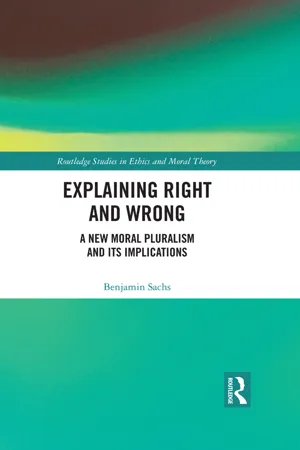
Explaining Right and Wrong aims to shake the foundations of contemporary ethics by showing that moral philosophers have been deploying a mistaken methodology in their efforts to figure out the truth about what we morally ought to do. Benjamin Sachs argues that moral theorizing makes sense only if it is conceived of as an explanatory project and carried out accordingly. The book goes on to show that the most prominent forms of moral monism—consequentialism, Kantianism, and contractarianism/contractualism—as well as Rossian pluralism, each face devastating explanatory objections. It offers in place of these flawed options a brand-new family of normative ethical theories, non-Rossian pluralism. It then argues that the best kind of non-Rossian pluralism will be spare; in particular, it will deny that an action can be wrong in virtue of constituting a failure to distribute welfare in a particular way or that an action can be wrong in virtue of constituting a failure to rescue. Furthermore, it also aims to show that a great deal of contemporary writing on the distribution of health care resources in cases of scarcity is targeted at questions that either have no answers at all or none that ordinary moral theorizing can uncover.
- 188 pages
- English
- ePUB (mobile friendly)
- Available on iOS & Android
eBook - ePub
About this book
Information
1
Normative Ethical Theorizing as an Explanatory Project
1. Introduction
My goal in this chapter is to establish that when we assess normative ethical theories we should represent their generalizations as explanatory claims and assess those claims for intuitiveness. In §2 I argue that if we do this then moral theorizing can be a way of gaining knowledge about what one morally ought to do. In §3 I take up an argument to the effect that doing this constitutes bad methodology, while in §4–5 I consider and reject two arguments to the effect that doing this is not necessary for moral theorizing to be a way of gaining knowledge about what one morally ought to do. Finally, in §6, I note the implications this proposed methodology has for the theory and practice of the method of reflective equilibrium.
2. Representing Normative Ethical Theories as Being Composed of Explanatory Claims
This chapter is about what kind of project moral theorizing is, where by ‘moral theorizing’, I mean reasoning all at once about which normative ethical theory to accept and which case-specific ethical claims to accept. Before we can embark, however, we need an initial, uncontroversial picture of what a normative ethical theory is. To this end, the first thing to note is that we wouldn’t call a set of claims a ‘theory’ if none of those claims were generalizations. Furthermore, we wouldn’t call a set of claims a theory of normative ethics if it didn’t contain generalizations connecting verdictive facts—facts as to the permissibility, obligatoriness, supererogatoriness, etc., of various actions or narrow act-types—to other facts. (So, for instance, Benthamite utilitarianism contains a generalization connecting moral permissibility and obligatoriness to utility-maximization.) So for now I’ll insist only that a normative ethical theory is that kind of set of generalizations.
With this settled, here’s our question: How should we decide which normative ethical theory to accept? There’s one option that immediately presents itself once we acknowledge that we each have intuitions as to the verdictive facts. This is the method of deriving as complete a list as possible of the verdictive claims we find intuitively plausible and then constructing a set of generalizations, X, that is consistent with that list and then accepting X for that reason. In other words, we could work exclusively from the bottom up. But almost no philosopher holds that we should proceed in this way. Furthermore, if this methodology is correct then moral theorizing cannot be a way of correcting mistaken beliefs as to what one morally ought to do. We tend to think, however, that it can, and I certainly hope that it can, as I emphasized in the Introduction. Therefore, I will not concede that it cannot without thoroughly exploring the alternatives.
Consequently, the following question presents itself: Under what conception of moral theorizing does the just-mentioned methodology emerge as mistaken? Or to put it more simply: Why not work exclusively from the bottom up?
I submit that the just-mentioned methodology is clearly mistaken if moral theorizing is (perhaps among other things) an explanatory project—specifically, the project of trying to come up with good generalizations as to how the verdictive facts are explained. If one thinks of the project this way then one immediately sees an argument against working exclusively from the bottom up. We can admit that working from the bottom up to a certain extent is justifiable, for the obvious reason that we should want, at the end of the day, to wind up with a set of generalizations that is consistent with our verdictive intuitions. But we can point out in addition that, since generalizations as to what explains the verdictive facts can themselves be intuitive or counterintuitive, we should want, at the end, of the day, to wind up with a set of generalizations the individual members of which are themselves intuitively plausible. This gives us a reason to work from the top down to a certain extent, deriving as complete a list as possible of the explanatory generalizations that strike us as intuitively plausible and then shaping our verdictive beliefs so as to make them consistent with that set. For instance, we might have the intuition that the fact that some action is the breaking of a promise can explain that action’s being impermissible. Working from the top down means accepting this generalization because it’s intuitively plausible and then accepting the verdictive claims that it implies.
I would add, as a final note, that I think most of us already in fact do this. Certainly most of us work from the top down to a certain extent, and I think when we’re working from the top down we’re usually doing the exact thing I just described. So I conceive of my contribution in this chapter not as the introducing of a new moral methodology but rather as introducing as a topic of philosophical inquiry a methodology already in use and showing why it is defensible (§3) and necessary (§4–5). Furthermore, if it can be established that we should work from the top down for the reason I just gave—which is the thesis of this chapter—and also work from the bottom up—which I assume no one will dispute—then we have a vindication of the moral methodology that just about everyone accepts: the method of reflective equilibrium. I end this chapter, in §6, by showing how conceiving of moral theorizing as an explanatory project vindicates the method of reflective equilibrium while at the same time explaining why we so often violate it despite accepting it.
3. The Reliability of Our Explanatory Intuitions
If we follow my proposed method the choices we make between competing normative ethical theories won’t be good ones if the intuitions on which I am proposing we rely—our explanatory intuitions—are unreliable. I admit that there is legitimate skepticism about the reliability of our moral intuitions in general. This is fair enough, but we have no choice but to rely on at least some of them.1 One has to start with what one already believes,2 and if one does not trust one’s intuitions at least some of the time then one cannot participate in moral theorizing as one will have no pre-existing moral beliefs to reflect upon and refine.3
It is worth noting, further, that the two most popular arguments against the reliability of our moral intuitions do not apply, at least in any powerful way, to our explanatory intuitions.
The first argument proceeds by way of inference from the mountain of research that has been done showing that our moral intuitions are influenced by morally objectionable biases and can be swayed by morally irrelevant factors concerning the agent’s environment and the framing of the question (see, for instance, the work of Joshua Greene). The reason this argument is, if effective at all, more effective in undermining the reliability of verdictive intuitions than explanatory intuitions is, quite simply, that all the research done to date has been on verdictive intuitions. Perhaps similarly damaging evidence could be collected against explanatory intuitions. We’ll have to wait and see.
The second argument is the evolutionary skepticism argument, a sub-argument within Sharon Street’s ‘Darwinian Dilemma’ argument against moral realism (Street 2006). When laying out the evolutionary skepticism argument, Street says that our moral judgments are heavily influenced by our basic evaluative tendencies (“an unreflective, non-linguistic, motivational tendency to experience something as ‘called for’ or ‘demanded’ in itself” (119)), which are directly influenced by natural selection. Although Street does not speak of moral intuitions, what is true of moral judgments must be true of moral intuitions, since the latter are a subset of the former. This gets us the claim that our moral intuitions are heavily influenced by our basic evaluative tendencies. This claim can be used in a skeptical argument since our basic evaluative tendencies have been subject to the forces of natural selection, and the forces of natural selection are blind to moral truth, given moral realism. In other words, whether a basic evaluative tendency could survive natural selection has nothing to do with its truth, given moral realism. Putting all this together, we should expect there to be no correlation between our moral intuitions and the moral truth, given moral realism.
The effectiveness of this argument depends on whether the moral intuitions mentioned in it are verdictive. Basic evaluative tendencies—those psychological features of us and our ancestors that are directly influenced by natural selection—must surely be tendencies to evaluate certain actions or types of actions, since natural selection selects for and against behavioral tendencies (or their genetic bases). In other words, basic evaluative tendencies must be verdictive tendencies. So Street can safely claim that natural selection must exert a strong influence on our verdictive intuitions; she can point out, quite simply, that our verdictive tendencies directly influence our behavior and natural selection promotes some behaviors while rejecting others.
The parallel argument for skepticism about explanatory intuitions would be much more tenuous, because in the case of explanation there is no analogue of basic evaluative tendencies. We don’t have “unreflective, non-linguistic, motivational” tendencies to experience certain things as explained by others. We may have tendencies vis à vis moral explanation, but they’re surely not motivational, which means they’re not directly connected to behavior. They are, I admit, indirectly connected to behavior, since explanatory claims bear inferential relations to verdictive claims (as I will argue in Chapter 2), which themselves are directly connected to behavior (as I already conceded). Therefore, Street can safely claim that natural selection exerts some influence on our explanatory intuitions; she can point out that our explanatory tendencies are indirectly connected to our behavior and natural selection promotes some behaviors while rejecting others.4 Again, however, the connection is more tenuous in this case than in the case of verdictive intuitions, so there are more grounds for suspicion in that case than in this one.
I conclude, therefore, that it is reasonable for us to put weight on our explanatory intuitions. This is because we have to use some intuitions and our explanatory intuitions, at least for now, seem at least as reliable as our other useable intuitions—our verdictive intuitions.
4. The Possibility of Appealing to Our Intuitions About Conditionals or Categorical Claims
I’ve suggested that if we conceive of moral theorizing as an explanatory project then we can vindicate the view that moral theorizing is a way of gaining knowledge as to what one morally ought to do. But whether this is the only way to achieve this vindication is another matter. In this section and the next I explore two alternatives.
First, while I’ve suggested formulating moral generalizations as explanatory claims and then appealing to our explanatory intuitions to sort through them, an alternative idea would be to formulate those generalizations as conditionals or categorical claims and then sort through them by appealing to our judgments as to their truth. For instance, we might represent a theory as claiming
‘necessarily, if an action is an instance of killing then it is impermissible’ (conditional) or ‘necessarily, all killings are impermissible’ (categorical claim)
and then reflect on our judgments as to the truth of these conditionals/categorical claims.
But this proposal must answer the question of how we arrive at our judgments about moral conditionals/categorical claims, and I doubt there’s a good answer to be given. Or, more carefully, there’s no good answer to be given if the moral conditionals/categorical claims aren’t analytically true or false (in particular, if the action-descriptions they contain do not refer to any thick or thin moral concepts).
One possibility—and this is what C. D. Broad (1930, 282) and possibly W. D. Ross (1939, 170) believed—is that we arrive at candidate conditionals/categorical claims by “intuitive induction” from our verdictive judgments.5 But this is working from the bottom up, whereas we are searching for a way of working from the top down.
Another possibility is that we can arrive at our judgments regarding conditionals/categorical claims via some sort of inference from our explanatory judgments. However, in this case the current proposal is parasitic on my preferred solution of construing moral generalizations as explanatory claims.
The final possibility I want to examine is that some of our judgments about the candidate conditionals/categorical claims might simply be intuitions about them. The problem with this proposal is that the justificatory force of such intuitions is too provisional to be of use in this context. If I have an intuition that necessarily all As are Bs, this may well constitute a sufficient justification, or at least a reason, for believing that all As are Bs if I haven’t yet examined all the As to verify that they’re Bs and examined all the non-Bs to verify that they’re non-As. But in our moral theorizing we can and should carry out precisely that examination with respect to any candidate categorical or conditional, using our verdictive intuitions as reference points. Having done that, it’s hard to see how our intuition as to the truth or falsity of some candidate categorical or conditional could still count for anything. Therefore, what might begin as an attempt to work from the top down will inevitably and justifiably turn into a working from the bottom up.
Just consider: Suppose I have an intuition of the form ‘all As are Bs’. Suppose, further, that I’ve checked all the As and found that in each case I have a verdictive intuition that that A is indeed a B and checked all the non-Bs and found that in each case I have a verdictive intuition that that non-B is indeed a non-A. This obviously constitutes a reason for me to accept the proposition ‘all As are Bs’. But if my intuition that all As are Bs also counted in favor of accepting that proposition, then I’d have two reasons to accept it. This, clearly, is one more reason than I have.6
I conclude from all this that conceiving of moral theorizing as the project of (perhaps among other things) coming up with plausible moral categoricals or conditionals provides no justification for working from the top down. Therefore, it doesn’t show how moral theorizing can be a way of gaining knowledge about what one morally ought to do.
5. The Possibility of Appealing to Theoretical Criteria
In §2 I proposed a way of vindicating the idea that moral theorizing can be a way of gaining knowledge as to what one morally ought to do and we are now asking whether there is another way. The new proposal I want to examine is that moral theorists should work from the top down for the same reason that scientific theorists do. Scientific theorists will sometimes (provisionally) accept a candidate theory partly on the grounds that its set of generalizations has the theoretical virtues to a sufficient degree, and partly on those grounds—i.e., because that theory possesses the theoretical virtues to a sufficient degree—will sometimes dismiss an apparent observation that is inconsistent with that theory. This, for scientists, is the analogue of rejecting some verdictive claim that one finds intuitively plausible.7
There’s no doubt that we can appeal to the theoretical virtues as a way of working from the top down, and I will argue later that we should do this when the only alternative is working exclusively from the bottom up. But we should not, I insist, adopt this method as our main way of working from the top down. Even if we allow that appealing to theoretical virtues is a good way to get at the scientific truth of the matter, which is an...
Table of contents
- Cover
- Title
- Copyright
- Dedication
- Contents
- Acknowledgments
- Introduction
- 1 Normative Ethical Theorizing as an Explanatory Project
- 2 How Should We Choose Between Competing Explanatory Stories?
- 3 Against Monism
- 4 Against Rossian Pluralism
- 5 Non-Rossian Pluralism
- 6 The Question of Scope, Part 1: Distributive Moral Concerns
- 7 The Question of Scope, Part 2: Non-Distributive Moral Concerns
- 8 Doing Harm and Failing to Rescue
- 9 The Distribution of Health Care Resources
- 10 Conclusion
- Appendix A: Moral Meta-Explanation
- Works Cited
- Index
Trusted by 375,005 students
Access to over 1.5 million titles for a fair monthly price.
Study more efficiently using our study tools.
Frequently asked questions
Yes, you can cancel anytime from the Subscription tab in your account settings on the Perlego website. Your subscription will stay active until the end of your current billing period. Learn how to cancel your subscription
No, books cannot be downloaded as external files, such as PDFs, for use outside of Perlego. However, you can download books within the Perlego app for offline reading on mobile or tablet. Learn how to download books offline
Perlego offers two plans: Essential and Complete
- Essential is ideal for learners and professionals who enjoy exploring a wide range of subjects. Access the Essential Library with 800,000+ trusted titles and best-sellers across business, personal growth, and the humanities. Includes unlimited reading time and Standard Read Aloud voice.
- Complete: Perfect for advanced learners and researchers needing full, unrestricted access. Unlock 1.5M+ books across hundreds of subjects, including academic and specialized titles. The Complete Plan also includes advanced features like Premium Read Aloud and Research Assistant.
We are an online textbook subscription service, where you can get access to an entire online library for less than the price of a single book per month. With over 1.5 million books across 990+ topics, we’ve got you covered! Learn about our mission
Look out for the read-aloud symbol on your next book to see if you can listen to it. The read-aloud tool reads text aloud for you, highlighting the text as it is being read. You can pause it, speed it up and slow it down. Learn more about Read Aloud
Yes! You can use the Perlego app on both iOS and Android devices to read anytime, anywhere — even offline. Perfect for commutes or when you’re on the go.
Please note we cannot support devices running on iOS 13 and Android 7 or earlier. Learn more about using the app
Please note we cannot support devices running on iOS 13 and Android 7 or earlier. Learn more about using the app
Yes, you can access Explaining Right and Wrong by Benjamin Sachs in PDF and/or ePUB format, as well as other popular books in Philosophy & Ethics & Moral Philosophy. We have over 1.5 million books available in our catalogue for you to explore.